1.1
Between the Mūša and Lielupė
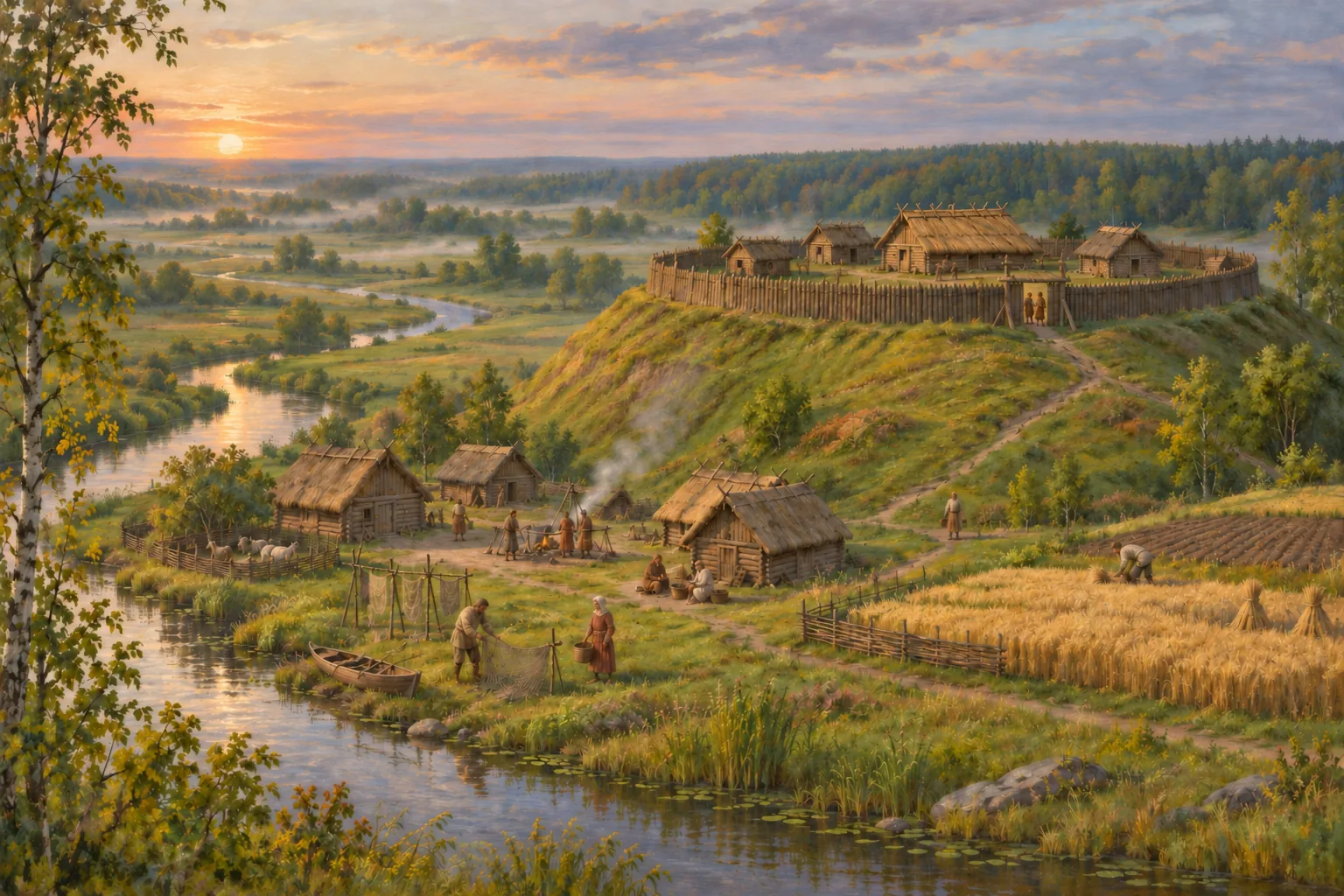
Semigallian lands covered present-day northern Lithuania and central Latvia. Today’s border cuts across this older connected region.
Marija Gimbutienė places the Semigallians in central Latvia and the northern part of central Lithuania. Her account of the Mūša and Lielupė basin connects sites now lying on either side of the border. Communities settled here, worked the land and later defended the strongholds named in chronicles. S11
Gimbutienė connects the name Semigalia with a Danish expedition in 870. The early text behind her report has not been checked separately for this article. S11
Cemeteries and hillforts allow Gimbutienė to follow life in this region before its people appear by name in written sources. The sequence of finds connects early centuries with the Middle Ages. Objects alone cannot tell us what those communities called themselves throughout such a long history. S11
Based on: S11
1.2
Regional boundaries on a cemetery map
Burial arrangements and ornaments outline the region. Researchers continue to refine its edges.
Gimbutienė connects communities in the Lielupė and Mūša basin with an earlier barrow tradition. The dead were laid at ground level, covered with an earthen mound and surrounded by a ring of stones. She reads several burials within one barrow as a possible family burial place. S11
In her 2000 study, Ilona Vaškevičiūtė proposes western boundaries along the Virvytė and Venta and southern limits north of Šiauliai and Kuršėnai. Sparse archaeological evidence leaves the eastern edge uncertain. The cemeteries outline a cultural region, not a state frontier. S143
Gimbutienė’s broader survey of early cemeteries places the first move towards flat graves in the third century. Her discussion of fifth- to tenth-century Semigallian culture gives the fifth and sixth centuries. These passages do not clearly explain the difference between the two dates. S11
1.3
Mežotne and Tērvete: building and rebuilding
Hillfort layers preserve centuries of building. People repeatedly altered and rebuilt their timber strongholds.
Work at Mežotne in 1938–1942 investigated the hillfort, neighbouring settlement and cemeteries. Gimbutienė describes ten phases of defensive works and buildings spanning the ninth to fourteenth centuries. She connects repeated rebuilding with attacks: after destruction, the inhabitants built again and strengthened the defences. S11
Timber buildings stood beside Mežotne’s gate and rampart. Gimbutienė’s eleventh- and twelfth-century houses measured about 4 × 4 m; later ones were somewhat larger. These dimensions convey the scale of buildings at one excavated centre, leaving room for differences elsewhere. S11
Gimbutienė follows occupation and building at Tērvete back to the end of the Bronze Age. She mentions more than thirty investigated hillforts in the Mūša basin, including Žagarė, Raktuvė and Sidabrė in Lithuania. Their layers preserve more life than any single episode of war in a chronicle could contain. S11
Based on: S11
1.4
Grain, vessels and cloth in a storeroom
Grain, vessels and cloth survived in Mežotne’s storeroom. Everyday life comes into view beside the defensive walls.
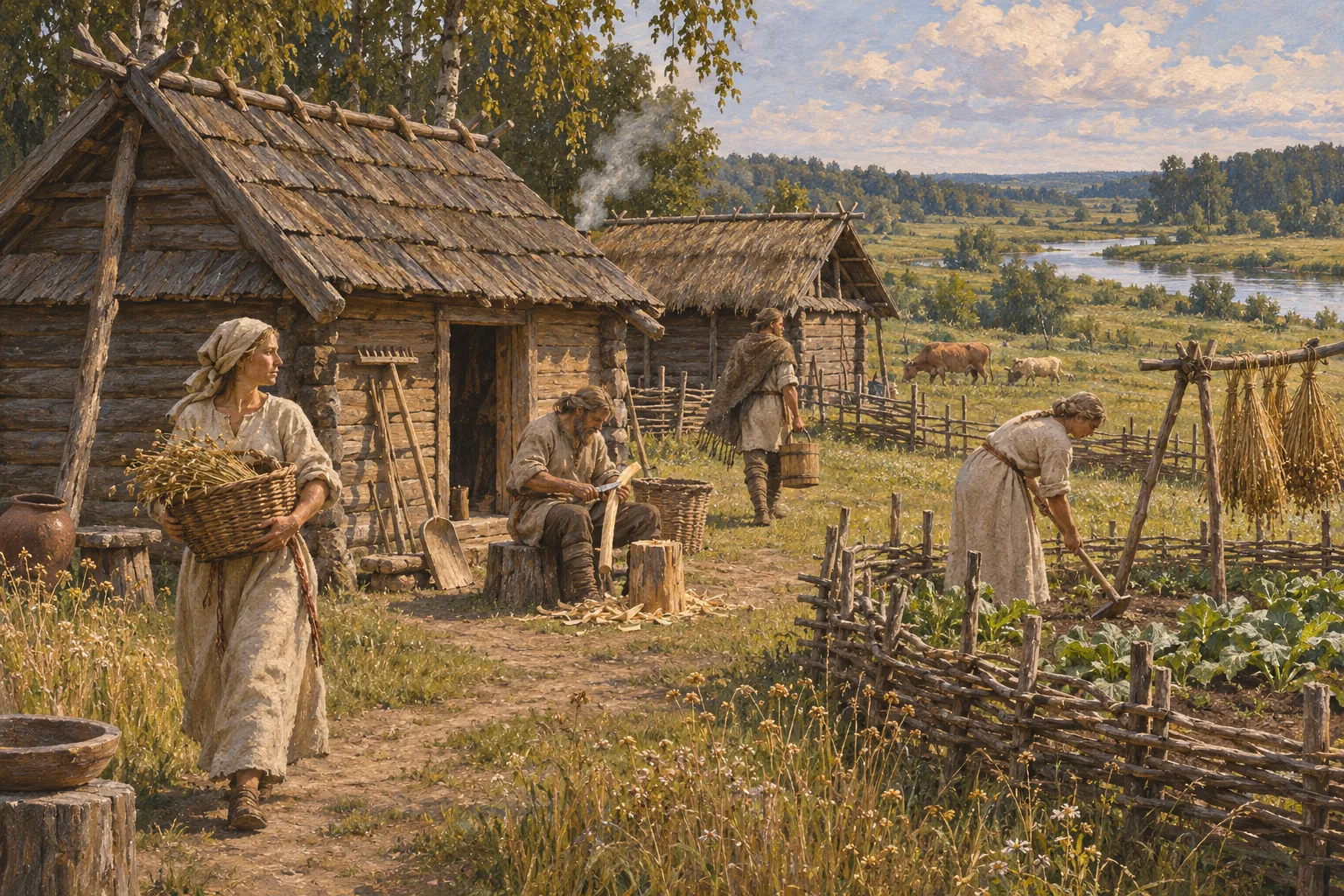
In an early thirteenth-century building at Mežotne, Gimbutienė describes a cellar stocked with supplies. Finds included pottery, wooden vessels, ropes, linen and woollen cloth. Containers in a corner held rye, wheat and peas. The contents of this particular storeroom add to the evidence from the surrounding defensive structures. S11
Rotary stone querns in the same storeroom served to mill grain. Cloth and rope show that the stores held more than food supplies. Together, the objects reveal a stronghold where people lived as well as fought. S11
Gimbutienė describes the small sickles used in Semigallian territory through the tenth century as knife-like tools with curved tips. She tentatively suggests that the shape suited fallow cultivation. Turnip seeds in a thirteenth-century layer at Tērvete add to the evidence for food plants used there. S11
Based on: S11
1.5
Objects connected distant places
Ornament metal, weights and imported materials connect this country with a wider Baltic world of exchange.
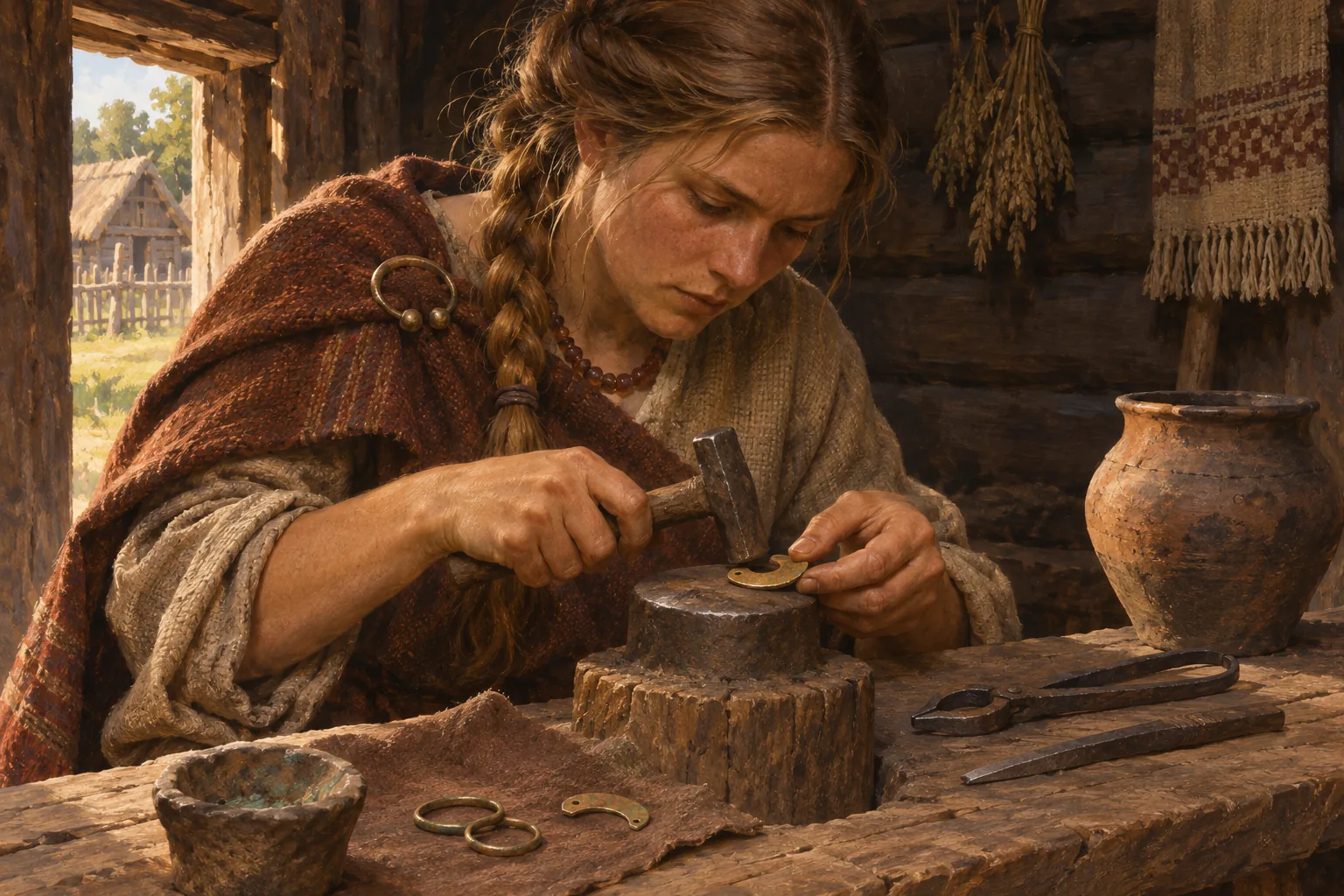
Gimbutienė singles out bracelets, wheel-headed pins and broad fighting knives among Semigallian finds. Their forms allow comparisons between regions and periods. Many survived in graves, selected by those carrying out the burial: they preserve both the objects themselves and the choices of a burial tradition. S11
Gimbutienė discusses broad fighting knives from both Semigallian and Latgalian areas. Their blades reached up to 40 cm, or up to 50 cm including the tang. These dimensions describe weapons found in the region. No evidence assigns a particular surviving example to Nameisis or another named leader. S11
The Daugava–Volga route, imported metals and shells from distant seas reaching northern Lithuania all appear in Gimbutienė’s account of Baltic trade. Eleventh-century scales from Biržai add to that regional picture. Objects could pass through many hands, while the intermediaries and their languages remain unknown. S11
Based on: S11
1.6
Graves and border communities
Burial customs changed, and neighbours’ traditions met at the region’s edges. The Pavirvytė study explores these contacts.
Gimbutienė discusses fifth- to tenth-century Semigallian finds alongside flat inhumation graves. She also records cremation graves in the southern area around 1000, interpreting them as Lithuanian influence. This is her explanation: a burial rite does not directly reveal a person’s language or origin. S11
In 2004, Vaškevičiūtė read Pavirvytė as a Semigallian cemetery with Curonian influence. Cremated and uncremated people were buried among one another; she attributed the cremation burials to incoming Curonians. Many graves were disturbed, limiting the conclusions. S144
Burial rites varied across Gimbutienė’s region, and local traditions changed. A custom cannot therefore be made into a permanent tribal characteristic. Graves preserve objects and human remains; prayers, divine names and the words of the dead cannot be recovered from them alone. S11
1.7
Several centres of power
Leaders gathered people around strongholds, and alliances with neighbours changed. These connections bring Semigallian political life into view.
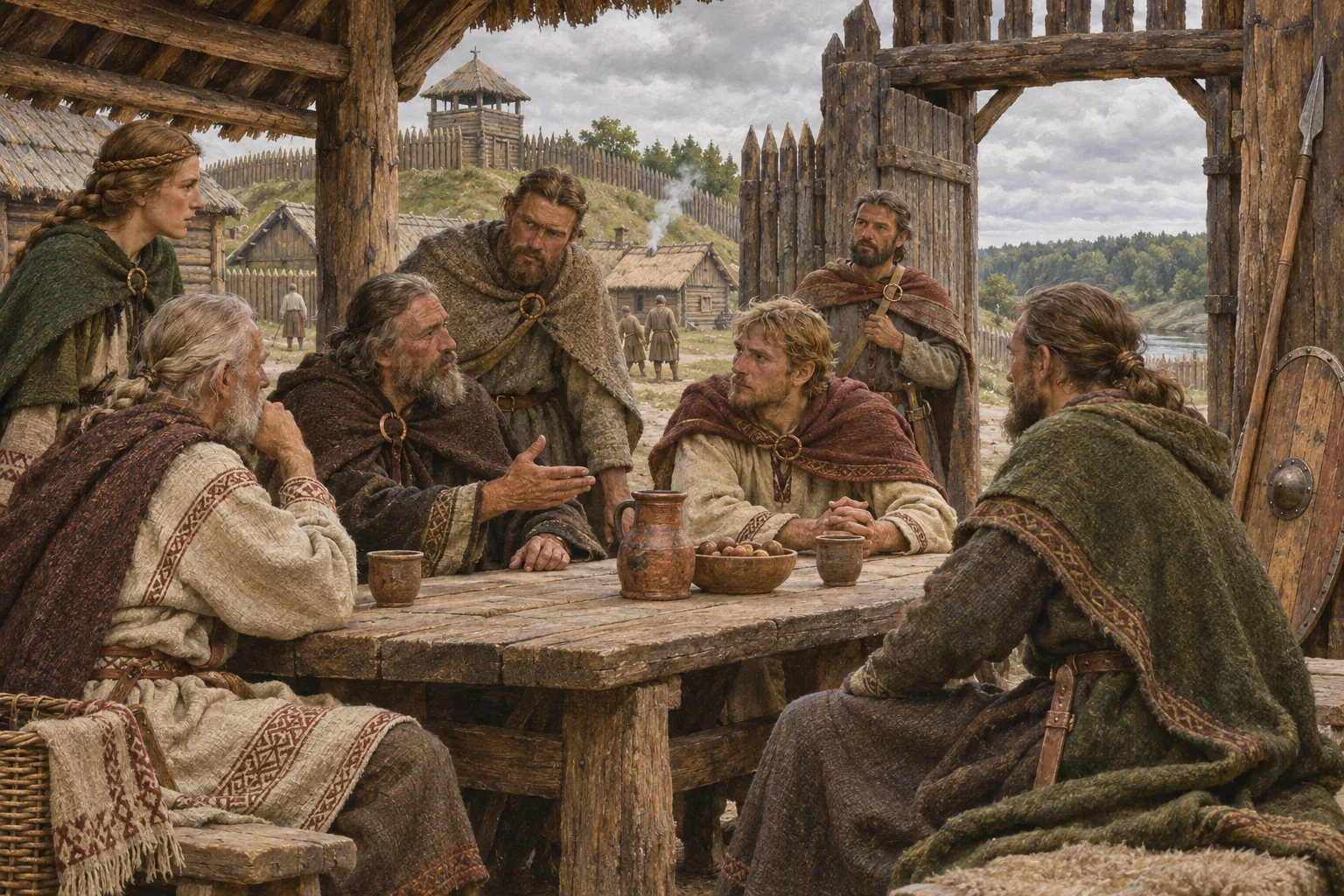
Gimbutienė compares regional structures among thirteenth-century Semigallians, Latgalians, Samogitians and Lithuanians. Sources gave local leaders different titles. Her comparison suggests similar centres and elders without establishing one administration governing all of Semigallia in the same way. S11
The history edited by Adolfas Šapoka describes the Semigallians breaking with the Order after the battle of Durbe and joining Lithuania. It connects Traidenis with authority over part of Semigallia. The Livonian Rhymed Chronicle gives Nameisis his own role, assembling forces and directing action at Tērvete: local leaders remain part of the story. S6 S146
Help also came from the Samogitians: Vijūkas-Kojelavičius tells of their defeat while supporting Semigallia. The seventeenth-century historian attributes the report to a Livonian chronicle and places it among the struggles of Mindaugas and Tautvilas. A later historian’s narrative preserved the episode, rather than a text written by the Semigallians themselves. S7
1.8
Alliance and conflict
Alliance with Riga gave way to conflict.
Zemītis’s 2026 account records Viestards’s 1205 alliance with Riga’s Germans. Mežotne accepted baptism and a garrison in 1219, bringing conflict with Tērvete’s Semigallians. S142
Gimbutienė dates the capture of Mežotne’s stronghold to 1220, when Bishop Albert of Riga takes it in her account. S11
Mežotne remained a place of conflict in later centuries. Gimbutienė writes that an Order master strengthened it against Lithuanians in 1321 and that Lithuanians destroyed it in 1346. Control of the castle changed at the same site; the name Mežotne connects several different chapters of its history. S11
1.9
Nameisis assembles the attack on Tērvete
At Tērvete, the Livonian Rhymed Chronicle singles out the Semigallian leader Nameisis. He assembles troops and directs the attack.
In the chronicle’s Tērvete episode, the outer settlement occupied by Christians is attacked first. Some people die or are captured, while the Order’s brothers still hold the inner stronghold. The attackers have reached one part of the fortified site, but defenders resist in another. S146
Crossbows are found in the outer settlement. According to the chronicler, an archer who joins the Semigallians teaches others to use them, while Nameisis assembles forces and orders fire on the defenders. Captured weapons and the ability to use them become as important to the narrative as the walls. S146
The chronicler praises the brothers and accuses their opponents of disloyalty. His account of Nameisis’s leadership follows the same pattern. The sequence traces the attack, while praise and blame retain the viewpoint of a narrator aligned with the Order. S146
Based on: S146
1.10
A retreat ends with the marshal’s capture
The Order pursues the Semigallians who marched towards Riga. In the chronicle, the chase scatters the pursuing force itself.
Riga is not caught by surprise. News of Nameisis’s expedition arrives through Mitau, and the marshal gathers troops. In the chronicle, the Semigallians see the opposing banners and shields and retreat in two groups. One rides overland; the other takes to the ice of the river called the Aa in the text. S146
Some Semigallians break through the ice, abandon their horses and scramble ashore. Some pursuers stop to collect horses and booty; the marshal rides on with a smaller force. The chronicler explains the reversal through this dispersal. He does not establish that Nameisis had planned an ambush from the outset. S146
Reappearing by the ice, Nameisis attacks the isolated pursuers. Some brothers of the Order die; two are taken to Tērvete, one of them the territorial marshal. A hurried Semigallian retreat thus ends in an unexpected setback for the pursuers. S146
Based on: S146
1.11
Nameisis in Traidenis’s war
Traidenis’s ambitions and the chronicle’s account of Nameisis’s expedition both reveal connections between Lithuania and Semigallia.
In the 1936 history, Traidenis gains authority over part of Semigallia but cannot finally defeat the Order. Winning a field battle does not mean taking a castle in this account. The Lithuanian ruler’s power overlaps with Semigallian resistance, although the book draws no precise boundary around the lands he controlled. S6
After the fighting at Tērvete, the Rhymed Chronicle describes a peace and a promise to pay tribute. Later, Nameisis joins an army that Traidenis sends to Prussia. The chronicler calls it a breach of peace. The episode also specifically connects the Semigallian leader with the Lithuanian ruler’s war. S146
Nameisis’s biography then breaks off in the chronicle: the narrator says only that he did not return to Semigallia. This passage gives no account of where, when or how he died. A later ring story or an invented final battle cannot fill that gap. S146
1.12
Strongholds burned in different circumstances
The chronicle tells of different endings for Tērvete and other strongholds. These are several stronghold histories, not a single battle.
In the chronicle, the Order builds Heiligenberg, and the inhabitants of Tērvete later burn their own stronghold. The narrator sees this as a grave Semigallian loss. Tērvete’s walls are destroyed by its occupants: the site’s end is not simply the result of an enemy storming it. S146
The chronicler later lists three castles: Racken, Doblen and Sydobren. His closing summary connects their burning with 1290. It gathers different stronghold endings; it establishes no single day or identical assault for all three. S146
Sidrabene’s outer settlement is repeatedly ravaged in the chronicle. Enemies take people and property; hunger presses on those who remain. Households and supplies must be preserved while the stronghold still stands. Under this pressure, the community divides over what to do next. S146
Based on: S146
1.13
Some departed; others negotiated with the Order
Sidrabene’s inhabitants divide in the chronicle: some leave for Lithuania, while others seek terms with the Order.
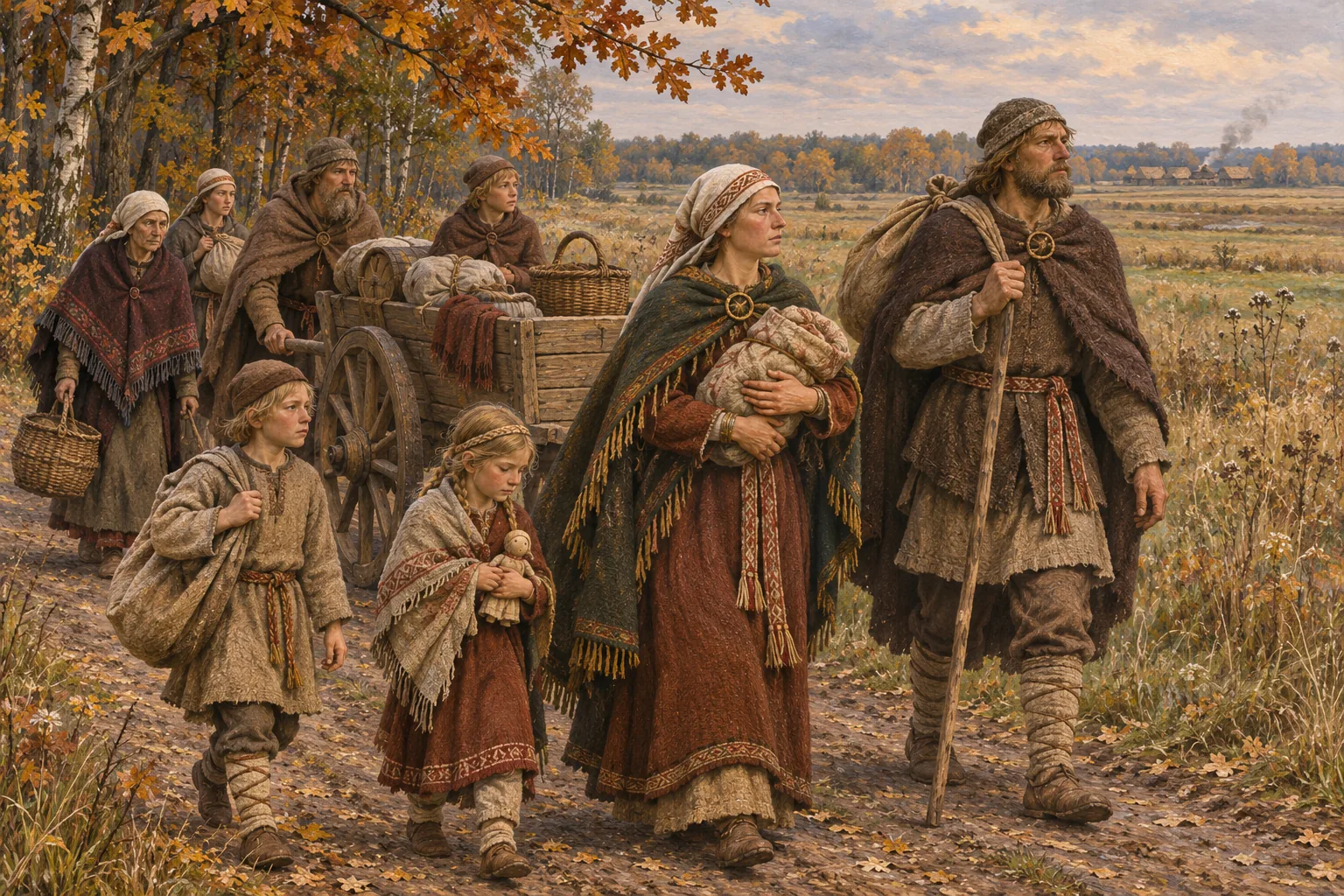
One group, the chronicler says, moves into the stronghold with household members and possessions. They invite anyone wanting peace with the brothers to join them. People left in the outer settlement face hunger and danger. Their paths begin to separate before they leave Sidrabene itself. S146
Some inhabitants leave their inherited land and head towards Lithuania. Others send messengers to Mitau’s commander, asking for help. The chronicler aligned with the Order judges these choices differently, but his account clearly preserves both those who departed and those who stayed to negotiate. S146
Once terms are agreed, the remaining people are brought out, livestock is driven away and goods removed. The stronghold is then burned. The chronicle takes the people and their belongings to Mitau. Their removal and the destruction close an episode in which not everyone dies and not everyone departs for Lithuania. S146
Based on: S146
1.14
1290 and the traces of migration
The chronicle left a dating formula; archaeologists follow traces of migration in objects.
The chronicler adds one thousand, two hundred and fifty, and forty years, giving 1290 at the end of his account. The people leaving Sidrabene for Lithuania form one part of a divided community. A single year formula does not encompass the fate of everyone in the region. S146
Zemītis dates the Sidrabene departure to late 1289 or early 1290. S142
Vasiliauskas’s 2005 abstract links Semigallian neck-rings and other ornaments at Jakštaičiai–Meškiai, Kuršėnai and Paprūdžiai with migration into Lithuania in the late thirteenth century. He also asks whether migrants brought necklaces of spirals, glass beads and cowries to Samogitia. This interpretation of finds leaves individual origins uncertain. S145
1.15
The struggle for the region continued
The chronicle closes its stronghold story, while the history edited by Šapoka follows the continuing struggle for control of Semigallia.
The history edited by Šapoka follows control over Semigallia into the reigns of Vytenis and Gediminas. It says the region’s future allegiance remained unsettled under Vytenis and places the Order’s consolidation in Gediminas’s time. That account of territorial power continues beyond the chronicle’s stronghold endings of 1290. S6 S146
The book mentions four new Order castles built in Semigallia under Gediminas. Through these buildings, it describes consolidation and the frontier. They leave the chronicle’s endpoint intact: one narrative follows the inhabitants of particular strongholds, the other the subsequent exercise of territorial power. S6 S146
The name Semigallia later enters a different political formation. Describing the settlement of 1561, the history edited by Šapoka mentions the Duchy of Courland and Semigallia with its capital at Jelgava. Kojelavičius also describes Kettler’s ducal title. The name survived while the thirteenth-century tribal order changed. S6 S7
1.16
The ring legend
The ring legend associated with Nameisis took shape later.
Jelgava’s museum links the ring legend to Aleksandrs Grīns’s Nameja gredzens: extracts appeared in 1928 and the novel in 1931. This does not prove the ring belonged to the thirteenth-century leader. S141
The museum describes the braided ring as a later sign of Latvian identity and unity. This meaning belongs to remembrance; it does not establish that the ornament belonged to Nameisis. S141
Based on: S141
1.17
The pond that left through the town
Recorded in 1936, the story of Žagarė’s water preserves a later layer of local memory.
In the collection compiled by Vėlius, the Žagarė tale begins beside the Švitė. One person builds a mill by the pond; another builds a second on the opposite bank. Some time later, all the water moves through the town to the other side of Žagarė. The fish stay where they were. S13
The teller heard the story in childhood. People explained the pond’s departure by mercury poured into it. The tale itself supplies a cause for the strange event: its explanation preserves the logic of the story rather than a verified account of a changing pond or natural process. S13
The collection dates the recording to 1936 in Gruzdžiai, Šiauliai county. Its archive reference is LTR 1020(2). The tale names no Semigallian leader, medieval date or tribe. It is a later story of Žagarė, leaving ancient Semigallian religion beyond what can be recovered from it. S13
Based on: S13
1.18
The country beyond the chronicle’s ending
Hillforts and cemeteries preserve material traces. Chronicles, historians and local tellers left other layers of Semigallia’s history.
Grain from Mežotne’s storeroom, turnip seeds at Tērvete and ornaments left in graves return us to life before the last stronghold wars. The finds described by Gimbutienė preserve traces of work and daily needs. S11
Both the people who departed Sidrabene and those who reached terms with the Order remain at the chronicle’s end. A destroyed stronghold is not the end of everyone’s history. Its walls burn, while inhabitants and belongings move on in different directions, following different choices and conditions. S146
Historians connected Semigallia with the wars of Lithuanian rulers. The Žagarė tale kept a different story of local water and people. Accounts from different periods and traditions meet in the same region. Alongside material traces, they preserve the distinct voices of their tellers. S6 S7 S13