2.1
Samogitians: a name, a region and its people.
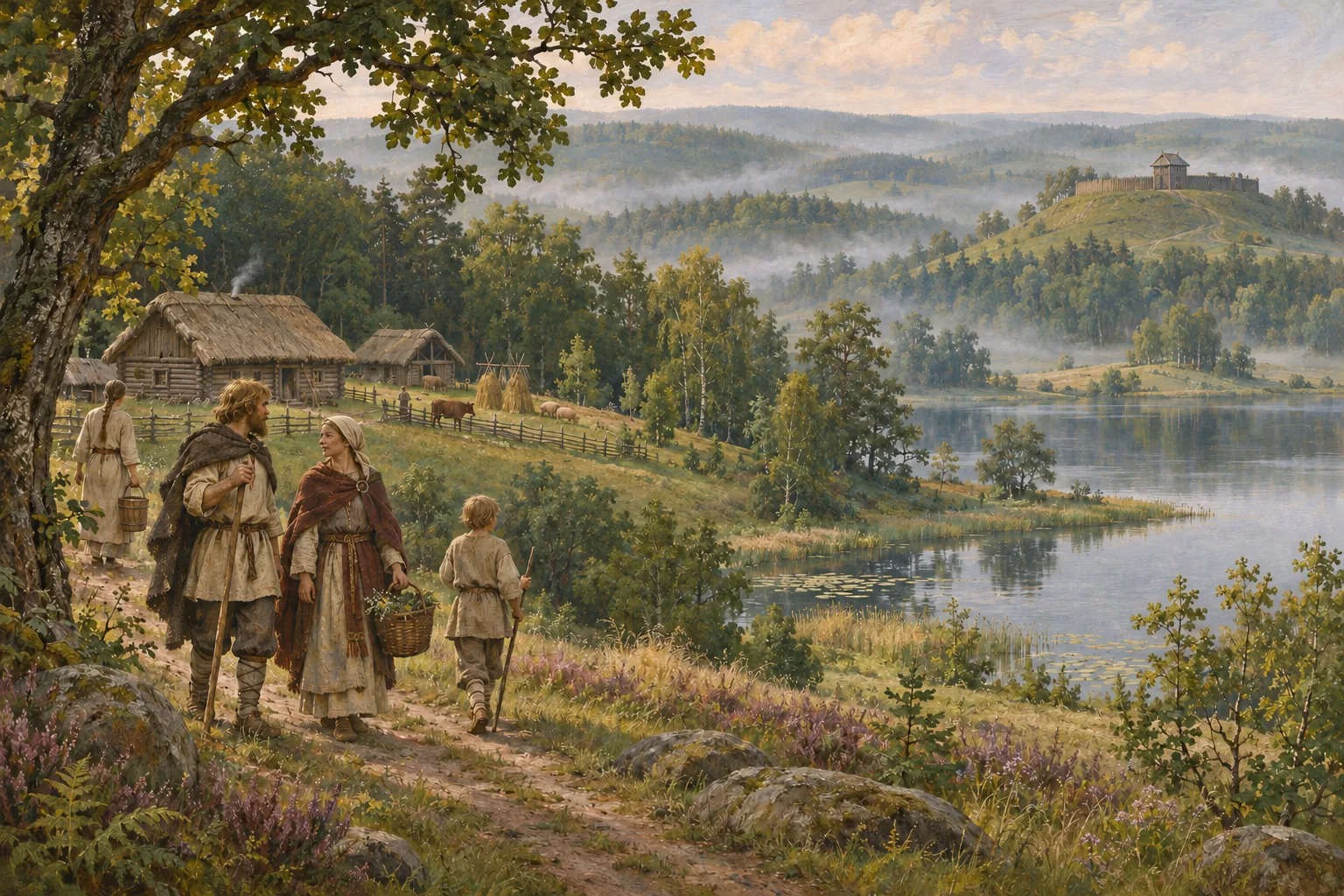
Samogitian history concerns both changing boundaries and people’s attachment to their region.
Historical Samogitia, today’s ethnographic region and the Samogitian dialect area have different boundaries. In the late Middle Ages, Samogitia also included lands inhabited by Aukštaitians. A present-day map cannot represent every earlier century. S38
In his 1420 letter to Emperor Sigismund, Vytautas explained the name through the region’s lower position and stressed its ties to Lithuania. The letter conveyed in Šapoka’s volume formed part of a dispute with the Teutonic Order. The ruler defended his rights to inherited land and spoke of its inhabitants. His argument helps explain that conflict, but does not answer every later question of identity. S6
2.2
What the ground preserved.
Cemeteries, ornaments and settlement remains tell us about the time before dukes appear by name.
Marija Gimbutienė linked the flat cemeteries of central Samogitia to Samogitian ancestors. In her survey, flat graves replace barrows in the later fourth century, and inhumation continues in the area into the tenth and eleventh centuries. Burial customs changed. This sequence does not establish one unchanging religion across the whole region. S11
The graves Gimbutienė describes contain weapons, horse equipment and bronze ornaments: necklaces, pins and decorations for head coverings. They point to metalworkers, makers of clothing and their communities as well as warriors. The finds allow us to compare customs, but do not tell us how each buried person described their own ethnic identity. S11
Based on: S11
2.3
Samogitian dukes and Mindaugas’s power.
The account of the 1219 treaty names the Samogitian dukes Erdvilas and Vykintas.
Samogitian dukes joined a wider agreement between Lithuanian rulers and the princes of Galicia–Volhynia. The 1219 list discussed by Artūras Dubonis shows several groups of rulers acting together. It does not show an established monarchy under one king. Samogitian leaders had a distinct place in the list rather than appearing as an anonymous frontier. S28
As Mindaugas strengthened his power, local dukes did not always share his aims. In Šapoka’s account, Vykintas joins the coalition against him. A struggle for authority inside Lithuania unfolded alongside pressure from enemies outside it. Both shaped the early state. S6
Mindaugas chose baptism in 1251 and the crown in 1253 as part of his diplomatic course. His agreements with the Livonian Order and grants of land did not mean that Samogitian communities accepted its rule. The gap between a ruler’s promise and effective control of the region would recur. S6
2.4
Victories and the cost of a long war.
Saule and Durbe made Samogitian warfare famous, but frontier life involved far more than major battles.
On 22 September 1236, the army of the Swordbrothers was defeated at Saule. The battle is associated with Vykintas, but Artūras Dubonis notes that neither the Lithuanian commander nor the precise battlefield has been securely identified. A familiar story centred on one hero does not fill that gap in the evidence. S6 S37
On 13 July 1260, the Samogitians won at Durbe in Courland. Šapoka’s volume links the victory to uprisings in lands held by the order and a turn in Mindaugas’s policy. The consequences reached across the region, beyond Samogitia itself. The wars nevertheless continued. S6 S35
Frontier warfare meant repeated campaigns, attacks on castles, captivity and ruined livelihoods. In Šapoka’s account of Lithuania’s conflict with the order, castles offered protection and helped organise military action. Inhabitants had to maintain them, supply people and rebuild daily life after attacks. A battle date tells us little about that work and loss. S6
2.5
Rulers negotiate, Samogitians resist.
A treaty provision and the obedience of local inhabitants were different things.
In Šapoka’s account of the late fourteenth and early fifteenth centuries, Samogitia repeatedly returns to negotiations between Jogaila, Vytautas and the order. Rulers sought support and exchanged commitments. Samogitian resistance meant the region could not simply be handed over as property. The uprising of 1409 helped set the larger war in motion. S6
After the Grunwald victory in 1410, the Peace of Toruń in 1411 recognised Samogitia as Lithuanian for the lifetimes of Jogaila and Vytautas. The dispute was not over. The Treaty of Melno on 27 September 1422 settled it for Lithuanian-held Samogitia, while Klaipėda and part of the coast remained with the order. Victory and settlement were separate stages. S6
Based on: S6
2.6
A Samogitian voice reaches Constance.
The Šapoka-edited history places the start of conversion in 1413 and the bishopric’s foundation in 1417. Diplomatic struggle at Constance came between them.
Jogaila and Vytautas came to Samogitia in 1413. Šapoka’s volume stresses that their first baptismal mission was brief. The Church organised afterwards had to establish a more sustained religious life. A single year does not mean that all families immediately changed their customs, understood the new teaching or abandoned earlier stories. S6
Jan Długosz tells how Jogaila sailed along the Nemunas and Dubysa into Samogitia in 1413. The king destroyed sacred fire and groves and explained belief himself because the visiting clergy lacked the local language. The ruler’s work dominates this later conversion scene. It remains separate from the bishopric’s establishment in 1417. S140
The Šapoka-edited history dates the Samogitian representatives’ complaint against the order at the Council of Constance to 1415. In the text conveyed by Šapoka, they speak of lost land, liberty and heavy obligations. The complaint formed part of a particular diplomatic struggle. It also gives Samogitians a voice and demands of their own, beyond their role as the subject of other rulers’ negotiations. S6
Baronas distinguishes the delegation’s arrival in 1415 from presentation of its complaint in February 1416. S80
The Samogitian bishopric was established in 1417, with its centre at Medininkai, today’s Varniai. In Šapoka’s account, its organisation and endowment continued into 1421. Building a church network, training clergy and choosing the language of religious teaching remained lasting concerns. A strong regional Catholic tradition would grow from these beginnings. S6
2.7
Distinct status did not mean equal rights.
The Samogitian eldership retained a distinct place within the Grand Duchy of Lithuania.
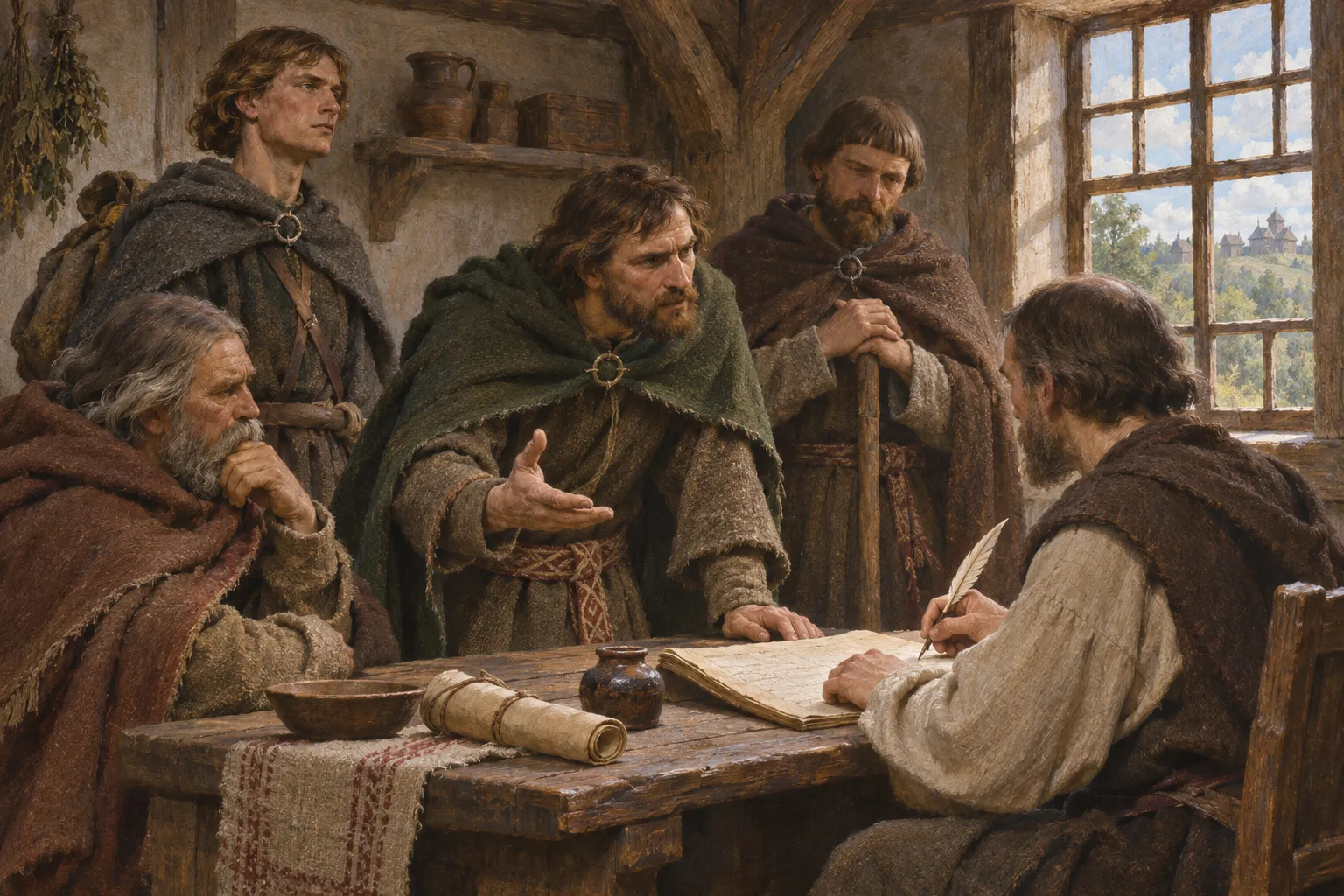
Voivodeships developed elsewhere, while Samogitia remained an eldership. Rulers’ privileges protected local nobles’ rights. Its status reflected regional history and negotiation over authority; it did not make Samogitia a separate state in the modern sense. S38
Writing about the early nineteenth-century Samogitian movement, Šapoka highlights the many poor nobles whose language and way of life remained close to villagers’. Even a poor noble, however, had political rights denied to a peasant. Calling everyone “free Samogitians” hides these differences in estate, landholding and obligations. S6
2.8
Life beyond the battlefield.
Work, buildings and communal singing reveal another side of Samogitia.
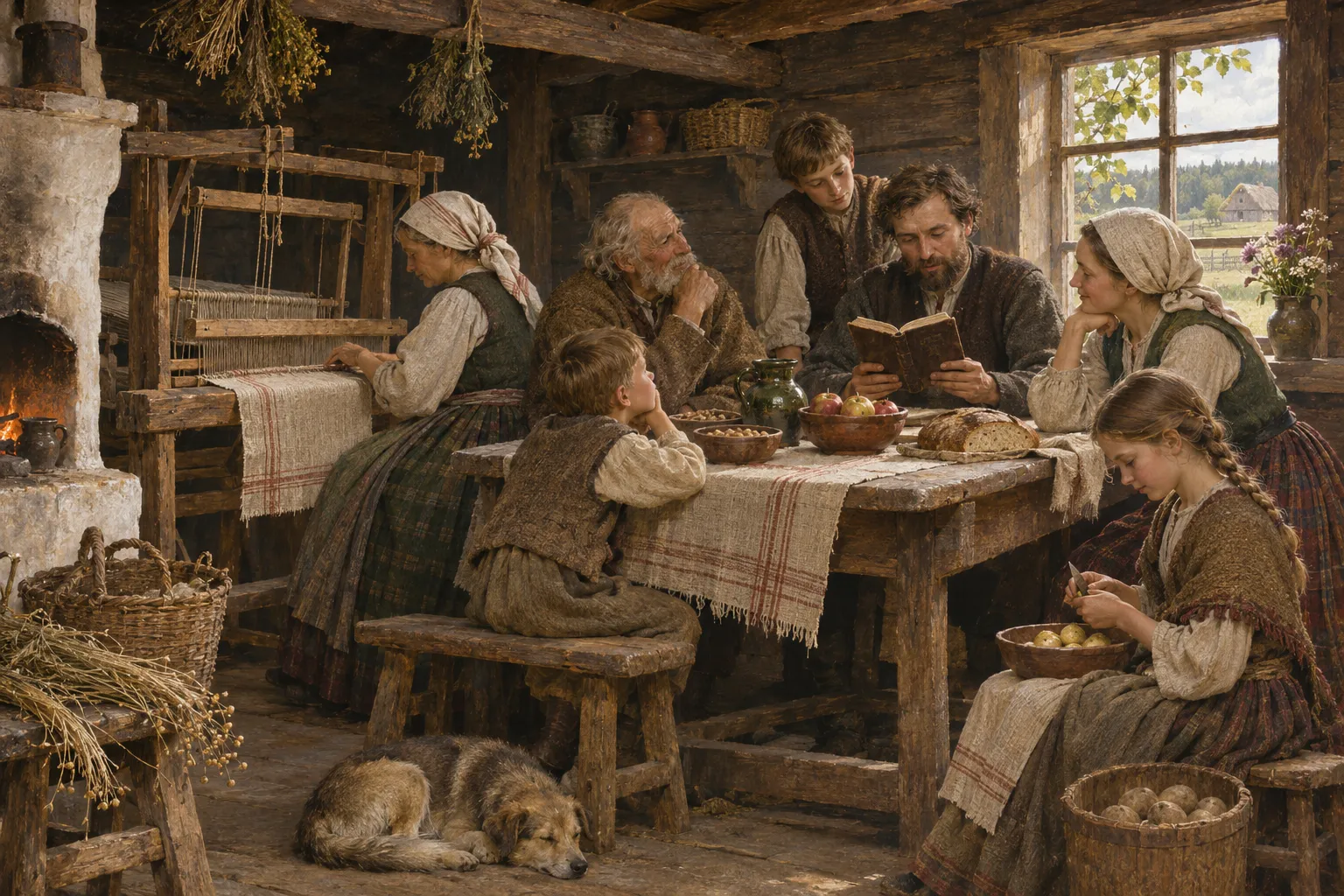
The Council for the Protection of Ethnic Culture describes spacious farmsteads with irregular layouts in upland Samogitia. Bread was baked in the ubladė and flax processed in the lininė. This is later rural culture; it does not by itself show how people lived in the thirteenth century. S39
The Council also highlights Kalnai singing at funerals. This tradition tells of Samogitia’s later Catholic life, which a story focused on resistance to baptism can leave out. S39
Based on: S39
2.9
One name, several ways of speaking.
The Institute of the Lithuanian Language classifies Samogitian as one of the two main Lithuanian dialect groups.
Samogitian has western, northern and southern divisions. The names donininkai, dounininkai and dūnininkai recall different pronunciations of duona, “bread”. Northern Samogitian includes the Kretinga and Telšiai varieties, and southern Samogitian the Raseiniai and Varniai varieties. No single locality’s speech captures the whole range. S40
In Daukantas’s Būdas of 1845, language offers a means of survival. He writes of mothers passing their speech to children at home while higher social groups adopt other languages. The passage can be read as a nineteenth-century cultural programme: regional memory lives in family life as well as in rulers’ documents. S20
2.10
From writing the past to reading in secret.
The nineteenth-century Samogitian cultural movement connected historical writing, local speech and education.
Šapoka’s volume links the movement to the local lesser nobility, wider education and Vilnius University. Simonas Daukantas wrote history in Lithuanian, and Motiejus Valančius published Žemaičių vyskupystė in 1848. Their work showed that the language spoken at home could also sustain a long account of society’s past. S6
Later in the nineteenth century, Valančius’s circle is associated with clandestine Lithuanian publishing and the transport of books from Lithuania Minor. Šapoka writes of children taught at home and in secret schools, primers, religious works and secular books. The network extended beyond Samogitia. Regional figures belonged to a wider Lithuanian history of reading and resistance to Russification. S6
Daukantas’s judgements, love of language and idealised ancient virtues remind us that an account of the past has an author. His is a perspective published in 1845. It contributed much to cultural memory, but does not describe one unchanging character shared by every Samogitian of earlier centuries. S20
2.12
Birutė’s vow and refusal.
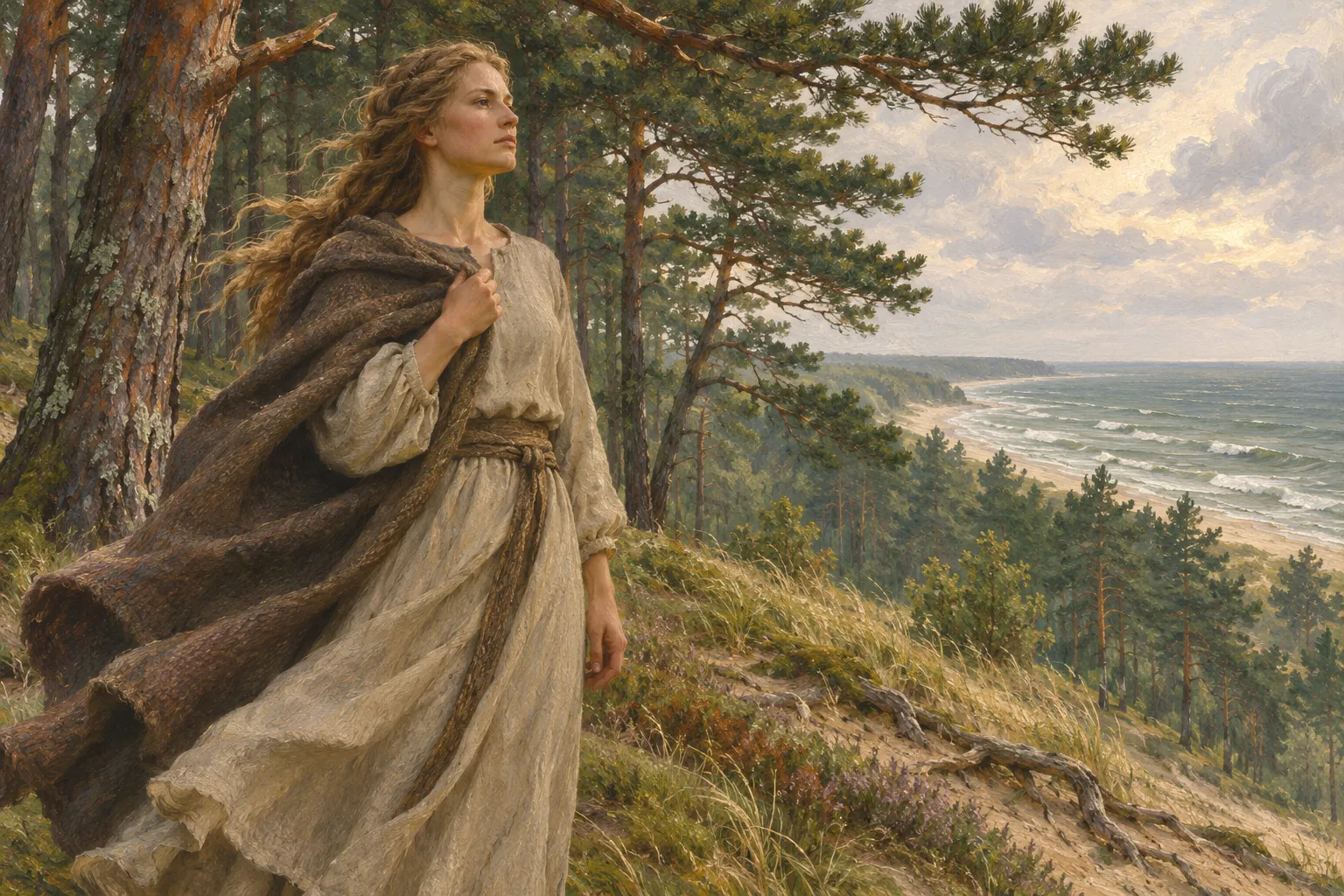
The Bychowiec Chronicle recorded Birutė’s story in the sixteenth century, long after Kęstutis’s time.
In the chronicle’s telling, Kęstutis hears of Birutė at Palanga: a beautiful, intelligent young woman who has vowed to the gods to remain chaste. He proposes marriage, but Birutė refuses. Her vow and her answer are explicit in this story. S19
The chronicle goes on to say that Kęstutis takes Birutė by force to Trakai, where a wedding is held. This is not simply a story of a mutually chosen romance. Nor does the later narrative confirm every detail of a fourteenth-century biography or allow an exact reconstruction of coastal religious rites. S19
Based on: S19
2.13
A hill from a clog, a lake from tears.
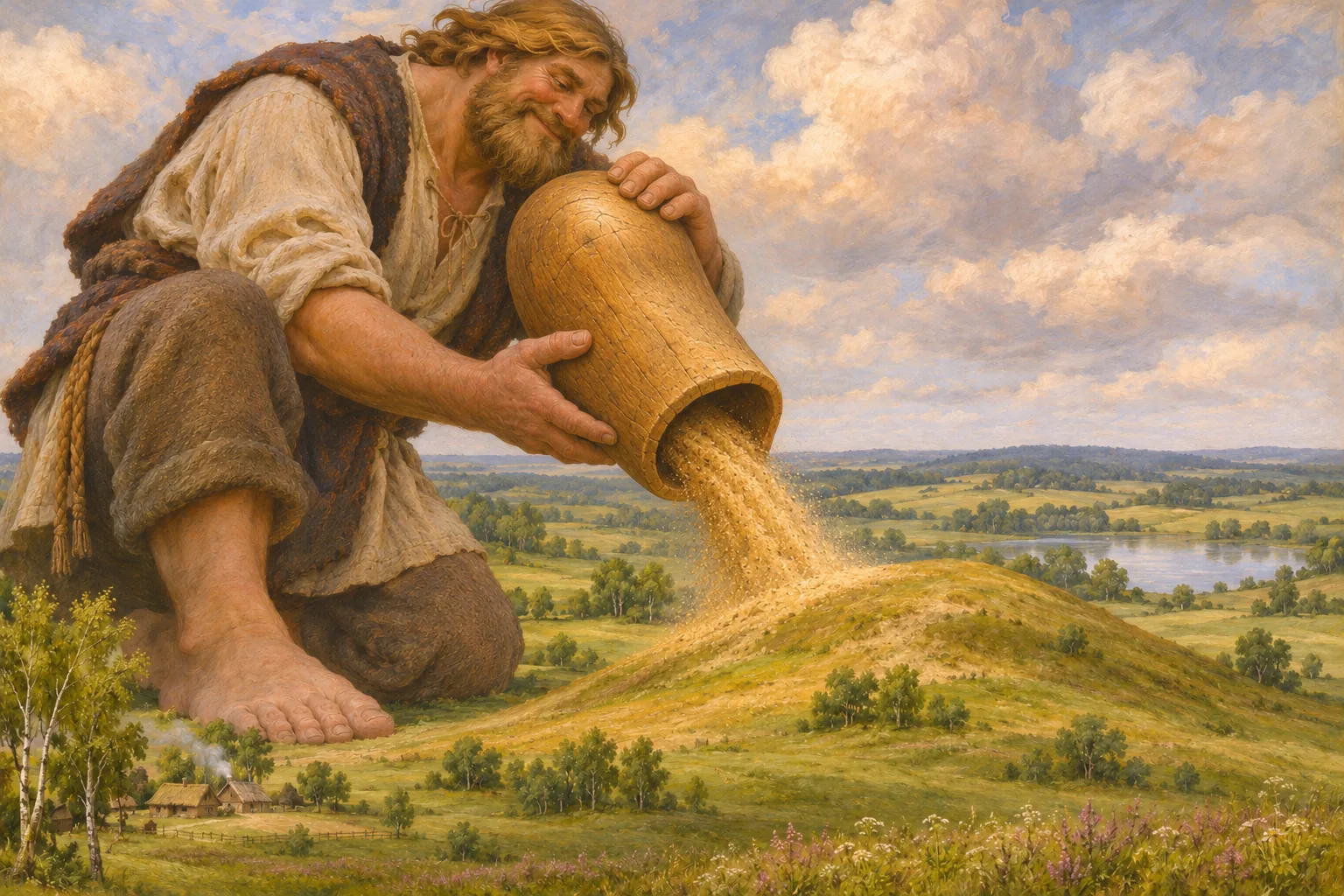
In the collection compiled by Norbertas Vėlius, Girnikai hill has several different legendary explanations.
In one tale, the giant Anžulis builds Girnikai hill with two shoe-scoops of earth. Beside it is the story of Alcis making Šatrija with three scoops in memory of his wife Jauterytė. She is exceptionally strong as well as beautiful. In this telling, the hill preserves the memory of a loved one. S13
In the Girnikai story recorded in 1930, a giant is on his way to bury his mother. He shakes the earth from his clogs to form the hill, and his tears become Lake Bulėnai. In the version recorded in 1932, a father seeks his missing son. Again, sand from his clogs forms the hill, but his tears become Lake Raizgiai. The loss and the lake differ: these are two versions. S13
The giants in these tales love, lose relatives, tire and weep. Their strength is immense, but their feelings are human, preserved in stories about hills and lakes. This is an imagined world: a collection’s publication date does not date a giant’s life, and a hill’s shape does not prove his existence. S13
Based on: S13
2.14
A hero whose friends were devils.
“Džiugo kalnas” in Vėlius’s collection tells of a hero who befriends devils.
The legend calls Džiugas a Samogitian knight. While alive, he builds his future burial mound; after his death, his friends the devils guard his body. They help him gain extraordinary strength. With an iron club he fights crusaders, breaks oaks and moves hills. S13
The same legend says Džiugas dug the lake at Telšiai and established the first homesteads beside it. One figure defends the land, shapes a place and befriends supernatural beings. This is a particular story preserved in the collection. A modern promotional telling cannot stand in for it, and it is not a documented biography of the founder of Telšiai. S13
Based on: S13
2.15
“We two can”: another story of courage.
In the Medvėgalis tale collected by Vėlius, two girls decide to act.
The legend is set during wars with the Swedes. People under attack hide in caves within the hill, behind great iron doors, and fear going out to see whether the enemy remains. Two girls volunteer. The story explains the name Medvėgalis through their words mudvi galim, “we two can”. S13
The words give a folk explanation of the place-name. They are not an established linguistic etymology, nor does the story establish the existence of caves with iron doors. It is not an account of a specific crusader attack either: the enemies in this version are Swedes. At its centre is a simple choice: while everyone waits, two girls go to find out for themselves. S13
Based on: S13