2.1
Žalgiris, Grunwald, Tannenberg.
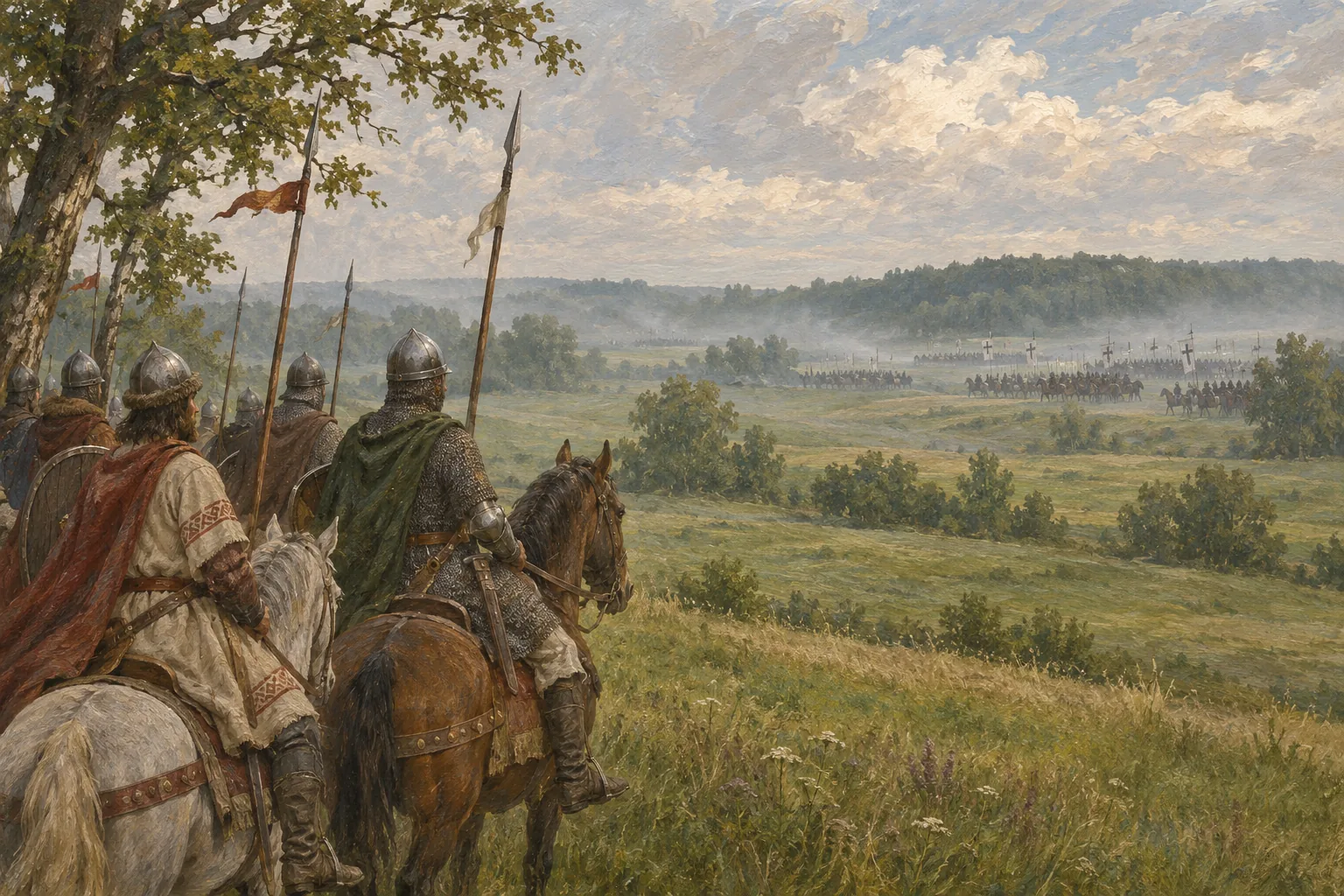
The armies that met on 15 July 1410 fought one battle, named differently in different traditions.
Žalgiris is the Lithuanian name for the victory of Jogaila and Vytautas’s allies over the Teutonic Order in Prussia. German tradition established Tannenberg, Polish tradition Grunwald. The history edited by Šapoka uses both of the latter names for the same battle. S6
In the Bychowiec Chronicle it is the battle of Dubrovna. Rimantas Jasas, commentator of its 1971 edition, explains the distinction: Dubrovna, or Gilgenburg, was taken before the battle, while the armies met elsewhere, near Grunwald between Ludwigsdorf and Tannenberg. The chronicle’s name preserves a campaign location without precisely defining the battlefield. S19
Teodoras Narbutas deliberately chose Grunwald over the German Tannenberg. He believed it marked the place where victory was completed. With this nineteenth-century choice, he emphasized one phase of combat and his own reading of the battle. S8
The dispute over Samogitia, agreements between rulers and extensive preparations brought the allies into Prussia. Food had to be assembled and armies taken across the Vistula. After victory, the Order’s capital still awaited them. The day at Grunwald belonged to the war of 1409–1411. S6
2.2
Samogitia between treaties and resistance.
The dispute over Samogitia joined Lithuania’s and Poland’s conflicts with the Order.
Before 1409, Vytautas had repeatedly agreed to cede Samogitia to the Order. The synthesis edited by Šapoka recalls the Treaty of Raciąż of 1404, which renewed that right. But inhabitants resisted; the ruler’s promise did not ensure their obedience. The Order still had to establish authority through castles and garrisons. S6
The same history describes the Order trying to win inhabitants over with food and livestock. For Samogitians, allegiance raised concrete questions: who would receive their dues, whose garrison would control the district and who would protect them? People had concerns of their own in a country divided by treaties. S6
Vytautas’s position changed with his wider objectives. In the 1936 synthesis, agreements with the Order coexist with subsequent support for resistance. Lithuania’s ruler used temporary agreements, but the Samogitian question remained and could again destroy relations. S6
Poland had its own disputes with the Order. Once Jogaila promised to assist Vytautas, the Order had to reckon with more than Lithuania’s forces. In 1409 it attacked Poland, widening the regional conflict. Both sides explained their cause to European rulers: one invoked defence of Christian Lithuania, the other accused its opponents of aiding pagans. S6
Based on: S6
2.3
In 1409, promises became open conflict.
Hostages, obligations and assistance from Lithuania became entangled with local resistance.
The history edited by Šapoka connects preparations for the rising with Vytautas’s agents. The Order’s demands, hostage taking and obligations fuelled resistance. Local grievances were essential to the rising. Vytautas’s support gave it wider military and political significance, though he still avoided open involvement. S6
Discussing the attack on Memel, Narbutas doubts Vytautas’s direct responsibility. He then presents the Order’s reports about Rumbaudas on the frontier and Lithuanian activity in Samogitia. His ruler publicly denies involvement as support becomes increasingly apparent. Narbutas does not describe a single plan anticipating every development. S8
Grain sent by Jogaila became another flashpoint. The history edited by Šapoka says a shipment for Lithuania was seized at Ragnit. Narbutas connects the incident with shortages after a poor harvest and describes transport from the Vistula by sea into the Nemunas. In his account the seizure becomes both an economic blow and an affront to the two rulers. S6 S8
According to Narbutas, the Order accused the senders of also carrying weapons. He explains these as protection against robbers. In a note, however, he acknowledges that Johannes Voigt omitted the grain story for lack of archival confirmation. Accounts differ over the shipment’s timing and purpose. S8
2.4
Jogaila and Vytautas prepared a joint campaign.
A combined army would change a war in which the Order could otherwise expect separate attacks.
Jogaila was king of Poland, Vytautas grand duke of Lithuania. Their powers and armies were distinct, so their alliance required agreement on joint action. The 1936 history treats the concentration on the Vistula as the central decision: instead of separate attacks from Lithuania and Poland, a combined campaign would enter Prussia and force the Order to concentrate. S6
Narbutas begins the preparations with a secret consultation at Brest. Only a small circle knows the plan, including Mikołaj Trąba. His account describes discussions of the direction of attack, food transport and bridges: men and horses would need feeding and passage across rivers. S8
Kojelavičius includes a Tatar ruler in the Brest consultation, calling him the khan of the Scythians. This is his vocabulary for Tatars; the name does not attest an ancient Scythian army in the fifteenth century. His account brings soldiers and leaders of different origins into Jogaila and Vytautas’s alliance. S7
In Narbutas’s account of the Białowieża hunts, meat is salted and shipped by river to the army. Supplies accumulate for a long campaign. Wagons carrying food and other necessities will have to follow the troops. The rulers’ secret agreement is accompanied by the practical work needed for an offensive. S8
2.5
The truce bought time without securing peace.
Negotiations, mediation and military preparations proceeded together.
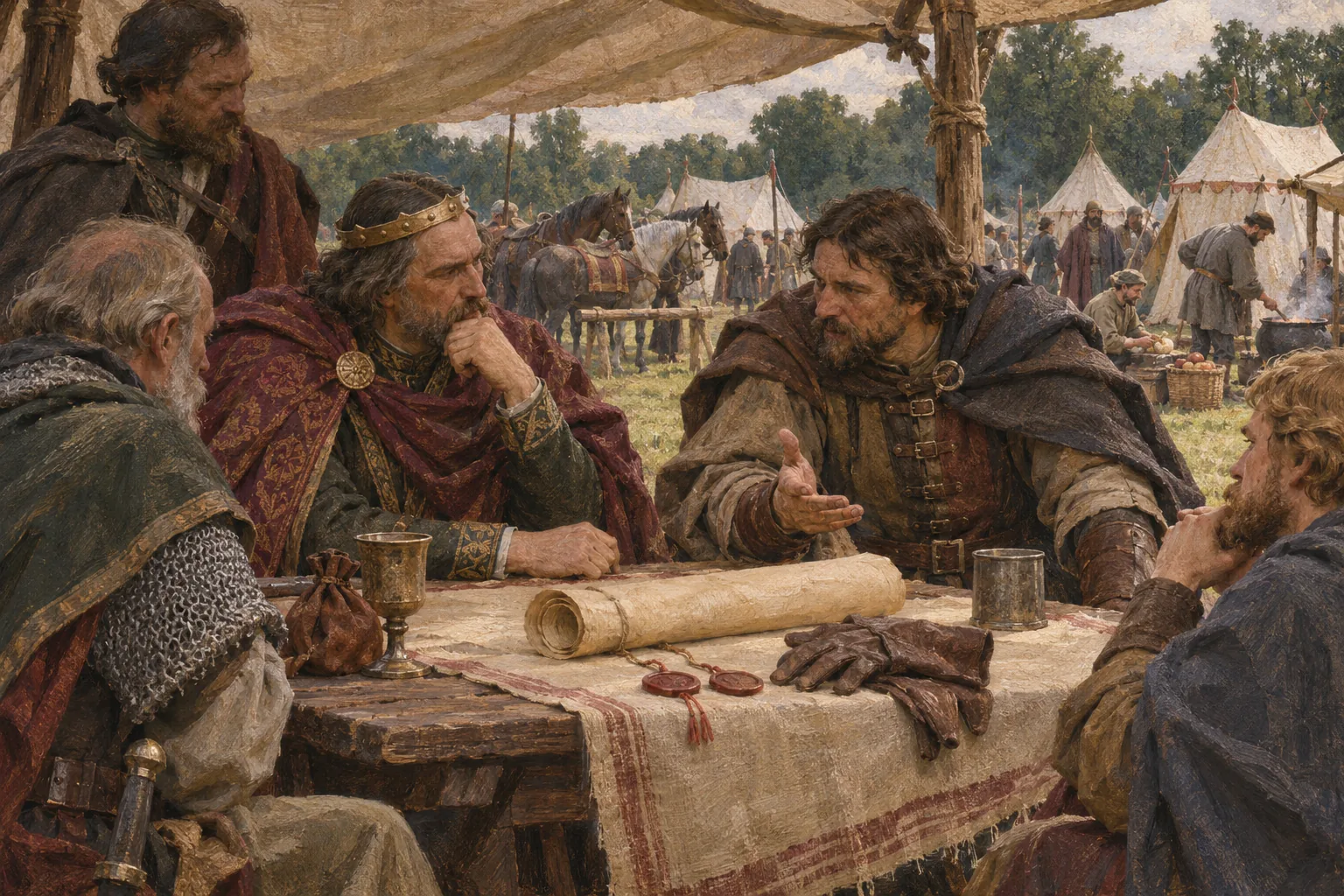
A truce interrupted the fighting of 1409. In the history edited by Šapoka, both sides use the pause to seek support and prepare for another clash. Arbitration left the dispute unresolved: the Order’s and allies’ aims over Samogitia and their relations were difficult to reconcile. S6
The history edited by Šapoka mentions arbitration by King Wenceslas of Bohemia and the allies’ rejection of his decision. There were also attempts to divide the cousins: Sigismund supposedly offered Vytautas a crown. The synthesis reads this as a means to weaken the alliance before the armies met in the field. S6
Narbutas says the truce was extended until 8 July 1410. Men and supplies assembled during the pause had to be ready for another campaign. The deadline approached, and the two rulers’ plan rested on joint military action. S8
The Order had to decide where to expect an attack. The 1936 synthesis stresses that allied concentration misled an opponent guarding several directions. Once Lithuania’s army reached the Vistula, the Order faced combined forces. It could no longer prepare only for separate offensives from the two states’ borders. S6
2.6
At Czerwińsk the plan became a combined column.
Crossing the Vistula enabled the armies to unite and advance together into Prussia.
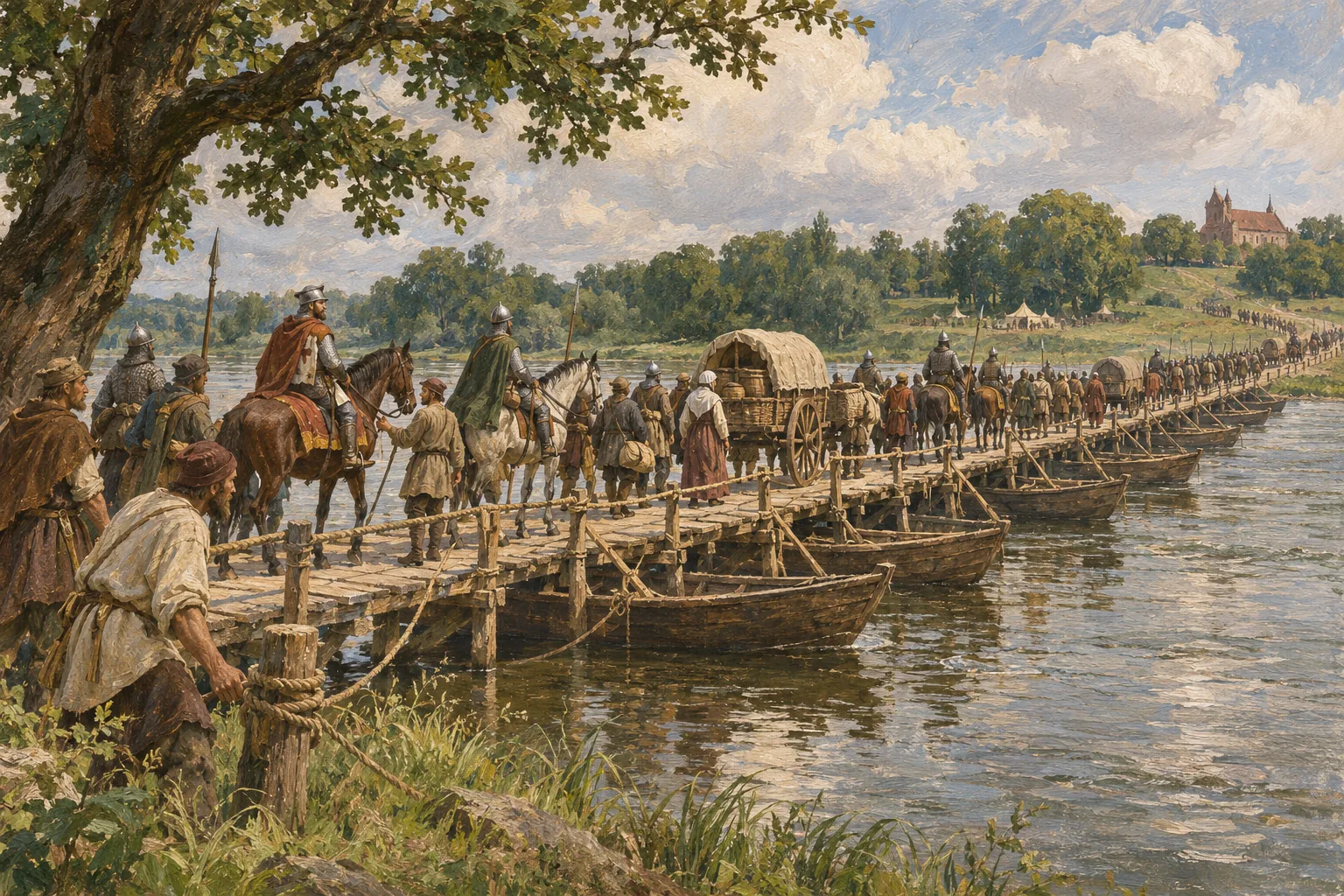
The forces joined at Czerwińsk, fulfilling the plan emphasized in the 1936 history edited by Šapoka. Once across the Vistula, both armies could advance together. Their combined offensive in 1410 denied the Order the option of meeting each enemy separately with frontier castles and dispersed forces. S6
Narbutas describes a bridge supported on boats, carrying soldiers, artillery and baggage. Preparations near Kozienice allow both horsemen and their loads to cross the river. Wagons travelling with the troops will supply the army as it advances. S8
According to Narbutas, the bridge was dismantled after the crossing and floated to Płock. The river thus becomes both obstacle and transport route in his narrative. S8
In a conversation narrated by Narbutas, the grand master disbelieves the successful crossing and belittles Lithuania’s army. The episode conveys the Order’s confidence and underestimation of its enemy. It is a literary account, not a verbatim record. The master will soon face a combined army already across the Vistula. S8
2.7
A defended river forced a change of route.
Narbutas’s campaign account leads to the Drewenz and onward towards Dąbrówno.
Narbutas takes the army through Prussian towns, castle country and waterways where the Order could halt its advance. The 2019 edition’s notes help connect his older place names, including Soldau and Neidenburg, with present-day locations. S8
On the Drewenz, today’s Drwęca, the allies faced a defended crossing. Narbutas says they abandoned an attempt near Kauernick. Instead of attacking across the obstacle where the enemy waited, they chose a detour towards the upper river. In his account this preserved the initiative while changing both armies’ movement and the location of their eventual encounter. S8
Narbutas next takes the army to Dąbrówno, called Gilgenburg in German. He dates its capture to 13 July and describes violence and destruction. Inhabitants suffer in his account as well. His dramatic descriptions of victims establish neither precise losses nor an independently verified sequence of events. S8
The Bychowiec Chronicle calls the encounter the battle of Dubrovna. Jasas explains that the army took the town two days earlier and fought elsewhere. Captured Dąbrówno and the field where the main armies met were separate places on the campaign. S8 S19
2.8
Different forces marched beneath allied banners.
Tatars and hired troops joined the forces of the Grand Duchy of Lithuania and Poland.
The Bychowiec Chronicle names Lithuanians, Ruthenians, Poles and others in the allied army. Narbutas distinguishes territorial and princely contingents. In the Grand Duchy, a ruler and military obligations united people of different languages, faiths and local allegiances. These ties differed from modern citizenship. S19 S8
Kojelavičius places Lithuania’s forces on the right and describes forty banners. That number does not establish how many men they contained. The banners could differ in their numbers of horsemen and accompanying personnel. S7 S8
Narbutas mentions both Tatars in Lithuania’s service and forces arriving from the wider steppe world. His divisions and large totals belong to his reconstruction. Their presence nevertheless matters throughout the account: later authors associated them with mobile warfare, while the Order used its opponents’ faith as a political accusation. S8 S6
Czech and Moravian mercenaries also served in the alliance. The chronicle mentions them, though Jasas corrects the offices assigned to its commanders and its chronology. Troops in the same campaign came through different lands, rulers and bonds of service; modern nationalities cannot adequately describe these ties. S19
2.9
The Order’s army extended beyond its knight-brethren.
Brethren, territorial forces, guests and mercenaries formed a varied host.
People of different status and allegiance fought under the Teutonic Order’s command. Narbutas’s banner list includes the devices of towns, bishoprics and territories. The brethren in white cloaks formed only part of this army. S8
The history edited by Šapoka emphasizes the Order’s heavy cavalry and differences in allied equipment; Kojelavičius stresses crossbow fire. Yet the allies also had well-equipped horsemen, while the Order’s troops performed different tasks. These authorial emphases do not describe every soldier’s clothing and weapons. S6 S7 S8
Jerzy Rajman distinguishes brethren, guests, mercenaries, local knights and townsmen in the Order’s army. He stresses uncertain army totals and unequal banner strengths. S90
Narbutas’s Grand Master Ulrich von Jungingen waits, gathers his forces and eventually chooses battle against an enemy already united. The author stresses his confidence in the Order’s strength. Armour cannot ensure the outcome: attacks, withdrawals, pursuit and commanders’ decisions shape what follows, with different accounts in different books. S8
2.10
Between woodland, open ground and disputed positions.
Older books offer a vivid battlefield, while later research continues to dispute its reconstruction.
In the 1936 synthesis, the allies use woodland cover while the Order waits on more open ground. Lithuania’s forces stand on the right, Poland’s on the left. The authors give the wings’ broad arrangement, without locating each banner precisely or establishing the distance between armies. S6
Narbutas describes roads, elevations, marshes and a lake, explaining how terrain could protect flanks and restrict movement. His plan draws on Fischer’s reconstruction transmitted through Voigt. It is a nineteenth-century interpretation, not a surviving deployment plan from 1410. S8
Narbutas describes a night storm, rain before dawn and delays in erecting the chapel. A vision of king fighting monk in the moon foreshadows the encounter. This religious omen belongs to his narrative; it cannot establish the precise weather in both camps or an hourly course of battle. S8
Using the distribution of finds from 2014–2017, Sven Ekdahl proposes fighting farther southwest. He does not identify radar anomalies as established graves. S93
Piotr Strzyż and Jakub Wrzosek criticize artefact dating and survey documentation. In their assessment, unsearched areas prevent treating the new localization as definitive. S94
2.11
The envoys brought a challenge.
The presentation of two swords became one of the battle narrative’s most memorable episodes.
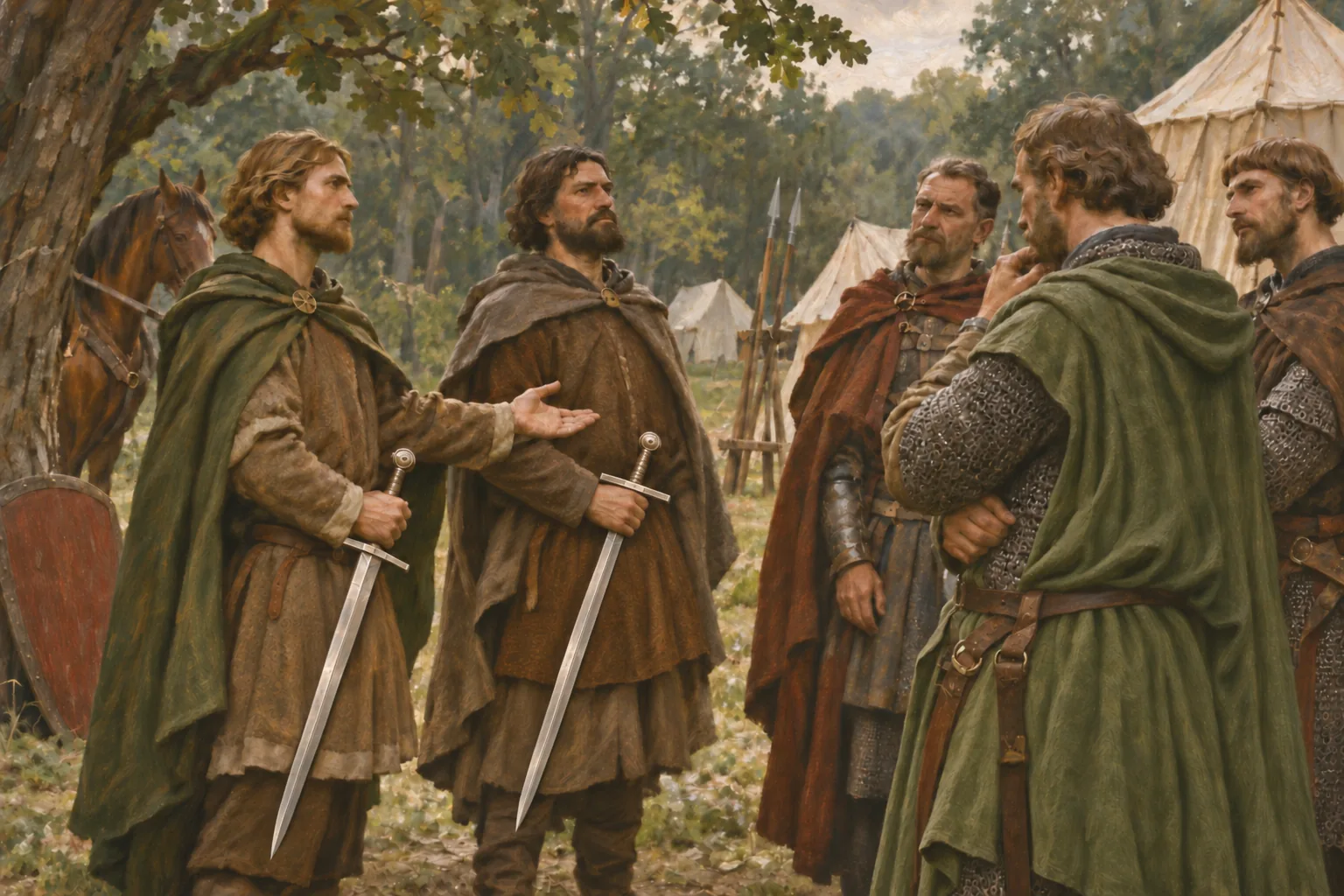
Before the encounter, envoys arrive with unsheathed swords. In the history edited by Šapoka, they proudly demand that the allies leave the woods and fight. The challenge turns waiting into a reproach: one side is accused of hesitation while the other asserts its confidence. S6
Kojelavičius’s envoy brings one sword for Jogaila and another for Vytautas, mockingly asking whether they lack weapons. The king listens calmly and accepts the challenge. After dismissing the envoy and briefly praying, Jogaila orders the trumpets to sound for battle. S7
Narbutas preserves more than one meaning. The swords may be a formal invitation to battle when waiting tires troops already drawn up. He also transmits Jogaila’s side’s understanding of an insulting provocation. Even the question of who sent the envoys and how much the grand master knew receives differing answers in his sources. S8
Narbutas rejects blood-smeared swords as an embellishment added by chroniclers. His envoys bring unsheathed weapons whose meaning the authors themselves interpret differently. S8
2.12
The opening clash soon changed direction.
The books connect the opening attack with Vytautas’s wing and a strong response from the Order.
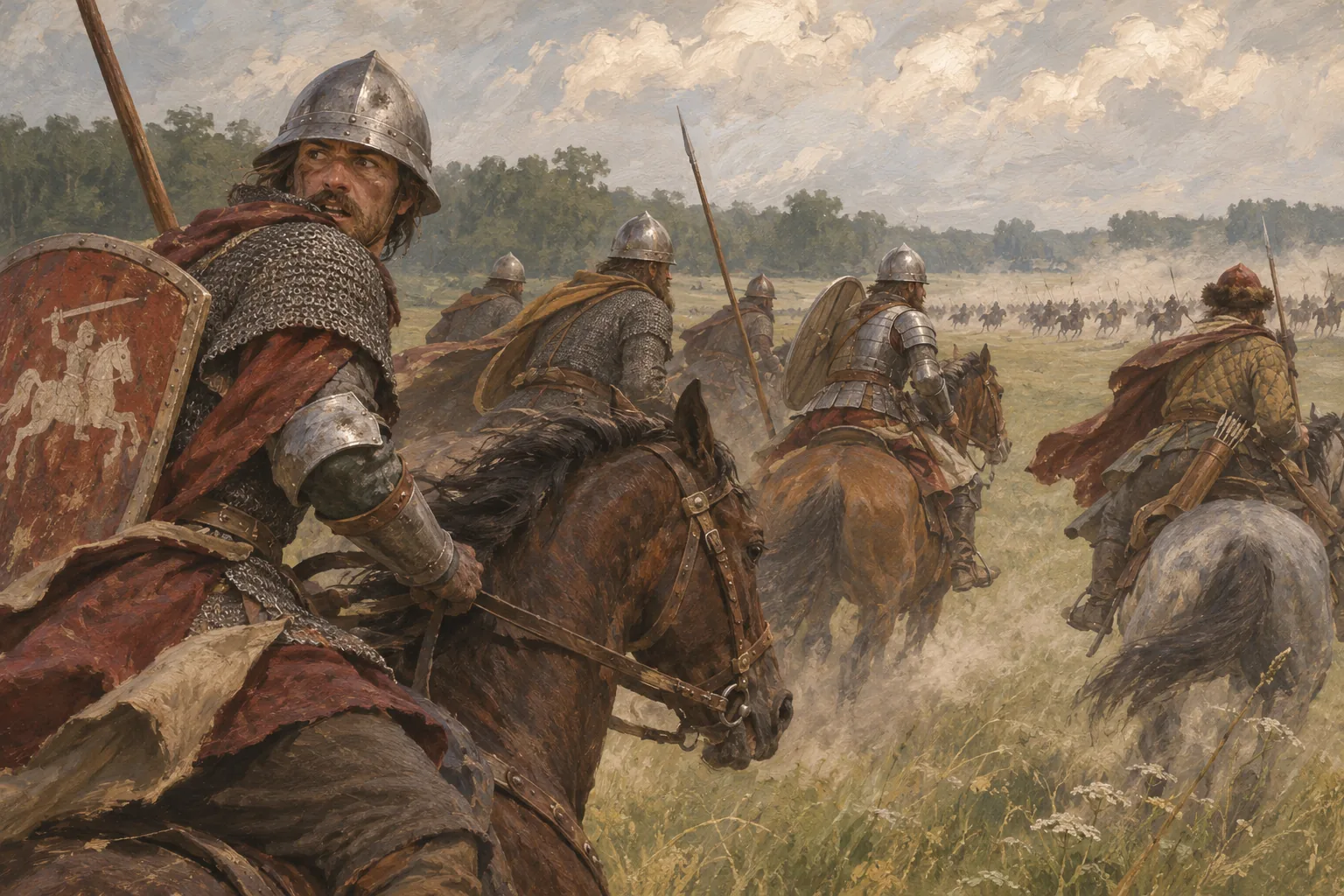
In Kojelavičius’s account, Vytautas’s forces attack first but meet crossbow fire and strong pressure. He contrasts mobile horsemen with a more heavily equipped opponent to explain the later withdrawal. His chosen image does not describe every soldier in the wing alike. S7
In Narbutas’s account, artillery fires before the horsemen clash, but has little effect. His own gun totals vary, and he attempts an intermediate estimate. The reconstruction establishes neither an exact number of guns nor of shots. S8
The history edited by Šapoka describes hard fighting before Lithuania’s forces withdraw. Its sequence is clear: the wing retreats after meeting the enemy and withstanding pressure for a time. S6
Better-equipped horsemen fight at the front of Narbutas’s formations. His allies are not simply unarmed men facing armoured knights. He nevertheless describes selected bodies of troops and the pressure on them, without listing the equipment of the entire army. S8
2.13
One wing’s fighting became withdrawal.
Authors describe the Lithuanian withdrawal differently, especially over order and intention.
Jan Długosz calls the withdrawal flight. Vytautas tries to halt the troops, but some fugitives reach Lithuania and spread false news that both rulers have died. The author singles out three Smolensk banners: most men of one are killed, while the other two reach the Polish forces. He praises these formations and condemns the others. His account alone does not settle the question of a deliberate manoeuvre. S140
In Kojelavičius’s account, partial retreat turns into flight. Vytautas tries to restore order but fails at that moment: the pressure of battle defeats his orders. The author later explains this calamity partly through religious guilt. S7
In Narbutas’s account, successive lines give way, disorder follows, and some fugitives reach Lithuania with news of disaster. This differs from a smoothly coordinated maneuver by the whole army. Later, the same author brings collected men and reserves back into combat. S8
The history edited by Šapoka connects the withdrawal with returning troops and dispersed pursuers. It treats deliberate action as probable. The authors agree that troops withdrew, but differ over their intentions, the maneuver’s success and their commanders’ ability to control them at that moment. S6
Beside the withdrawal, Kojelavičius describes Smolensk troops holding: the whole wing does not act alike at once. Some reach the Polish forces, others retreat farther. Narbutas later regathers some scattered men. These groups experience different courses of fighting. S7 S8
2.14
Was the withdrawal planned?
Returning to the fight and a prearranged maneuver by the entire force are different claims.
In the 1936 synthesis, withdrawal was most probably intentional. Its authors connect it with warfare familiar from Tatars: pursuers separate and disperse, allowing returning troops to strike from another direction. This is their probable explanation, rather than a surviving order from Vytautas to the entire wing. S6
After the disorder, Narbutas brings together Vytautas, surviving Smolensk troops, reserves and some scattered men. Return in his account may mean overcoming a breakdown. He does not depict all the earlier fugitives as soldiers secretly following a shared plan. S8
An undated letter studied by Ekdahl warns against pursuing one or two withdrawing banners. It was filed with documents of 1413; its author is unknown. It does not establish a plan for Lithuania’s entire army. S64
A small body might withdraw deliberately while other men fled or later returned. The accounts do not establish how many belonged to each group. Withdrawal itself is clear; a single intention explaining it all remains a particular author’s interpretation. S6 S8
2.15
Troops that held and mobile allies.
Smolensk troops and Tatars belonged to the wider story of the forces gathered by Vytautas.
Kojelavičius’s Smolensk soldiers withstand attacks and reach the Polish forces. Narbutas places them between Lithuanian and Polish contingents, where they continue fighting. In both accounts, these troops of the Grand Duchy hold while others withdraw. S7 S8
Rajman notes that Długosz supplies the three Smolensk banners episode, while the anonymous near-contemporary account Cronica conflictus omits it. The latter survives in a later shortened copy. Smolensk’s contingents were not a separate modern Russian army. S90
Narbutas calls the Tatar leader Saladinas. In the 2019 edition’s notes, Reda Griškaitė identifies him as Jalal al-Din, distinct from the twelfth-century Saladin. Later commentary clarifies the nineteenth-century account here. The corrected name alone establishes neither the organization nor the strength of all Tatar contingents. S8
Later, Narbutas’s Tatars attack the enemy rear, adding to pressure on the Order from several sides. This does not mean their leader devised the entire allied plan. Tatar action, Smolensk resistance and the men gathered by Vytautas have distinct roles in his account. S8
2.16
The Polish lines faced crises of their own.
In Narbutas’s account, the royal banner and Jogaila’s own safety become focal points of danger.
As the Lithuanian wing withdrew, fighting continued elsewhere. Narbutas depicts hard combat between the Poles and the Order. In his account, the great white-eagle banner falls into enemy hands and is recovered in a renewed attack. He describes its loss and recovery, rather than simply its falling to the ground. S8
The banner gathered troops around it, so its loss in Narbutas’s account seems to promise victory to the enemy. A victory hymn begins on the Order’s side. But the Poles recover the banner and continue fighting: one side’s celebration and the other’s crisis have not decided the outcome. S8
Długosz’s great royal banner falls to the ground, but soldiers immediately raise and defend it. His version contains no capture by the enemy of the kind Narbutas later describes. Zbigniew Oleśnicki uses a broken spearshaft to knock the knight charging Jogaila from his horse. The king strikes the attacker’s forehead, and the guards kill him. Długosz ranks Oleśnicki’s action above other heroic deeds. S140 S8
In Narbutas’s account, the German knight Diepold von Köckeritz charges Jogaila with his lance levelled. Zbigniew Oleśnicki throws a broken spearshaft and knocks the attacker from his horse; the king’s guard then falls upon him. S8
Kojelavičius emphasizes Polish bravery at the end of the fighting. The Bychowiec Chronicle leaves most of their army watching. These authors distribute the credit for victory differently, disagreeing over who actually fought. S7 S19
2.17
Vytautas among advancing, withdrawing and regrouping troops.
These activities do not establish one undisputed portrait of the supreme commander.
The history edited by Šapoka assigns supreme authority to Jogaila and actual battlefield command to Vytautas. He changes horses, oversees combat and commits a reserve. In the 1936 synthesis, his activity joins separate phases of fighting into a shared victory. S6
Kojelavičius’s Vytautas moves among the troops but cannot halt their retreat. Battle conditions limit what he can achieve. This failed attempt differs from the command of events emphasized in the 1936 synthesis. S7 S6
Długosz’s Vytautas moves between Lithuanian and Polish formations, changes horses and brings fresh men to support tired units. A separate escort guards Jogaila. Yet the king also urges troops into battle in this account, leaving him hoarse afterwards. The narrator gives the rulers different roles without establishing one undisputed command structure. S140
Narbutas initially assigns general field command to Zyndram and describes a council including Vytautas. Later, Vytautas gathers men into a renewed force. This division of roles differs from the 1936 synthesis; the two accounts cannot yield a common command structure. S8 S6
The Bychowiec Chronicle supplies a different roster of hetmans. Jasas notes the anachronistic offices and that the named Spytko would have been a child in 1410. The chronicle’s names therefore do not reliably establish who issued orders during the battle or on what scale. S19
2.18
Ulrich led a final attack himself.
In Narbutas’s account the Order’s reserve enters in an attempt to change a battle still in progress.
Narbutas takes the grand master into battle with sixteen small reserve banners. Their number gives no reliable headcount. The Order’s leaders still have troops to strike at the critical point, but the attack will end in failure and the master’s death. S8
In Narbutas’s account, enemies press the Order’s reserve from several directions. Troops still fighting and others newly gathered act together. As the reserve is encircled, a fresh attack has less chance of restoring a favourable position. S8
The history edited by Šapoka also connects the outcome with Vytautas’s reserve and returning Lithuanian forces. Both works emphasize troops committed later, but differ over their deployment and command. The Order’s chances of reversing the battle diminish, though the accounts yield no shared minute-by-minute sequence of attacks. S6 S8
Ulrich von Jungingen died in battle. The 1936 synthesis attributes his death to a Lithuanian spear. Narbutas describes fatal blows and differing accounts; Kojelavičius names no killer. The works agree on the master’s death, but the killer’s identity remains unverified. S6 S8 S7
2.19
The leaders’ deaths were followed by fighting at the baggage train.
As the Order’s army broke up, resistance did not end everywhere at once.
After the grand master and other leaders died, the Order’s men still resisted among the wagons, according to the history edited by Šapoka and Narbutas. The baggage train could gather scattered soldiers for a final defence. To take the camp, the allies had to overcome them too. S6 S8
Narbutas’s victors take horses, weapons, provisions, wagons and valuables. He mentions restraints prepared for prisoners: an intended fate turns back upon those who prepared it for others. Abundant booty conveys victory’s scale in his eyes, without establishing how much wealth each soldier gained. S8
Narbutas describes groups of fugitives pursued over a long distance. In the history edited by Šapoka, fatigue and the need for rest prevent long pursuit that day. These endings differ; even Narbutas’s pursuit does not show the whole army marching without pause towards the Order’s capital. S8 S6
Kojelavičius links victory to Polish bravery and heavy Lithuanian and Ruthenian losses. The Bychowiec Chronicle instead gives the main role to Lithuanians and the king’s guard. The dispute over credit begins within the victory narrative: the dead master and captured banners enter differing memories of the shared struggle. S7 S19
2.20
Victory left dead men and prisoners behind.
Narbutas’s aftermath brings together mourning, captivity, reward and revenge.
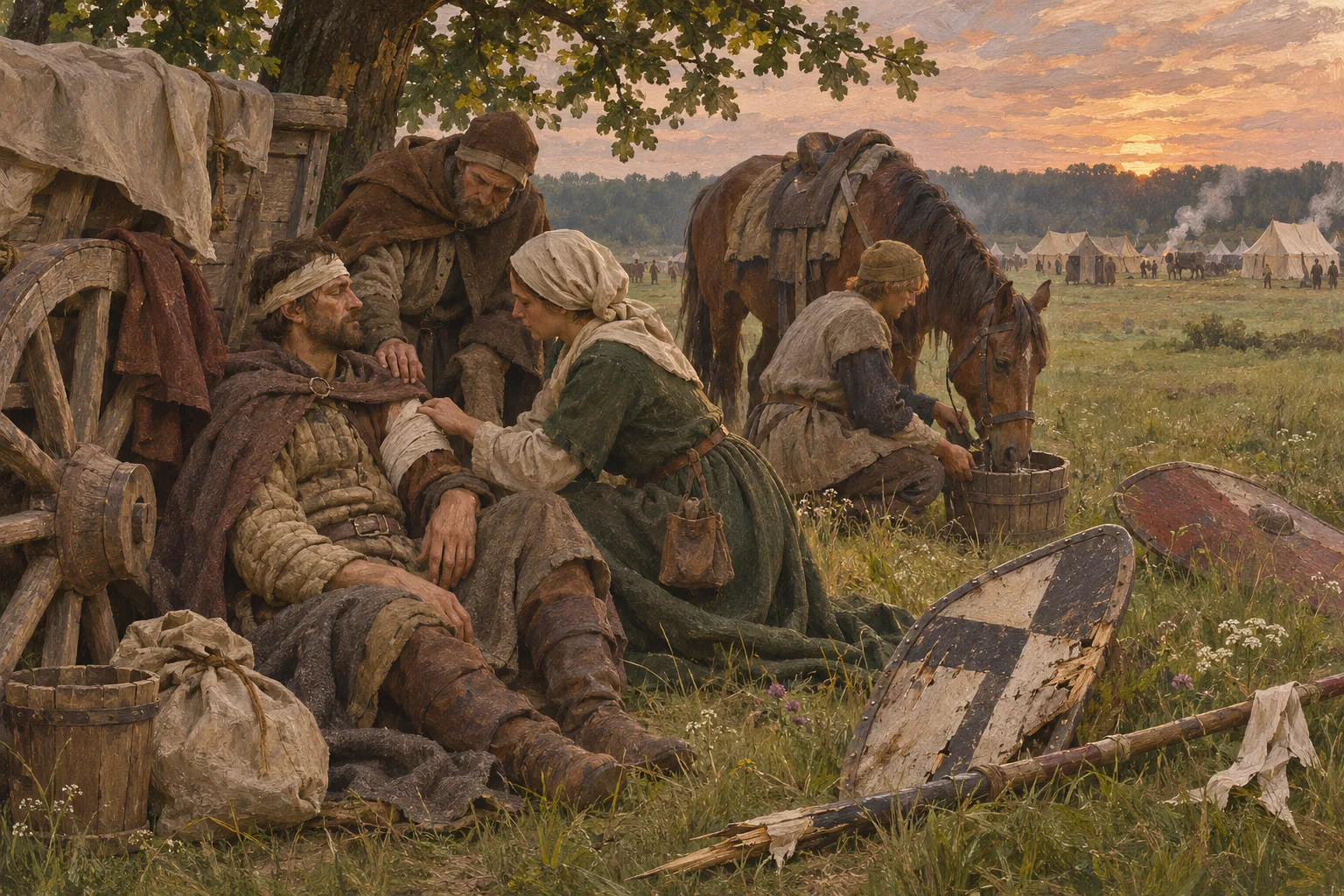
Narbutas names the grand commander, marshal, other officers and the men they led among the dead. Defeat struck several levels of command. His total casualty and prisoner figures are exceptionally large and unevenly supported; they do not permit a precise comparison of the armies’ losses. S8
Narbutas describes a wounded Swabian standard-bearer carried to Jogaila’s tent asking to see his banner once more. With the king’s permission it is brought to him; the captive takes it, presses it to his chest and dies. S8
Narbutas recounts Marquard von Salzbach’s capture and execution on Vytautas’s orders, connecting revenge with earlier insults. The accompanying story of the ruler’s sons being poisoned is called an invented tradition by Rimvydas Petrauskas in the 2019 introduction. It is no secure fact of the family’s history. S8
In Narbutas’s account, the grand master’s body is laid beside Jogaila’s tent, moving the king to grief. It is then sent to Marienburg for burial. The war continues: surviving soldiers in the Order’s capital prepare a new defence. S8
Based on: S8
2.21
Victory still had to become control of castles.
Heinrich von Plauen gathered defenders while the allies moved through Prussia.
After the battle, Narbutas’s army rests for two days. As it advances, towns and castles submit, and proclamations demand allegiance. The Order’s authority falters across a wider area, but its capital remains untaken. The allies must assign troops to new garrisons and other tasks. S8
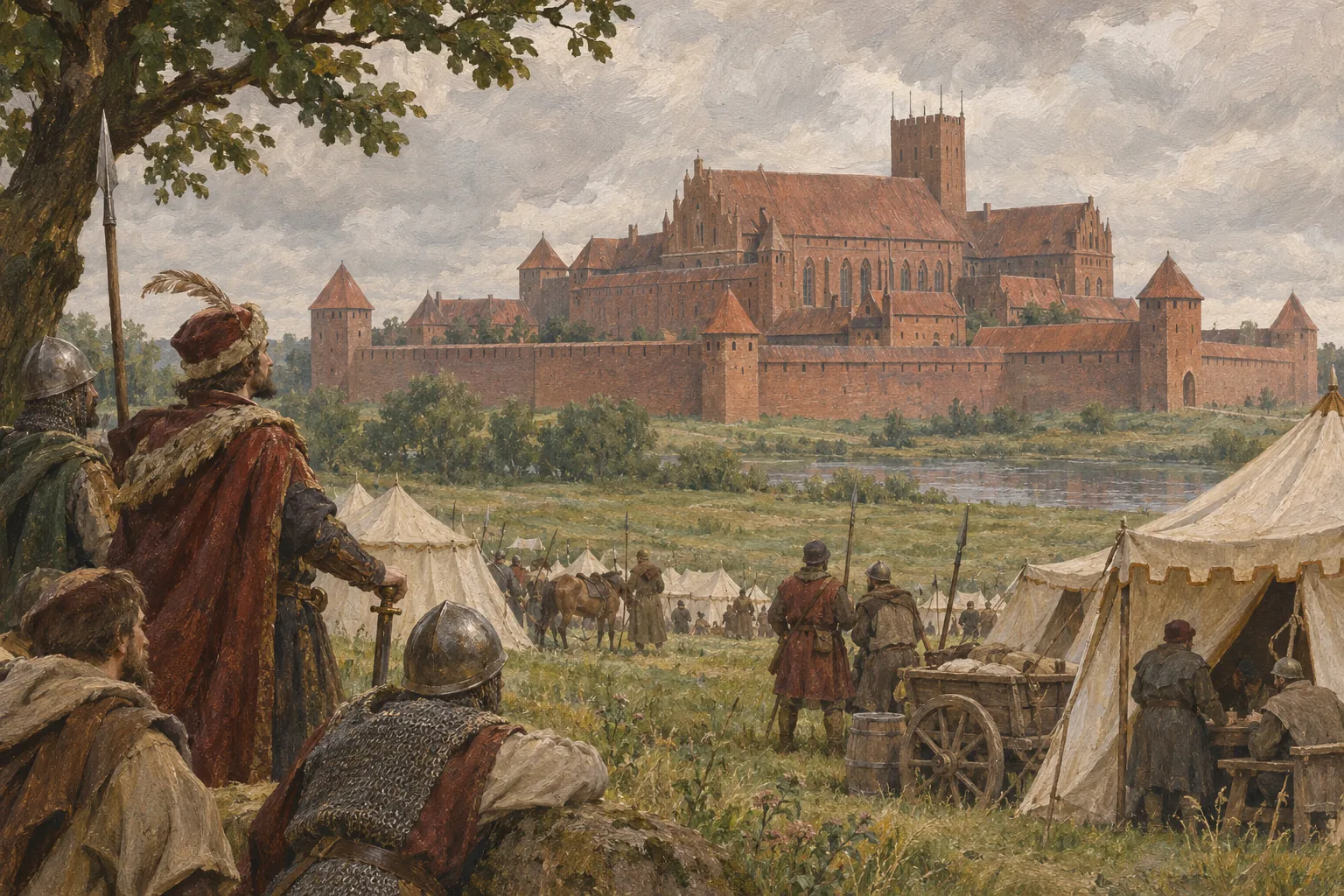
Meanwhile Heinrich von Plauen, commander of Schwetz, reaches Marienburg and organizes its defence. Narbutas describes survivors, reinforcements and treasury resources being assembled. The indefensible town is burned, and preparations focus on holding the castle. In his account, saving the key stronghold takes precedence over restoring authority across Prussia. S8
Narbutas accuses Jogaila of delay and a missed opportunity. The history edited by Šapoka also stresses the slow advance and Plauen’s preparations. Earlier arrival would have changed the circumstances. The authors’ speculation that it would certainly have ended the Order’s history does not establish that outcome. S8 S6
An Order letter of 22 July already mentions siege. Biskup distinguishes this from the main leaders’ conventional arrival date of 25 July, suggesting earlier detachments as the explanation. S91
2.22
Marienburg castle held.
The difficulties of the siege and Vytautas’s departure receive different explanations in the books.
Narbutas’s siege drags on: food deteriorates, and illness afflicts men and horses. Victory in the field is insufficient before the fortress. Communications and nearby garrisons must be maintained, and news of assistance to the Order watched. S8
Kojelavičius connects failure with a trick by the Livonian marshal Bernas: supposed peace mediators enter the castle and strengthen its defenders. Narbutas rejects this tradition as invention. One author directly disputes the other’s explanation. S7 S8
Narbutas’s Vytautas leaves to attend to sick men and Lithuania’s defence, retaining some troops with the king and in garrisons. He also invokes a circular promising a return with fresh men. This differs from the 1936 history’s suggestion that Vytautas perhaps wished to limit Polish gains; the synthesis itself acknowledges uncertainty over his motives. S8 S6
Jogaila eventually withdraws as well. Narbutas dates the lifting of the siege to 19 September; the camp is burned before departure. The allies won the principal battle, but Marienburg remained in the Order’s hands. By holding the capital and restoring a working leadership, the defenders could continue the war. S8 S6
2.23
The peace of 1411 did not fulfil every expectation.
Samogitia’s disposition was tied to the lives of the two rulers.
Fighting continued after the withdrawal. The history edited by Šapoka describes a peace comparatively lenient to the Order: some territories were relinquished and payments imposed, but its core survived. Victory strengthened the allies in negotiation, while failure to take Marienburg also limited the settlement. S6
The Peace of Toruń was concluded on 1 February 1411. Adam Szweda distinguishes it from the exchange of principal instruments on 10 May and examines subsequent disputes over implementation. S92
Samogitia remained with Jogaila and Vytautas for their lifetimes, without the Order renouncing its claims forever. The history edited by Šapoka stresses that neither ruler intended to surrender the region. The dispute therefore continued beyond victory in 1410. S6
Narbutas describes payments concerning prisoners and delays in their release. The treaty did not end the war for captives on the day it was signed: returning home still depended on agreements being fulfilled. S8
2.24
The Order survived, but the balance changed.
Victory at Grunwald and the Treaty of Melno in 1422 mark different stages of a longer conflict.
The history edited by Šapoka sees Grunwald as a major break in the Order’s power, while acknowledging its continued strength during Vytautas’s reign. The field army was defeated, but the state survived. Its capital, revenues and recruitment sustained political action after the heavy loss of leaders. S6
The Order’s letters published by Biskup mobilize assistance after defeat. Their religious accusations against Lithuanians and Tatars serve that mobilization. S91
The Samogitian dispute led to further fighting and negotiation. In the history edited by Šapoka, a lasting settlement comes with the Treaty of Melno on 27 September 1422: most of Samogitia is recognized as Lithuanian, while Klaipėda remains outside. Eleven years separate it from the Peace of Toruń in 1411. S6
The synthesis of 1936 portrays a halted Germanic wave and credits the victory chiefly to Lithuanians. More concretely, it describes the Order’s diminished ability to resist combined forces. This was a significant change, though later wars continued and the organization survived. S6
2.25
Banners, books and the name of the battle.
Each period of storytelling chose what to emphasize about Grunwald.
The Bychowiec Chronicle divides trophies between the cathedrals of Vilnius and Kraków, also describing beards torn from dead Order leaders. This is its memory of victory. Jasas considers whether horse-tail ornaments might underlie the unusual detail, without confirming the literal act. Narbutas carries the chronicle’s motif into his history. S19 S8
The Order banners listed in the appendix to the history edited by Šapoka were not all taken on 15 July: some are later captures. The collection tells a longer story of victories and does not precisely reconstruct the army of this battle alone. S6
Tomas Baranauskas traces the Lithuanian name from Vileišis’s Žalkrūmis in 1885 and Žaliagiris in 1887 to Maironis’s Žalgiris in 1891. His study shows how today’s name became established in nineteenth-century writing. S95
The 1936 synthesis recalls the Tannenberg name of 1914 and Hindenburg commemorations. Its “now” means the interwar period. The chronicle’s cathedral trophies, Narbutas’s chosen Grunwald and this political reading preserve the same victory, but each author emphasizes different actors and purposes. S6 S8 S19