2.1
A Gediminid son from Trakai.
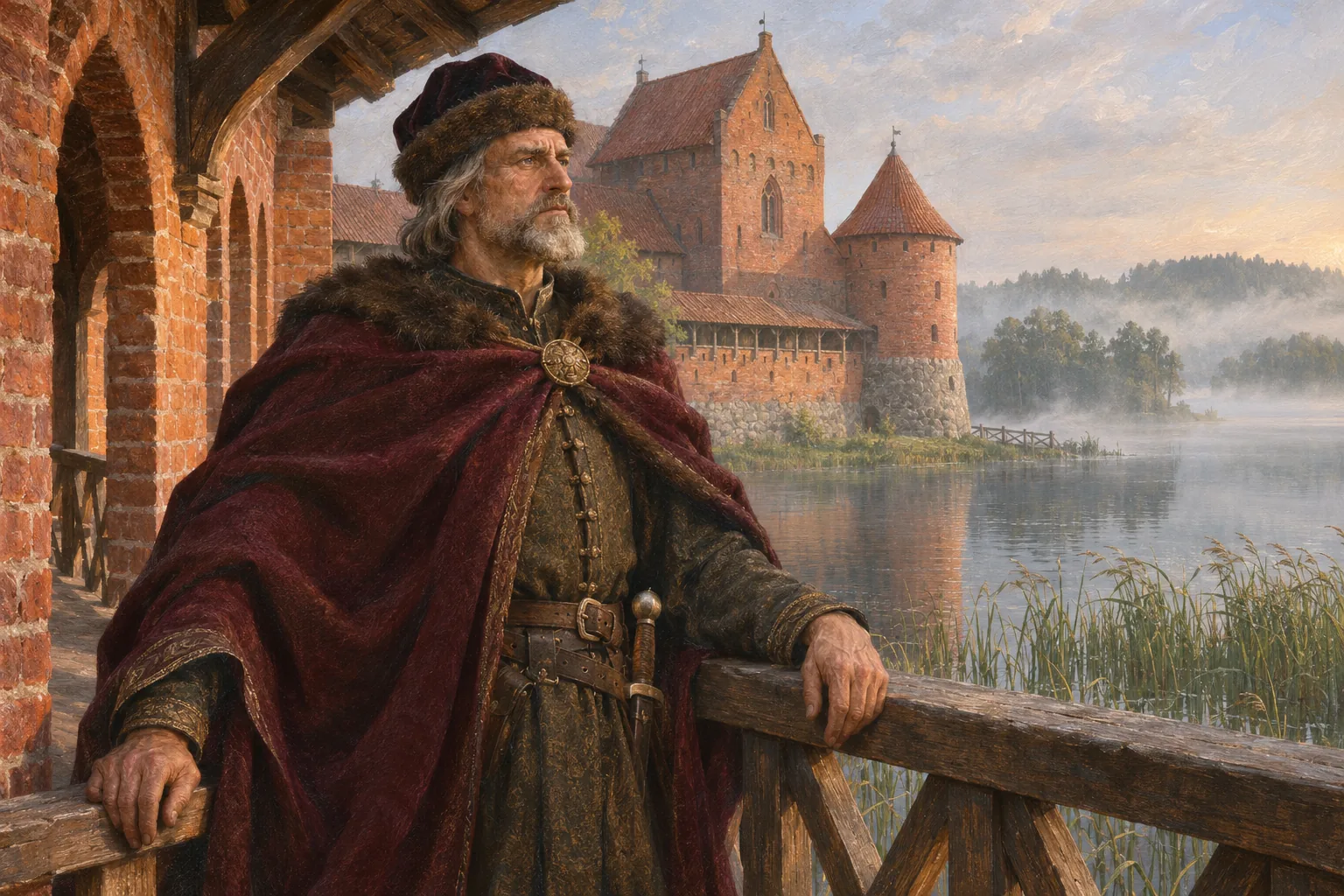
Vytautas was born around 1350 into a world where kinship offered claims to power without guaranteeing security.
Vytautas, the son of Kęstutis and Birutė, is associated with Senieji Trakai. His exact birthday is unknown; around 1350 is an approximate date. He grew up among the Gediminids, whose members ruled different territories and based their claims on descent, agreements and military strength. S6 S62
His father Kęstutis ruled Trakai and worked with his brother Algirdas to defend and expand the state. Algirdas’s son Jogaila was Vytautas’s cousin. While the older brothers cooperated, their sons could expect to continue that partnership; each family branch nevertheless had its own supporters and expectations of inheritance. S6
The Trakai lands stood near the frontier of war with the Teutonic Order. Campaigns, castle defence, captives and negotiations belonged to the same political world. The Grand Duchy of Lithuania already included Orthodox territories of Rus’. Vytautas’s generation had to preserve that authority while changing relations with its Christian neighbours. S6
The later Bychowiec Chronicle places Birutė in Palanga and tells of a marriage imposed by Kęstutis. This story of dynastic origins became central to Vytautas’s memory. Later accounts tell us little about his childhood lessons, daily life or temperament. S19
2.2
Cousins between two rulers.
After Algirdas died in 1377, the older brothers’ partnership did not simply pass to their sons.
When Jogaila became grand duke, Kęstutis initially recognised him. The 1936 Šapoka-edited history links this decision partly to the closeness of Vytautas and Jogaila. The new ruler nevertheless needed a policy of his own, while constant warfare encouraged negotiations with the Order that the older generation could regard as dangerous. S6
In the secret agreement of Dovydiškės in 1380, Jogaila negotiated with the Order, leaving Kęstutis exposed. Vytautas attended the hunt. The author of the interwar synthesis nevertheless considers it likely that he knew nothing of the secret treaty and still trusted his cousin. S6
In 1381 Kęstutis seized Vilnius, found evidence of the agreement and removed Jogaila from power. Caught between father and cousin, Vytautas also interceded for Jogaila. Dynastic disputes could still be settled by leaving a rival lands and a route back to power, so the coup did not end the struggle for Vilnius. S6
In 1382 Jogaila recovered Vilnius. Vytautas withdrew towards Hrodna while Kęstutis returned to continue the struggle. Both sides assembled forces again, but a meeting for negotiations proved decisive. It was intended to end the civil war; instead, Vytautas soon found himself a prisoner, deprived of his father and the political support he had provided. S6
Based on: S6
2.3
Negotiations end behind locked doors.
In 1382 Kęstutis and Vytautas were arrested; the father died at Krėva, while the son escaped.
Kęstutis and Vytautas came to negotiate under assurances of safety but were arrested in Vilnius. Kęstutis was sent to Krėva, where he died soon afterwards; Vytautas was transferred there after his father’s death. Kęstutis’s death transformed the struggle: resistance lost the authority of the old ruler of Trakai, and Vytautas’s ability to continue his father’s cause depended first on surviving and regaining his freedom. S6 S19
The Bychowiec Chronicle directly blames Jogaila’s circle and names the stranglers. The Šapoka-edited history also describes murder, but leaves Jogaila’s personal responsibility unresolved and directs greater suspicion towards Skirgaila. Political gains from a rival’s death alone cannot identify who gave the order. S6 S19
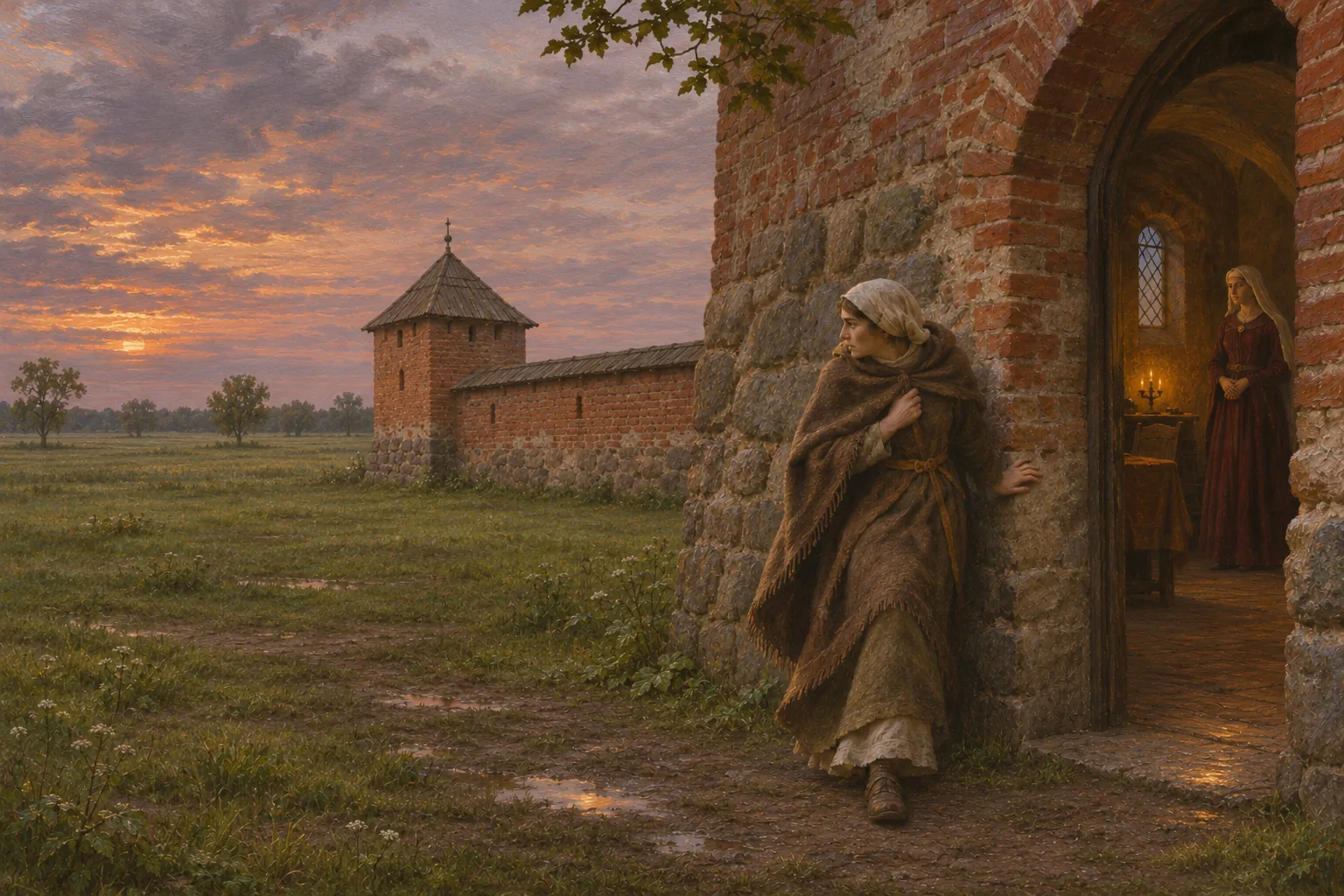
The escape stories give Ona and a disguise in women’s clothing the central roles. In the 1936 history, Vytautas leaves with his wife. In the Bychowiec Chronicle, Ona devises the plan, one maid remains in his place and another escorts the disguised prisoner out. These passages give no maid’s name. The same escape tradition has reached us with different companions. S6 S19
The 1971 editor, Rimantas Jasas, also explains the route compressed in the chronicle: through Navahrudak and Mazovia to Prussia. Family shelter could protect a fugitive, but could not alone recover his lands. The accompanying illustration depicts the legendary escape motif; appearances, clothing and the chamber are modern artistic inventions. S19
2.4
The price of support in the Order’s lands.
In 1382–1384 Vytautas sought help from the military power his father had fought for decades.
In the Order’s territory, Vytautas gained a chance to renew his struggle for Trakai. The Order acquired a useful claimant who could prolong Lithuania’s civil war and open castles to its forces. Each needed the other: Vytautas lacked strength without outside support, while raids brought the Order fewer lasting advantages without a Lithuanian ally. S6
In 1383 he was baptised as Wigand. Baptism changed his public standing and relations with his protectors, but did not settle the contest for Lithuania’s seats of power. Their combined forces captured Trakai that year but failed to take Vilnius. Military success had still not given Vytautas independent possession of his patrimony. S6 S62
In 1384 Vytautas promised the Order territorial concessions and future vassalage — recognition of a superior lord’s authority. In exchange for help returning, he offered other lands and part of his future freedom of action. The Order sought to turn those promises into actual power. S6
An agreement with Jogaila offered another route. Vytautas burned the Order’s castles and returned, receiving part of his father’s lands, Hrodna and other possessions. Trakai remained with Skirgaila. The reconciliation of 1384 ended his first alliance with the Order but left his central demand unfulfilled: possession of the patrimonial seat over which conflict would soon resume. S6
2.5
Alexander within a new alliance.
Jogaila’s marriage and Lithuania’s conversion changed Vytautas’s political world without resolving the dispute over Trakai.
The agreement at Krėva in 1385 connected Jogaila’s marriage to Jadwiga, the Polish throne and his commitment to accept Catholicism. Lithuania’s rulers entered a new dynastic relationship. Warfare with the Order increasingly also concerned who could legitimately speak for a Christian country. S6
At Kraków in 1386, Vytautas received the Catholic baptismal name Alexander. His earlier name Wigand and later accounts of his faith are sometimes arranged into a tidy sequence of baptisms. Evidence for intermediate ceremonies is less secure than the evidence connecting these two names to their specific political settings. S6 S62
In 1387 Jogaila established Catholic institutions in Lithuania’s core and granted privileges to Catholic nobles. The Orthodox Church already operated in the Ruthenian lands. The ruler’s faith and the legal position of part of the elite changed, while religious life in different regions followed its own course. S6
With Jogaila living in Kraków, Skirgaila served as his deputy in Lithuania. Vytautas initially supported closer relations with Poland but did not recover Trakai even when Skirgaila obtained other possessions. The patrimonial dispute concerned more than two cousins: it would determine which Gediminid commanded enough territory and support to act across Lithuania. S6
2.6
Back to the Order, back against Vilnius.
Civil war resumed in 1389–1390, and Vytautas’s relatives had to pledge their freedom as security for his alliance.
After a plan to seize Vilnius by surprise failed, Vytautas could no longer rely on his existing possessions alone. He again turned to the Order. Having already been abandoned once, his ally demanded hostages rather than promises: his brother Žygimantas, other relatives and nobles pledged their freedom as security against another breach. S6
During this period, his daughter Sofija’s marriage to the Muscovite ruler Vasili strengthened Vytautas’s eastern dynastic ties. It did not guarantee military support for every undertaking, but connected the exiled prince to a powerful rival of Jogaila. Through both marriage negotiations and military alliance, Vytautas sought a return to power. S6
In 1390–1391, Vilnius and its surroundings again faced attacks by Vytautas and the Order. Fighting over castles also endangered settlements and their inhabitants. Some local nobles supported the claimant, but his return with the Teutonic forces was no peaceful liberation: the contest for power burned and exhausted the country he sought to govern. S6 S62
Secret negotiations between Jogaila and Vytautas in 1392 opened a path to reconciliation. Vytautas burned Ritterswerder and other Order strongholds before leaving. The reversal strengthened his bargaining position, but his brother Žygimantas remained a prisoner until 1398. The hostages’ fate showed that the ruler’s changes of allegiance also carried a cost for his relatives. S6
2.7
Trakai restored, Vilnius entrusted.
The agreement of 1392 ended a phase of civil war and began Vytautas’s long rule.
At Astrava near Lida, Vytautas reconciled with Jogaila. He recovered his father’s lands including Trakai, retained Lutsk and was entrusted with Vilnius. These terms far exceeded those of his first return. Governing Vilnius gave him the standing to address other princes and nobles as a ruler responsible for the wider state. S6 S62
In return, Vytautas acknowledged Jogaila’s supreme authority and promised support. Vilnius remained connected to Jogaila’s rights even as his cousin took over government. The arrangement served both: Jogaila escaped a recurring military crisis, while Vytautas gained the means to build effective power without renouncing their dynastic relationship. S6
The rulers’ wives Jadwiga and Ona also confirmed the agreement separately. Ona’s guarantee survives. Their promises were intended to make renewed cooperation credible to both rulers’ followers after repeated reversals and civil war. S6
The 1936 history describes Vytautas’s ascent as a deputy becoming Lithuania’s effective ruler. This happened through governing lands, gathering revenues and changing provincial rulers, rather than merely announcing a title. The year 1392 marks the beginning of his long reign; the acts of 1401 would separately define his formal position. S6
2.8
Princes, governors and nobles.
Vytautas strengthened his authority by changing the people through whom the state’s territories were governed.
Gediminid princes in the major provinces commanded their own troops and revenues, with claims grounded in descent. Holding Vilnius was insufficient while they pursued separate policies. Removing Švitrigaila, Kaributas and other princes from their possessions reduced the number of autonomous dynastic centres and transferred key positions to governors trusted by the ruler. S6
A governor acted in the ruler’s name, allowing revenues and military support to reach Vytautas more directly. Much local organisation nevertheless survived. Changes came at different times in Kyiv, Volhynia and Podolia. Rival claims persisted, while Podolia’s connections to Poland limited what Vytautas could take into his own hands. S6
Rimvydas Petrauskas stresses that Vytautas’s leading magnates came from established noble families. He relied on their connections and support; they used service to strengthen their position. Princely authority grew through cooperation with an elite whose independent roots predated his reign. S70
The interwar synthesis calls these changes the unification of the state, emphasising the revenues and forces now available to its ruler. They did not create a uniform modern administration. Noble service and landed power still depended on labour and obligations; stronger government did not automatically give peasants a political voice or noble privileges. S6
2.9
Power travelled with the court.
Campaigns alone did not sustain Vytautas’s authority: envoys, documents and a travelling household also carried it.
Ruling an extensive state, Vytautas had to consult governors, receive foreign envoys and confirm agreements carried out far away. This work required intermediaries and a court. Travel brought him in person to different possessions. Vilnius and Trakai remained important bases, but government was conducted elsewhere too. S6
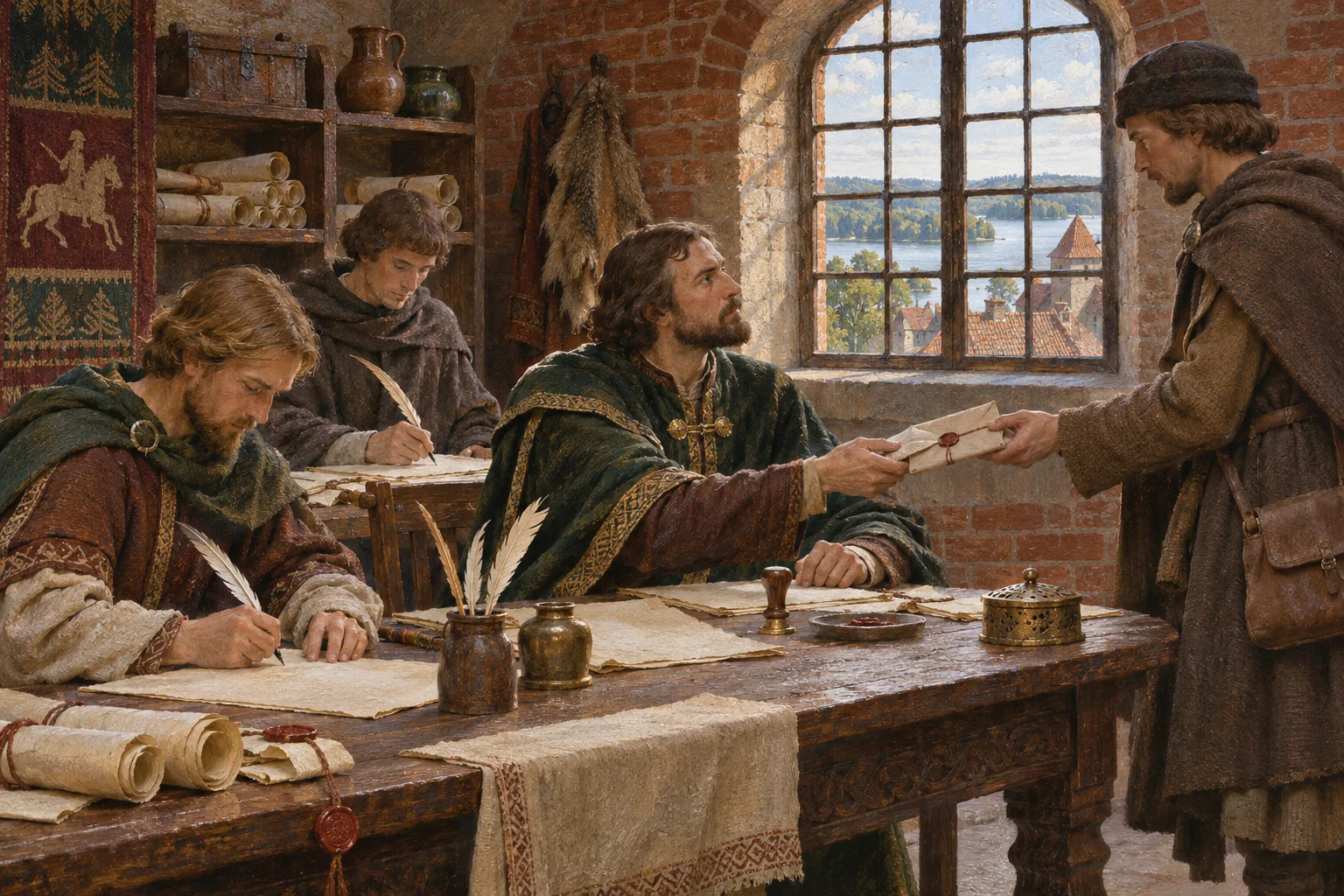
Dovilė Keršienė describes clerks in Vytautas’s chancellery who came from Poland, the Order, Volhynia and other Ruthenian lands. They brought different written and diplomatic traditions. A letter need not speak in the ruler’s voice alone: literary writing could follow older models, while authorship and transmission remain separate questions. S71
Correspondence connected negotiation with practical action: an alliance had to be announced, guarantees secured and instructions sent. A seal authenticated the document’s authority. Such work reveals the needs of a multilingual polity, but the activities of the chancellery alone cannot establish a reliable list of languages Vytautas personally spoke. S6
Raimonda Ragauskienė describes the travelling court through Birštonas, with its wooden castle and hunting residence. During his journey of 1413–1414, the knight Ghillebert de Lannoy met Vytautas there with his family. The ruler could receive a foreign visitor while staying for several weeks at a residence away from the capital’s castle. S67
2.10
Kinship and different memories.
Vytautas’s family connections shaped politics, while different communities preserved his reputation as a protector.
Ona guaranteed political agreements, while Sofija’s marriage connected her father’s court to Moscow. After Ona died in 1418, Julijona became Vytautas’s wife. Family ties created diplomatic connections, public commitments and expectations of succession. Vytautas nevertheless left no son who could straightforwardly inherit his position. S6 S8
The people of his state differed in faith and legal standing as well as origin. Tatars, Karaims and Jews were not a single migrant group. Their histories cannot be reduced to one campaign or a common privilege. Even a celebrated reputation for protection does not establish when each community settled or how its rights developed. S6 S8
Jurgita Šiaučiūnaitė-Verbickienė distinguishes Tatar memories of the “white khan” from Karaim memories of a protector. Later accounts describe people brought back from campaigns and allies who stayed; some motifs passed between traditions. These stories linked communal origins to a powerful ruler. They provide no contemporary census or verified household total. S73
The Lithuanian Karaim cultural community remembers Vytautas as Vatat Bij, “a king who crushes enemies”. The tradition expresses a connection to Lithuania and respect for a protector. This communal memory matters, but not every resettlement detail is direct testimony to a late-fourteenth-century event. S66
2.11
Western peace at others’ expense.
In 1398 Vytautas secured peace with the Order by promising Samogitia.
The Order’s attacks continued after 1392, devastating areas around Hrodna, Merkinė and Lida and again threatening Vilnius. Lithuania’s conversion gave Jogaila and Vytautas a new diplomatic argument but did not automatically stop campaigning. Lasting peace required negotiations over the territory the Order particularly wanted: Samogitia. S6
Under the treaty of 1398, Vytautas conceded Samogitia as far as the Nevėžis and other western territories. The Order was to stop attacking and assist him in the east. The interwar historian interprets this risk as a plan to expand his power in Rus’ and later recover the conceded lands from a stronger position. S6
Samogitians had no equal say as their territory was bargained over. A treaty promise could not ensure peaceful, universal submission to a new ruler. The Order’s efforts to establish itself met local resistance, leaving Samogitia’s future unsettled after the Salynas feast and the sealing of documents. S6
At the Salynas meeting, nobles acclaimed Vytautas as their king. The 1936 history stresses that neither a coronation nor a legal change of status followed. The declaration of 1398 reflects his circle’s ambitions and Vytautas’s authority. S6
Based on: S6
2.12
An expedition ending in defeat.
In 1399 an alliance with the displaced khan Tokhtamysh led Vytautas into one of the worst defeats of his reign.
Tokhtamysh sought help recovering power in the Golden Horde. Vytautas saw an opportunity: restoring the khan might produce favourable conditions for his own policy in Rus’. He was entering the Horde’s internal struggle, where one claimant could not guarantee that rival leaders and their forces would accept a new arrangement. S6
Lithuanian and Ruthenian princely forces joined Polish nobles and troops from the Order in the expedition. Papal approval allowed the campaign to be presented as a crusade. Such expeditions had recently targeted Lithuania; now its ruler led a coalition that included some of his former principal enemies. S6
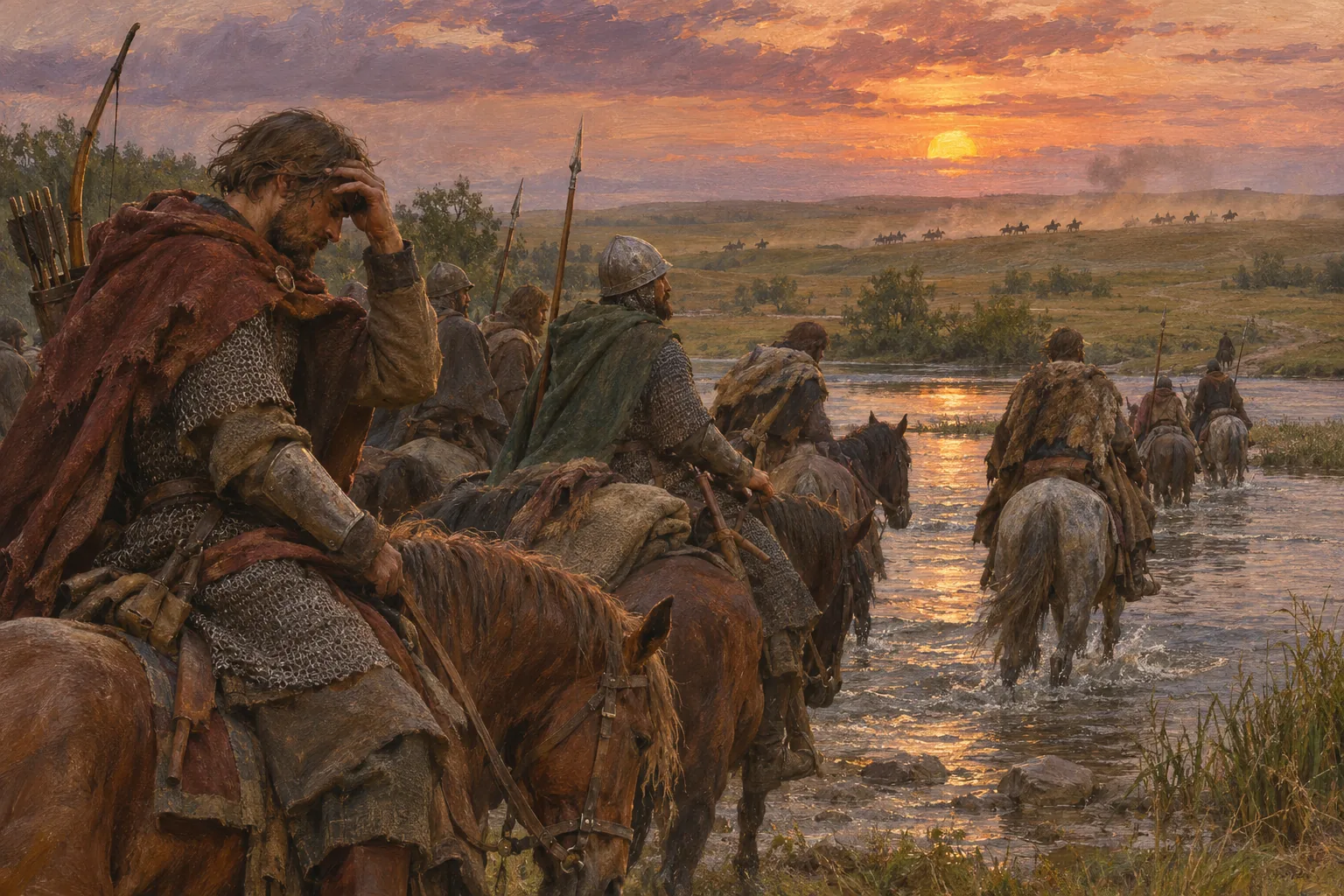
In 1399 Vytautas’s coalition was crushed on the Vorskla River. Many commanders and soldiers died, while he escaped. The interwar book gives estimates of losses, not a verified casualty register. The army failed to restore its ally to power, dealing a severe blow to Vytautas’s plans. S6
Defeat encouraged resistance elsewhere in his possessions, especially Smolensk. Vytautas now had to protect existing gains and renegotiate relations with Jogaila. Vorskla did not, however, end all eastern policy. He continued to intervene among Ruthenian and Tatar rulers, although the coalition of 1399 had not achieved what he intended. S6
Based on: S6
2.13
New agreements after defeat.
The acts of 1401 and subsequent conflicts show how often Vytautas’s position had to be secured anew.
The acts of Vilnius and Radom in 1401 recognised Vytautas’s rule for life. They preserved Jogaila’s supreme rights and provided for the lands to revert to him or his heirs after Vytautas’s death. They also regulated participation by the political elites: the future could not rest solely on a personal promise between two cousins. S6
The 1936 synthesis sees these acts as a threat to separate Lithuanian statehood after Vytautas’s death, reflecting its concern with independence. The acts strengthened recognition of his position for life. Yet the arrangement balanced different claims to authority and left room for future succession disputes. S6
Vytautas had to establish his authority in Smolensk anew. After initial submission and revolt, he recovered the city; the encyclopaedic biography dates this to 1404, while the 1936 history gives 1405. His earlier victory had not persuaded local princes and their supporters to abandon their own claims. S6 S62
Sofija’s marriage did not eliminate conflict with Moscow. An agreement on the Ugra in 1408 reduced the threat of eastern war. As confrontation with the Order approached, this had practical value: Vytautas needed to act in the west without another major front opening against his eastern possessions. S6 S62
2.14
Samogitian revolt and a combined army.
In 1409 local resistance developed into a war for which Jogaila and Vytautas prepared together.
Samogitia had not become a settled possession of the Order after the earlier concessions. Vytautas renewed its cession in 1404 but later supported resistance, with his agents active in the rising of 1409. Samogitian opposition and princely policy now converged, although their interests had not always aligned in earlier years. S6
Jogaila’s support for Vytautas turned the conflict into a war involving both states against the Order. Joint action required coordination, mobilisation and persuasion abroad that Christianity itself was not being attacked. Diplomacy accompanied warfare as each side claimed that law and the defence of faith justified its cause. S6
The forces assembled in 1410 were diverse. Alongside the Polish king’s army marched contingents from Lithuanian and Ruthenian lands, Tatar allies and other supporters. These were not two modern national armies. Their contingents were joined through different obligations of service, princely connections and a shared objective in this particular war. S6
After assembling and crossing the Vistula, the allies could advance deep into the Order’s territory. Separate forces had to arrive, cross the river and continue together. On 15 July 1410 they met the Order’s main army on the field known as Žalgiris, Grunwald or Tannenberg. S6
Based on: S6
2.15
A shared victory, a disputed retreat.
Jogaila and Vytautas’s allies won on 15 July 1410, but questions remain about how the battle unfolded.
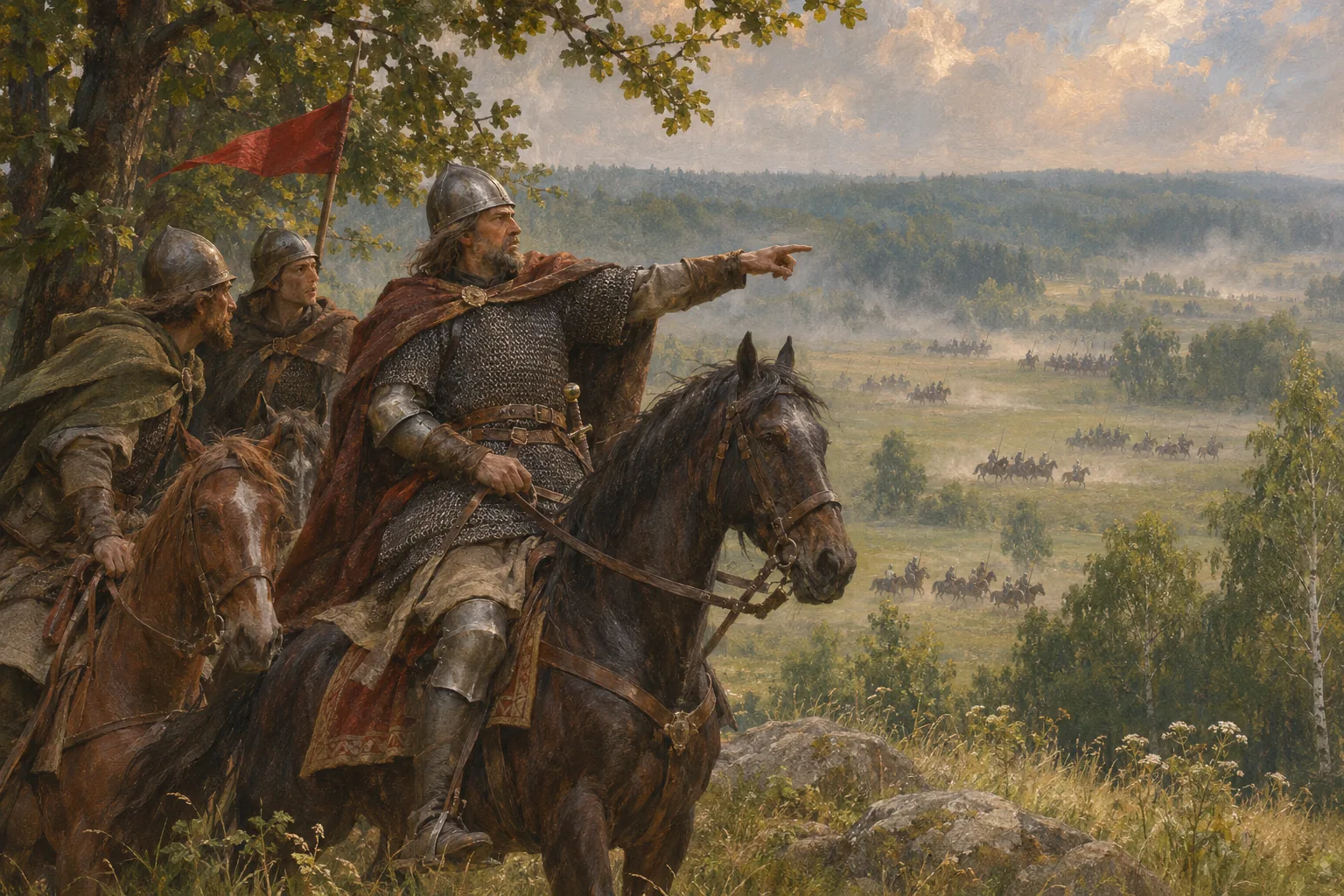
Vytautas actively directed troops in action, while Jogaila stood at the centre of the alliance and its royal command. The supplied authors assign different weight to their contributions, but victory depended on the forces assembled by both. The Order’s army was defeated, Grand Master Ulrich von Jungingen was killed and the balance shifted towards the allies. S6 S8
One of the battle’s hardest episodes to explain is the withdrawal and return of part of Vytautas’s army. The 1936 history considers the retreat probably deliberate, intended to draw pursuers out of formation. It offers a likely tactical explanation; it supplies no surviving order by Vytautas from which every unit’s movements could be reconstructed. S6
Narbutas tells a different story: the lines break, panic spreads and Vytautas initially fails to halt the fleeing troops. The author then emphasises the Smolensk contingents, reserves and regrouped men. In his account, victory comes through overcoming a crisis, rather than smoothly carrying out a single plan from beginning to end. S8
Sven Ekdahl examined an undated letter warning the grand master against pursuing one or two withdrawing banners and breaking formation as in the “great battle.” It supports an interpretation involving feigned retreat, but does not prove an army-wide manoeuvre. The writer and exact date remain unknown; firm evidence assigning the action specifically to Tatars is also lacking. S64
The Bychowiec Chronicle gives still more of the glory to Lithuanian and Ruthenian troops, leaving the Polish army little part. Jasas reads this as a polemic against the tradition emphasising Lithuanian flight. The late, partisan chronicle records a dispute over the memory of victory, but cannot establish the movements of every contingent. S19
2.16
Winning the battle did not end the war.
Malbork remained untaken, and the peace of 1411 settled Samogitia’s position only temporarily.
The allies reached Malbork, the centre of the Order’s government. Destroying its field army did not ensure the fall of its principal castle. The siege failed, leaving the Order a base from which to recover politically. Victory had to be translated into treaties whose terms proved narrower than the hopes raised by the battlefield. S6 S8
The 1936 history treats Vytautas’s reasons for leaving the siege as uncertain. It suggests that he may have opposed excessive Polish gains. This remains the author’s hypothesis, not documentary proof of a secret intention. The siege’s outcome alone cannot reveal precisely what he thought. S6
The Peace of Toruń in 1411 left Samogitia to Jogaila and Vytautas for their lifetimes. This stopped the war while preserving the Order’s future claim. For inhabitants, present possession was not enough: the rulers’ deaths could reopen the question of who was entitled to the land. S6 S8
Disputes over boundaries, obligations and earlier agreements continued. Vytautas and Jogaila still cooperated through warfare and embassies. Grunwald reduced the Order’s power to impose its will, but securing Samogitia permanently required further confrontation and another settlement: the Treaty of Melno in 1422. S6
2.17
Nobles also give the union substance.
The acts of Horodło in 1413 addressed future rulers and created new ties among Catholic nobles.
Horodło provided for a separate Lithuanian ruler after Vytautas, chosen in consultation with Jogaila and Poland’s political elite. The Lithuanian side was likewise to be consulted over Poland’s ruler. The union was renewed by defining participation in major decisions rather than abolishing every distinction between the two polities. S6
Forty-seven Lithuanian noble families were adopted into Polish heraldic clans. Their coats of arms publicly affirmed bonds among nobles. Offices were also reorganised on Polish models. The nobility took an increasingly active political role and supported Vytautas’s government; future rulers would need its consent too. S6
Important privileges and high offices were tied to Catholicism. Orthodox nobles remained significant in the state but did not receive equal access to every newly defined right. Horodło therefore did not establish universal religious or political equality. The closer relationship offered to Catholic nobles also drew a boundary within the realm. S6
The Šapoka-edited history emphasises the preservation of separate Lithuanian government and suspects Polish attempts to attract its nobles. Narbutas celebrates the same assembly as an exceptional common political achievement. Petrauskas examines his sympathy for a shared history in the 2019 introduction. These authors assess the union differently. S6 S8
2.18
A regional voice reaches Constance.
Samogitia’s conversion changed local life and formed part of the international dispute over the region.
In 1413 Jogaila and Vytautas came to Samogitia to begin conversion. A short royal visit could proclaim a new religious order and set a political course, but could not immediately transform customs throughout the region. The 1936 history itself distinguishes the first baptisms from the later establishment of parishes, clergy and resources. S6
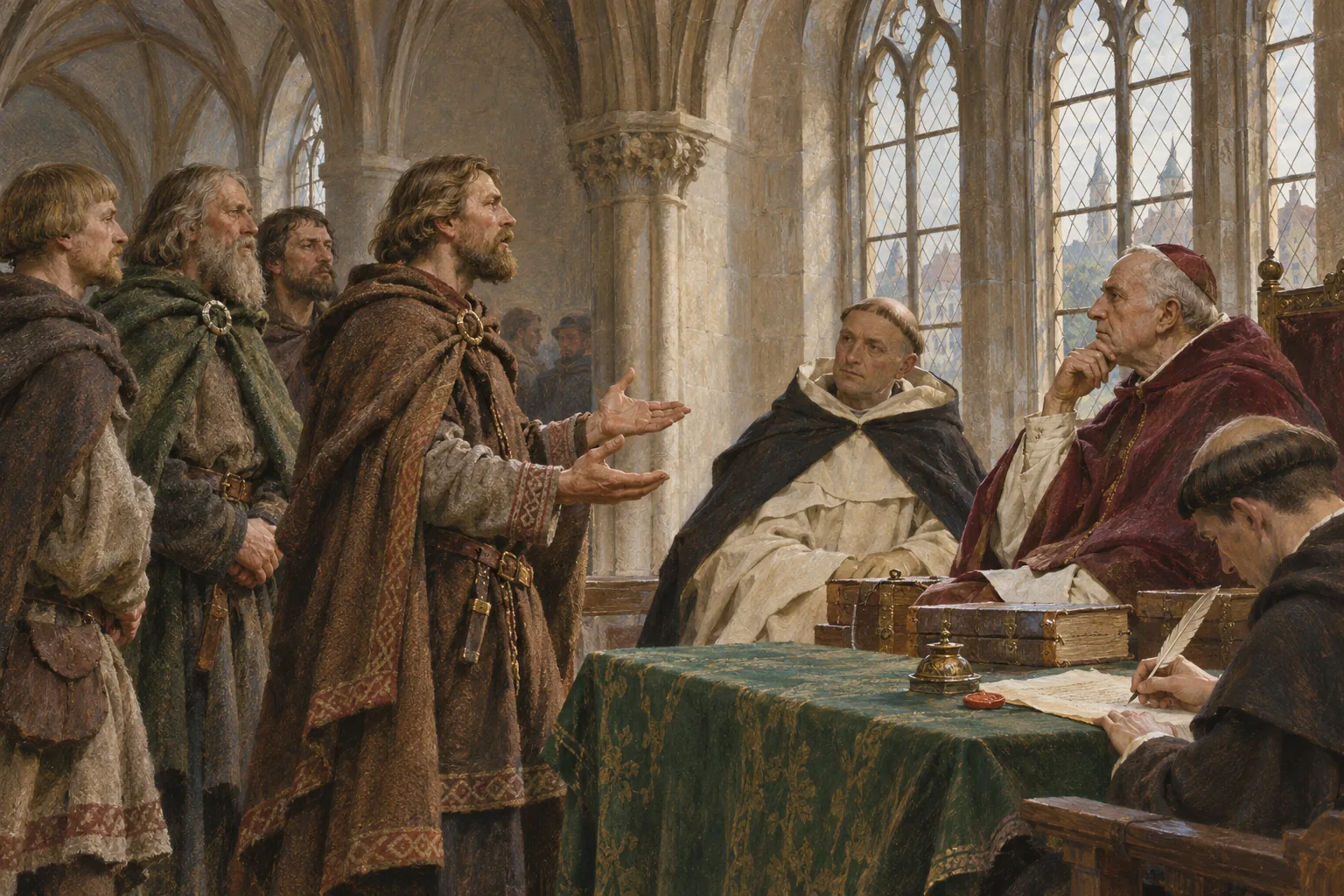
In 1415 Samogitian representatives came to the Council of Constance to complain about the Order’s conduct. Alongside territorial agreements between rulers, they raised the inhabitants’ experience of life under the Order. The illustration imagines this act of representation; it does not reconstruct actual faces or the meeting chamber. S6
The Samogitian diocese was founded in 1417, centred on Medininkai, now Varniai. Church life required land, income and permanent organisation, and putting these in place took time. Vytautas’s patronage created institutions intended to remain after he left, giving conversion a significance far beyond the ceremonies of one visit. S6
Recognition of Christian Samogitia weakened the Order’s claim that it needed to rule the region to convert it. Religious change did not itself end the political dispute. Samogitians brought their own experience of resistance and representation; princely decisions worked alongside local efforts to escape a government they experienced as alien and burdensome. S6
Based on: S6
2.19
Another Christian part of the realm.
The Ruthenian lands were Christian before Jogaila and Vytautas accepted Catholic baptism.
Orthodox bishops, monasteries and churches served much of the realm. Its ruler needed the support of local elites, while privileges granted to Catholics created legal distinctions. Religion also raised political questions: ecclesiastical connections extended beyond Vytautas’s possessions, and a metropolitan residing in Moscow could strengthen a rival’s influence. S6 S8
Andrius Jurkevičius stresses that Orthodox life continued after 1387. On 15 November 1415, Grigalius Camblakas was elected metropolitan at Navahrudak, but Fotijus contested his position. Camblakas’s appearance at Constance in 1418 did not achieve church union. These attempts to reorganise ecclesiastical authority did not convert all Ruthenians to Catholicism. S68
The interwar history links plans for church union to unequal religious rights, and support for a separate metropolitan hierarchy to reducing dependence on Moscow. Narbutas gives a fuller account of Camblakas and his election. Both narratives show the limits of princely will: clergy, the patriarch and other ecclesiastical centres also had to agree. S6 S8
After the union project failed, Orthodox communities remained part of the state. Vytautas had to reconcile his political objectives with an established religious order. Christianity followed different paths in central Lithuania, Samogitia and the Ruthenian lands; a single date for Lithuania’s conversion cannot encompass them all. S6
2.20
A distant crown, a nearby frontier.
The Hussite offer and war with the Order belonged to the same search for diplomatic leverage.
After 1419, the Bohemian political crisis and Hussite struggle reopened the question of the throne. When Jogaila declined the crown, Vytautas became a candidate, represented by Žygimantas Kaributaitis. Vytautas was never crowned king of Bohemia. The Hussite connection extended his influence beyond neighbouring territories and offered leverage against Sigismund of Luxembourg. S6 S8
The award at Wrocław in 1420, favourable to the Order’s claims, sharpened the conflict with Sigismund. The interwar synthesis connects the Bohemian policy with this pressure: supporting an opponent’s rivals could alter negotiations. Religious conflict over the Hussites and political conflict over Samogitia became entangled, although their participants pursued different ends. S6
In 1422 the forces of Jogaila and Vytautas again entered the Order’s lands. The Treaty of Melno, concluded on 27 September, recognised Samogitia as Lithuanian without the earlier lifetime restriction. This broke the long deadlock. Klaipėda nevertheless remained with the Order: the settlement established a particular frontier rather than satisfying every possible territorial ambition. S6 S8
After agreements with Sigismund, Kaributaitis was recalled from Bohemia. Vytautas linked separate negotiations: support in one country could be exchanged for a better settlement elsewhere. Melno secured a firmer western frontier and freed attention for other possessions, although relations with his neighbours continued to shift. S6 S8
2.21
Influence was far from uniform.
Vytautas’s connections reached Moscow and the Black Sea frontier, but authority meant different things in different places.
Sofija’s son Vasili II was Vytautas’s grandson. Kinship gave the Lithuanian ruler a special place in Moscow’s dynastic affairs without turning Moscow into an ordinary province governed by his appointee. Guardianship, neighbouring princes’ oaths and gifts could display political ascendancy, but that advantage still required maintenance. S6 S8
Campaigns against Pskov in 1426 and the Novgorod lands in 1428 forced negotiations and payments. The interwar history presents them as signs of immense power. A contribution extracted by military pressure was not permanent government, however: these cities retained their political structures rather than becoming uniform parts of his administration. S6
From a later summary of a lost letter of 1427, Darius Baronas dates Vytautas’s Black Sea visit to February that year. The account mentions the Dniester estuary, gifts of fish and fortification building. It challenges the idea that Vytautas never returned after Vorskla. The journey alone, however, does not establish permanent control of the entire coast. S65
Tomas Čelkis stresses that the distant coast’s integration was conditional. Rivers and other landmarks marked boundaries, while steppe politics shaped practical authority. Lithuania “from the Baltic to the Black Sea” describes a broad sphere of power. It implies neither uniform administration on a modern state model nor conquest of the whole Crimea. S72
2.22
A crown proposed before assembled rulers.
At Lutsk in 1429, Vytautas’s prestige met disagreement over what status Lithuania’s ruler should hold.
Jogaila, Vytautas, Sigismund of Luxembourg and representatives of many other rulers assembled at Lutsk. Hospitality displayed the host’s resources. Wider regional affairs were discussed, and a proposal raised in public touched the structure of the Lithuanian-Polish relationship itself. S6
Sigismund proposed crowning Vytautas king of Lithuania. He was then King of the Romans, not yet emperor. Royal rank would have given Lithuania’s ruler a different international status. How it could coexist with earlier agreements and the rights of Jogaila’s dynasty immediately became a matter of dispute. S6 S63
Jogaila initially agreed, but the Polish council opposed the proposal. It feared the consequences for choosing a ruler after Vytautas and for Lithuania’s connection to Jogaila’s heirs. The interwar synthesis presents a defence of Lithuanian independence; participants also faced concrete questions of succession, prior obligations and political influence. S6
Jogaila left with his advisers before a final agreement was reached. Each side sought to define its rights through correspondence and further embassies. Noble standing and the choice of a future ruler depended on the coronation question too. The dispute soon extended beyond an ageing ruler’s personal glory and relations between the cousins. S6
2.23
No crown was placed on 8 September.
Preparations in 1430 left both diplomatic evidence and a lasting legend of a stolen crown.
Vytautas prepared for coronation on 8 September 1430, with royal insignia intended for both him and Julijona. Guests arrived and negotiations continued, but the ceremony did not take place. Neither preparations nor his supporters’ determination conferred kingship: the necessary ceremony and recognition were not achieved amid the dispute. S6
The Bychowiec Chronicle says the crown was intercepted, cut up and used for a Kraków bishop’s crown. Its 1971 editor, Jasas, considers this story of lost kingship probably legendary. In his account, the insignia-bearing embassy stopped before entering Poland. The same book thus preserves both a vivid chronicle narrative and the editor’s conflicting explanation. S19
Rimvydas Petrauskas distinguishes two embassies. The first carried coronation documents and was stopped in Poland. The second carried the crowns, but learned of the obstruction, halted and turned back. Intercepted documents thus do not establish the later, compelling story of crowns seized and destroyed in Kraków. S63
Jan Długosz also separates the envoys carrying documents from the delegation carrying the crowns. The latter, he says, turned back and returned the crowns and gifts to Sigismund. He welcomes the obstruction of the coronation as a defence of Poland’s rights. His account of the crowns’ journey ends there; this episode leaves their later fate untold. S140
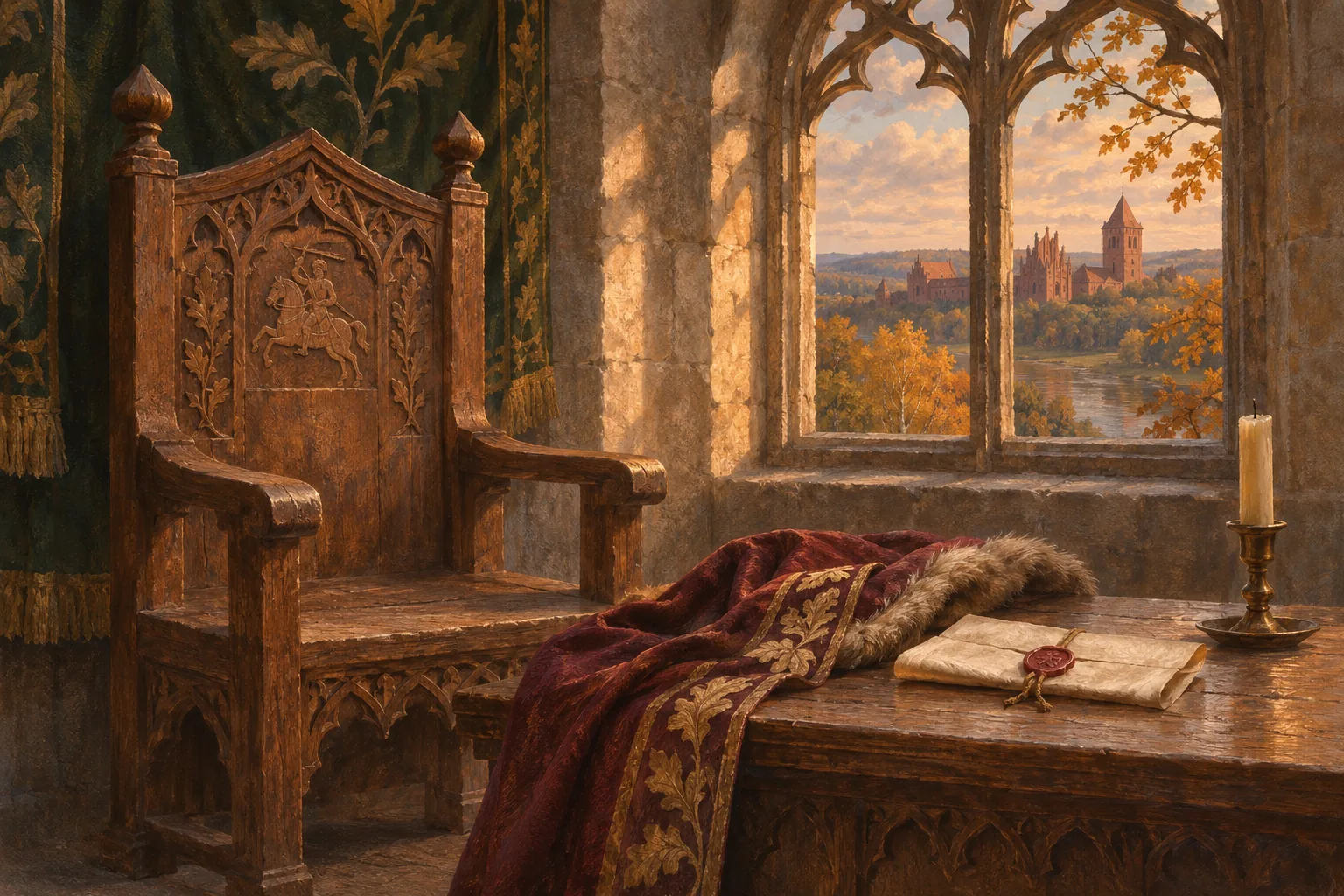
Negotiations continued into autumn when Jogaila visited his cousin. The 1936 history describes another attempt to reconcile coronation with the rights of Jogaila’s sons, but Vytautas did not live to see its outcome. The illustration’s empty place is symbolic: it depicts neither a completed coronation nor a stolen crown supposedly present in the chamber. S6
2.24
The ruler died with succession unresolved.
Vytautas died on 27 October 1430, leaving the future of the power he had built contested.
Vytautas died at Trakai on 27 October 1430. The Bychowiec Chronicle’s date of 23 October is corrected by its own 1971 editor. The interwar history sets differing accounts of illness and injury from a fall from a horse alongside one another. Neither is presented here as an established cause of death. S6 S19 S62
Długosz’s Vytautas weakens while riding. He is helped from his horse into a carriage; no fall is described here. After the ruler’s death, the author praises his industry, justice administered even while travelling, generosity and international standing. He also includes moral accusations, some attributed to what people said. The portrait is mixed, and the narrator’s thoughts about grief do not establish a cause of death. S140
He was buried in Vilnius Cathedral. Later fires, rebuilding and wars altered the tomb’s setting, while memorials were repeatedly renewed. The 1936 book’s account of searches for his remains belongs to the time in which it was written. Alone, it cannot establish what may be claimed about their location or survival today. S6
Vytautas left no son, but Sofija and her children connected his line to Moscow’s rulers. These dynastic descendants did not ensure a clear direct succession to Lithuania’s throne. Earlier agreements, Jogaila’s rights and Lithuanian noble ambitions now had to be reconciled without the man who had long held them in balance. S6 S8
Švitrigaila, one of Vytautas’s old rivals, became grand duke. In elevating him, Lithuania’s political community showed it could act on its own initiative. Vytautas’s long reign had strengthened the princely office without establishing a succession system that could prevent disputes. The new government had to contend with them. S6
2.25
Each age shaped its own Vytautas.
The ruler’s deeds and the stories told about him have long coexisted, but belong to different layers of history.
Grand duke names an office; “the Great” attached to Vytautas is an honorific. Tomas Baranauskas traces its history well before 1930 and discusses medieval praise of the ruler. Panegyrics convey the image their authors created, but do not independently verify every achievement they celebrate. S74
In the nineteenth century Narbutas portrayed a hardworking, accessible yet stern ruler, connecting Lithuanian grandeur with a history shared with Poland. In the 2019 edition, Reda Griškaitė examines portrait traditions and the cathedral memorial renewed in 1853. Historical books were not the only makers of memory: visible monuments also sustained his reputation. S8
Giedrius Viliūnas examines the commemoration of 1930 as modern political culture. For the five-hundredth anniversary of Vytautas’s death, associations and state institutions organised celebrations, monuments and public rituals linking him to state and nation. Interwar Lithuania gave inherited esteem for Vytautas a new scale and its own political language. S75
The archive’s account shows the scale of commemoration: from 15 July to 7 September 1930, an image of Vytautas by Petras Rimša travelled across Lithuania with a Report Book. Honour guards and local entries joined separate places in marking his death. No coronation had taken place five centuries earlier. S69
The 1936 history prizes the strengthened state and victory over the Order while criticising the western costs of eastern ambitions. In 2019 Petrauskas considers how sources and Narbutas’s own age shaped his portrait. The scale of Vytautas’s government remains visible alongside war, concessions, unequal rights and a succession dispute that personal authority alone could not resolve. S6 S8