2.1
The Order in historical writing
Historians connect war with Lithuania to negotiation and trade.
The history edited by Šapoka describes distinct centres of Order government in Prussia and Livonia. Riga and its archbishop can ally with Lithuania against the Order, while peace agreements connect warfare with trade. S6
In Kojelavičius’s telling, Riga’s merchants defend trade and civic liberties while the Order seeks power. Lithuania’s ruler watches their conflict and seeks an alliance. This is the historian’s interpretation, rather than surviving minutes of the ruler’s council. S7
2.2
A hospital made with a ship’s sail
A medieval account places the Order’s beginnings in care for the sick during the siege of Acre.
The account of the Teutonic Order’s beginnings printed in an appendix to the 1890 edition opens at the siege of Acre in 1190. Men from Bremen and Lübeck use a ship’s sail to establish a hospital, gathering and caring for the sick. This is how the medieval author tells the story of the community’s beginnings. S176
After Acre is captured, the brothers, according to this author, acquire a garden by Saint Nicholas’s Gate. There they build a church, hospital and necessary rooms. A temporary shelter for the sick becomes a settled religious house. S176
The narrative then describes prelates and princes choosing Saint John’s hospital in Jerusalem as the model for care, and the Templars for military service and the organisation of the brothers. It combines examples from distinct institutions, rather than announcing a merger of all these orders. S176
Based on: S176
2.3
Vows governed the individual’s life
The Order’s rule begins with obligations a brother undertakes for life.
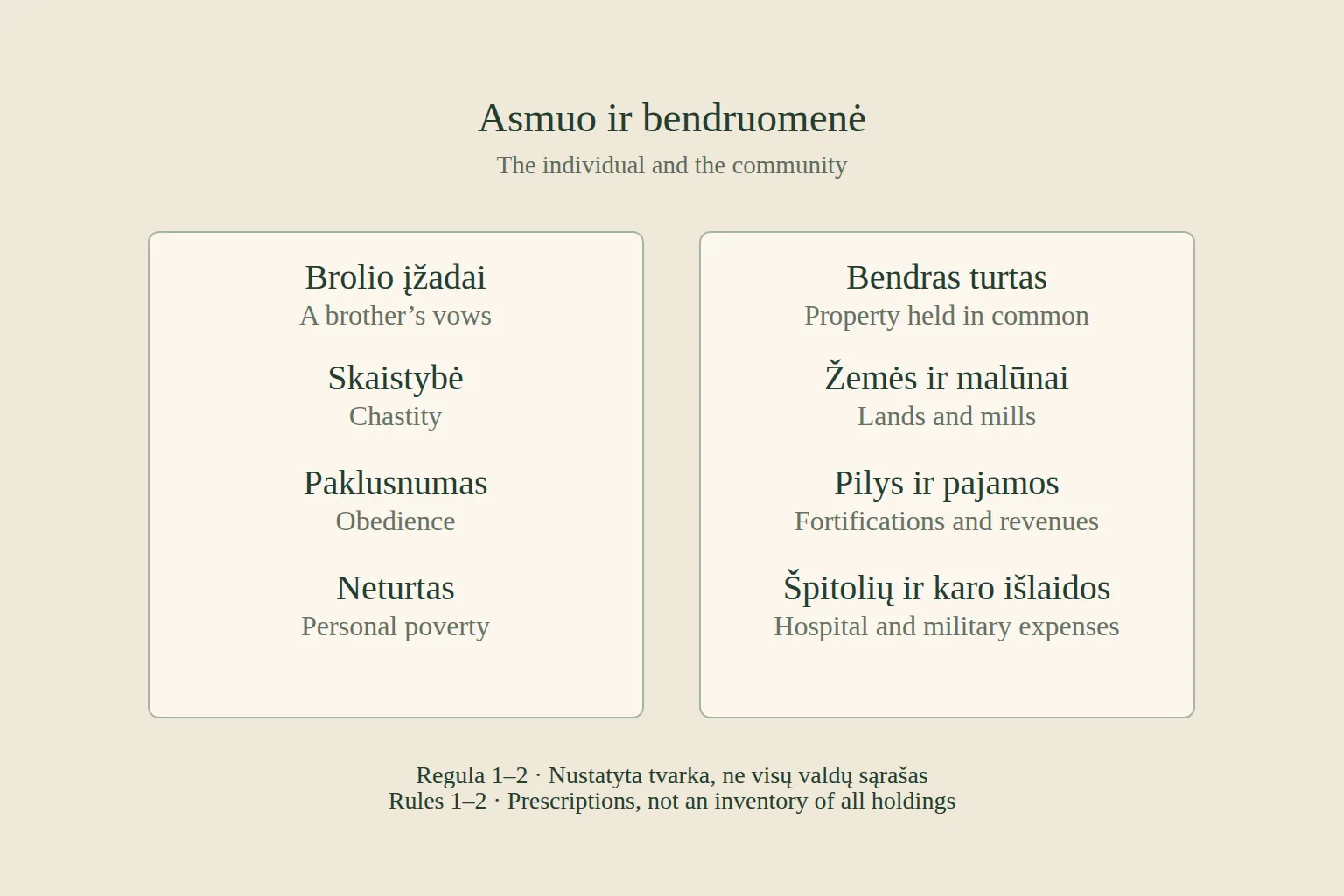
Chastity, obedience until death and renunciation of personal property are the commitments set out in Rule 1. They define the religious community to which a brother belongs, extending beyond military discipline. S176
Even the master may not dispense with these fundamental obligations. The rule thus places limits on a superior’s decisions too. It is a normative text, setting out how the community should live rather than certifying the conduct of every member. S176
Based on: S176
2.4
Personal poverty and a common estate
Renouncing personal wealth did not abolish the Order’s property.
Movable and immovable property may be held in the name of the Order and its chapter under Rule 2. It is to support people, hospitals, military service, the sick and the poor. The common estate provides the means to carry out these obligations. S176
The list includes lands, fields, vineyards, villages, mills, fortifications, parishes, chapels and tithes under the privileges held. These are permitted kinds of holdings and revenue. The list does not place every item at every Order house in the Baltic. S176
The same rule permits holding dependent men and women, termed servi and ancillae, under a perpetual right. The Order’s property arrangements thus included dependent labour. Charitable obligations coexisted with unequal legal status. S176
Based on: S176
2.5
Privileges and limits on conduct
Rule 3 addresses protection and conduct in disputes.
The rule invokes religious privileges and papal protection. Yet brothers bringing lawsuits are forbidden to harass others maliciously or wrongfully. Those defending an action must likewise avoid deceitful evasions. S176
These provisions matter when considering later disputes over the Order’s conduct: its own rule recognises limits in legal dealings. A general invocation of papal protection does not establish separate approval for every campaign or property claim. S176
Based on: S176
2.6
Care before military service
Rule 4 states that hospital work preceded military service.
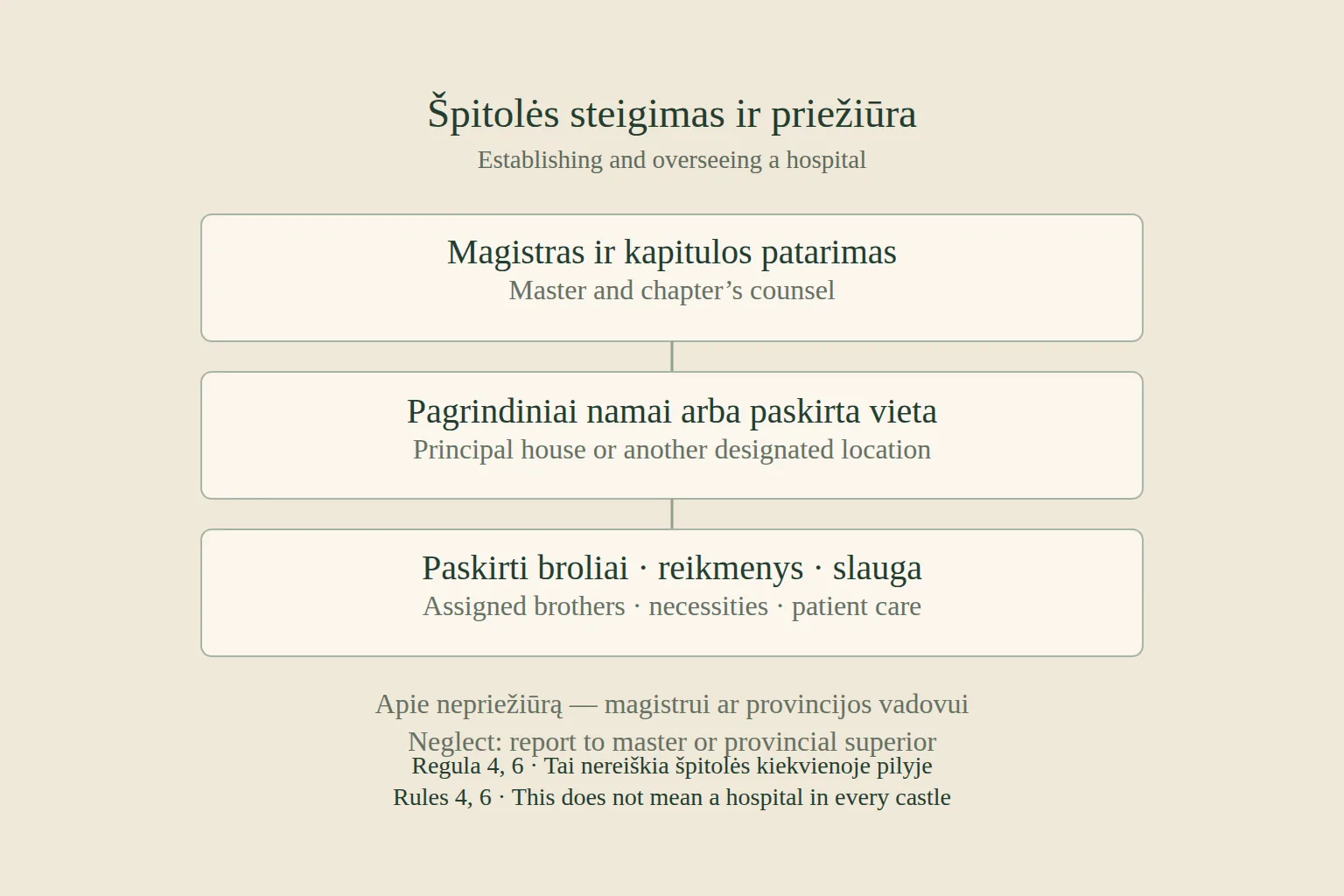
A hospital is to be maintained at the principal house or wherever the master determines with the chapter’s counsel. Care of the sick concerns the whole community, with its superiors deciding on location and resources. S176
A provincial superior may accept an existing endowed hospital after consulting prudent brothers. A house without one needs the master’s special authorisation and the brothers’ counsel to establish it. Provision for care is tied to decisions about sustaining it. S176
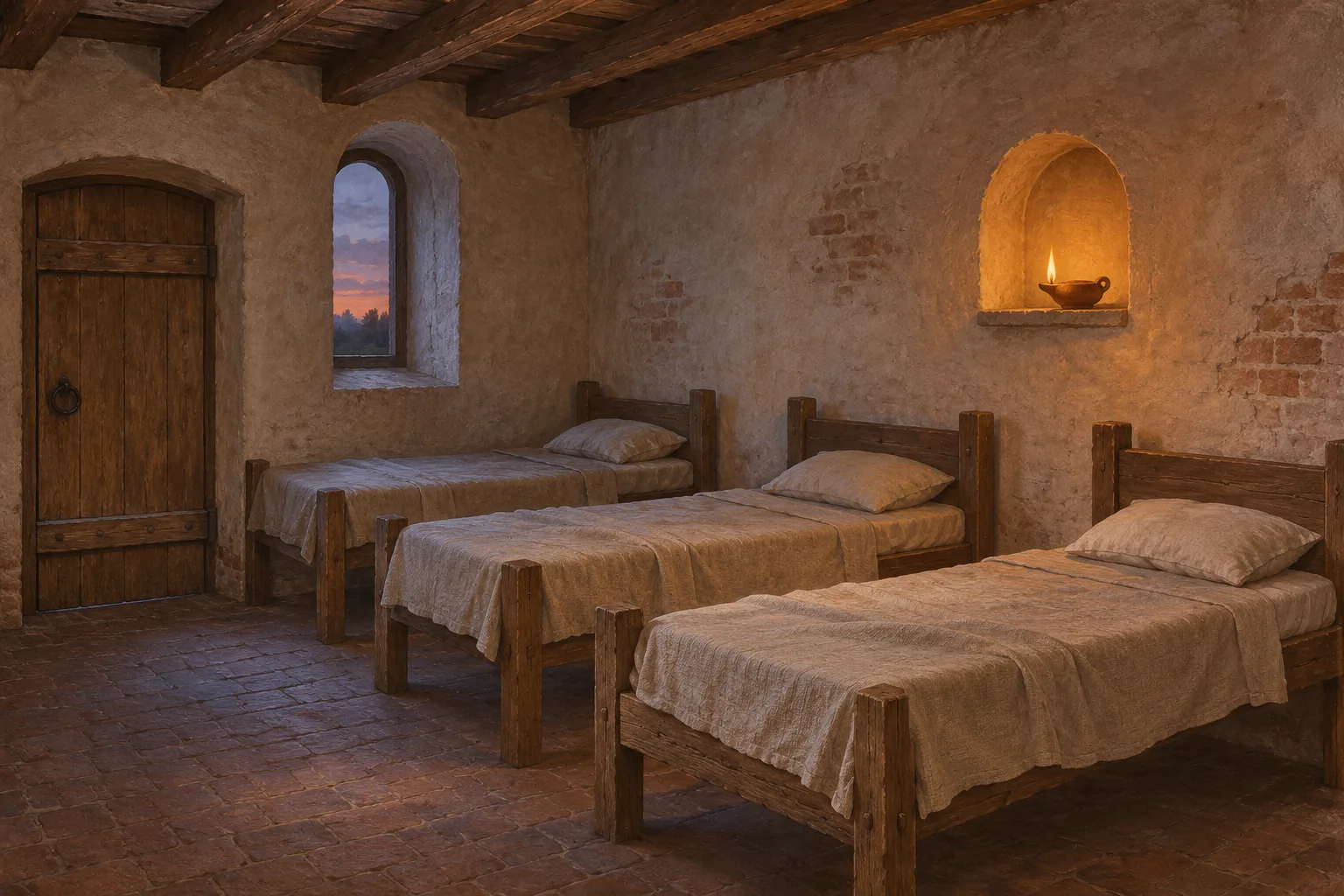
Commitment to the sick does not imply a hospital in every castle. The rule itself distinguishes the principal house, existing hospitals and houses without them. The accompanying interior is imagined, rather than a plan of rooms in a particular castle. S176
Based on: S176
2.7
Receiving a person and recording property
The admission arrangements in Rule 5 concern both faith and a patient’s money.
Confession is provided for if the patient has the strength and a confessor is available. Communion depends on the confessor’s judgement of when it is appropriate. Spiritual care is framed around the patient’s condition and the availability of a priest. S176
Money received from a patient must be recorded, and the patient’s decisions about it respected. Alongside care, a hospital needs accounts and responsibility for property entrusted to it. The patient’s wishes have a recognised place in these arrangements. S176
Based on: S176
2.8
Patients were to eat first
Rule 6 sets out practical arrangements for daily care.
Physicians at the principal house are provided according to resources and patient numbers. Care is to follow medical advice within the means available. The scale of provision is thus tied to local circumstances. S176
Patients are to be fed before the brothers eat. This sequence places care within the community’s timetable. A light is to burn for patients at night, and brothers assigned to serve them are urged to work humbly and devotedly. S176
Sunday observances at the principal house include readings from the epistle and Gospel and a holy-water procession. Spiritual observance accompanies food and personal care. Qualified arrangements apply to other hospitals. S176
Based on: S176
2.9
Who supplies care and hears complaints
The rule names carers and says where to report neglect.
Commanders are to supply necessities. Suitable, compassionate attendants are to be sought for service to patients. The arrangements distinguish direct care, provisioning and decisions about the institution as a whole. S176
Neglect is to be reported to the master or provincial superior, with punishment proportionate to the fault. The reporting procedure anticipates that care may fail. The rule’s provision and its fulfilment are therefore separate questions. S176
Based on: S176
2.10
Reading accompanied the meal
Rule 13 governs the meal and relations between the brothers at table.
Brothers are to eat two to a dish but drink individually. Differing allowances or extra provision are tied to need. A brother receiving an additional concession must not boast of it to others. S176
Continuous reading accompanies the meal and is to be heard in silence. Brief, quiet speech is permitted when necessary. Reading, food and restrained conduct belong to the same daily routine. S176
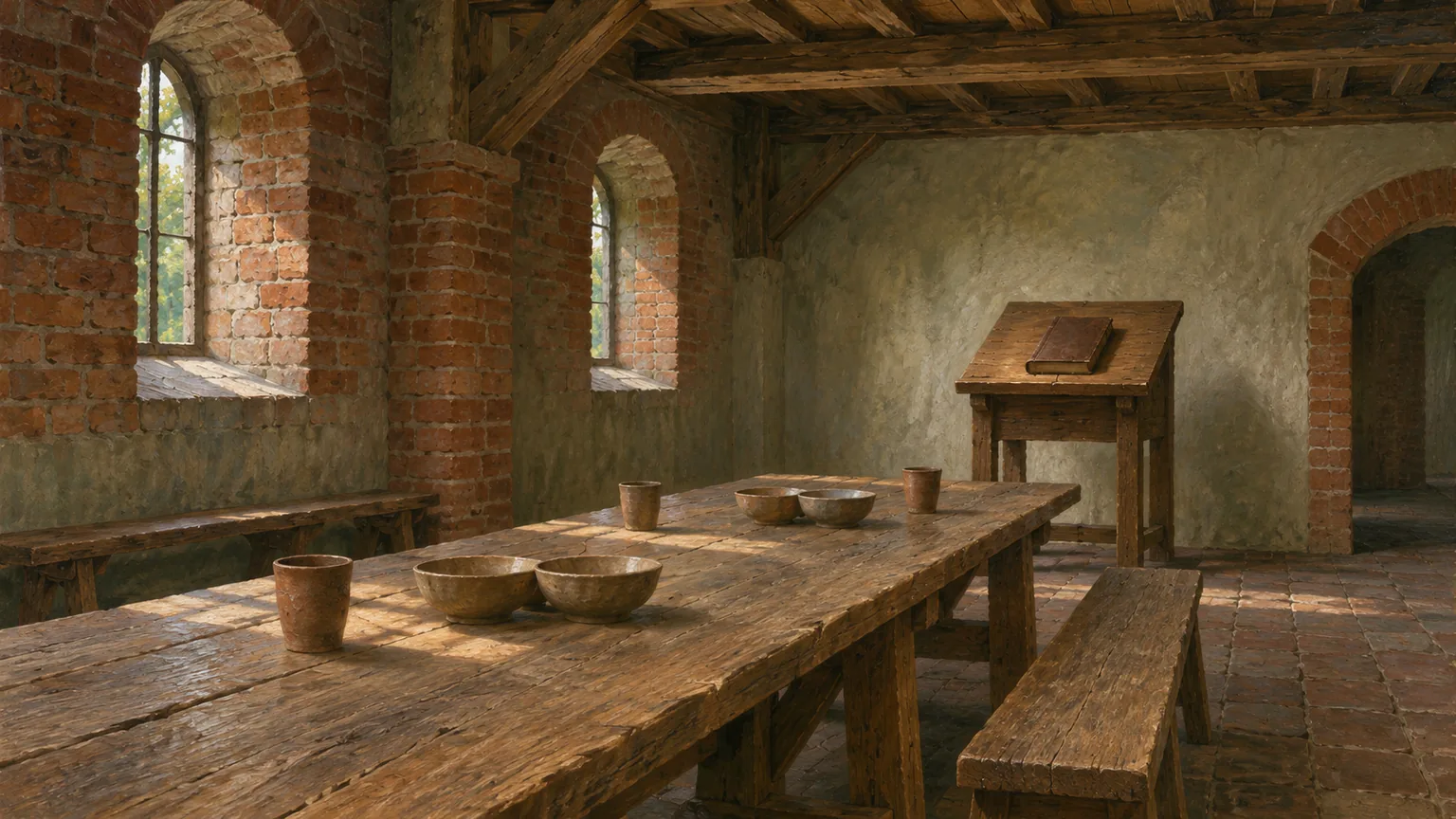
Rule 13 gives no exact menu, vessel material or standard refectory plan. Bowls, cups and a reading place in the illustration suggest the room’s purpose. Their forms and the architecture are artistic choices. S176
Based on: S176
2.11
A shared dormitory with separate places
Rule 17 carries the community’s routine into the night.
Healthy brothers are to sleep together where possible, in separate sleeping places. Duties or a superior’s decision can require exceptions. A night light is prescribed in the main dormitory. S176
The opening of Rule 18 sets silence from compline, the evening office, until after prime the following morning. This defines a particular period of the night. It does not establish a ban on speech at every hour. S176
Based on: S176
2.12
A Livonian master was not the grand master
A documentary title gives regional authority a name.
The opening of a 1298 instrument styles Gottfried as master of the brothers of the Teutonic house in Livonia. The title specifies a region. It does not make him the grand master of the whole Order. S104
In their Klaipėda study, Ehrlich and colleagues connect the castle’s foundation with the Livonian Order in 1252 and its transfer to Prussian administration in 1328. This concerns a change in regional government, rather than a simple succession of wholly unrelated orders. S178
The title attests an office without listing all its powers. The Klaipėda example, in turn, shows a change in one place’s government. The institution’s name, regional authority and an individual house operate at different scales in these sources. S104 S178
2.13
City, church and Order
Several institutions speak through Riga’s documents of 1298.
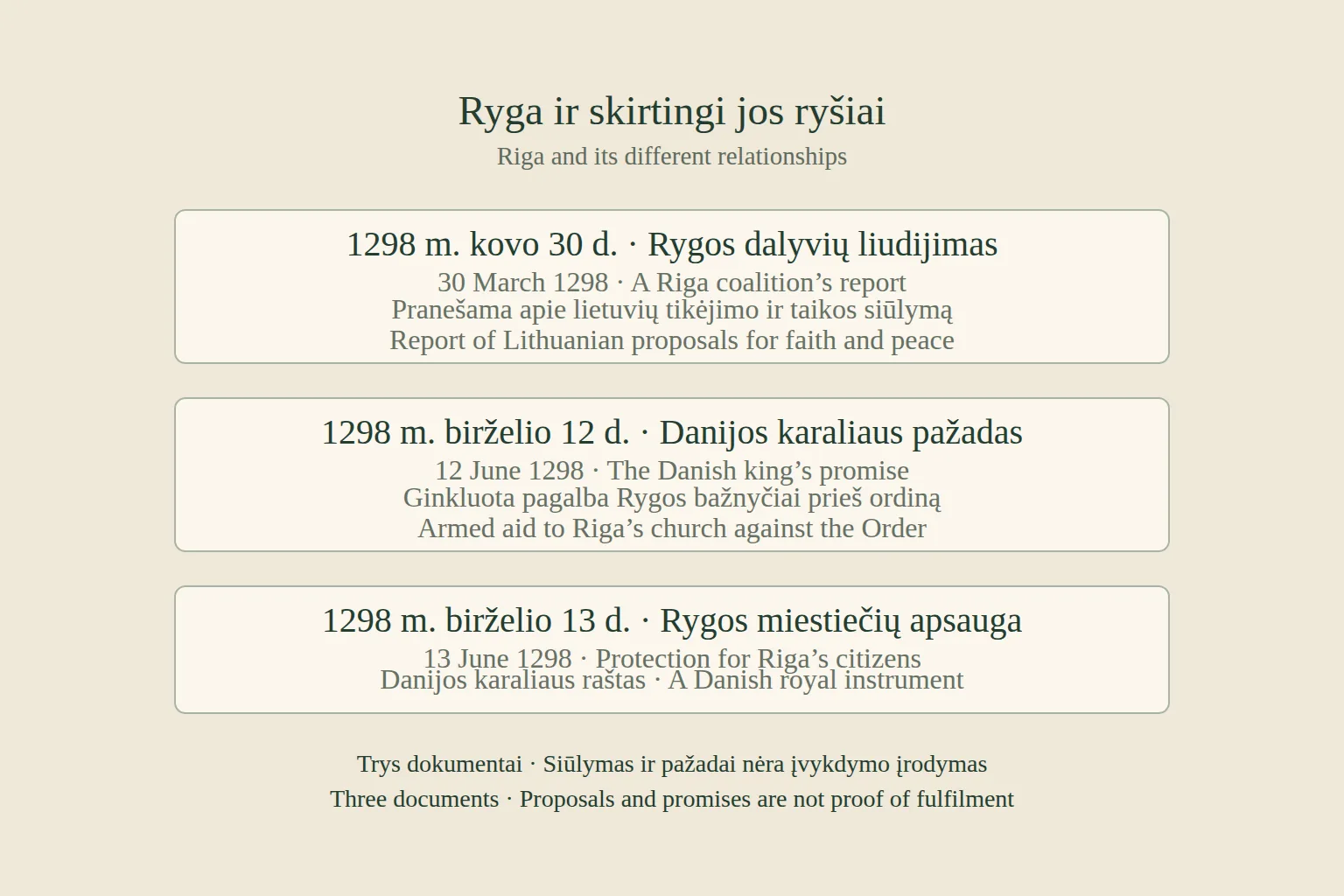
The instrument of 30 March is issued by Riga’s council and community, the chapter, the abbot of Dünamünde, religious communities and other named participants. They describe Lithuanian envoys and a proposed bond of faith and peace. It is their collective statement, rather than a letter by Vytenis himself. S104
The institutions issuing the document say that the archbishop worked through messengers towards a religious agreement and peace. They accuse the Order’s brothers of obstructing those messengers. This is an allegation by parties to the conflict, rather than independent verification of every action alleged. S104
Here Christian institutions support an agreement with Lithuanians while accusing another Christian community. The document reveals interests extending beyond a single opposition between Christians and pagans. Riga’s city, chapter, archbishop and the Order cannot be reduced to one voice. S104
Based on: S104
2.14
A proposal is not a record of baptism
Riga’s document places faith within a wider proposal for peace.
The reported Lithuanian proposals include abandoning condemned rites, marriages with Christians and a bond of faith and peace. The document conveys negotiating terms without certifying their fulfilment. S104
Mindaugas, described as a crowned king, is invoked as a precedent. This reference gives the proposal a historical argument. It does not describe a new coronation or an already contracted marriage. S104
Faith, peace and political support form parts of the same negotiating proposal. The document reveals that publicly advanced proposal and its supporters, while leaving the Lithuanian ruler’s private resolve unknown. S104
Based on: S104
2.15
Requesting help and promising support
Riga’s church sought secular support beyond Livonia.
In another instrument, Riga’s chapter explains its request for help by invoking both pagan incursions and persecution by the Order. The proposed arrangement with Denmark distinguishes ecclesiastical holdings, feudal obligations and access to castles during war. It states the chapter’s legal position, rather than mapping uncontested possession. S104
In a separate instrument, the Danish king promises armed support to Riga’s church against the Order and its supporters. Castles made available during the war are to be restored to the church when war ends. This term limits the promise without proving that all promised troops arrived. S104
The king’s instrument of 13 June 1298 calls for favourable reception of Riga’s citizens and assistance in their affairs. Royal officials and subjects are forbidden to injure them in goods or person. The Danish king grants this protection specifically to Riga’s citizens. S104
Based on: S104
2.16
The rule becomes an argument against the Order
At Constance, envoys of Jogaila and Vytautas answer the Order’s claims.
The rebuttal’s opening names the rulers represented: King Władysław Jogaila and Alexander Vytautas. Their cause is presented as strengthening and extending the Catholic faith. This is a joint reply from the rulers’ diplomats, rather than a Samogitian delegation’s speech. S134
The envoys accuse the Order of misrepresenting the rulers’ conversion. They appeal to its own religious identity, arguing that the brothers fail to act according to the rule they profess. Religious language becomes a means of challenging the Order’s conduct. S134
This accusation can be read alongside the rule’s actual requirements for conduct and litigation. Yet the envoys’ reply is not a judicial verdict. A norm, an allegation of breach and a proven violation remain distinct. S134 S176
2.17
An argument about burned granaries
In the Constance reply, wartime damage becomes a diplomatic argument.
In section VI, the envoys contest the other side’s explanation of fires. They invoke burned granaries belonging to the king and nobles. The text records a dispute about responsibility without independently identifying who burned every building. S134
The envoys offer their attendance at the council as proof that they seek peace. Riga’s issuers had likewise spoken in the name of faith and peace. In both cases these words seek to persuade an audience; the document preserving them does not test every participant’s intentions. S134 S104
2.18
What provisions and bones reveal
A meal rule and food remains answer different questions.
Žulkus and Daugnora study Klaipėda’s provisioning through inventories and animal bones. Their material includes layers after the Order’s period; remains from brothers, servants, artisans and townspeople are difficult to separate. S177
The rule specifies conduct at table and when patients should eat. It gives no complete account of food actually consumed. Daily-life prescriptions and local finds complement one another, while differing in purpose and date. S176
2.19
What a cut mark can establish
The Klaipėda finds show how an observation becomes a qualified interpretation.
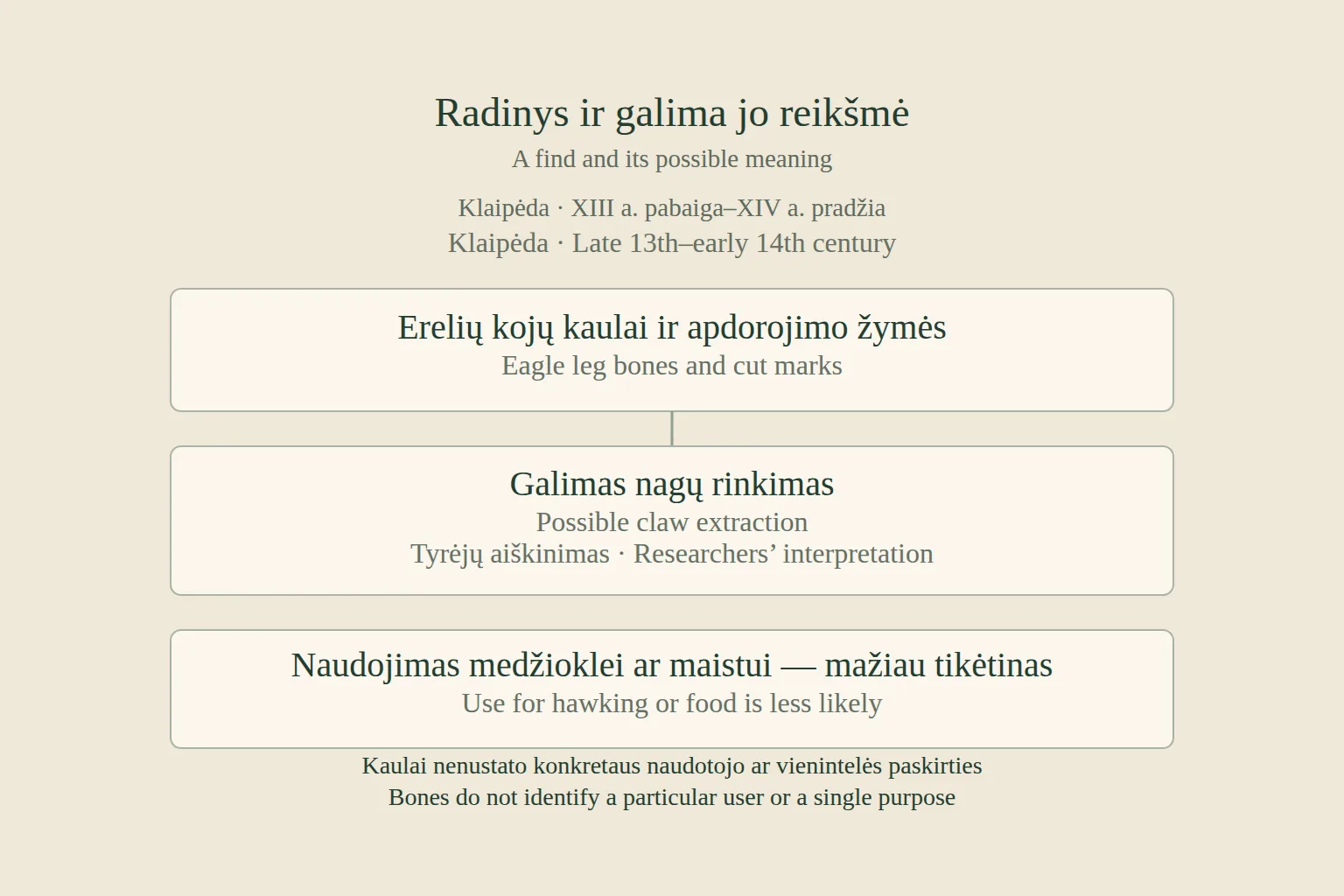
Ehrlich, Piličiauskienė, Urbonaitė-Ubė and Rannamäe studied bird remains collected in 2016 from a late-thirteenth- to early-fourteenth-century context. They counted 75 bird specimens or fragments. These are not 75 birds, but a small hand-collected assemblage. S178
Four eagle bones bear cut marks. The predominance of meat-poor leg parts and the position of the marks lead the authors to consider claw extraction. The marks are observations; their proposed purpose is an interpretation supported by comparison. S178
The authors consider hawking and food less likely explanations, while not excluding feather use or the killing of scavengers. The bones establish neither a finished claw ornament found here nor a particular owner. Alternative explanations therefore remain open. S178
The Order’s history likewise requires a distinction between what was observed, prescribed and argued in a dispute. The rule sets obligations, diplomatic documents defend interests and archaeologists interpret material traces. Read together, these sources reveal an institution without equating its ideals with every action taken in its name. S176 S104 S134 S178