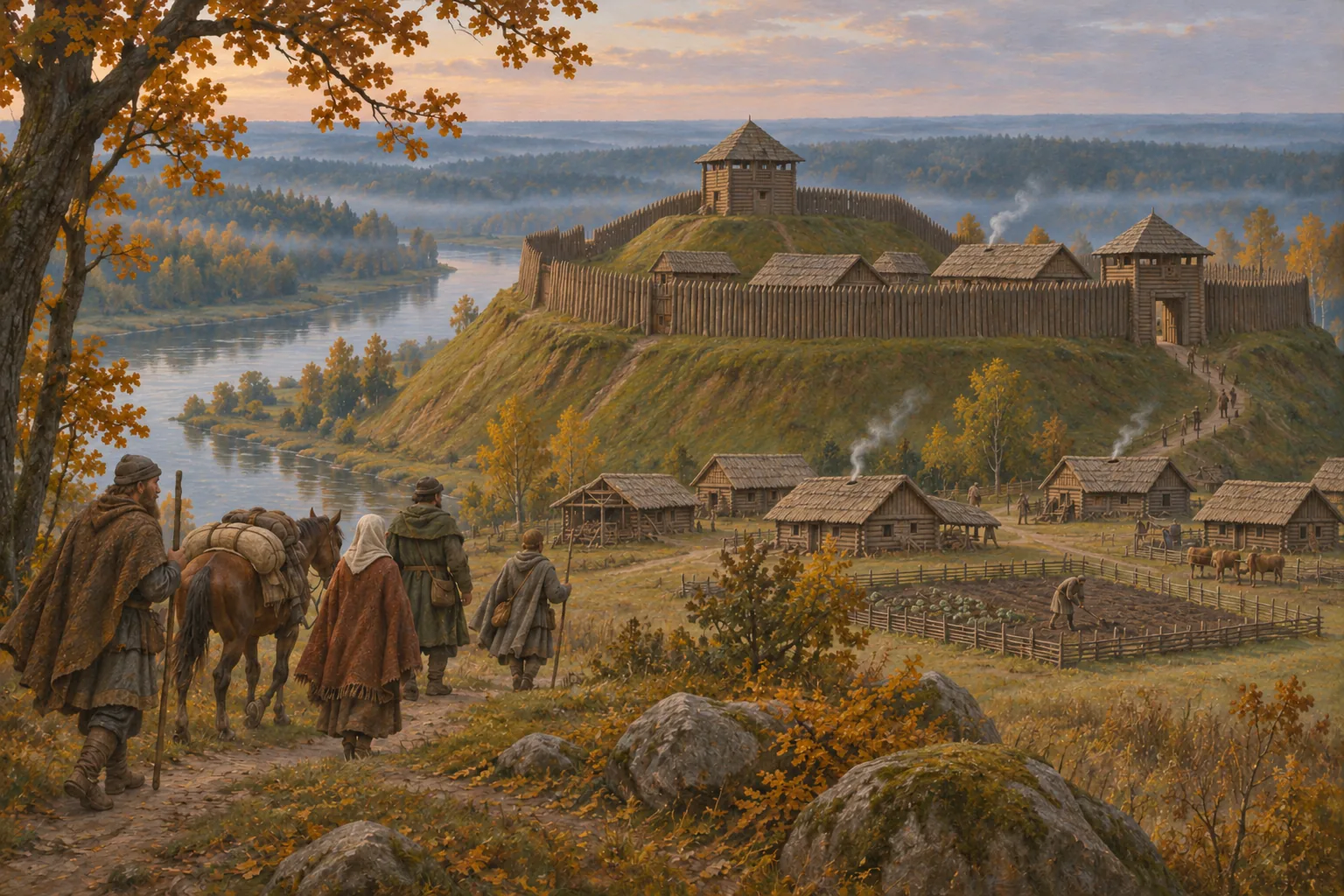
2.1
1263: the king was killed; the state remained.
Mindaugas’s death set rivals against one another. They fought to take over the forces, lands and connections he had brought together.
Mindaugas and two of his sons, Ruklys and Rupeikis, were killed in 1263. The history edited by Šapoka connects the attack with rivalries among princes and a grievance within Daumantas’s family. With the kingdom’s founder dead, others immediately fought to take his place. His murder had ended neither their ambitions nor the possibility of ruling Lithuania. S6
The 1971 edition of the Bychowiec Chronicle fills a gap in the murder narrative with material from the Hypatian Chronicle. Daumantas returns from a campaign and attacks Mindaugas; Vaišelga withdraws to Pinsk. These events belong to the passage inserted by the editor, rather than wording transmitted in the Bychowiec Chronicle tradition itself. S19
After the king’s death, accounts still describe Lithuania, its princes, armies and neighbours. Centres of power could shift, and rulers had to win submission afresh. The rivals fought for more than a dead man’s possessions. Their struggle to command Lithuania shows that the possibility of wider rule had survived him. S6 S19
The 1936 synthesis edited by Šapoka calls the killings a blow to the state’s foundations, then follows the rulers who came next. Between Mindaugas and Gediminas came a monk’s return, Volhynian alliances, northern wars, displaced communities finding shelter and negotiations with Christian Riga. Their decisions fill a period too easily passed over between two familiar names. S6
2.2
Winning the first struggle did not secure power.
Treniota had Tautvilas killed, then soon died violently himself. Accounts differ over the people involved and their reasons.
Treniota and Tautvilas, ruler of Polotsk, emerged as powerful rivals after Mindaugas’s death. In the Šapoka-edited history, Tautvilas is murdered and Treniota takes power. Holding a principality in Rus’ had not put Tautvilas outside the contest for Lithuania. The boundary between a rival at home and a ruler abroad was less clear than a modern map suggests. S6
In the Bychowiec Chronicle, Treniota and Tautvilas each secretly plan to kill the other. Tautvilas’s boyar Prakapas betrays his lord’s intentions, allowing Treniota to strike first. The narrator makes betrayal the turning point. The vivid detail is part of the chronicle’s telling, rather than a witnessed conversation or a verified account of every step in the plot. S19
Treniota’s brief rule ends at different dates in the two editions. The Šapoka-edited history gives 1265 in its reign heading; Rimantas Jasas’s 1971 commentary places his death in spring or summer 1264. A year makes a considerable difference in this crowded succession. The books leave that disagreement unresolved. S6 S19
The 1936 history connects Treniota’s fall with his persecution of Mindaugas’s supporters and Christians. The chronicle gives the killing to four former servants who had tended Mindaugas’s horses: they attack Treniota on his way to bathe. One account stresses a wider political response, the other revenge by particular servants. Either way, his hold on power was brief. S6 S19
2.3
A Lithuanian prince’s life continued in Pskov.
Daumantas’s part in Mindaugas’s death was followed by a new career outside Lithuania. In Pskov, he became a ruler in his own right.
The Šapoka-edited history follows Daumantas from the struggles in Lithuania to his election as prince in Pskov, where he gains a military reputation. The participant in Mindaugas’s killing became a city’s defender. His career continued until 1299, leaving very different memories in the two political communities. S6
Jasas dates Daumantas’s move to Pskov to 1266 and records his later marriage to Dmitry’s daughter. His earlier wife’s name is unknown. Marriage helped give the prince a place in his new surroundings, although these ties leave gaps in his early life and do not establish what he planned after Mindaugas’s death. S19
Daumantas also appears under the name Timotiejus. In his introduction to the 1989 edition of Kojelavičius, Juozas Jurginis explains how later histories could turn those names into two characters. That observation comes from the modern introducer, not Kojelavičius’s seventeenth-century narrative: two names in the accounts need not mean two princes. S7
Jasas rejects the chronicle’s story of Daumantas ruling Pskov and Polotsk at once and waging a revenge war against Traidenis. He sees names and events entangled by later storytelling. Pskov’s Daumantas died in 1299. Another Daumantas appears in the 1280s, but the shared name does not make him the same ruler. S19
2.4
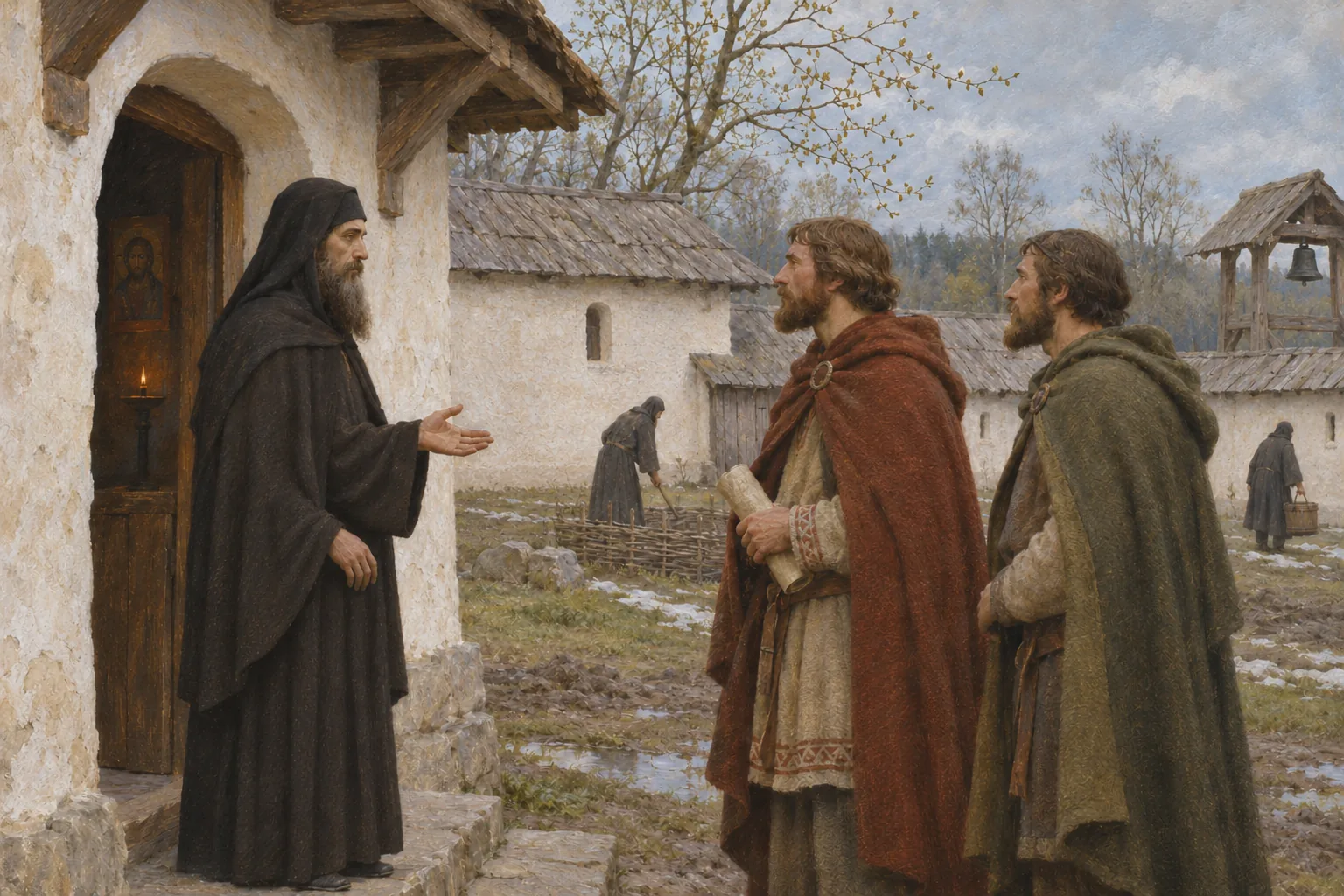
Vaišelga: Mindaugas’s son at the monastery door.
Before he returned to rule Lithuania, Vaišelga had already entered Orthodox monastic life. Princely birth and religious ties would both shape his career.
Mindaugas’s son is known as both Vaišelga and Vaišvilkas; this article calls him Vaišelga. The Bychowiec Chronicle follows him to baptism in Navahrudak, contrasting his earlier cruelty with religious change. This is a life told as a moral transformation, rather than a way to establish his beliefs at every stage. S19 S7
The chronicle brings Vaišelga into the circle of the Volhynian princes Daniel and Vasilko and makes him godfather to Lev’s son Yuri. Baptism created ties and obligations between families as well as religious commitments. These connections later mattered in politics, though spiritual kinship alone cannot explain every subsequent alliance or quarrel. S19
According to the chronicle, Vaišelga spent three years in monastic life before attempting to reach Athos. Unrest stopped the journey. He returned and founded a monastery by the Nemunas, between Lithuania and Navahrudak. The account places his monastic foundation beside that river; it does not say he completed the pilgrimage or lived on Athos. S19
The accounts differ over Vaišelga’s whereabouts when Mindaugas died. The Šapoka-edited book places him in Greece and then Pinsk. The Hypatian passage inserted in the 1971 edition describes his flight to Pinsk after the killings. Neither account supplies a route that can be securely joined to the other. Both leave the king’s son alive, with connections beyond Lithuania. S6 S19
2.5
The monk returned with armed supporters.
Vaišelga returned with supporters from Pinsk and Navahrudak and backing from Volhynia. Reprisals followed as he established his authority.
Vaišelga returns to Lithuania with supporters from Pinsk and Navahrudak in the Bychowiec narrator’s account. A welcome of universal rejoicing is soon followed by opponents being killed or fleeing. The king’s son needed armed help to make his claim effective. His birth gave him a claim to power, not automatic command of the country. S19
Volhynian help and Samogitia’s refusal to submit stand out in the Šapoka-edited history. Different regions and their leaders had forces and connections of their own; the returning prince did not receive a unanimous welcome. In this account, he restores his authority through alliance and coercion as well as a claim to inheritance. S6
Kojelavičius gives Vaišelga a different return in his seventeenth-century history. Princes assemble, send envoys to persuade the monk and proclaim him at Kernavė. In this telling, a black monastic garment covers princely purple, bringing his two duties together. The scene emphasizes reluctant acceptance of power; it is neither an assembly record nor evidence of an authenticated garment. S7
Kojelavičius then turns to revenge and confiscation, condemning a ruler whose monastic clothing conceals cruelty. Across these accounts, Vaišelga faces family enemies, relies on armed supporters and encounters uneven submission. His religious connections helped bring him back. They could not settle the struggle for authority. S7 S6 S19
2.6
Handing over power did not end a family conflict.
Vaišelga handed power to his sister’s husband Švarnas. Švarnas’s brother Lev then killed Vaišelga; the accounts differ over his motive.
Švarnas, a son of Daniel Romanovich, was also Mindaugas’s son-in-law. Jasas dates his marriage to Mindaugas’s unnamed daughter to 1254. Lithuania’s and Volhynia’s ruling families were therefore connected before Mindaugas died. When Vaišelga later handed over power, he chose someone already bound to his family rather than an unrelated prince at a foreign court. S19
In the Šapoka-edited history, Vaišelga gives up power, returns to monastic life and leaves Lithuania to his sister’s husband. Jasas dates the transfer to 1267; the 1936 synthesis ends Vaišelga’s reign heading in 1268. Despite the different chronology, both make the family connection central: Švarnas belonged to the Volhynian princely house and was Mindaugas’s son-in-law. S6 S19
The accounts give Lev different motives for killing Vaišelga. The 1936 synthesis points to envy: Lithuania had gone to Švarnas. The Bychowiec narrator instead recalls injuries Mindaugas and Vaišelga had inflicted on Rus’ lands. Jasas discusses the Hypatian Chronicle’s envy explanation separately. These are the accounts’ competing motives, rather than a statement left by Lev himself. S6 S19
The chronicle places the killing amid visits and hospitality. Jasas dates it to 1267 and notes that a December date given elsewhere does not fit the Easter setting. The 1936 history then gives Švarnas a brief reign ending with his death in 1269. Family ties had helped transfer power, but could secure neither personal safety nor a lasting succession. S6 S19
Under 1267, Jan Długosz describes a dispute between Lev and Vaišelga over Rus’ lands. In his telling, Lev attacks Vaišelga while he is staying in a village and kills him. The author supplies the motive; this episode gives no statement of intent from Lev himself. S140
2.7
Traidenis: connections clearer than ancestry.
Under Traidenis, Lithuania fought in the north, received displaced people and maintained connections with neighbouring dynasties.
Traidenis emerges after repeated changes of ruler. The Šapoka-edited history assigns him 1270–1282 and admits that his relationship to earlier rulers is unknown; Jasas’s commentary also gives 1269 for his rise. His actions leave a clearer trace than his ancestry or the exact day he took power. S6 S19
Kernavė appears on an invading army’s route through Traidenis’s lands. Jasas notes its mention in the Livonian Rhymed Chronicle’s events of 1279, where the place is called Kernowen. That links the ruler to the settlement without telling us its layout, the appearance of his residence or whether he always governed Lithuania from one castle. S19 S103
Traidenis’s relatives take different forms in the chronicle and its commentary. Drawing on the Hypatian tradition, Jasas names brothers Borza, Lesis, Svelkenis and Sirputis and connects members of the family with Orthodoxy. The later Bychowiec Chronicle supplies a legendary sequence instead. Even a ruler portrayed as defending the older religion could have more varied ties within his family. S19 S6
The 1936 synthesis casts Traidenis as a defender of pagan Lithuania fighting the Order. That portrait reflects the history writing of its time. Yet the same book describes refugee settlements and marriage ties with a Mazovian prince. Its own details show a ruler with more ways to act than fighting every neighbour alone. S6

2.8
On sea ice: the battle of Karusė.
The Livonian Rhymed Chronicle describes a sledge barrier and the Order’s defeat. It does not name the Lithuanian commander.
Tomas Baranauskas dates Karusė to 16 February 1270. He considers Traidenis’s command probable, not certain. S106
The medieval chronicle follows a Lithuanian force home across the frozen sea after a raid towards Osele, now Saaremaa. Master Otto’s men, the bishops’ forces and the Danish king’s men confront it. The narrator says the ice held beneath both armies. The fighting takes place on firm ice, rather than above a sea about to swallow armoured horsemen. S103
The Lithuanians surround themselves with sledges. In the chronicle, the brothers charge into the barrier and lose horses, but the fighting continues. Equipment used on the journey has become a defence in the open. The account makes the sledges’ role clear without supplying each unit’s position or the commander’s orders. S103
Master Otto and 52 brothers die in the chronicle’s account. The surviving Order force withdraws; its opponents keep the ice and the victory. The narrator, writing from the Order’s world, dwells on its fallen brethren while leaving the Lithuanian commander unnamed. His account places the battle in Traidenis’s period without placing Traidenis himself on the field. S103
2.9
A field victory did not remove a castle.
Daugpilis gave the Order a fortified base on the Daugava. The account of Traidenis’s siege shows how much effort it could take to try to remove one.
In the mid-1270s, the Order’s forces went up the Daugava and established themselves at Daugpilis. The Livonian Rhymed Chronicle lists what they left there: fortifications, crossbows, bolts, provisions and a garrison. The main army could go home while a supplied garrison stayed, extending an invasion’s reach beyond a single expedition. S103
The Šapoka-edited history dates the castle’s construction to 1274 and stresses that Traidenis failed to destroy it. Together with the chronicle, it shows the difficulty of dislodging an enemy who had come to stay. Success in open fighting or a return with booty could still leave the river occupied by a garrison and fortifications. S6 S103
For this siege, the chronicle names the attacker: King Thoreiden, or Traidenis. It describes four large stone-throwing engines, Rus’ bowmen helping him and four weeks of attack. These details come from a writer close to the defenders’ world. They nevertheless show an assault requiring time and technical effort, well beyond a rapid raid. S103
The defenders repair the damage; the attackers eventually destroy their engines and withdraw. The Order keeps its foothold on the river. That is the clear outcome of the chronicle’s victory story, although the telling gives neither a reliable castle plan nor a record of each day’s work. Traidenis could sustain a siege without being able to take the fortress. S103
2.10
Aizkrauklė: the dangerous journey home.
After raiding Traidenis’s lands, the Order’s force faced pursuit. The chronicle also describes an allied contingent leaving during the battle.
In Baranauskas’s chronology, Aizkrauklė took place on 5 March 1279. Traidenis’s personal command is again presented as probable. S106
The Livonian Rhymed Chronicle begins with Order and Danish forces marching towards Kernowen, devastating Traidenis’s lands and taking booty. Lithuanian forces pursue them as they return; some local auxiliaries have already gone home. Getting out was dangerous too. The raiders had to carry away their booty and keep their army together. S103
The battle unfolds in snow. In the chronicle, the Lithuanians recover from an initial setback, while the Semigallians leave the Order’s side in greater difficulty. The narrator does not name the Lithuanian commander or identify Nameisis as the Semigallians’ leader. What he does describe is an army whose allies leave during the fighting. S103
The chronicle reports Master Ernst and 71 brothers dead, dwelling on the fate of particular men of the Order. Those reported losses belong to Aizkrauklė; Karusė was a separate defeat, with different participants. Even these victories left the Daugpilis garrison and other enemy bases in place. S103 S6
2.11
Shelter and obligations on the frontier.
The Order’s campaigns displaced people from western Baltic lands. Accounts of Traidenis’s period connect their new settlements with frontier defence.
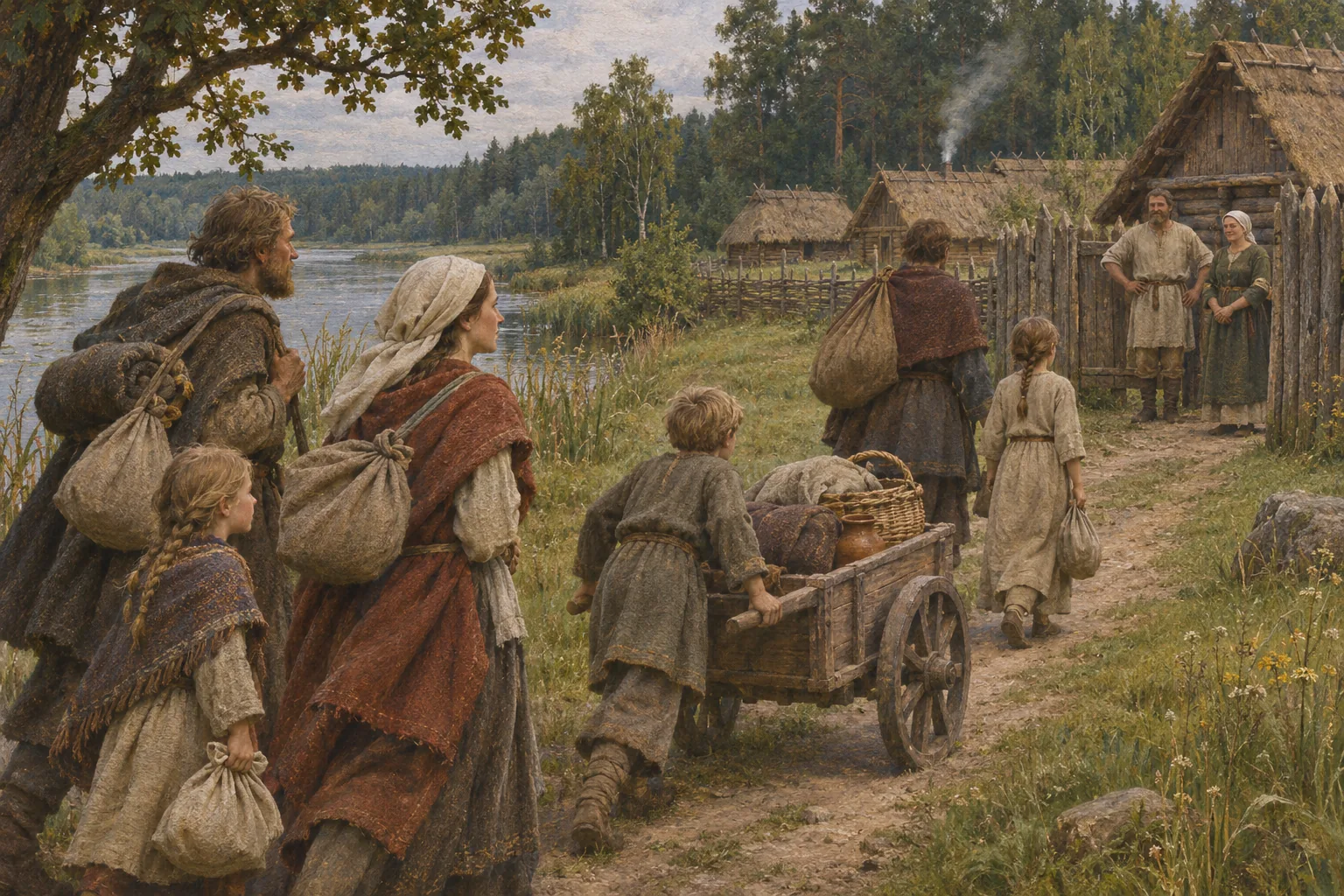
People fleeing the conquest of Prussian lands found a place in Traidenis’s Lithuania. The Šapoka-edited history says he settled them on the Volhynian frontier. They were moving to make new homes, rather than passing through on campaign. Their settlement also served the ruler’s defence, though the text leaves individual families’ lives unrecorded. S6
Jasas describes Jotvingians and Prussians moving towards Hrodna and Slonim. He connects their settlements with defence against Order, Tatar and Volhynian attacks. People who had sought shelter could strengthen the districts receiving them. Pressure came from several powers and directions, rather than across a single frontier between two unchanging states. S19
The 1936 synthesis also records Traidenis taking Drohiczyn from Volhynian control. Gaining territory or a stronghold and settling newcomers appear together as ways to extend authority in the south. The book gives neither a full campaign sequence nor a list of every village, so this notice cannot fix Lithuania’s borders for a particular year. S6
Kojelavičius recounts Pogesanian resistance and movement towards Hrodna, painting a broad picture of emptied lands. It gives no reliable count of those who left or stayed. What these accounts preserve is the longer aftermath of war: lost homes, life under a new ruler and defensive obligations on another frontier. Survival continued after a battle ended. S7 S6 S19
2.12
Families also connected neighbouring courts.
Traidenis’s family ties led to neighbouring courts as well as battlefields. The accounts still leave disagreements over his family.
The Šapoka-edited history records the marriage of Bolesław II of Mazovia to Traidenis’s daughter, whose name it does not give. The marriage belongs alongside campaigns into Polish territories: neighbouring ruling houses could seek security through family ties while still living with war. Kinship and warfare were not mutually exclusive. S6
Kojelavičius also marries Traidenis’s daughter to Bolesław, placing the connection within a larger legendary family history. A known marriage does not establish that whole genealogy. The seventeenth-century narrator preserves the relationship while using it to build a continuous ruling house. S7
The Bychowiec Chronicle gives Traidenis a Mazovian wife and a son, Rimantas, who becomes the monk Lauras. In his 1971 commentary, Jasas accepts the marriage account but finds no other testimony to Rimantas. He recognizes an echo of Vaišelga in the son’s monastic life and renunciation. These family stories therefore rest on different kinds of evidence. S19
Traidenis’s daughter helped connect ruling families, even though the relevant 1936 passage leaves her unnamed. She has a place in the story without a preserved name. The chronicle’s son rests on a different foundation; a chart presenting daughter, wife and legendary son with equal certainty would conceal those differences. S6 S19
2.13
Rulers’ names grow scarce; warfare continues.
After Traidenis, rulers become harder to follow. Later chronicles tell vivid stories where the older synthesis admits gaps.
The Šapoka-edited history admits how little it knows about 1282–1295. It follows campaigns but cannot clearly identify the rulers behind them. That silence does not mean Lithuania went without government. An account might record an army entering a neighbour’s lands while saying nothing about who was securing authority at home. S6
The Bychowiec Chronicle ends Traidenis’s life with a jealous Daumantas, killers attacking as he leaves a bathhouse and Lauras seeking revenge. Jasas sees Mindaugas’s murder story being told again. He dates Traidenis’s death between autumn 1281 and early 1282, with the circumstances unknown. The chronicle’s detailed chain of rulers cannot settle how he died. S19
Ričardas Dediala examines Daumantas, killed near Oleshnia in 1285, and questions beginning his reign immediately after Traidenis. His proposed chronology remains a reconstruction. This Daumantas should not be identified with the prince of Pskov who lived until 1299. S105
Jurginis also examines the expanded account of Traidenis’s death in his 1989 introduction, noting its lack of evidence. Older histories tried to join rulers into a continuous chain. Here, armies, isolated names and changes of power survive without all the links between them. Those missing connections are part of the period’s history. S7 S6
2.14
One letter is clearer than a whole family tree.
Early rulers appear in brief notices. Older histories and modern studies connect their names in different ways.
Butegeidis, Budividas and Budikidas appear beside Pukuveras or Liutauras in the 1936 synthesis, which admits uncertainty about their connections. Similar spellings can tempt a reader to arrange them into a neat succession. Proposed identifications, however, are no substitute for evidence of who was whose parent or how power changed hands. S6
A letter of 1290 gives a firmer glimpse of one ruler. In Bunge’s edition, the Livonian master proposes a coordinated attack with the Prussian master on the land of King Butegeyde. The military letter preserves his name and title. It has nothing to say about his father or the date he took power. S104
The Šapoka-edited history suggests a peaceful inheritance within one family because it finds no reports of internal conflict. This is reasoning from silence. Jasas places Vytenis on firmer ground, relaying another chronicler’s reference to his father Pukuveras. The evidence becomes clearer in fragments, rather than revealing the beginnings of a whole dynasty at once. S6 S19
The Livonian master wants the Prussian side to name a day and time secretly, at least three weeks ahead. He promises to attack Butegeyde’s land at the same time, putting the ruler under pressure from two directions. Yet the letter also mentions difficulty obtaining support. The proposal still had to be turned into joint action. S104
2.15
Castles and garrisons along the Nemunas.
The Nemunas grew more important as the Order advanced from the southwest. Castles and the people holding them feature increasingly in accounts of Lithuania’s defence.
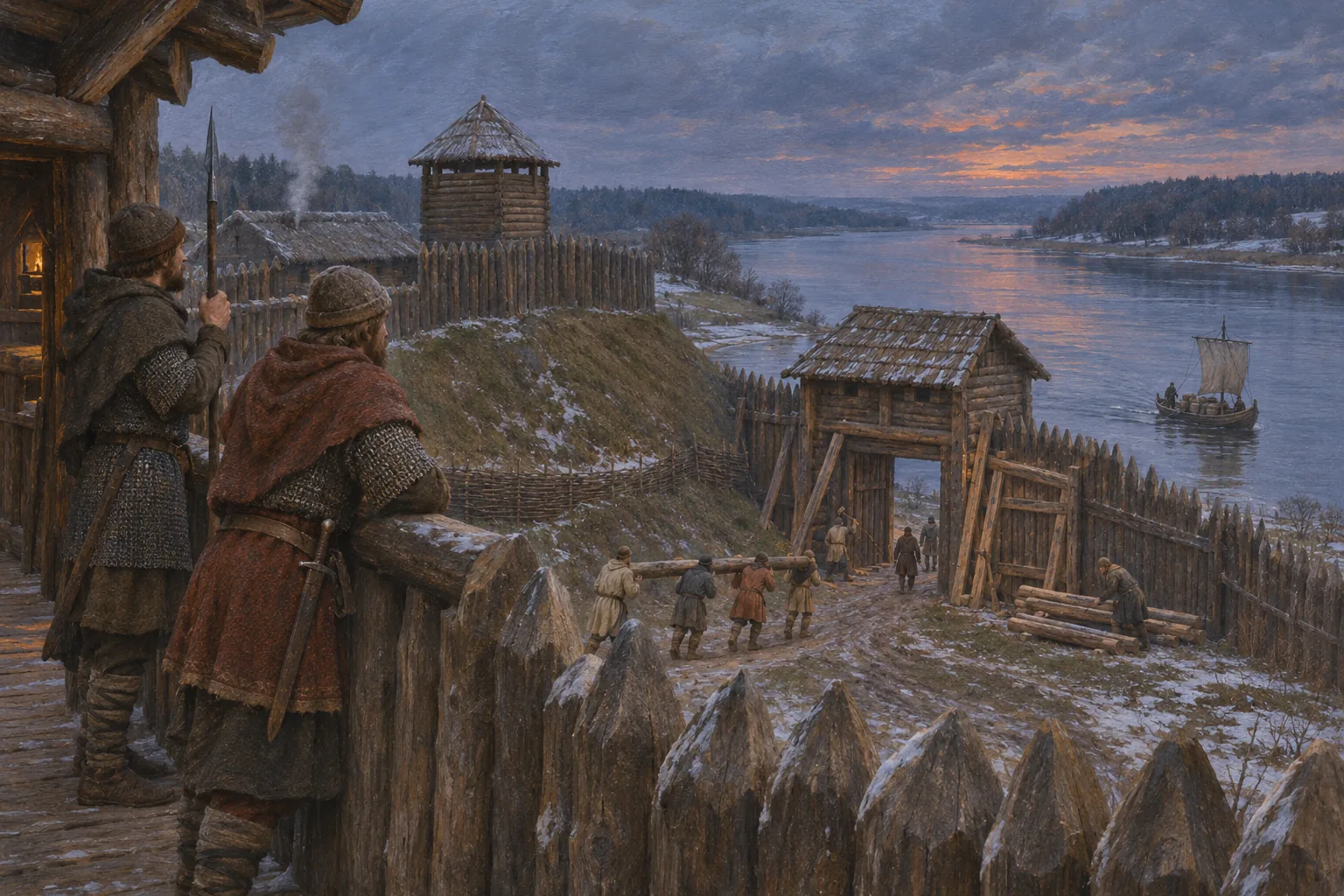
The Šapoka-edited history follows the Order from the Vistula towards the Nemunas, bringing growing pressure on Lithuania. It gives Samogitia a central place in plans to join the Livonian and Prussian branches. This is a broad view of military geography: castles, river routes and districts exposed to raids, rather than a surveyed border running continuously across a map. S6
Ragainė, Jurbarkas and Skirsnemunė appear on the Order’s side in the book; Veliuona, Kolainiai and Bisėnai on the Lithuanian side. Attacks and defence gathered around these places, each needing people to hold it and help when threatened. They should not be imagined as identical parts of a single system all operating at the same moment. S6
Kojelavičius describes garrisons taking turns at service, men endangered as they leave Bisėnė and inhabitants displaced from Karšuva. His later account brings war down to the scale of a district or a journey. Someone had to hold a castle while the main army was elsewhere. Men heading home from service could walk into an ambush. S7
The 1290 letter makes the threat from two directions concrete. The Livonian master seeks secret notice so he can attack at the same time as the Prussian forces. He also describes trouble securing support. Even within the Order, a joint campaign required arrangements that might prove difficult to make. S104
2.16
Vytenis’s campaigns precede a clear accession date.
Vytenis first comes into view through campaigns. Later chronicles gave him an origin story linking him to earlier rulers.
Vytenis had a military reputation before he became ruler. The Šapoka-edited history suggests an accession in 1295, since his father was still alive in its account of 1294. Unlike the rapid changes after Mindaugas’s death, this ruler’s emergence can be followed through activity before his likely accession. S6
In the Bychowiec Chronicle, the monk Lauras refuses power and recommends Traidenis’s marshal Vytenis, whom the nobles elect. The story gives Vytenis a childhood in Ariogala and a place at the earlier ruler’s court. It supplies a claim to dynastic legitimacy, rather than a surviving election record or a secure account of his childhood. S19
Kojelavičius takes the connections further, giving Vytenis Roman ancestry and Traidenis’s favour. He starts the reign in 1283, unlike the 1936 synthesis. Noble descent and a legitimate transfer of power hold his history together. Jasas warns that such accounts bring the institutions and customs of later centuries into the earlier period. S7 S19
In the 1936 history, Vytenis campaigns abroad while defending Lithuania’s own districts. Success on the open field still leaves enemy castles standing. His ability to rule depended on more than raids: holding Samogitia, dealing with neighbours in the south and east, and finding partners beyond the recurring war with the Order. S6
2.17
1298: Christian Riga seeks Lithuanian help.
Riga’s city, its archbishop and the Order were distinct political powers. Their conflict opened a new path of alliance for Vytenis.
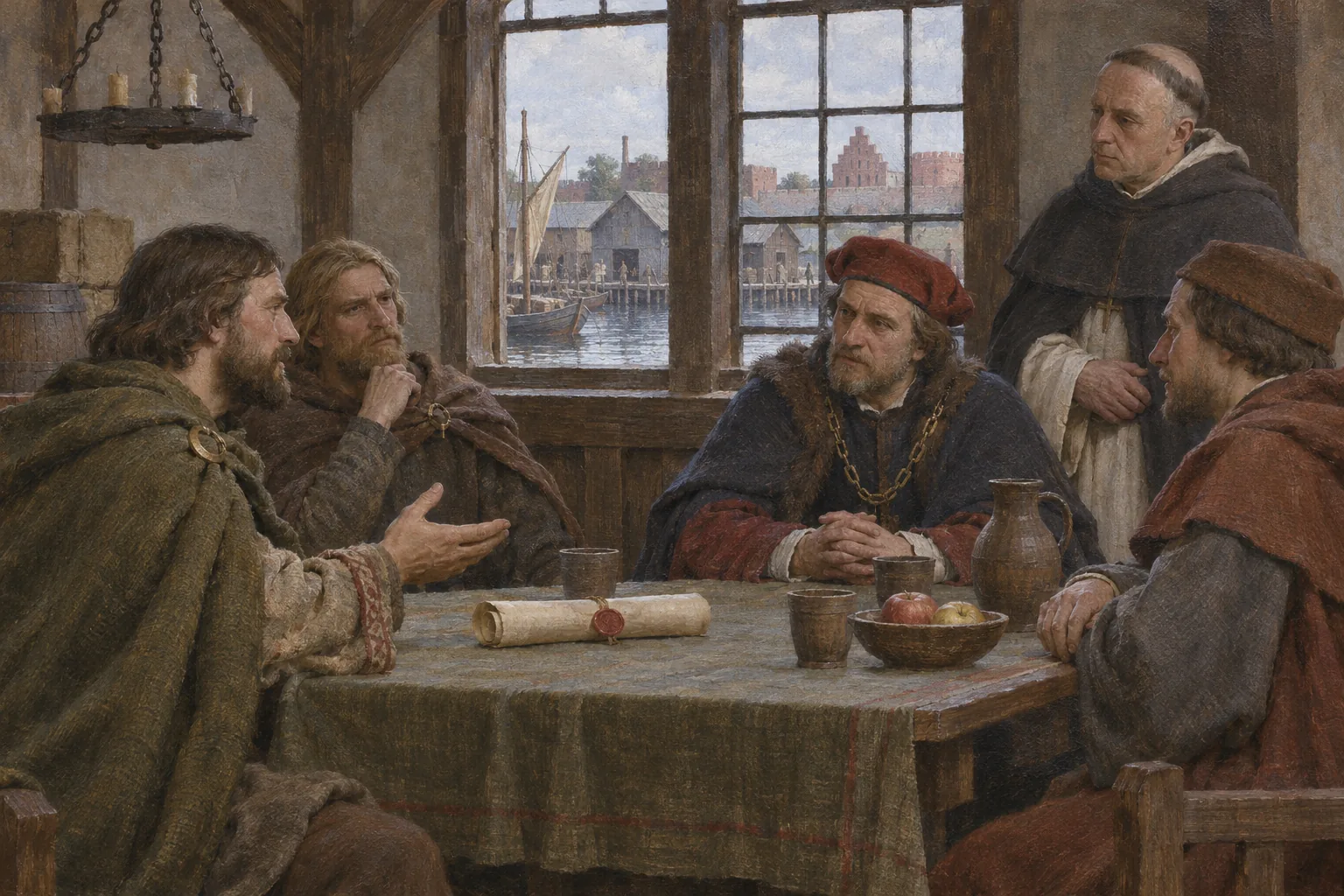
In 1298, Riga and the archbishop’s side turn to Vytenis for help against the Order. The Šapoka-edited history distinguishes these powers: a wealthy city, an archbishop and a military order could pursue different interests despite their shared Christianity. Local authority, civic interests and armed power divided potential allies as well as enemies. S6
Riga’s allies speak for themselves in the document of 30 March 1298 published by Bunge. The council and city community issue it alongside representatives of the cathedral and other ecclesiastical institutions. They accuse the brethren of injuring their church and city. Their complaint is also an argument for the alliance they have chosen. S104
The document follows negotiations through the archbishop’s envoys and the arrival of Lithuanian messengers in Riga. The relationship depended on people carrying messages across political and religious boundaries. The parties were working out how to cooperate while confronting their enemy. S104
The 1936 synthesis recounts victory followed by defeat within the same year, without bringing the alliance to an immediate end. It describes a Lithuanian garrison remaining in Riga until 1313. That is the book’s date for the garrison, not the end of every connection. A lost battle could coexist with continuing diplomacy. S6
2.18
The river route also led to religious negotiations.
Riga offered commercial connections and Christian partners. Negotiations also brought Mindaugas’s coronation back into political memory.
Riga connected Lithuania with commerce in the Daugava and Dnieper basins, western goods and weapons, according to the Šapoka-edited history. Alliance could also help movement through a neighbour’s territory. The book calls this a sole trade route, a sweeping claim that cannot account for all commerce. The important connection it describes does not depend on that claim. S6
Trade, civic liberties and the Order’s pressure begin Kojelavičius’s account of the Riga conflict. The townspeople seek Lithuanian help to protect their interests. Though he leaves no record of every merchant’s words or cargo, his account shows why a city’s independence and connections belonged in the history of war. S7
The Christian issuers of the 1298 document report that the Lithuanians wished to abandon pagan rites and establish Christian marriages and peace. The promises reach us through people defending their alliance. They were part of political and religious negotiation, rather than evidence of Vytenis being baptized or writing his own confession. S104
The allies also invoke Mindaugas as an anointed and crowned ruler. His memory offers a precedent for the agreement Riga now seeks between Lithuania and Christians. Decades after his death, the earlier kingdom still supplied an argument in negotiations. More had survived from before 1263 than the struggle for his power. S104
2.19
War’s consequences outlasted the campaign.
Warfare in Vytenis’s period meant raids, captives and castles left untaken. One campaign did not decide the state’s entire future.
Baranauskas dates Vytenis’s defeat at Wopławki to 7 April 1311. Warfare continued afterwards. S106
Villages burn and people are taken captive in Kojelavičius’s account of the raids, counterattacks and gathering forces of 1311. The harm continues after a ruler leaves the battlefield: lost homes and captivity last longer than a campaign. His figures need not be treated as a census to recognize these consequences within the later account. S7
Kojelavičius links the defeat with sacrilege and punishment. His religious explanation runs alongside the sequence of raid and counterattack, but does not establish divine punishment as the battle’s cause. Nor do words he places in the story give us a securely recorded speech by Vytenis. S7
Kojelavičius returns to siege warfare in his account of 1315. At Christmemel, he describes an attempt to burn the castle and a withdrawal following reports of approaching relief. This later telling recalls the problem at Daugpilis: even a demanding attack might leave a fortress standing. A ruler could spend considerable effort without permanently removing an enemy base. S7 S103
2.20
Gediminas inherited more than a ruler’s title.
Castles, military connections, settlements and diplomacy carried Lithuania towards Gediminas’s period. His predecessors left more than a sequence of names.
The Šapoka-edited history credits Vytenis with holding Samogitia and strengthening Lithuania’s position in the east and south. It gives a broad assessment, rather than dates for each annexation. His successor entered a world already shaped by allies, enemies, defended districts and routes travelled by armies and envoys. The relationships were there before the next ruler took his title. S6
Gediminas’s relationship to Vytenis varies between accounts. The Bychowiec Chronicle and Kojelavičius call him a son; the Šapoka-edited history calls him a brother. The chronicle also has Vytenis die by lightning, an unestablished account of his last moments. The continuity of rule is clearer than either his final day or an uncontested family tree. S6 S7 S19
In his 2024 study, Tomas Baranauskas proposes Skalmantas as Gediminas’s father and places Gediminas and Vytenis in collateral branches of the family. This reads the source’s “brother” more broadly; it does not supply a complete contemporary genealogy. The older brotherhood account remains alongside that attributed alternative. S84
Baronas and Rowell place Vytenis’s last mention in 1315 and Gediminas’s likely accession around 1316, without establishing an exact death date. The transition ends this account. The connections earlier rulers had formed continued into the next reign. S80