2.1
Families take refuge in the castle
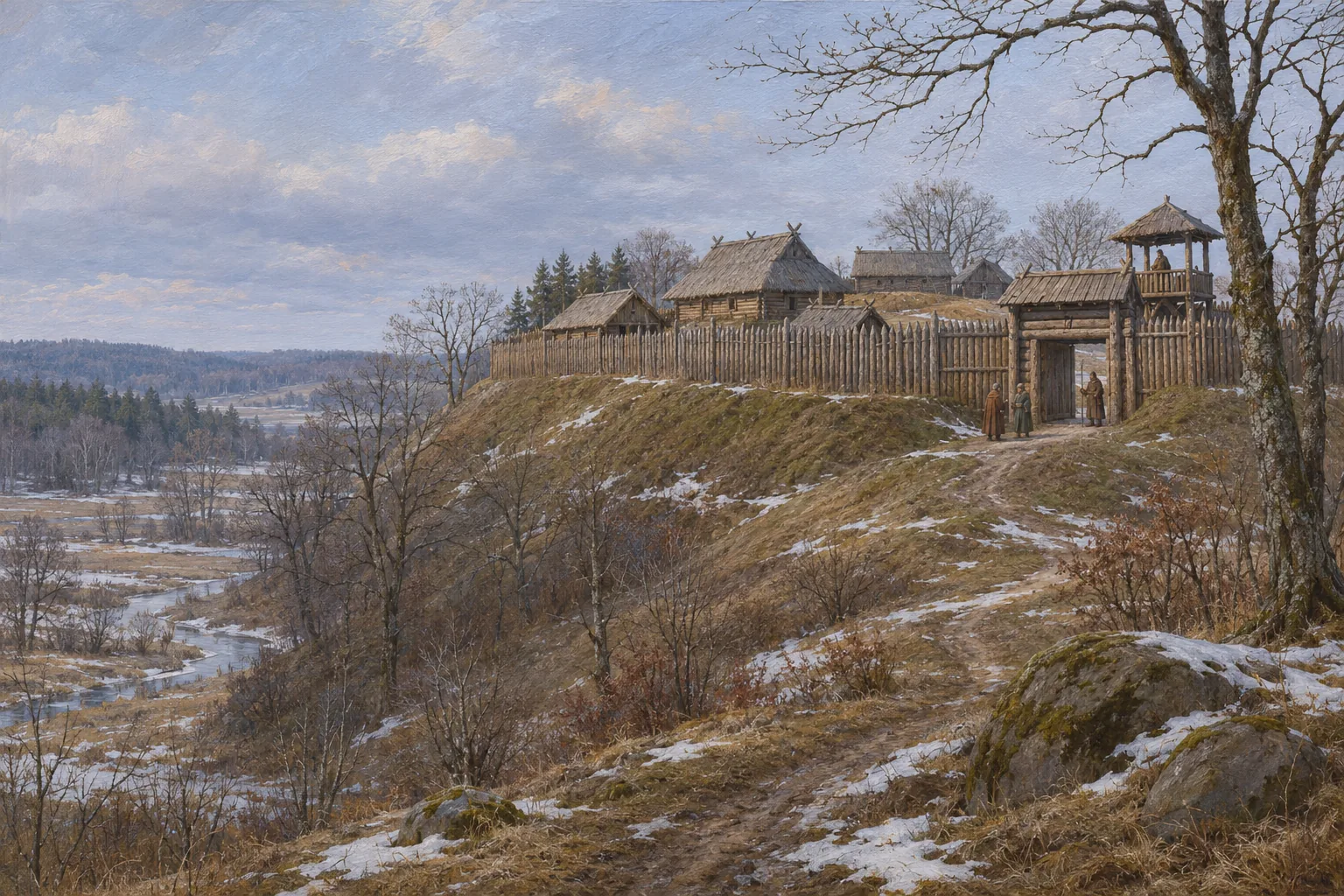
In 1336 the Teutonic Knights attacked Pilėnai. Kojelavičius’s later account places families alongside the men defending its walls.
Albertas Vijūkas-Kojelavičius describes men hurrying from nearby villages with their families when they hear of the approaching enemy. They seek a castle he calls Pulė and identifies as Punia. His account brings people seeking refuge together with men preparing to defend the walls. S7
The families share the defenders’ refuge and later appear among the victims of its destruction. We know their arrival and fate through a seventeenth-century account; none of the people sheltering inside speaks in the surviving narrative. S7
The 1936 history edited by Adolfas Šapoka gives a much shorter account. Duke Margis leads the Lithuanians, who choose death in the flames when they can no longer hold out. That brief image differs from the unfolding siege described by Kojelavičius. S6 S7
2.2
Castles in the path of war
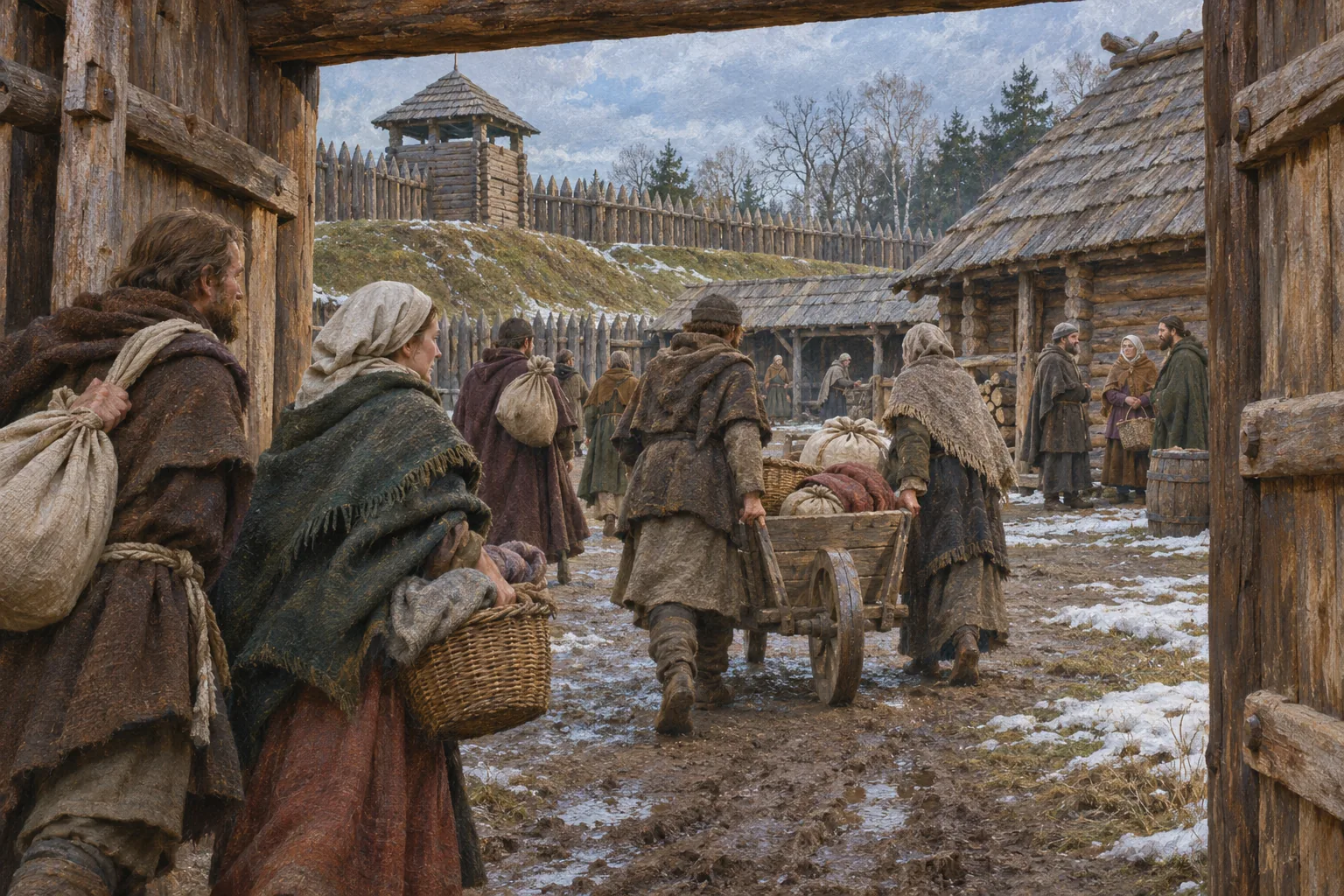
The history edited by Šapoka places Pilėnai within a long war along the Nemunas and in Žemaitija.
The history describes opposing castle systems along the Nemunas. Strongholds supported expeditions, defended routes and helped each side hold its position. Pilėnai belongs to this wider struggle, although the other castles named in the book were not necessarily involved in its siege. S6
The 1936 synthesis describes pressure from both branches of the Order. The Prussian Knights operated along the Nemunas, while Livonian forces also attacked farther east. These repeated expeditions help explain the villagers seeking protection behind castle walls in Kojelavičius’s account. S6 S7
The synthesis also distinguishes raiding from lasting conquest. It says the Order had not achieved a deep territorial breakthrough. A destroyed castle and ravaged villages did not necessarily end the wider struggle. S6 S7
2.3
From verse to a Latin text
Wigand of Marburg’s account of Pilėnai survives in a later Latin translation. An anonymous annalist records the capture in a few words.
The chronicle’s colophon dates the completion of the German verse work to 1394 and its Latin translation to 1464. The translator says the work took twenty-two days and acknowledges difficulties. This surviving account was written and translated well after the attack of 1336. S124
The anonymous Annals of a Sambian Canon record a capture: Grand Master Theoderic of Altenburg took the Lithuanian castle of Pillenen on Saint Matthias’s day in 1336. The entry names no defender and gives no story of the old woman or the inhabitants’ deaths. S126
Wigand’s Latin account places Pillenen in the land of Troppen. It describes burned possessions, deaths, wounded people riding away and the leader’s actions before the castle falls. The ending mentions captives and booty, leaving a different picture from the claim that everyone died. S124
Darius Baronas stresses panic and the development of later heroic retellings. This remains his interpretation of the sources. S127

2.4
From expedition to siege
In Kojelavičius’s telling, the army ravages the country before surrounding the castle.
Kojelavičius names the Teutonic Knights, the margrave of Brandenburg and the counts of Namur and Henenberg in his account of 1336. The force he describes includes both the Order’s men and nobles coming from elsewhere. S7
The army ravages the country and surrounds Pulė. Kojelavičius then follows the fighting at its walls and gates as the defenders’ strength diminishes. S7
Based on: S7
2.5
Who is included in the four thousand?
Kojelavičius counts four thousand warriors, with families accompanying them.
Kojelavičius gives a figure of four thousand warriors who arrive from nearby villages with their families. He does not count those family members separately. His figure cannot serve as a total for everyone sheltering inside. S7
These men gather hurriedly after news of the enemy. Kojelavičius does not clearly describe a permanent garrison: his castle brings together armed defenders and families seeking safety. S7
The history edited by Šapoka gives no headcount here. Kojelavičius’s fuller description supplies warriors and families, but those details belong to his telling rather than to the shorter account. S6 S7
Wigand’s Latin account gives a different figure: more than four thousand people from four lands. It does not restrict the number to warriors. That figure and Kojelavičius’s warriors with their families count different groups. S124 S7
2.6
While the defences hold
Kojelavičius describes defenders fighting at the rampart and making sallies before the walls begin to fail.
The defenders fight at the rampart and make sallies through open gates. For a time, Kojelavičius shows them attacking the besiegers as well as holding the fortifications. S7
Deaths and wounds thin their ranks. At the same time, the wall weakens. Kojelavičius describes both losses together: fewer men can fight, while the defences offer less protection. S7
Mining and battering rams weaken the wall in Kojelavičius’s telling. He describes how the attack progresses, but leaves no plan showing the gates or the eventual point of entry. S7
In the Latin chronicle, people see the army, lose hope of holding the castle, burn their possessions and kill themselves. The text then tells of an old woman who kills others before killing herself. This report begins with “as they say”: the chronicler presents a story he has heard. S124
2.7
Burning what the enemy might take
As the defence weakens in Kojelavičius’s account, the defenders burn their possessions.
The defenders first burn what the enemy might plunder. Kojelavičius then turns from destroyed possessions to the people inside. His account distinguishes the burning of property from the killings that follow. S7
He describes the killing of wives, children and others he considers unable to fight because of age or sex. Their bodies are then cast into the fire. His account includes violence against the castle’s inhabitants as well as the destruction of possessions. S7
Kojelavičius records no consent from the wives or children. Later, the armed men ask the commander to kill them. Treating both episodes as a unanimous choice would give the first group a voice the text does not preserve. S7
The Latin account also mentions wounded people riding away. The leader is protected by his retainers’ shields; he later retreats to a hiding place and kills his wife and other people. His own final fate is unstated. The castle is destroyed, yet the ending includes captives and booty, rather than confirming that everyone died. S124
2.8
The siege ends; a few are taken alive
Kojelavičius ends with killings inside the castle, the attackers’ entry and a very small number taken alive.
The remaining armed men ask the commander to kill them, according to Kojelavičius. He does so and finally kills himself. The author gives him no name in this passage; neither Margis nor Margiris appears here. S7
Kojelavičius calls the act memorable while condemning its desperation. His response is part of the account: a seventeenth-century Christian historian judges the deaths as he tells their story. S7
The attackers approach the undefended wall and break in, interrupting the killings. Some people still inside die fighting them. In this ending, people are killed both before and after the enemy enters. S7
A tiny, unnumbered remnant is taken alive. The others die, the castle is razed, and the army ravages neighbouring villages before returning towards Prussia. Kojelavičius thus leaves captives among the survivors of the siege. S7
Jan Długosz describes families seeking refuge in Pullen castle with their possessions and cattle in 1336. In his account, the defenders burn their belongings, kill their wives and children, and offer their necks to an unnamed commander’s sword. People remain when the attackers enter: some are killed, others taken captive. The account leaves captives alive but gives neither the commander’s name nor the castle’s precise location. S140
2.9
The named and unnamed commander
The 1936 history calls the leader of the Pilėnai defenders Margis. The commander in Kojelavičius’s siege remains unnamed.
The history edited by Šapoka identifies Duke Margis as the leader of the defence. Its brief passage gives him no birthplace, age or connection to another ruling family. S6
Kojelavičius’s commander appears near the end, when the remaining men ask him to kill them. The detailed siege account leaves this central figure unnamed. S7
A note in the 1863 edition says that Schütz reported Wigand’s use of the name Marger. The surviving Latin calls the leader a Lithuanian ruler but gives no name. The name comes through a different layer of transmission. S124 S125
2.10
Schütz’s fuller story of resistance
Caspar Schütz’s sixteenth-century telling adds motives and scenes absent from the surviving Latin chronicle.
Schütz describes determined resistance lasting several days. In his telling, hostility towards the attackers’ religion becomes one reason for choosing death. Schütz then describes “most” offering their necks to the leader, without defining exactly who belongs to that group. Separately, he describes an old woman with an axe and men who, he says, willingly accepted death at her hands. S125
Schütz depicts brothers of the Order watching in tears and trying to save those left. His Marger fights fiercely, kills his wife and then kills himself. The surviving Latin account does not explicitly describe the leader’s suicide. S124 S125
The endings also disagree about plunder. The Latin reports captives and considerable booty. Schütz says the attackers gained more wounds than wealth, apart from livestock. The 1863 edition prints both accounts together while marking them as separate texts. S124 S125
2.11
Interpreting the deaths
Gimbutienė and Beresnevičius offer religious interpretations.
Marija Gimbutienė connects the deaths at Pilėnai with belief. In her synthesis, the chronicle account becomes part of religious history: this is her interpretation. S11
Gintaras Beresnevičius considers consent and ritual meaning. He relays Norbertas Vėlius’s conjecture that the old woman may have been a priestess. This is Vėlius’s conjecture, discussed by Beresnevičius. S12
2.12
Why Kojelavičius names Punia
Kojelavičius identifies the besieged castle as Punia.
Kojelavičius calls the castle Pulė, then corrects the name to Punia. The identification gives his story a recognisable setting. It records a seventeenth-century historian’s choice of location rather than a site investigation of the attack in 1336. S7
Punia remains one of the locations attached to the Pilėnai story. Kojelavičius’s identification helps explain that tradition, even though other sites have since been proposed. His place-name establishes where he set the siege; it does not settle the castle’s location. S7

Based on: S7
2.13
Hillforts proposed as Pilėnai
Gintautas Zabiela surveys competing locations.
Zabiela’s report attributes Molavėnai to Antanas Girčys, Ižniškiai to Zabiela himself, Bilioniai to Stasys Kasperavičius and Pilės to Tomas Baranauskas. S130
After the 2017 Bilioniai excavations, he reports no evidence identifying the site as Pilėnai. S130
Based on: S130
2.14
Layers from different periods
Bilioniai’s layers belong to different events.
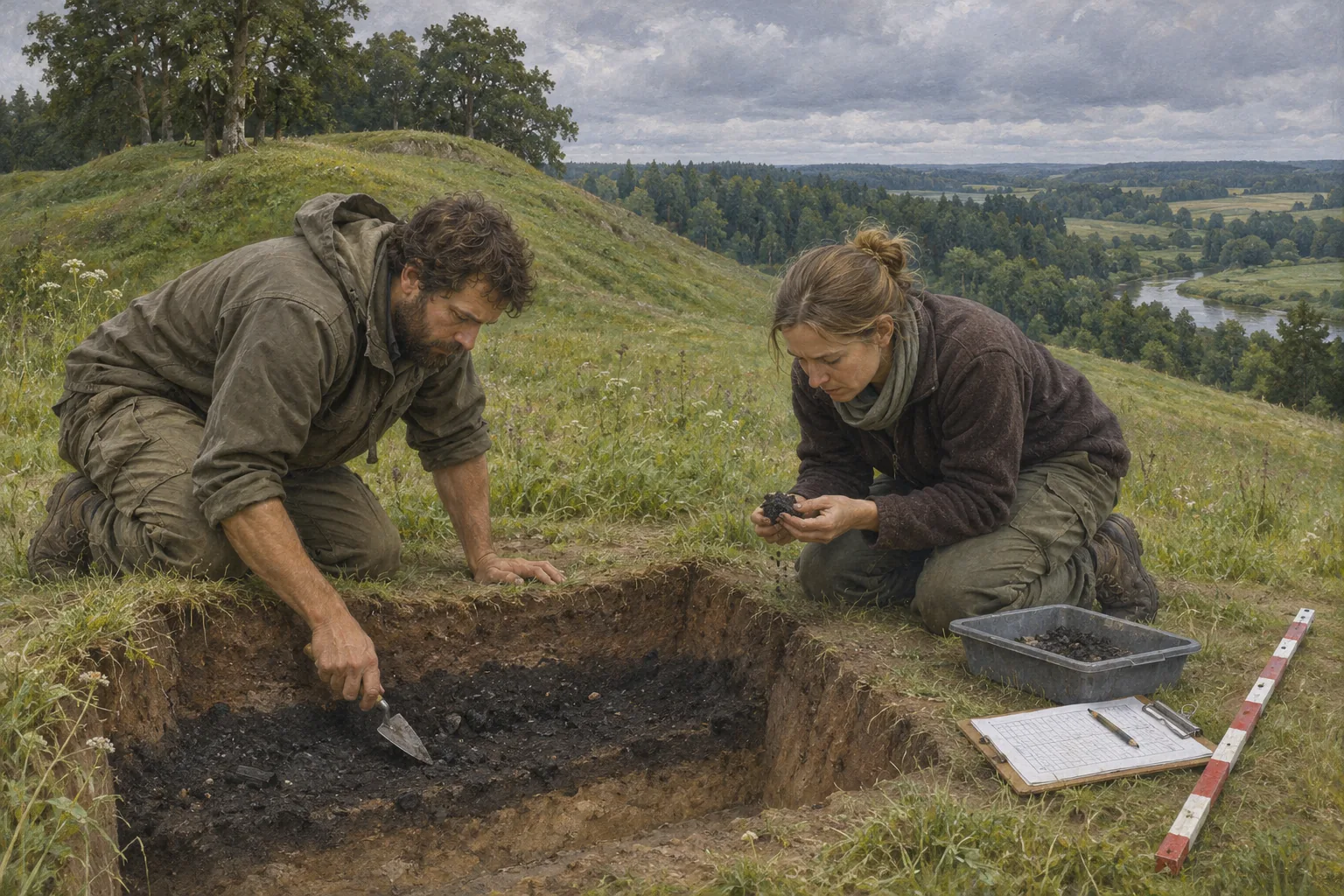
In his report on the 2018 excavations, Zabiela distinguishes five phases. Cremation graves belong to the third–fourth centuries; a fortification fire belongs to the early fifth century. S128
His latest phase contains an unnamed fourteenth-century wooden castle. That dating establishes neither its name nor a connection with the destruction of 1336. S128
Based on: S128
2.15
The story becomes a performance
Pilėnai also lives in musical theatre.
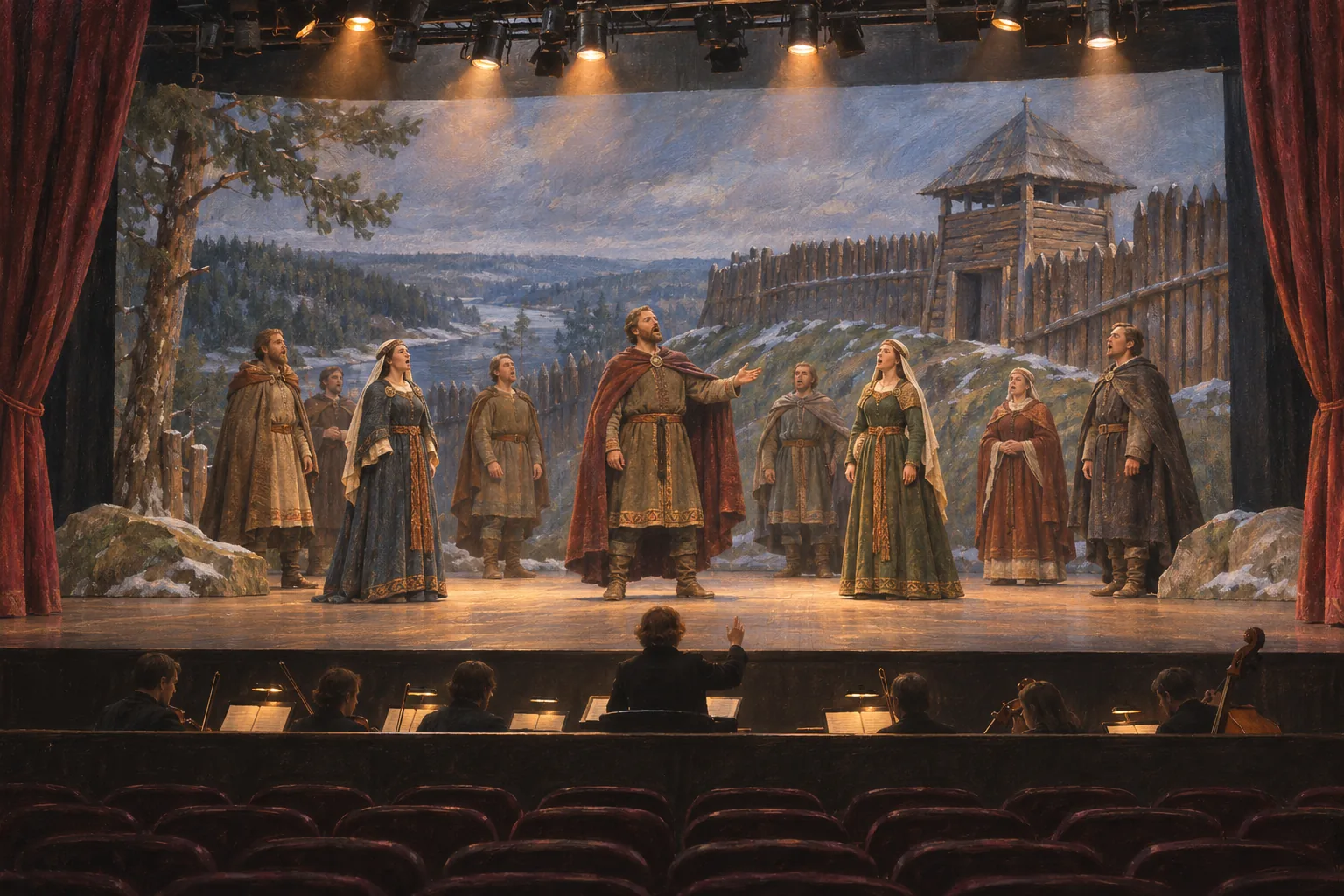
The ensemble Lietuva’s programme names Vytautas Klova’s 1956 opera Pilėnai and librettist Jonas Mackonis. S129
Its 2017 adaptation uses an abridged libretto, prose, dance and folk instruments. This is stage art, rather than testimony to the siege. S129
Based on: S129
2.16
An event with different endings
The 1936 history condenses the defence into a brief passage. Kojelavičius follows the siege through several stages and leaves a few captives alive.
The brief history remembers a defence led by Duke Margis and death in the flames. Kojelavičius follows families arriving, fighting at the walls, burning possessions and differently described killings, ending with a few people taken alive. The two accounts preserve different details and emphases. S6 S7
The Latin chronicle also leaves captives, but does not state the leader’s final fate. Schütz supplies his suicide. Their different endings cannot be combined without losing a distinction between the texts. S124 S125
The inhabitants leave no testimony of their own in these accounts. Later authors speak of their decisions, count them differently and give some a name or a voice. Their disagreements remain part of what we can read about Pilėnai. S6 S7