2.1
Victory in an older history
The 1936 synthesis places the victory alongside the failure to recover Smolensk.
Z. Ivinskis contributed the account of this period to the history edited by A. Šapoka. In the book, 30,000 troops defeat 80,000 at Orsha, with 30,000 Muscovites killed. These are the figures given in the 1936 synthesis. S6
Based on: S6
2.2
The war began earlier
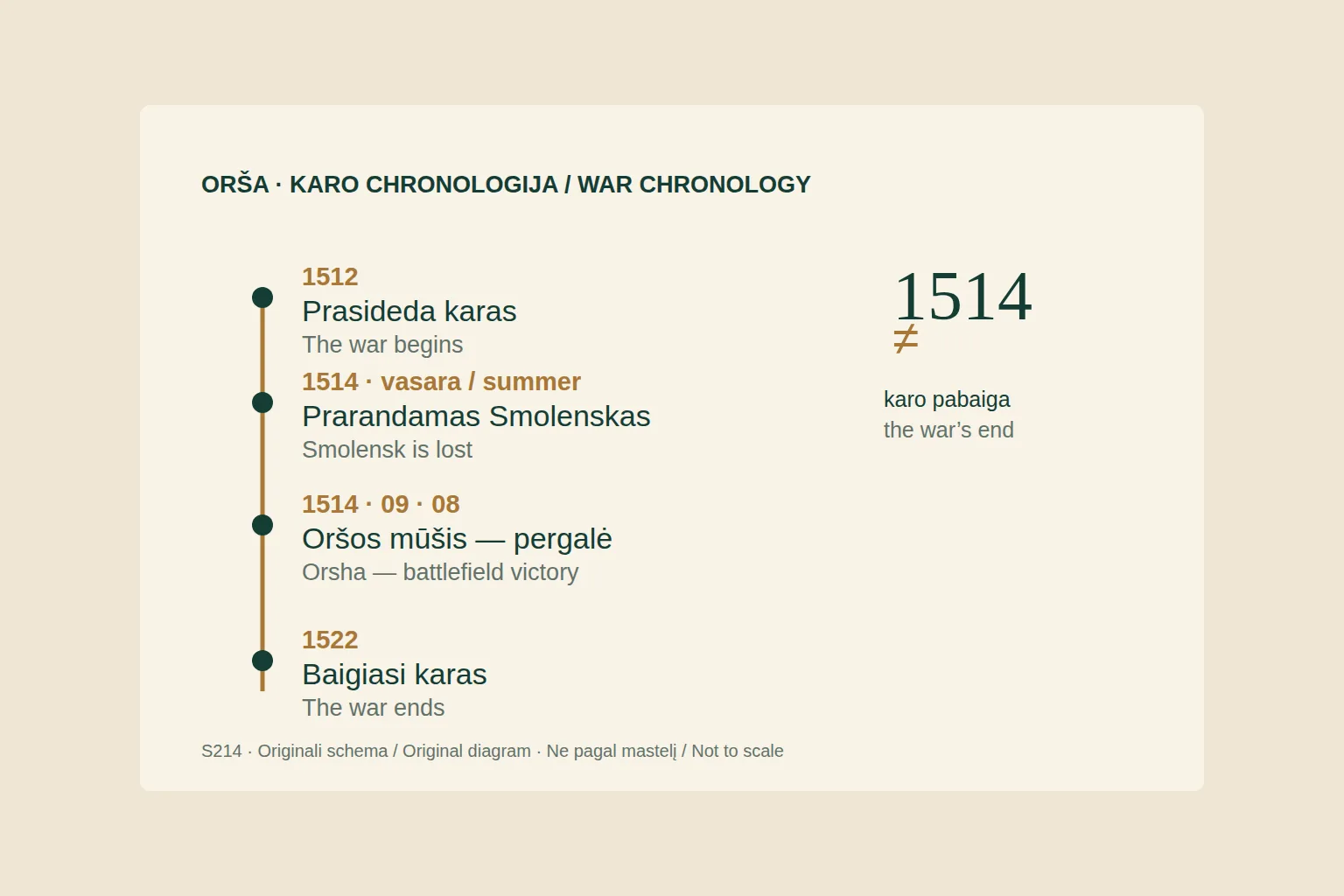
The fighting in 1514 belonged to the Lithuanian–Muscovite war of 1512–1522.
The army approached Orsha after a severe setback: Moscow had captured Smolensk in the summer of 1514. Mintautas Čiurinskas links the fighting at Orsha to the failure to reach Smolensk in time. The forces being assembled had two tasks: to halt the advance and attempt to recover the city. S214
The Lithuanian Armed Forces’ overview stresses that winning the battle did not give Lithuania the upper hand in the war. The fighting continued after 8 September. S218
2.3
First came the loss of Smolensk
In the summer of 1514, Smolensk fell to Moscow.
Sigismund the Old assembled Lithuanian and Polish forces, but they arrived too late to help Smolensk. The army had to halt the further Muscovite advance and attempt to recover the city. S214
Čiurinskas stresses that defeating an army in the field and recovering an occupied city were different tasks. At Orsha, the first was achieved. The second remained unfulfilled and shaped later assessments of the victory. S214
Based on: S214
2.4
The king stayed at Borisov
Sigismund the Old did not command on the battlefield.
Sigismund remained at Borisov with part of the force, while Grand Hetman Konstantinas Ostrogiškis led the army to Orsha. In the account discussed by Čiurinskas, about 4,000 troops stayed with the king. The hetman commanded in the field; the victory would also bring glory to the ruler. S214
Letters and poems often awarded the laurels of victory to Sigismund. They celebrated the ruler who had organised the war and represented the realm. The victor they portrayed was at Borisov while Ostrogiškis commanded the fighting. S214
Based on: S214
2.5
Konstantinas Ostrogiškis
The Grand Hetman of Lithuania commanded the army.
Ostrogiškis commanded a varied army: Lithuanian and Polish formations, cavalry, infantry and artillery. Their arms and tasks differed. In Čiurinskas’s account, coordinating these forces helped bring victory. S214
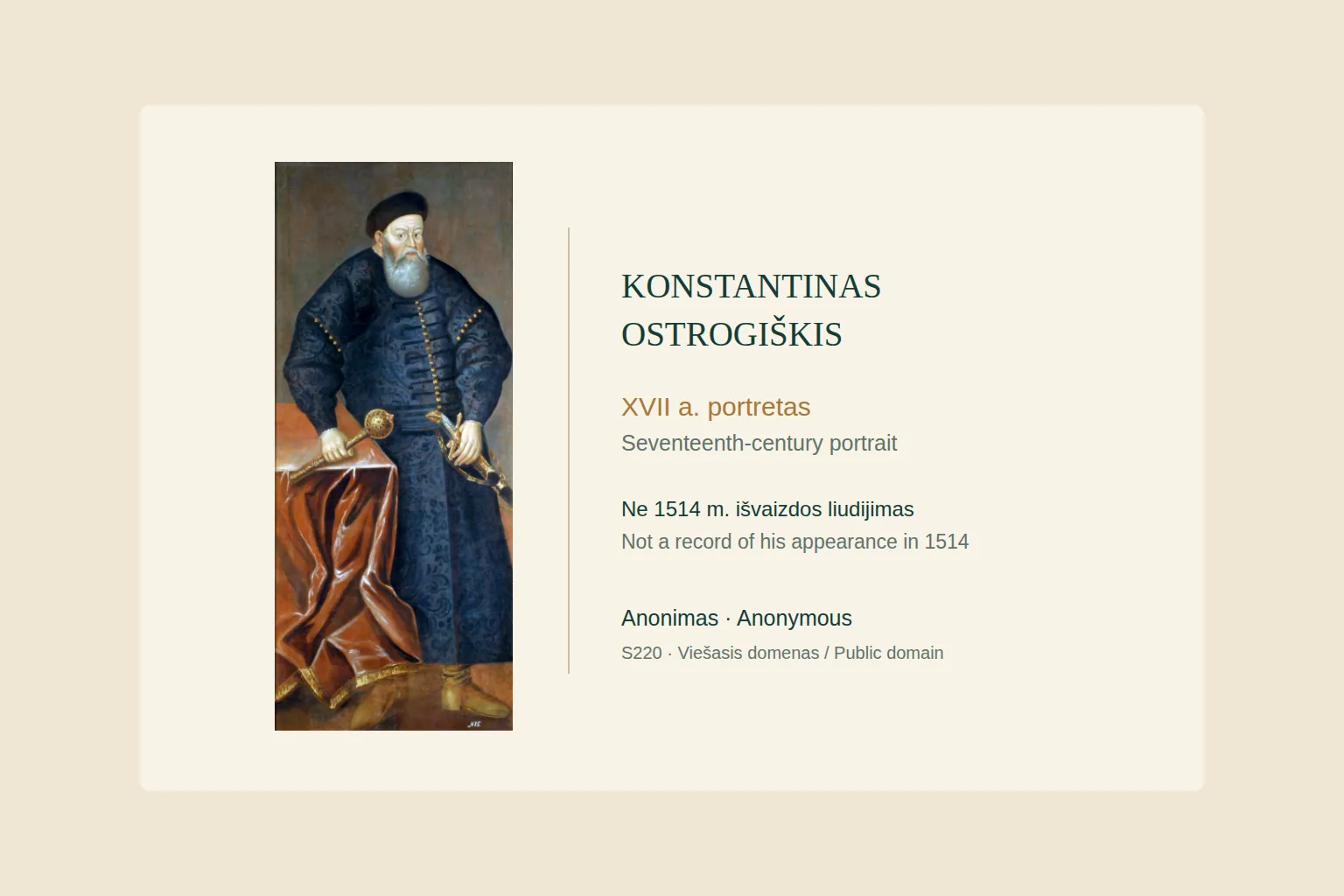
The portrait shown here belongs to the later remembrance of Ostrogiškis. The Commons catalogue dates it to the seventeenth century. Its clothing does not establish how the hetman looked or dressed in 1514. S220
2.6
Who fought together
Several commanders brought their formations to Orsha.
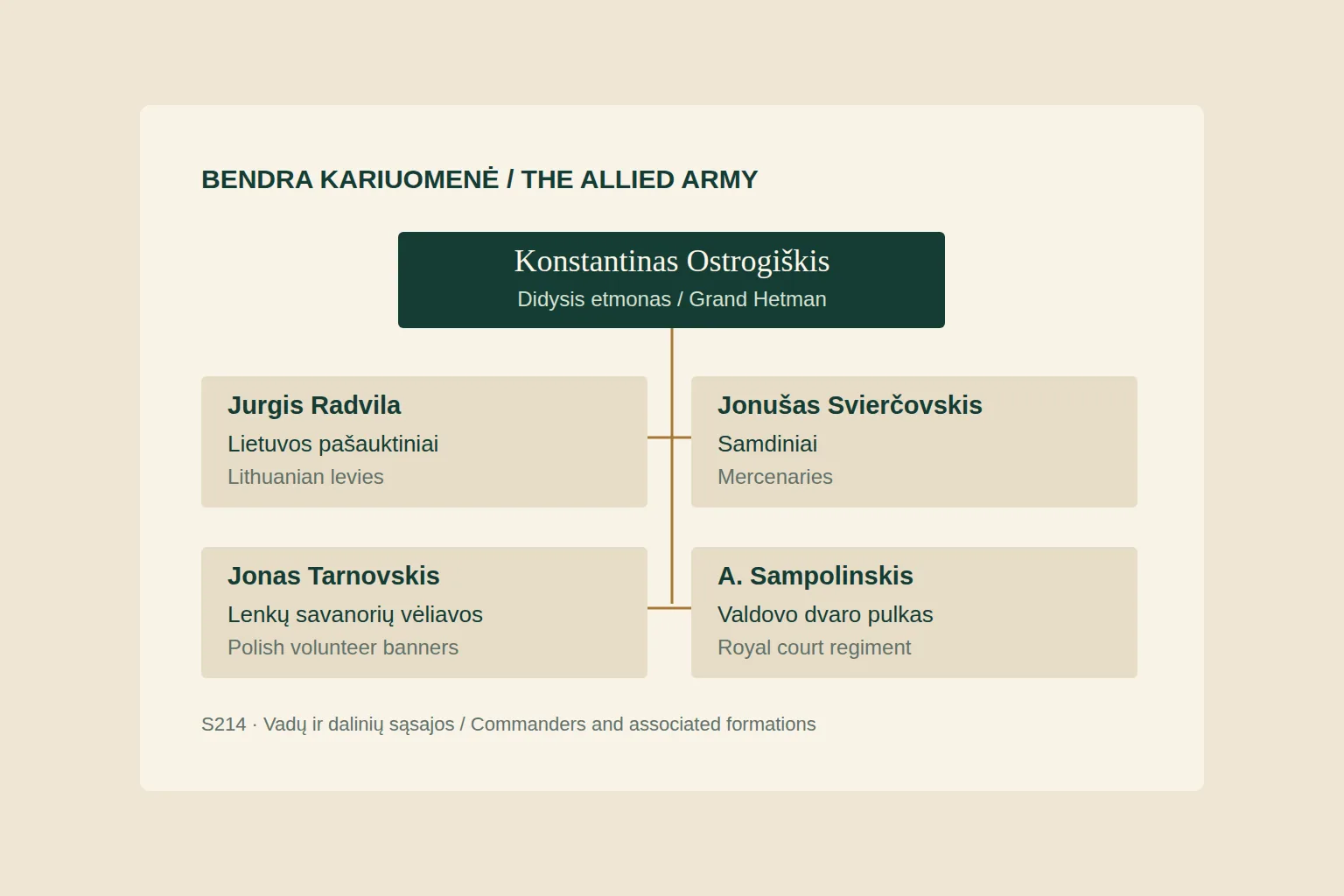
Čiurinskas also names other commanders. Jurgis Radvila led the Lithuanian levies, and Jonušas Svierčovskis the mercenaries. Jonas Tarnovskis (Jan Tarnowski) commanded the Polish volunteer banners, while Albertas, also called Vaitiekus, Sampolinskis led the royal court regiment. Ostrogiškis had to coordinate these different formations. S214
The diagram links Lithuanian and Polish formations in the joint campaign with their commanders. It summarises the associations described by Čiurinskas; the names alone do not establish each regiment’s composition or position on the battlefield. S214
Based on: S214
2.7
Muscovite commanders
Muscovite command remains disputed.
Przemysław Gawron discusses the forces of Ivan Chelyadnin and Mikhail Bulgakov-Golitsa. Their command, size and deployment remain disputed. S215
Based on: S215
2.8
How many troops were there?
Researchers give widely differing estimates of the armies’ size.
Alongside the traditional totals of 80,000 Muscovites and 30,000 allied troops, Čiurinskas presents much lower estimates. Some researchers put the Muscovite force at about 15,000 and the allies at around 16,000. These figures come from different scholars; placing them side by side does not establish the actual balance of forces. S214
The estimate chosen also changes how victory is explained. In one account, a small army defeats an enemy several times its size; in another, the forces are more evenly matched. The differences matter both to military historians and to the remembrance of the victory. S214
Based on: S214
2.9
Across the Dnieper
Before battle, the army had to cross the Dnieper.
Čiurinskas describes diversionary actions drawing the enemy’s attention away from a bridge being built elsewhere. A pontoon bridge across the Dnieper was intended to carry cannon and infantry. This is one reconstruction of the crossing; the account does not establish its precise location. S214
Gawron discusses disputes over the crossing place, bridge and Muscovite response. S215
2.10
8 September
On 8 September 1514, the armies fought near Orsha.
On 8 September, Ostrogiškis’s forces engaged the Muscovite army. In the sequence discussed by Čiurinskas, infantry and cannon fire support the cavalry attacks. He connects the outcome with cooperation between these parts of the army. S214
Based on: S214
2.11
Cavalry, infantry and cannon
Čiurinskas connects the victory with cooperation between different parts of the army.
In the reconstruction outlined by Čiurinskas, a cavalry withdrawal redirects the enemy attack. Infantry and artillery create an opening for a counterattack. This interpretation shows how one formation’s actions could assist another. S214
The broad sequence is easier to reconstruct than its details. This account establishes neither the position of each cannon nor the precise moment it fired. It suggests how the formations worked together, while leaving the full battle plan incomplete. S214
Based on: S214
2.12
Feigned flight
In a later account, Kojelavičius describes feigned flight.
Kojelavičius recounts how Ostrogiškis withdrew, drawing pursuers towards infantry and cannon. The seventeenth-century historian presents 40,000 Muscovite dead as a circulating report and gives 400 losses on the victorious side. S7
Gawron finds it unclear whether the withdrawal was deliberately feigned and where the ambush lay. S215
2.13
One reconstruction of the right flank
Aleksander Bołdyrew proposes a particular interpretation of the manoeuvre.
In Bołdyrew’s proposed reconstruction, Polish mercenary cavalry operates on the right flank. Infantry and artillery are concealed in an alder grove on the battlefield’s southwestern edge. This is one interpretation of the manoeuvre. Only the study’s abstract was consulted for this article, not the full paper. S217
Based on: S217
2.14
The Muscovite army is defeated
News of victory spread alongside large casualty figures.
The Muscovite army was defeated, and European rulers received news of a great victory. Numbers travelled with that news. The 40,000 dead discussed by Čiurinskas was a publicised estimate, rather than a verified count of soldiers killed. S214
The larger the enemy appears in a letter, the greater the victor’s glory seems. Reports of losses therefore tell us about both the fighting and the effort to celebrate its winner. Victory was a military event; the numbers accompanying it also formed part of its political presentation. S214
Based on: S214
2.15
Smolensk remained in Moscow’s hands
The victory did not recover the principal city that had been lost.
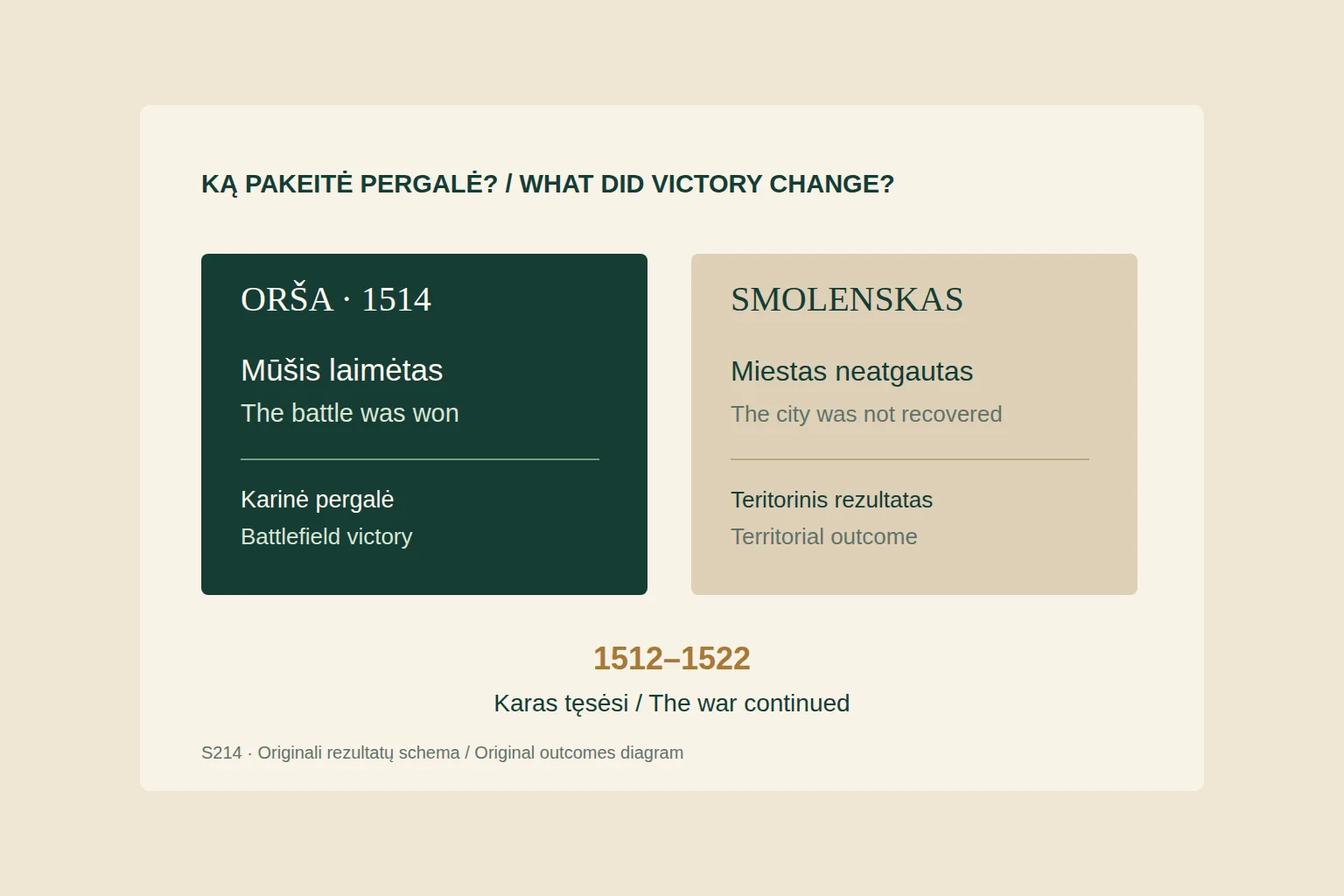
After Orsha, Smolensk was not recovered. Čiurinskas stresses the victory’s limited territorial results: the city remained under Moscow for almost a century. Having defeated an army in the field, the victors still faced a different task: recovering a fortified city. S214
The aim of recovering Smolensk remained unfulfilled, yet the victory acquired political significance far beyond its territorial gains. The ruler’s circle could proclaim a triumph across Europe while Smolensk remained in enemy hands. S214
Based on: S214
2.16
The war continued until 1522
Orsha did not end the war.
Čiurinskas dates the war to 1512–1522. It continued for years after the September victory. Letters spread news of triumph quickly, but the battle of Orsha did not bring a final peace. S214
Based on: S214
2.17
Victory travels in letters
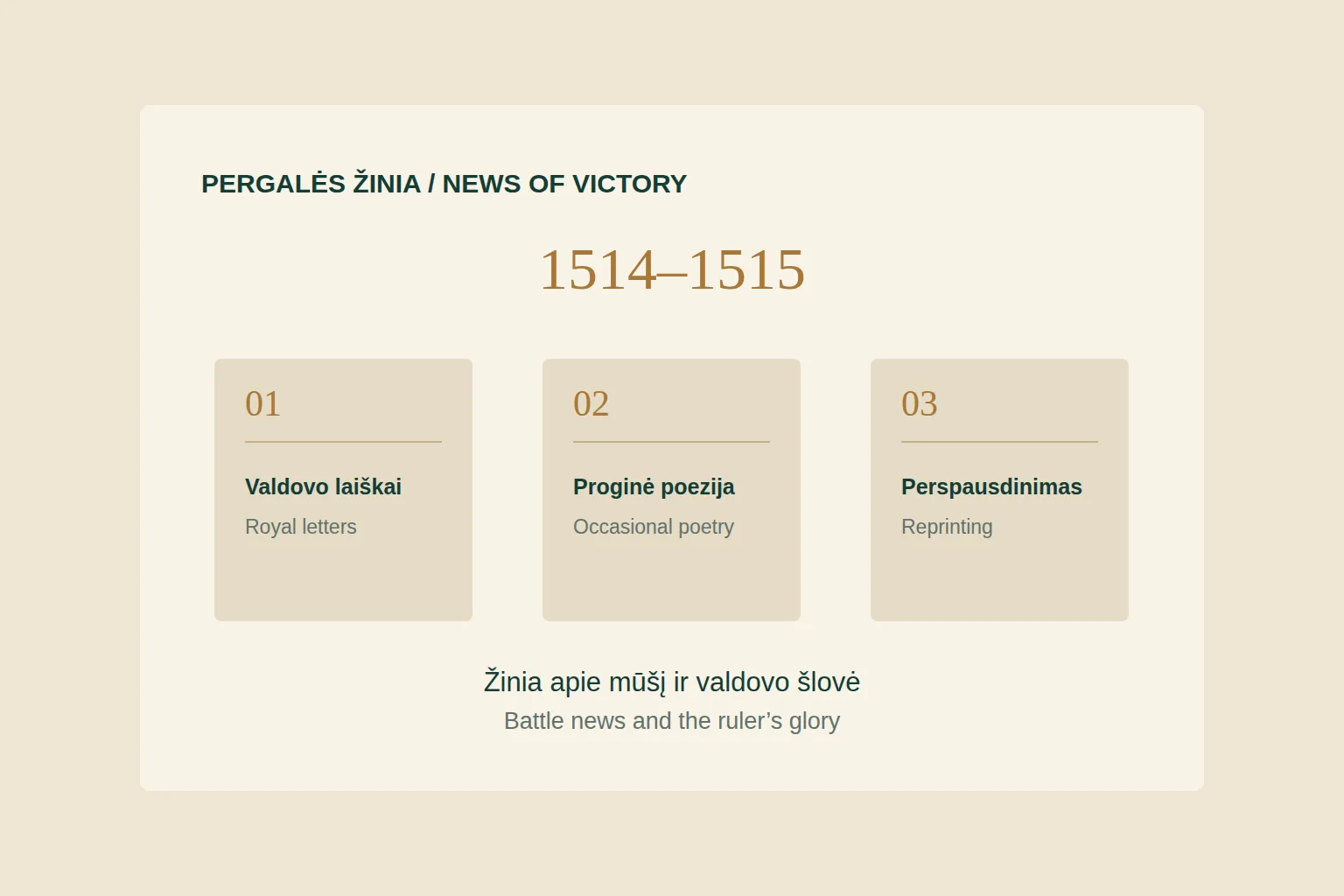
Letters and occasional literature gave the victory a European audience in 1514–1515.
After the battle, Sigismund’s circle set about spreading news of victory. In the letter to the pope examined by Čiurinskas, the ruler magnifies his achievement and disparages his opponent. He reports the fighting while also seeking to shape how it will be judged. S214
The news travelled in copies, printed works and verse. Texts addressed to different audiences helped spread the victorious ruler’s fame. Success on the battlefield thus became part of the presentation of Sigismund’s rule. S214
Based on: S214
2.18
Who received the glory?
Different writers distributed the credit differently.
Jacobus Piso, who was in Vilnius, benefited from the ruler’s patronage. Čiurinskas considers that relationship important when reading his account. Gratitude to a patron could influence whom the humanist credited with victory. S214
Andrzej Krzycki gave military leaders more attention. Other victory poems emphasised the contrast between two rulers: Sigismund triumphant and the Muscovite ruler defeated. The same battle had different heroes in different writers’ works. S214
Based on: S214
2.19
A painting filled with scenes
The surviving sixteenth-century painting is a later representation of the battle.
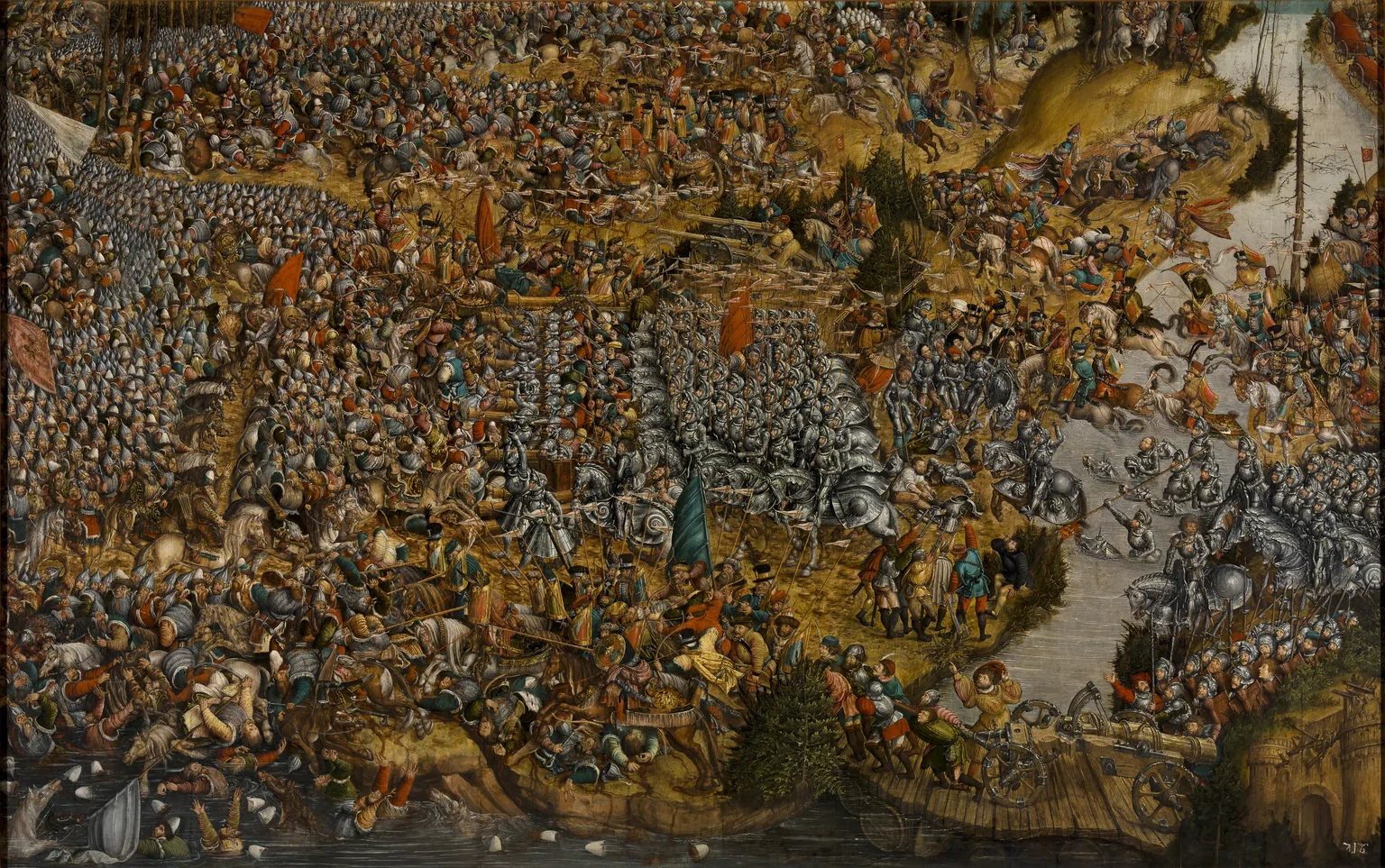
The reproduction metadata dates the painting held by the National Museum in Warsaw to 1525–1535. Its maker is unknown; links to a particular painter remain an attribution. The composition brings together cavalry, infantry, cannon and scenes of a river crossing. S219
The painting helps us study how the battle and the period’s arms were depicted. Scenes joined in a single composition cannot simply be plotted on a map as an established sequence of fighting. The image does not confirm the location and timing of every action. S219
Based on: S219
2.20
Remembering Orsha on maps
Later maps placed Orsha within different political narratives.
Jakub Niedźwiedź studies how inscriptions about Orsha on maps served dynastic, Ruthenian, republican and Lithuanian memory. Different maps gave the same event different political meanings. S216
The battle won at Orsha did not recover Smolensk, but its echoes reached far beyond the battlefield. Letters and poems returned to the question of whose victory it was and what it meant. The fighting, the campaign’s outcome and its later remembrance remained closely connected. S214