2.1
People and provisions sustained the castle
Historians describe cargo, changing guards and the memory of defenders.
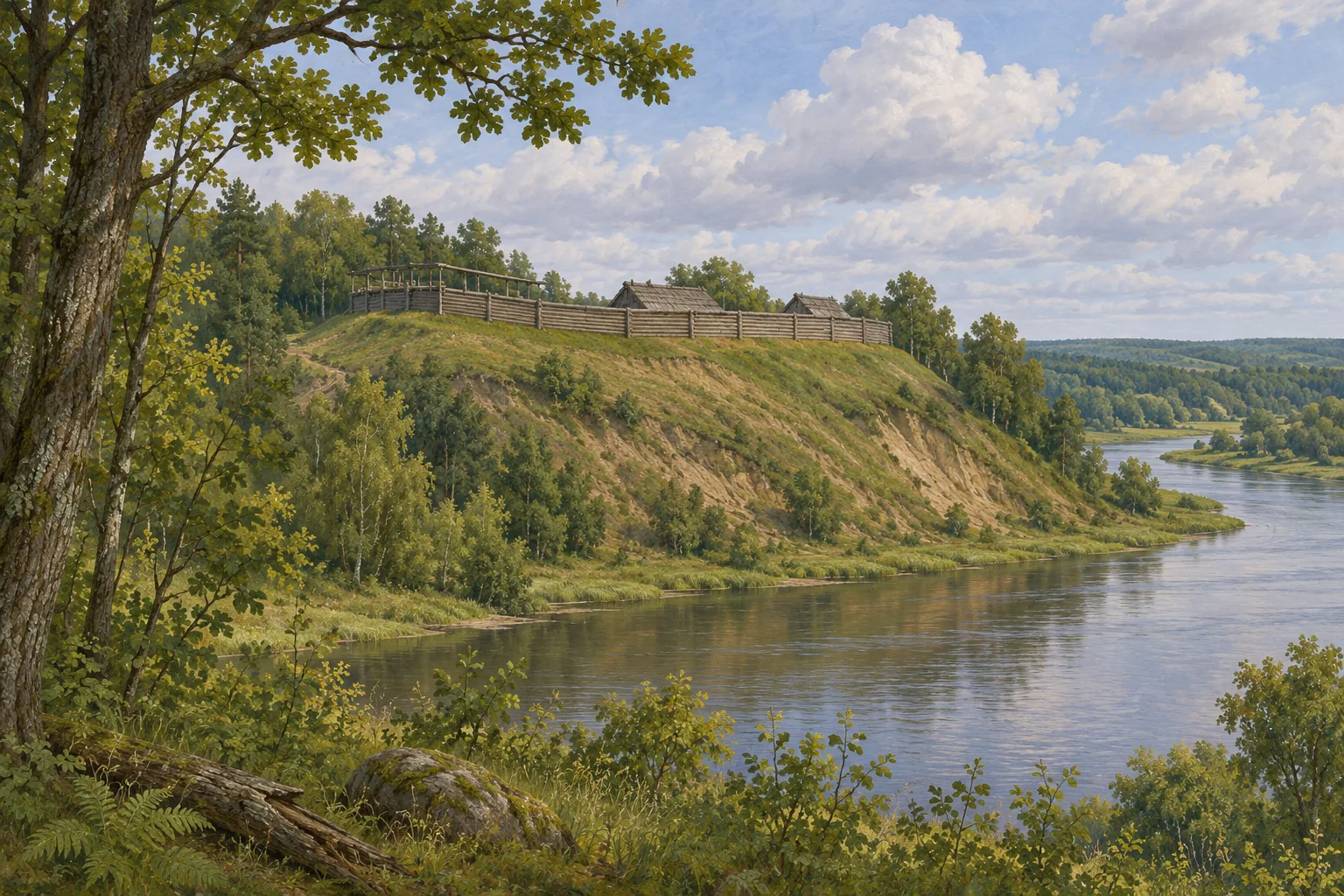
After the rebuilding of Ritersverderis fails, prepared materials are floated to Ragainė, according to the history edited by Šapoka. There, in 1409, grain sent by Jogaila to Lithuania is stopped. S6
Kojelavičius describes Bisenė guards returning home when replacements arrive, then being called back to the same castle. Writing about the fall of Kaunas, he says people still sing laments for its defenders. S7
2.2
The Nemunas connected and divided
Along the river, movement mattered as much as a fortified position.
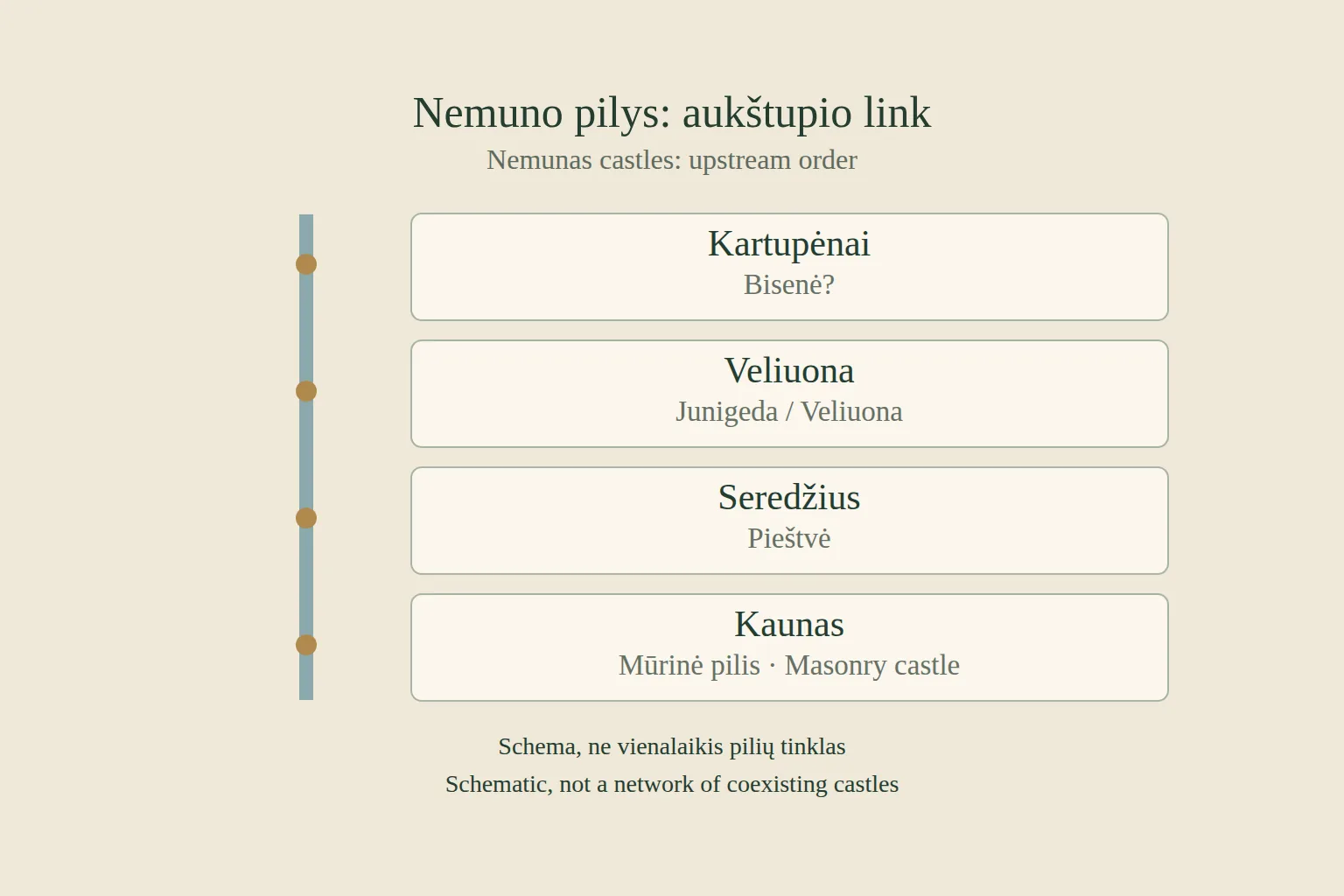
Tomas Baranauskas reconstructs the castles’ history from records of individual places. He identifies Veliuona with Junigeda and places Pieštvė to its east at Seredžius. Farther along the Nemunas–Neris corridor lies Kaunas. These were separate centres, rather than a continuous wall. S179
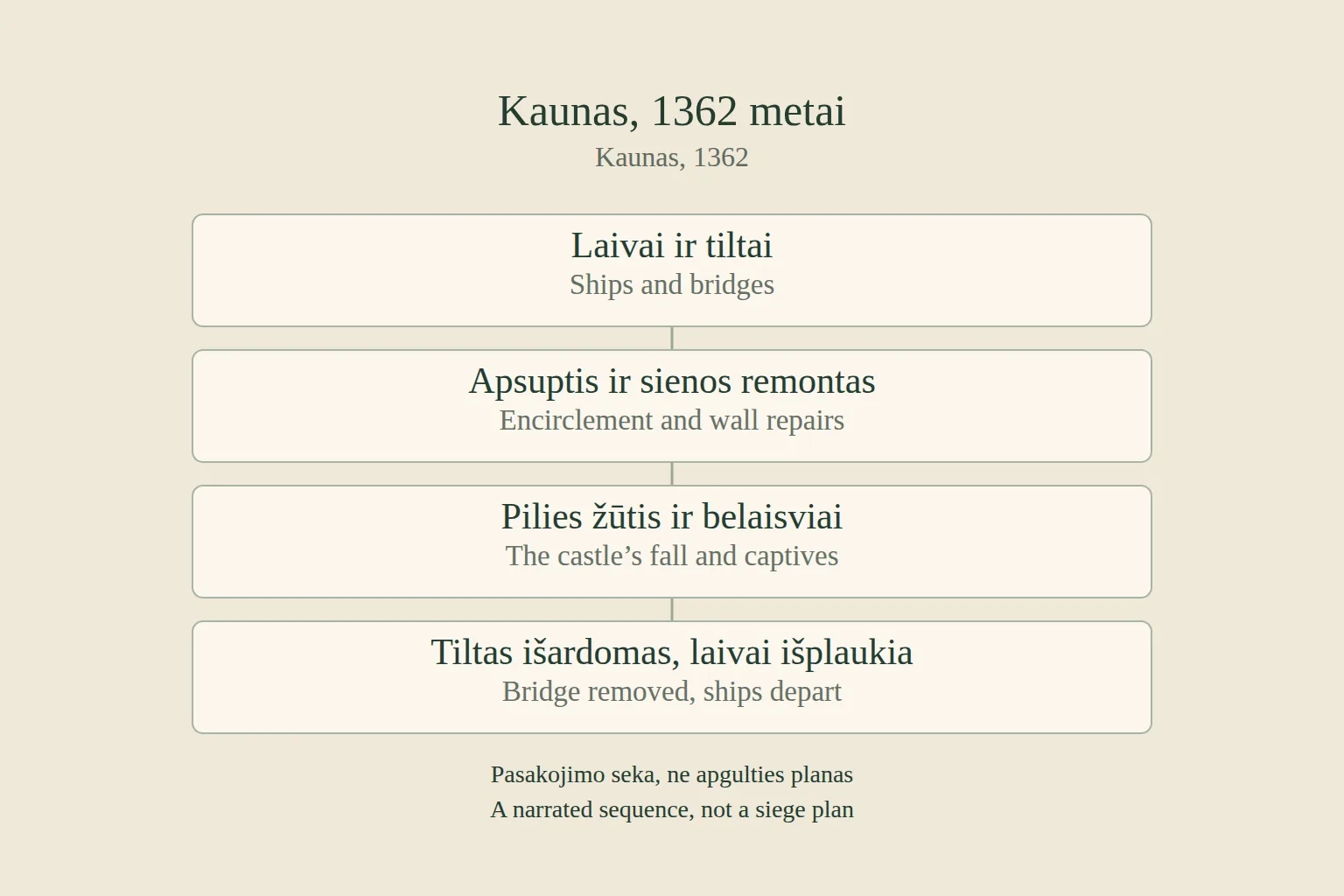
In the account of Kaunas in 1362, ships carry the army, guards protect them and bridges are built. The river serves transport and crossings. Besieging a castle requires reaching the bank, keeping access to ships and protecting connections. S124
Laurynas Kurila stresses that today’s hillfort map combines sites used at different times. The diagram therefore gives only their approximate order along the river. It does not place all the castles in operation at the same moment. S180
2.3
A name in a chronicle, a place on the map
Bisenė’s history is easier to follow than its location is to establish beyond dispute.
Baranauskas proposes identifying Bisenė with Kartupėnai and Kolainiai with Jurbarkas’s Bišpilis hillfort. He compares campaign routes and evidence associated with Surminas. This is his proposed correspondence between historical names and present-day sites. S179
In his synthesis, Bisenė burns in 1283, withstands an open attack in 1313 and is destroyed in 1316. Between these episodes it is used and guarded again. A recurring name records a continuing place history, rather than necessarily the same unchanged timber wall. S179
2.4
Exposed on the way to the castle
Bisenė’s defence also depended on people arriving to replace its guards.
From chronicle episodes, Baranauskas reconstructs guard groups of about 80–85 people changing roughly monthly. The figures describe the cases he interprets. They are neither staffing levels for every Nemunas castle nor a census of Bisenė’s inhabitants. S179
After an unsuccessful open assault, attention shifts to the movement of replacement guards. Attackers target people arriving or returning as well as walls. The castle’s strength depends on routes beyond its defences. S179
Guard rotations connect the castle with homes and surrounding communities. The stronghold cannot function in isolation: new defenders must arrive and previous guards return. In the Bisenė episodes, this movement itself becomes a vulnerability. S179
Based on: S179
2.5
A rebuilt place becomes a target again
Veliuona also appears in the sources as Junigeda.
Baranauskas associates Junigeda’s construction with 1291. Later accounts describe attacks, burning and renewed building. In this sequence, survival means the ability to restore defences, rather than the uninterrupted existence of one building. S179
He distinguishes two outer settlements at Veliuona, one on a hill and one in the valley. The fortified height and activity below belong to the same complex but may suffer differently. Burning the outer settlement does not necessarily mean taking the castle. S179
Accounts of campaigns mention a devastated place again soon afterwards. The differing fortunes of castle and outer settlements help explain this: attackers reach one part while defenders hold or rebuild another. Reports of burning are followed by renewed work. S179
Based on: S179
2.6
A castle and outer settlement recorded in 1293
The notice of 1293 names Pieštvė’s castle and its outer settlement.
The earliest Pieštvė entry listed in Baranauskas’s catalogue is dated 25 July 1293. It names both castle and outer settlement. This attests their existence in writing, rather than recording the first construction work. S179
The researcher places Pieštvė at Seredžius, east of Veliuona. Reports of attacks distinguish the fortification from nearby homes. The site emerges as a combination of defence and daily activity. S179
Based on: S179
2.7
An open walkway above the wall
A timber wall had to support both defenders and their movement.
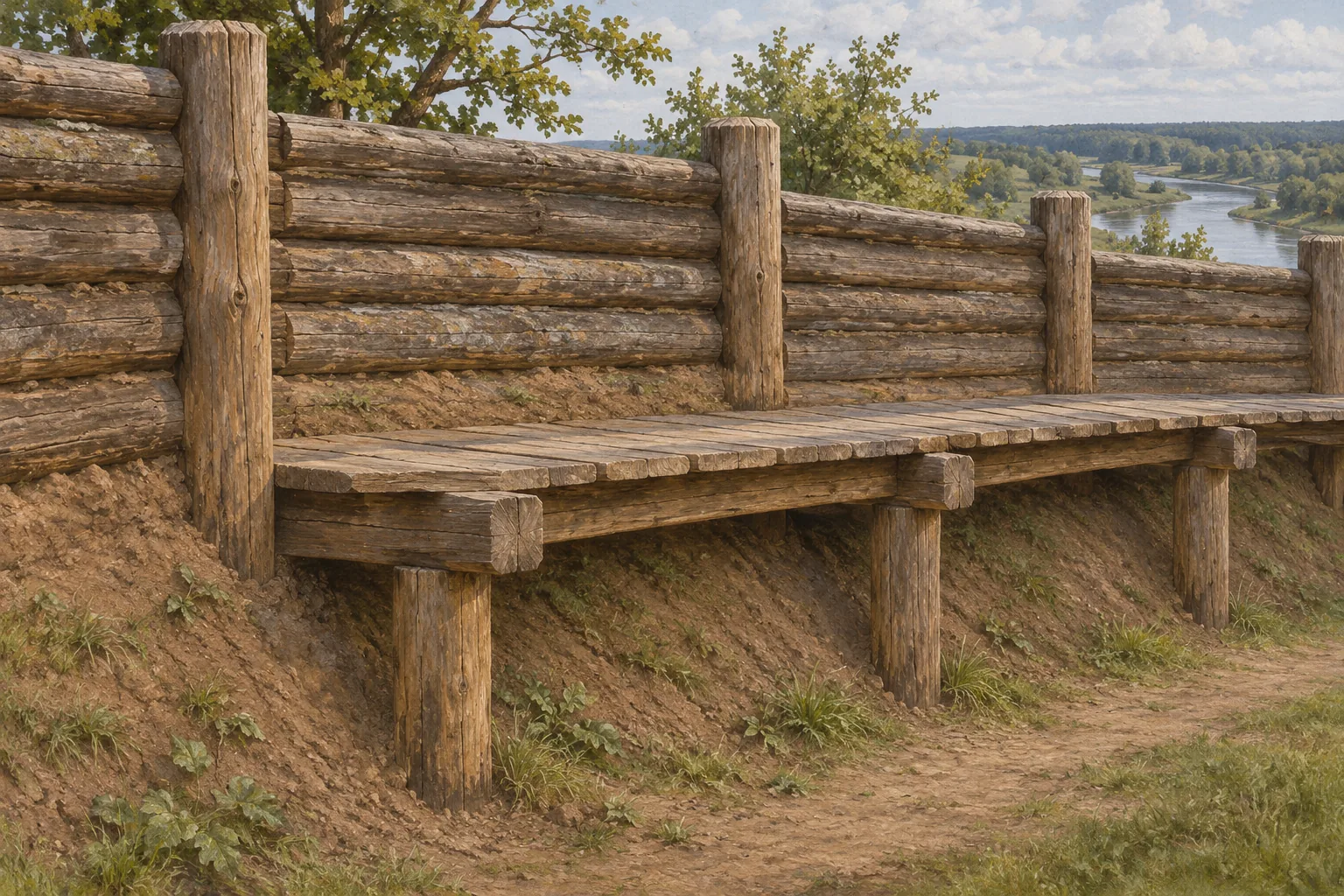
From accounts of assaults on Kolainiai and Pieštvė, Baranauskas infers open defensive platforms or walkways atop timber walls. His reconstruction differs from the fully enclosed galleries of later periods. The open walkway is an architectural interpretation, rather than a surviving castle drawing. S179
The study compares different timber constructions, including horizontal timbers held by posts and later log-built forms. Excavated examples elsewhere help interpret changes without establishing every joint in a Bisenė or Pieštvė wall. S179
The illustration uses a short wall section and an open, visibly supported walkway to show how earth, timber and supports relate. Its construction gives a material impression without reconstructing a particular castle’s cross-section. S179
Based on: S179
2.8
A connection could be removed
A castle bridge could provide access or obstruct it.
The account of Paštuva in 1369 describes a bridge being thrown into a ditch, Baranauskas stresses. This does not establish its mechanism. It could be a removable connection, but a drawbridge raised by chains and counterweights is not demonstrated here. S179
Another example is Kęstutis’s bridge across the Nemunas by New Kaunas in 1363. Two defensive works on it obstruct river passage. Its purpose extends beyond crossing the water to controlling movement along it. S179
Based on: S179
2.9
Food and homes beyond the walls
The outer settlement also had a place in everyday provisioning.
Baranauskas distinguishes castle, fortified outer settlement, a less strongly defended settlement below and an additional outwork. Medieval terms do not always match these modern definitions precisely. Their functions matter: places for living, gathering, provisioning and additional defence. S179
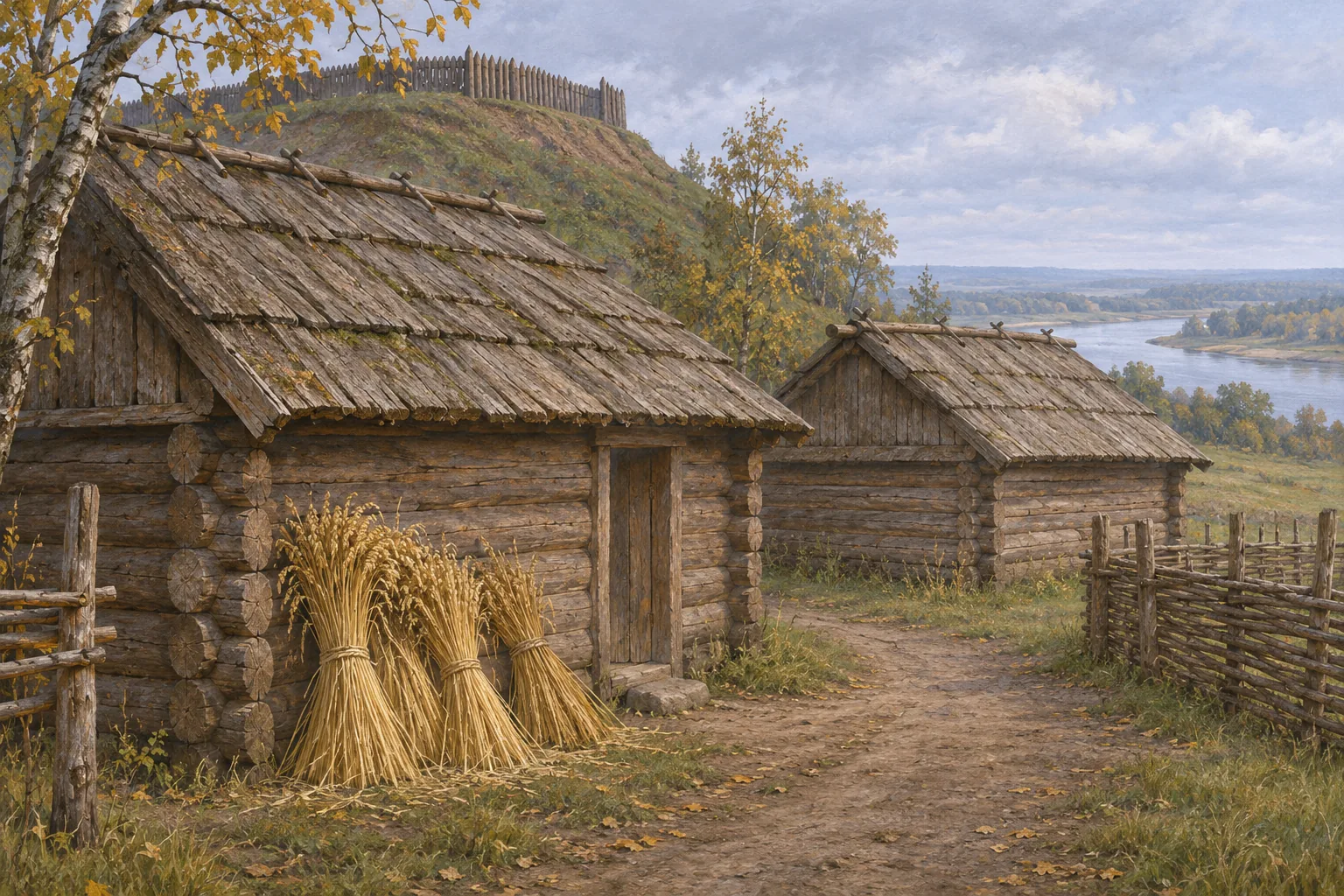
The notice for 1318 describes the burning of Junigeda’s and Pieštvė’s outer settlements, which held much grain from the new harvest. Alongside buildings, provisions needed by people and the castle are lost. The attack also damages future supplies. S179
Modest timber houses, cereal bundles and a distant castle suggest these supply connections in the illustration. This is an imagined outer settlement, rather than a particular raid in 1318. House forms, cereal species and storage arrangements remain artistic choices. S179
Based on: S179
2.10
Building again after a raid
Veliuona’s outer settlement reveals a short interval between damage and renewed work.
The study compares attacks on 8 September and 12 October 1315. Between them the outer settlement had been rebuilt. Roughly a month describes recovery of one part of the complex, rather than rebuilding the entire main castle from its foundations. S179
Rebuilding gathers people and materials again where the enemy has already reached. In the changes described by Baranauskas, survival means both repelling attacks and returning to work on damaged ground. S179
Based on: S179
2.11
Help might not reach the bank
A river route does not guarantee entry to a besieged place.
Baronas describes the siege of Christmemel in 1315: reinforcements arriving by water could not enter. He proposes that Lithuanian boats helped obstruct access. This is an interpretation of the blockade, rather than a surviving exact plan. S181
In the Kaunas account of 1362, the besiegers themselves must guard their ships and connections to them. Control of the river thus involves more than navigation. The army must land, hold access to the bank and gather again for departure. S124
2.12
Ships, guests and three days for bridges
The siege of Kaunas in 1362 begins with travel and preparation.
In the Latin transmission of Wigand’s chronicle, the Order’s leadership prepares the expedition with Grand Master Winrich. Guests from England, Italy and German lands are also named. The account records wider participation without supplying a complete army roster. S124
Ships travel along the Nemunas past places whose names are associated with Veliuona and Bisenė. Below Kaunas, the army stops for three days to build bridges. Having reached the castle, it must prepare crossings before establishing its siege. S124
Kęstutis arrives with an army to protect the castle but is forced back. The defenders’ position now depends on more than strong walls. It also depends on whether a field army can reach them and maintain contact. S124
Based on: S124
2.13
A ditch between castle and relief
The besiegers build their own defences around the castle.
The chronicle describes a ditch dug around the castle from the Neris towards the Nemunas. A strong fence with defensive works is built. This separates the defenders from the army outside while allowing the besiegers to support one another. S124
Some troops are assigned to guard ships at the island, while others take positions by the castle and siege fence. Ships remain part of the campaign after landing. They provide connections and the means of returning, and must be defended. S124
The accompanying sequence separates ships and bridges, encirclement and repair, the fall and captives, and the fleet’s departure. It summarises actions in the chronicle rather than surveying the siege of Kaunas. It does not reconstruct exact shapes or distances. S124
Based on: S124
2.14
Attacking from outside, repairing within
The assault on Kaunas’s walls is narrated as sustained work.
The Latin account names Marquard of Marienburg and Matthias, a carpenter from Königsberg, as builders of siege machines. Timber structures rise to wall height. The wording does not give their complete design, but makes builders part of the assault. S124
After fourteen days, the chronicler mentions fatigue. Attackers work against the wall while defenders repair it from within. Damage is not automatically an open route: a breach must be exploited before the other side closes it. S124
On Palm Sunday, defenders’ arrows repel those attempting to enter through the breach. It is then to be widened by day and night until Good Friday. In the narrative, sustained pressure on the wall and its defenders links these days. S124
Based on: S124
2.15
A conversation beside blocked access
In the chronicle, the military barrier also enters the account of negotiation.
In the Latin account, Kęstutis and the master talk under an agreement of mutual safe conduct. Their conversation emphasises the fence and ditch separating the castle from relief. Defences protecting the besiegers also block access to those within. S124
The chronicler uses this scene to explain the position of the field army and the besieged castle. The talks take place with the barrier already established. It remains his reported conversation, rather than a verbatim record of negotiations. S124
Based on: S124
2.16
Names of captives after the fire
In the chronicle, Kaunas’s fall extends beyond broken masonry.
Fire breaks out in the account, part of the wall collapses and defenders continue resisting at the breach. When the castle falls, people die through fire, suffocation and killing, while others are captured. Broken masonry is only part of this destruction. S124
The Latin transmission names Vaidotas among the captives and calls him Kęstutis’s son. This filiation belongs to that version: Bornbach’s later account associates him with Algirdas. The different voices are not treated as one agreeing witness. S124
The rulers ask for written information about the number and names of those captured; a notary conveys the news in the account. After the castle’s fall comes an effort to learn people’s fate. The chronicler reports this correspondence, without providing the original captive list as a surviving document. S124
Based on: S124
2.17
A campaign also needs an exit
After taking the castle come worship, further demolition and the journey back.
On Easter morning, the chronicler describes mass led by the bishop of Sambia, singing and the conquerors’ thanksgiving. He attributes success to divine will. This is a religious interpretation of the Order’s victory, rather than a shared voice of everyone involved. Walls still standing are further demolished. S124
During withdrawal, access towards the island is prepared while pursuers burn the siege fences. The bridge over ships is removed and ships assigned for departure. The army that built the siege now dismantles its connections so it can leave. S124
Based on: S124
2.18
Smoke at Junigeda
In the account of 1317, smoke gives warning of a local danger.
Kurila singles out the smoke warning at Junigeda in 1317 and interprets it as a local response to danger. The report concerns a particular situation; it does not establish fires burning simultaneously at every castle. S180
The researcher questions a continuous late-thirteenth- and fourteenth-century chain of castle beacons. He treats fire signals as one means of communication alongside others. A local warning and a permanent long-distance system operate at different scales. S180
Based on: S180
2.19
One hill is not always visible from another
Kurila tests which hills might be visible from others.
The study uses terrain data and selected observer and target heights. These are modelling assumptions. They do not establish the actual height of every tower, smoke plume or medieval woodland. S180
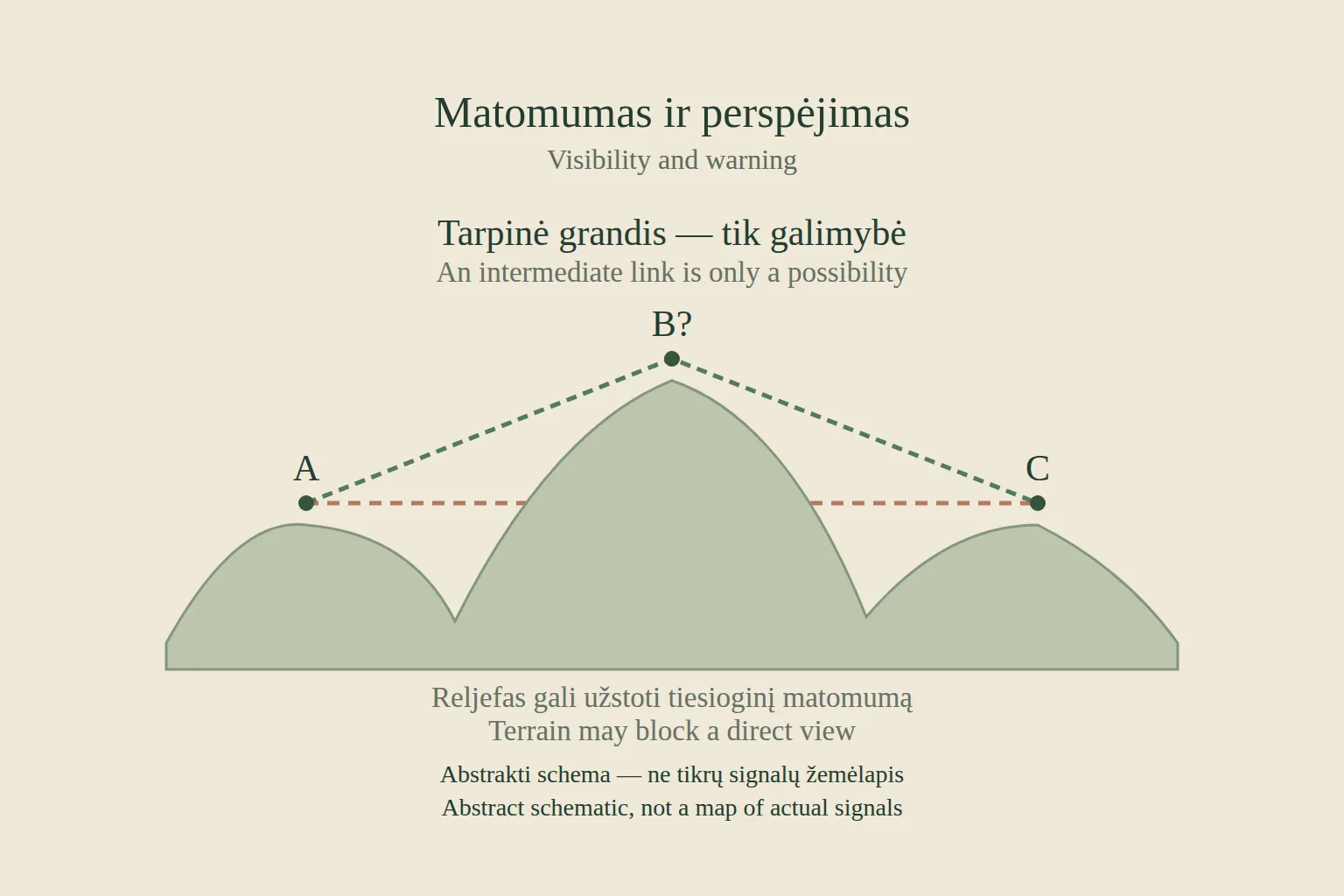
Within the modelled Nemunas corridor, many links cross the river rather than follow the same bank. Even the important centres at Seredžius and Veliuona lack direct visual contact in the model. The result depends on the selected conditions; historical weather and vegetation remain uncertain. S180
In the diagram, terrain blocks one sightline while another remains possible. It uses no actual terrain profile and marks no verified signal tower. Turning a possible link into a historical connection would also require evidence that the sites were contemporary and used that way. S180
Based on: S180
2.20
What survives timber and fire
A hillfort today preserves traces of more than one event.
Baranauskas cautions that fuller sixteenth- and seventeenth-century descriptions of timber castles combine inherited forms with innovations. They cannot simply be transferred to the earlier Nemunas frontier. A later image or standing structure does not automatically portray the same fourteenth-century building. S179
Kurila’s map of hillforts used at different times and Baranauskas’s sequence of building and outer settlements reveal places continually changing. Guards are replaced, harvests gathered and lost, bridges built and removed. Frontier life runs through this work as well as the dates of castles falling. S179 S180 S124