2.1
From duke to sole ruler
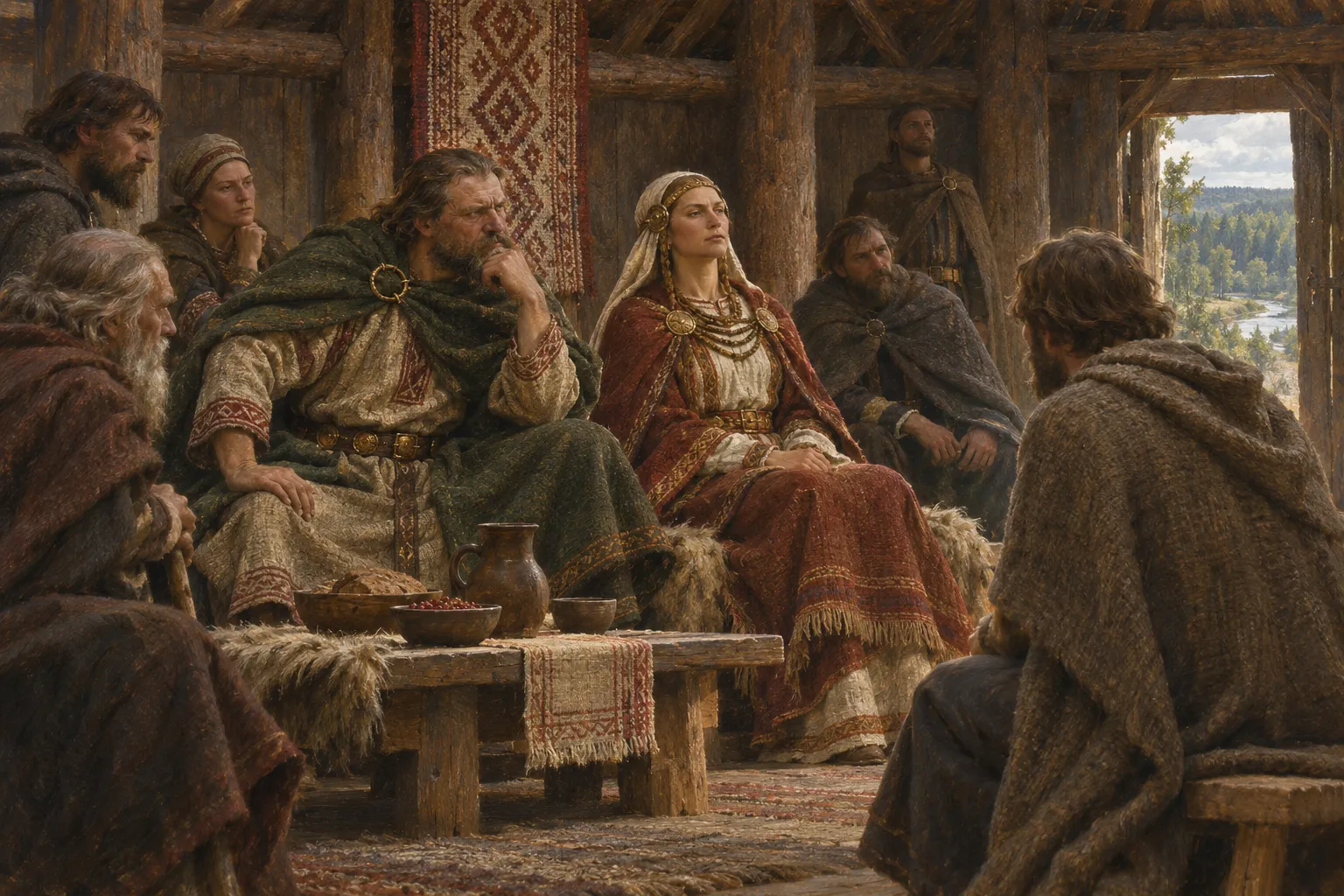
Mindaugas’s path to the throne began among other dukes.
In the agreement of 1219, Mindaugas already appears among the senior dukes, though he is not yet a sole ruler. The 1936 synthesis explains his rise through rivalries between families, military resources and the subordination of other dukes. S6
The 1936 synthesis places Mindaugas’s supremacy before 1236. The Universal Lithuanian Encyclopedia (VLE) dates his first description as ruler of all Lithuania to around 1245. One date reflects an interpretation of when power was concentrated, the other the first such description in a source. S6 S29
As Mindaugas grew stronger, other rulers’ opportunities narrowed. Some lost lands, others were expelled or became dependent. More forces gathered under his authority, but he also gained enemies, including relatives of his own. S6
2.2
Relatives build a coalition
An internal dispute became a war involving neighbouring powers.
In the late 1240s, Mindaugas came into conflict with his nephew Tautvilas, Tautvilas’s brother and their uncle Vykintas. The loss of lands and authority drove the relatives to seek support beyond Lithuania. S6
Daniel, ruler of Galicia and Volhynia, supported the relatives. The Livonian Order and some Samogitians and Yotvingians joined the fighting. Their aims differed, so Mindaugas’s survival could depend on a chance to split the alliance as much as on victory in battle. S6
Based on: S6
2.3
Voruta: a castle with an uncertain location
At Voruta, Mindaugas had help from a former enemy. The castle’s location remains uncertain.
The synthesis recounts an attack on Mindaugas at Voruta in which his opponents failed to take the castle. This time, the Livonian Order supported him. Internal warfare had turned a former enemy into military support. S6
We cannot say exactly where Voruta stood. The 1936 author already discussed competing suggestions, and this article does not confirm any one of them. A photograph of a present-day hillfort or an invented castle illustration cannot provide an undisputed view of Mindaugas’s capital either. S6
Based on: S6
2.4
Baptism and new allies
A religious act also offered a way out of political encirclement.
Mindaugas reached an agreement with the Livonian master Andreas von Stirland. In 1251 the ruler, Morta and members of their court received Catholic baptism. Mindaugas thereby drew an important adversary away from the coalition against him. S6 S30
Baptism opened a relationship with Pope Innocent IV and a path to recognition of royal authority. Its consequences went beyond the ruler’s private convictions. Even so, the baptism of Mindaugas and his court did not mean an immediate change of religion for everyone in Lithuania. S6
2.5
Mindaugas and Morta receive their crowns
Negotiation and ecclesiastical approval stood between baptism and coronation.
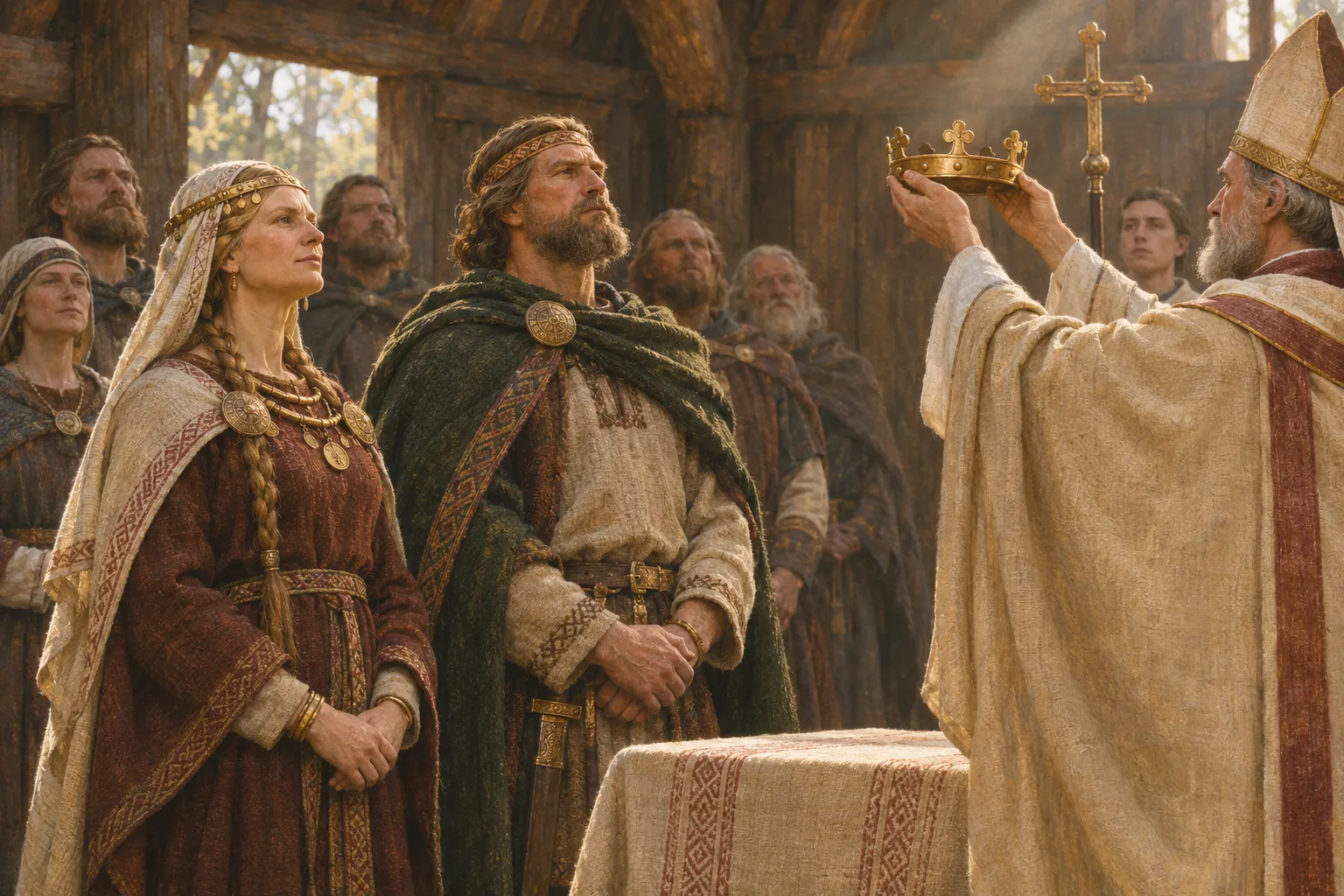
In 1251, Pope Innocent IV supported Mindaugas’s coronation, and in 1253 the ceremony took place. Mindaugas became king of Lithuania and Morta queen. His authority gained a new form of recognition within the political and ecclesiastical order of Catholic Europe. S6
The royal title did not stop internal conflicts, and authority remained firmer in some lands than others. To hold on to the crown, Mindaugas had to maintain agreements with foreign partners and withstand pressure from other dukes. S6
Morta was both queen and a participant in court life. The synthesis attributes to her support for Christian ties with Livonia. Narratives of court conversations help us follow this portrayal, but they are not verbatim records of the queen’s words. S6
Based on: S6
2.6
A bishopric and disputes over land
A bishopric, its jurisdiction and donated lands became questions of power.
As the Lithuanian bishopric was being established, a question arose: would Bishop Kristijonas answer to Riga’s ecclesiastical authority or directly to the pope? The synthesis explains Mindaugas’s pursuit of a direct connection with Rome as an effort to reduce intermediaries’ influence. S6
Agreements with the order and bishop came with grants of land, particularly in Samogitia. Yet a right claimed in a document did not bring effective control over local inhabitants. Resistance and the bishop’s insecure position showed how hard it was to turn written agreements into everyday rule. S6
Some historians consider certain later donation charters forgeries. The lands listed in them therefore cannot provide an undisputed map of Mindaugas’s concessions. S29
2.7
Wars and dynastic ties in the east
In the lands of Rus’, warfare, marriage and different religions brought people into contact.
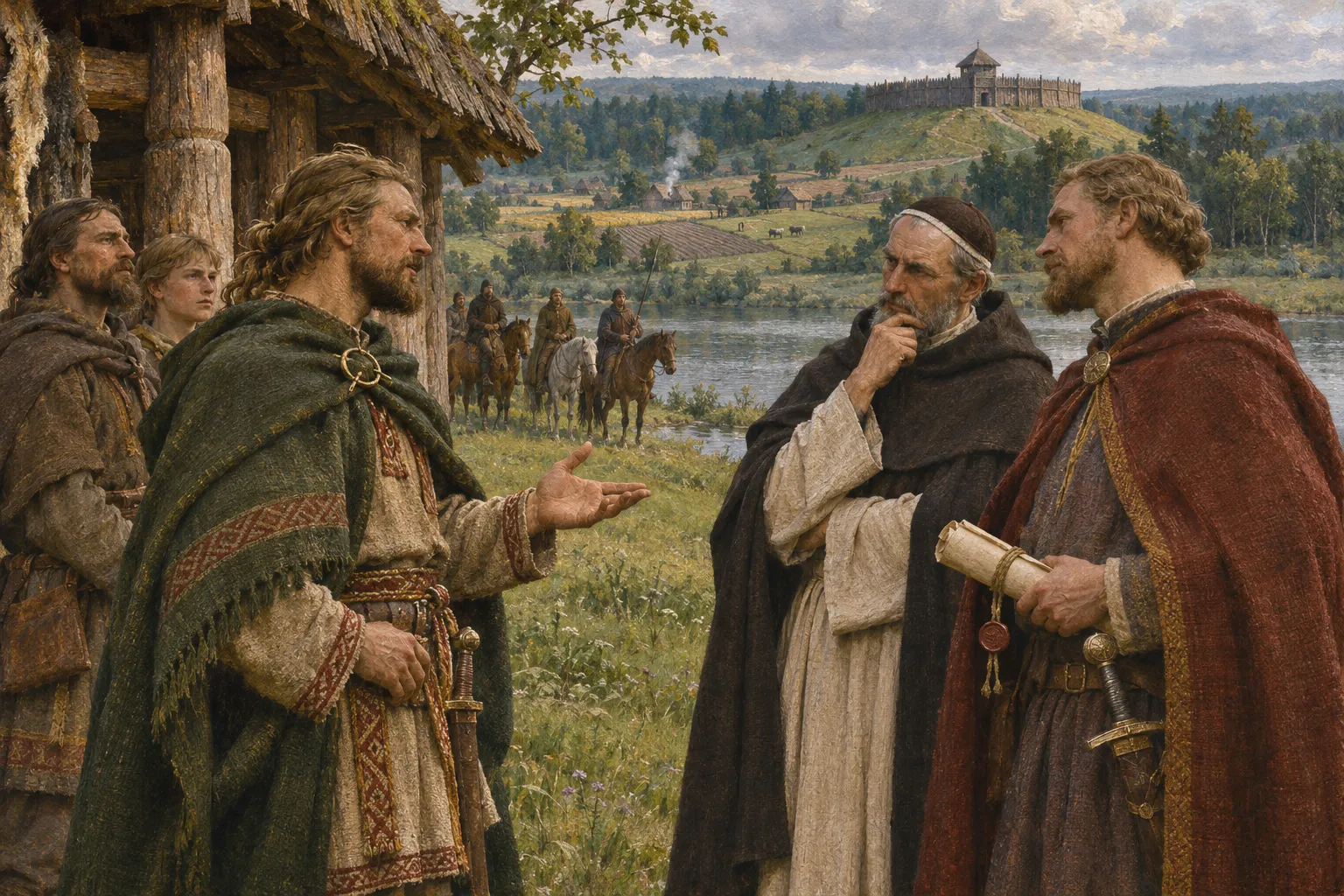
Mindaugas’s relationship with Daniel extended beyond hostility. After the war, dynastic connections reinforced peace: Mindaugas’s daughter married Daniel’s son Švarnas. Rule over Navahrudak and other lands of Black Rus’ formed part of these arrangements. S6
Mindaugas’s son Vaišvilkas adopted Orthodoxy and chose monastic life. Later, he returned to struggles for power. His biography, like the dynasty’s wider world, brings together Catholic, Orthodox and older religious connections. S6
In the late 1250s, a campaign by Mongol-led forces reached Lithuania. The synthesis discusses this danger alongside relations with Galicia and Volhynia. Mindaugas had to balance several directions of policy; ties with Rome and Livonia were only part of the picture. S6
Based on: S6
2.8
Durbe shifts the balance of power
Durbe shook the order and strengthened demands for a change of policy.
In 1260, Samogitians defeated the order’s forces at Durbe. The synthesis stresses heavy losses among its leaders and the resistance that spread afterwards through Baltic lands under its rule. This was a Samogitian victory; the account does not claim that Mindaugas personally commanded it. S6
After the victory, Treniota pressed harder for support of war against the order. Mindaugas abandoned his earlier course of peace and entered a new conflict. Strong castles and poorly coordinated allied action hampered joint campaigns: success in one battle did not guarantee the next victory. S6
Based on: S6
2.9
What do we know of Mindaugas’s faith?
Accounts of the old religion have their own authors and purposes.
Did Mindaugas abandon Christianity? VLE attributes this reading of apostasy after Durbe to some researchers. It remains an interpretation. Breaking peace with the order does not by itself tell us everything about the ruler’s religious life. S30
The Hypatian Chronicle claims that Mindaugas sacrificed to older gods. Beresnevičius examines this account and the meanings of the recorded divine names. The chronicler’s assertions and the scholar’s conclusions answer different questions; neither alone can reconstruct the beliefs of society as a whole. S12
Under 1260, Jan Długosz brings together Mindaugas’s baptism, royal title and abandonment of Christianity. He asks whether discontent over lands ceded to the Order could have prompted the religious turn. This is the author’s proposed explanation. His compressed sequence does not change the baptism and coronation dates given in this article. S140
2.10
The king died. The state endured.
Conspiracy ended Mindaugas’s reign, but did not undo the entire process of state formation.
In 1263, Mindaugas was murdered together with his sons Ruklys and Rupeikis. The conspiracy is associated with Treniota and Daumantas, duke of Nalšia. The ruler’s family circumstances added to political conflicts and discontent among other dukes. S6
The synthesis recounts that, after Morta’s death, Mindaugas retained her sister, Daumantas’s wife. This story explains Daumantas’s personal hostility, but does not establish one certain cause of the conspiracy. The 1936 author’s moral judgements likewise belong to him, rather than to the thirteenth-century participants. S6
Treniota took power after the murder. Vaišvilkas and Švarnas later entered the succession. Violence and dynastic rivalry continued, but the struggle was now over an enlarged Lithuanian polity. The authority Mindaugas had built, and which his successors sought to inherit, was part of his legacy alongside the royal title. S6
Based on: S6