
1.1
What lies within the name Lietuva?
A recorded name, its original meaning and a story about its origin are different questions.
Who wrote down Lithuania’s name, and what land did they describe? What did the word originally mean? These are different questions: one calls for a historical record, the other for a study of earlier word forms and their meanings. Chronicles offer another answer, connecting the name with a memorable ancestor or a vivid story. S6 S7 S19
In the Bychowiec Chronicle, Lithuania’s name emerges from a legend of a shore and wind instruments. Kojelavičius disputes some explanations known to him and offers his own. The origins of a word and a country intertwine in these older books, but each account has its own author and period. S7 S19
1.2
A short entry, a long history.
The Quedlinburg Annals connect Lithuania’s name with the end of Bruno’s mission in 1009.
The entry for 1009 tells of the death of Bruno, or Boniface, on the border of Lithuania and Rus’. The Heritage Commission presents it as the first written mention of Lithuania’s name. The name is already in use, but the entry does not explain its origin. S27
The entry’s date differs from the manuscript’s age: Dresden’s SLUB library holds a later sixteenth-century copy, rather than an original leaf written in 1009. S27
Based on: S27
1.3
Why Lituae on the page, but Lietuva in speech?
A written form also depends on the language of the record.
Tomas Baranauskas explains Lituae as a Latin genitive, with Litua as its nominative. Medieval u/v spelling connects it with Litva. It is a rendering in another language, rather than a phonetic transcript of present Lithuanian. S44
Kojelavičius also discusses different forms of the name. The same letter could suggest a different explanation to writers in different periods. Reading an old form alongside the text’s language and the author’s argument keeps those differences visible; replacing it with the modern word would obscure them. S7
1.4
Could a country’s name begin with a stream?
In 1964 Kazimieras Kuzavinis developed a river-name explanation.
Kuzavinis turned to Lietava, also called Lietauka, a tributary of the Neris. In his explanation, the river gave its name to the surrounding land and then its people. He linked the forms Lietava and Lietuva through the suffixes -ava and -uva. S41
Kuzavinis also examined forms of the name used by local speakers. His explanation proposes how the name developed, without identifying a particular occasion when the country was named. S41

Based on: S41
1.5
A name from a community of people.
In 1995 Simas Karaliūnas looked for an original meaning in a term for a war band.
Karaliūnas proposed the reconstructed words *leita, *lietava and *lietuva, meaning a retinue or troop. The asterisk marks a reconstructed form, rather than one directly attested. He based his argument on chronicle uses of Litva and related Germanic words. S42
In his account, a name for a community came to denote a people; he connected that development with older cognates. S42
Based on: S42
1.6
The ruler’s people and an old name.
Artūras Dubonis connects the discussion with the documented leičiai.
Dubonis describes the leičiai as the grand duke’s service people. Their duties included horse care, military road service and farming: more than soldiers assembled for battle. S43
In Dubonis’s explanation, the name’s social and ethnic meanings could overlap. Latvian leitis also means a Lithuanian. Yet the presence of leičiai in the records does not explain exactly how the word Lietuva formed; that needs its own argument. S43
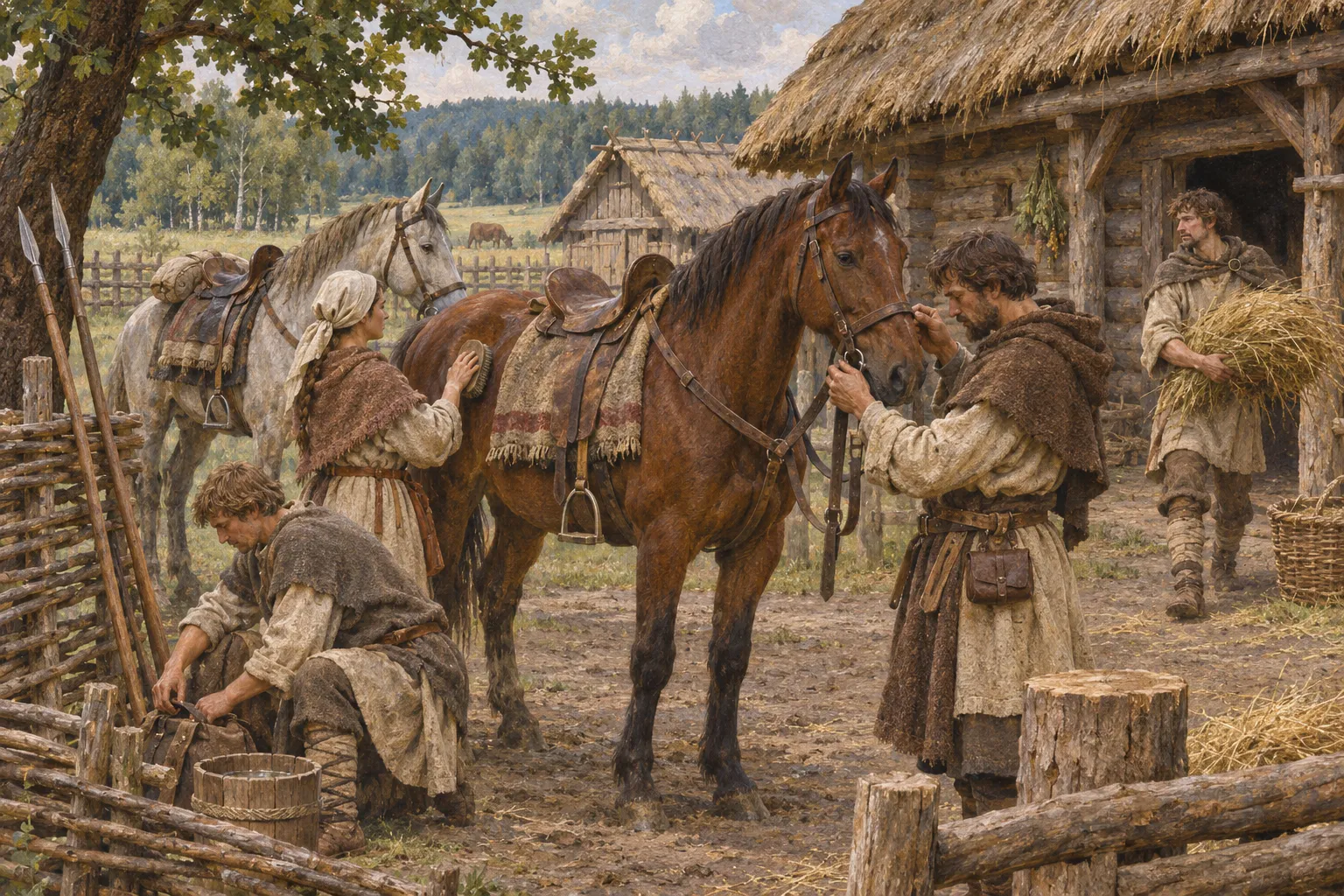
Based on: S43
1.7
Similar words are only part of an origin story.
Baranauskas raises questions about both the stream and war-band explanations.
Can a small stream explain how a name spread across a region? Baranauskas doubts it. He poses a different question about Karaliūnas’s explanation: a chronicle term could mean a Lithuanian army, but does that show that the people’s name originally meant army? S44
What received a name first, who used it and how did it spread? These questions also arise in the stories of Kernius’s shore and Kojelavičius’s ancestor. They propose different sequences of beginnings, which we can compare while keeping each account’s reasoning intact. S19 S7
1.8
Does Lietuva mean a land of rain?
Resemblance to lietus, “rain”, does not by itself establish an origin.
Karaliūnas reviews earlier connections with pouring, flowing and rain. Direct naming after weather and derivation through a water-name are different hypotheses. S42
Writers known to Kojelavičius also sought appealing resemblances, comparing Lithuania’s name with Italy, a shore or a trumpet. Kojelavičius himself disputed some of these explanations. A memorable story may reveal its maker’s imagination, but explaining a name’s origin requires showing how it could have formed that way. S7
1.9
Kernius gives a name: a chronicle legend.
The Bychowiec Chronicle gives Lithuania’s name a place, a protagonist and a sound.
In the sixteenth-century chronicle’s story, Kernius rules beyond the Neris, where his people settle and play wind instruments. The account then introduces Latin litus, a shore, and tuba, a pipe or trumpet. Joining them supplies an intermediate name which the story turns into Lietuva. S19
The episode belongs to the chronicle’s broader story of Roman origins. Latin is more than decoration: it connects the people with ancient newcomers and the language they supposedly brought. The name’s explanation becomes part of a genealogy, while a riverbank becomes the scene of a new country’s beginning. S19
In the chronicle’s translation, the intermediate name is Litusbania. That is the wording of this redaction, which we leave unchanged rather than adjust to the modern name. The story shows how a meaningful account of origins was made in the sixteenth century. It does not establish a naming event or form part of the annals’ entry for 1009. S19

Based on: S19
1.10
Even the older authors disagreed.
Kojelavičius does more than transmit familiar stories: he chooses between them.
Writing in the fifteenth century, Jan Długosz tells of people who fled Rome’s civil wars and travelled north. They supposedly named their new land Litalia, keeping Italy’s name. He argues for kinship from similarities he perceives in language and customs. This is his own explanation, distinct from the Kernius and Litalanus stories; it does not establish the linguistic origins of Lithuania’s name. S140 S7 S19
In his seventeenth-century history, Kojelavičius considers a story about newcomers from Italy. They supposedly preserved their homeland’s name abroad, with Italia later becoming Litalia and Lietuva. This is one of the older explanations he examines, rather than a conclusion of modern linguistics. S7
Kojelavičius himself rejects dating the name from the Italians’ arrival. He prefers an account linking the land with the Alans, the Heruli and Litalanus, also called Litvanus. In his text, Alania becomes Litalania and Litvania. He replaces one origin story with another; both belong to the historiography of his time. S7
Kernius’s account explains the name through a shore and wind instruments. Kojelavičius offers a different account and debates the ancestors’ origins. Each has its own protagonists and arguments, so they cannot be combined into a single tradition. Read together, they show how Lithuania’s name was discussed and reinterpreted long before twentieth-century linguistic studies. S7 S19
1.11
Even the first mention has a research history.
Šapoka’s 1936 volume offers an earlier account of the name’s recognition.
Šapoka’s volume claims in its section on the earliest historical notices that a scout of Charlemagne mentioned the Lithuanians in the early ninth century. That differs from the Lituae entry for 1009. It is a claim in the 1936 synthesis; its manuscript basis has not been established here, and no exact quotation is supplied. S6
The same book describes rulers and nobles seeking an honourable account of the state’s past. Origin narratives operated within politics, supporting claims to antiquity, nobility and the dignity of the state. The name’s history thus includes its use and later efforts to explain who its people were. S6
Based on: S6
1.12
The name survived. Its beginnings remain a question.
Different accounts can be compared while preserving their provenance.
The Kernius legend asks about a community’s beginnings and gives them a memorable image. Kojelavičius shows an earlier explanation being challenged and another ancestral story preferred. These books preserve both proposed answers and the desire, in different periods, to give Lithuania’s name a meaningful past. S7 S19
A source’s date tells us when testimony was recorded or an explanation proposed, rather than when the name itself arose. The accounts below return to the different authors. The illustrations help us imagine the subject, but cannot replace written evidence. S6 S7 S19