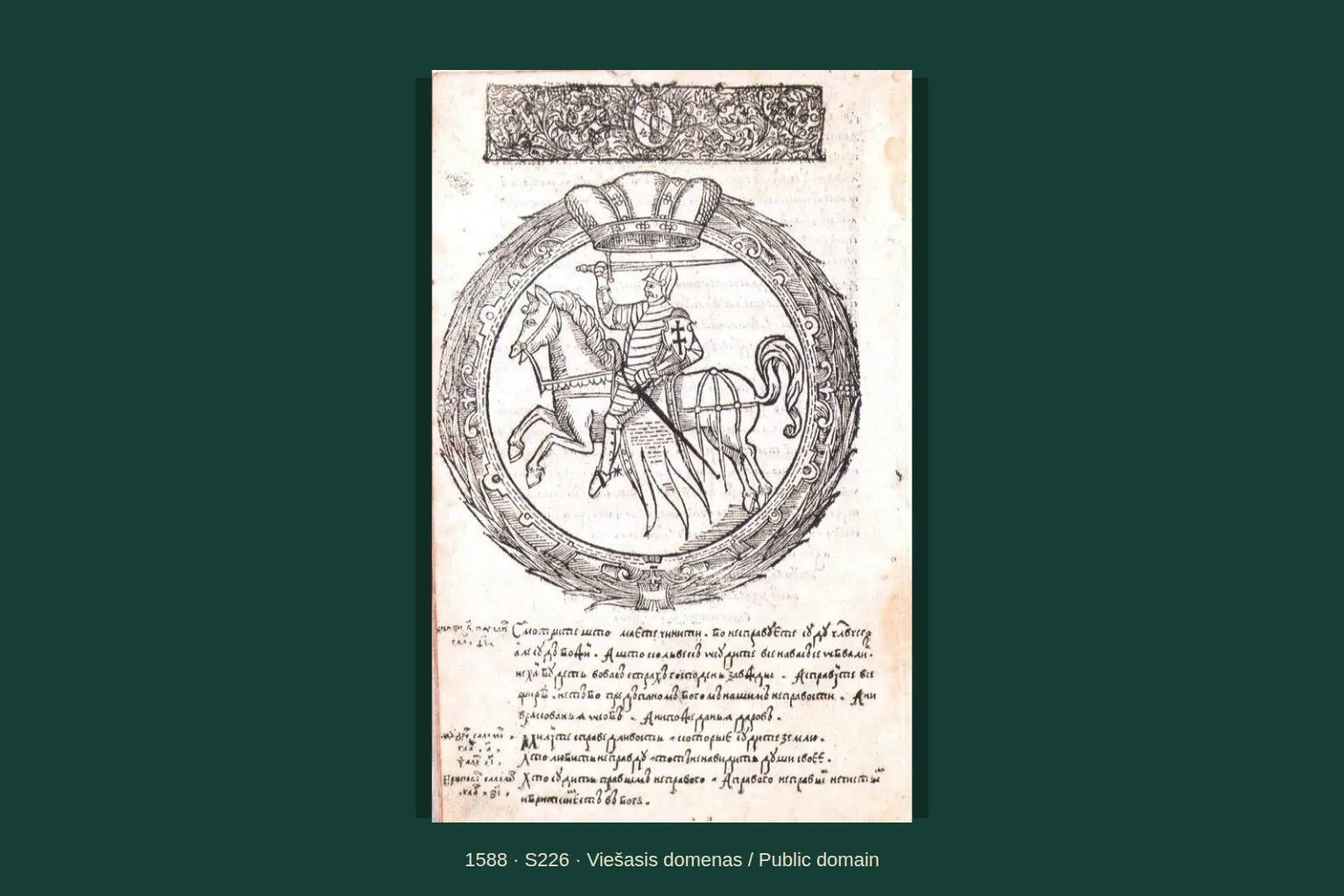
2.1
The Statute in the 1936 history
The history edited by Šapoka links separate law with political autonomy.
The book presents the Statute as an ordering of customs and privileges. It connects the 1566 redaction with noble court reform and the 1588 text with the Lithuanian chancery and Leonas Sapiega. The authors place these changes within their account of the polity’s autonomy. S6
Based on: S6
2.2
Three redactions of the Statute
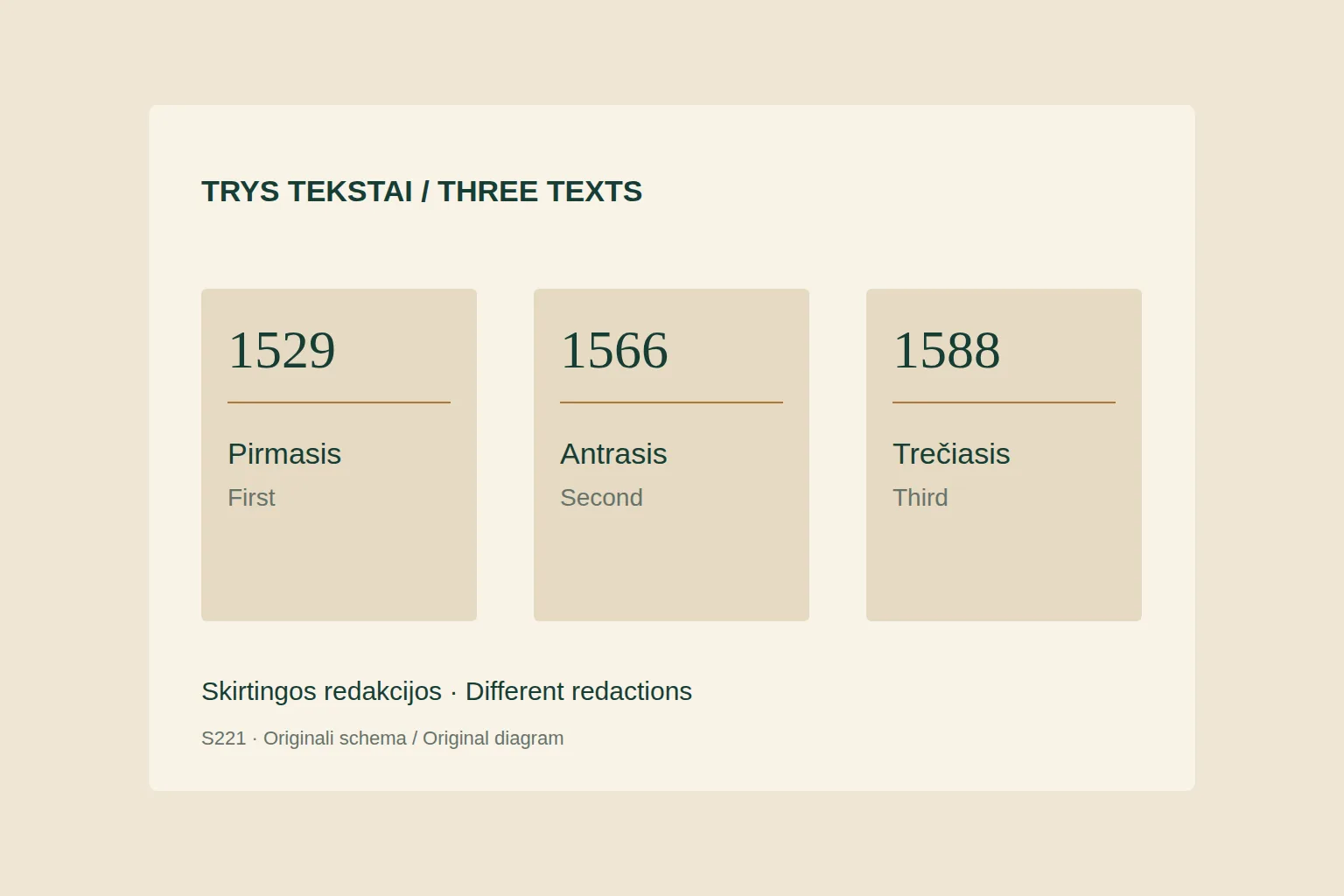
1529, 1566 and 1588 mark three different redactions of the code.
The First Statute, approved in 1529, was copied, used in courts and later revised. Jūratė Kiaupienė sees the history of all three redactions as an interaction between legal and political culture: in making rules, society also defined its relationship with the state. S221
The Second and Third Statutes changed earlier provisions. Courts and political circumstances changed alongside them. Each rule discussed here belongs to a particular redaction, identified by both its year and its article number. S221 S222
2.3
Law travels in manuscript copies
The First Statute reached courts through manuscript copies.
Kiaupienė notes that both the complete code and portions of it were copied. Courts thus received manuscripts of differing scope rather than a uniform printed edition. Surviving copies attest to the Statute’s use, but do not reveal how many people possessed its complete text. S221
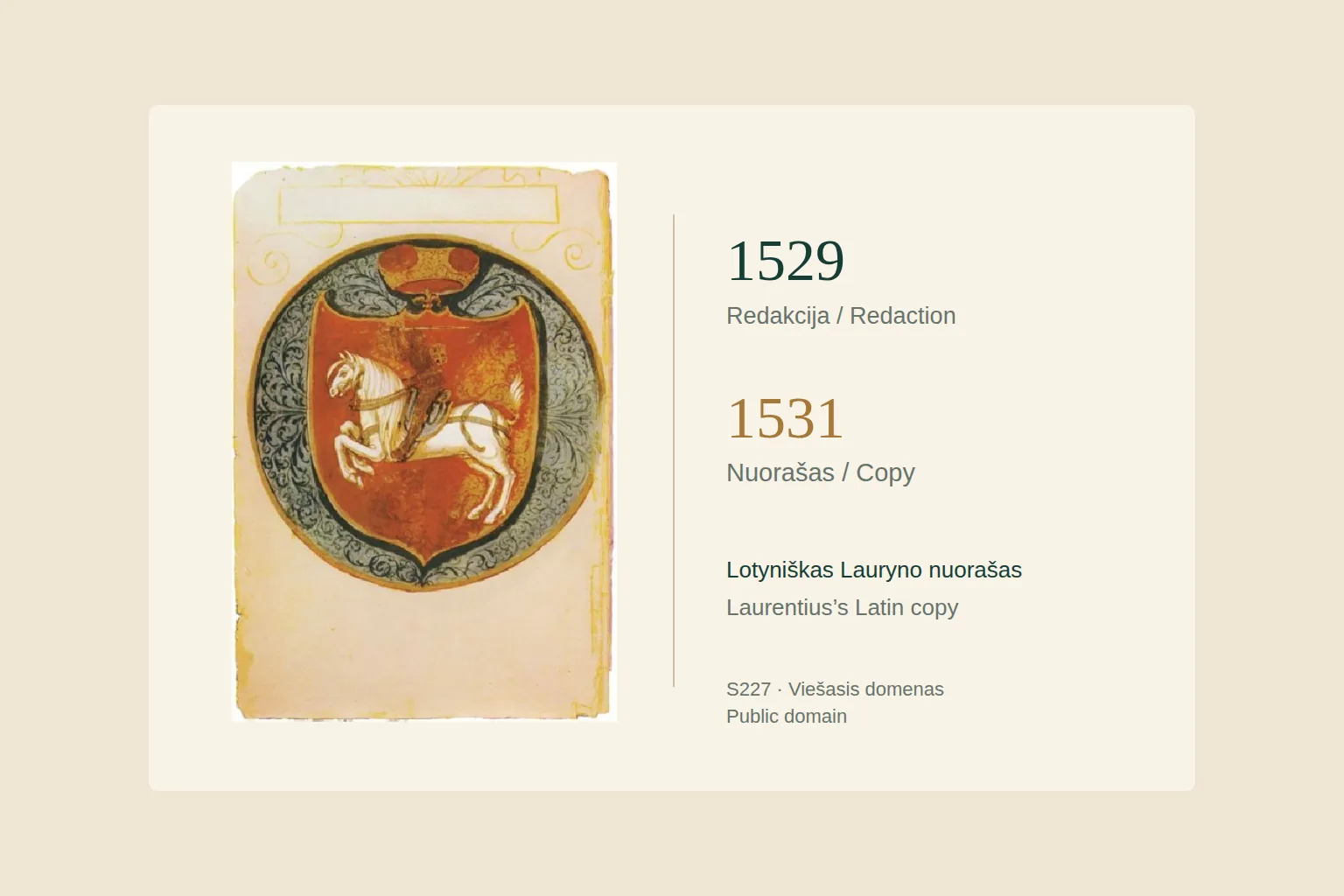
The illustration shows a page catalogued on Commons as belonging to Laurentius’s Latin copy of 1531. This dates the copy, rather than a new redaction of the Statute. The page displays a coat of arms; it contains no legal articles. S227
2.4
What language carried the law?
The Second Statute was written in the chancery language of the Grand Duchy of Lithuania.
The Second Statute, Kiaupienė writes, was drawn up in chancery Slavonic. This written tradition of the Grand Duchy of Lithuania is often called Ruthenian. “The Statute of Lithuania” names the polity’s code; its original was not written in modern Lithuanian. S221
Latin translations reached a different readership. Translators had to find ways to express local legal concepts and the polity’s name. Translation into another language did not, however, constitute a new redaction of the Statute. S221
Based on: S221
2.5
Liberties in a society of estates
Noble liberties did not amount to equality for all inhabitants.
Vaidotas A. Vaičaitis examines the Second Statute through the history of constitutionalism. He also notes that the full range of civic rights he discusses chiefly belonged to settled Christian noble men. Other groups occupied different positions. S222
Other groups also held rights, but their opportunities to participate in government, manage property, go to court or obtain judicial protection differed. The single word “liberty” does not capture those differences. S222
Based on: S222
2.6
The judicial changes of 1566
The Second Statute accompanied reform of the nobility’s courts.
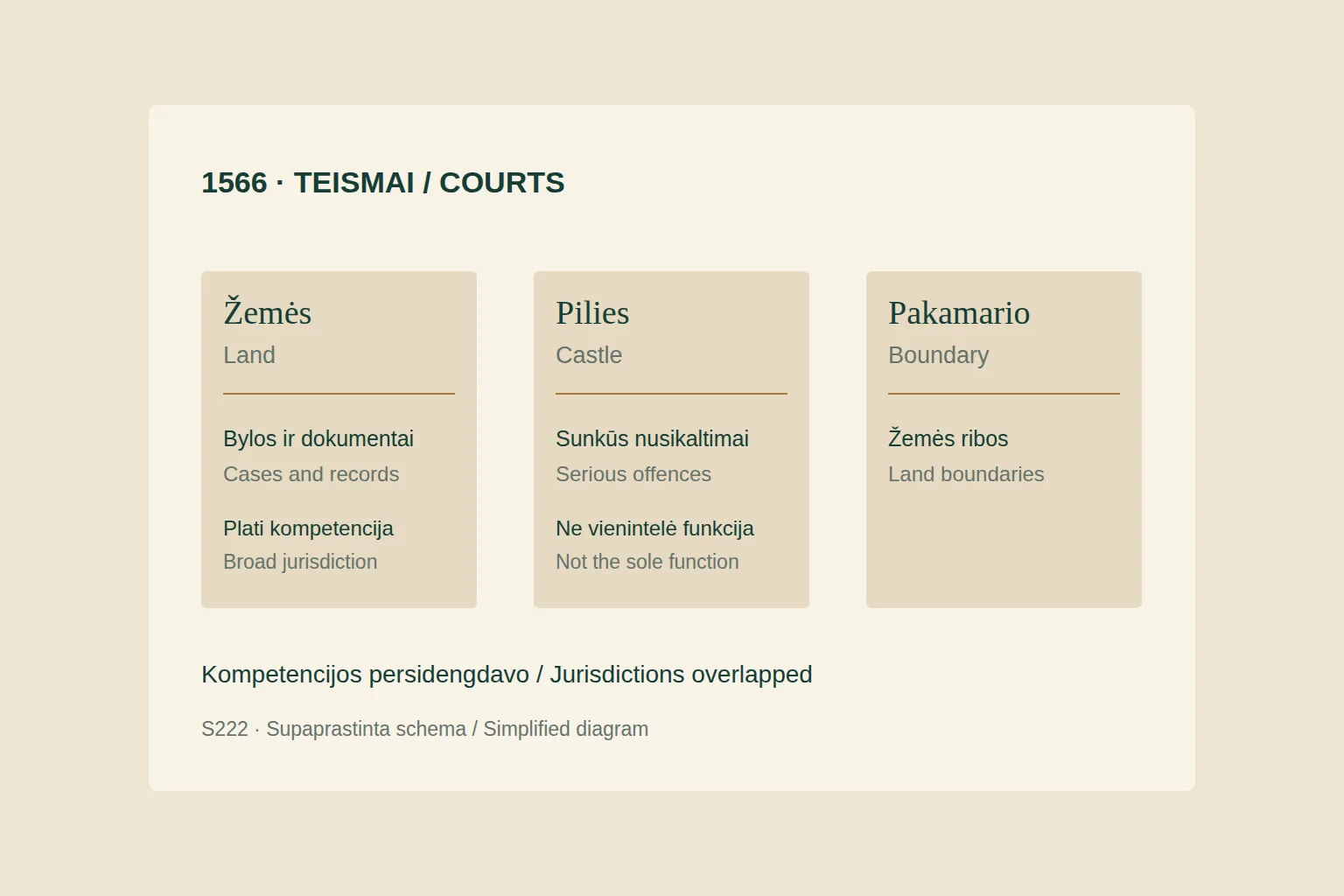
Vaičaitis describes land, castle and boundary courts. Land courts heard various cases and registered documents. Castle courts dealt especially with serious offences, while boundary courts settled disputes over land boundaries. S222
Their jurisdictions did not follow today’s division between civil and criminal courts. Vaičaitis also mentions disputes between nobles and townspeople heard in land courts. A person’s status, the nature of the dispute and privileges could determine where a case was heard. S222 S223
2.7
How a judge was chosen
Under section IV, article 1 of the 1566 text, both local nobles and the ruler took part in choosing a judge.
The provision discussed by Vaičaitis set out two stages: the local noble assembly was to choose four candidates, and the ruler was to appoint one of them as judge. Noble election and the ruler’s decision formed a single appointment process. S222
Candidates needed a good reputation and knowledge of the law. These requirements defined the judge the code sought. Whether an appointee met them, and how he performed, must be investigated through records of his work. S222
Based on: S222
2.8
Court order and the judge’s oath
The Statute regulated conduct in court as well as the subject of a dispute.
Vaičaitis discusses the judicial oath and the prohibition on judging one’s own case. Section IV, article 38 of the 1566 text also governed the court’s space: firearms could not be brought into it. S222
Court procedure required more than a list of penalties. The Statute had to establish who decided a case, how participants behaved and what obligations a judge assumed. These provisions reveal the intended order, but not how often it was breached. S222
Based on: S222
2.9
Who paid for the court’s work?
Section IV, article 3 of the 1566 text specified a payment.
Under the provision discussed by Vaičaitis, the losing party owed one Lithuanian grosz for each kopa awarded. Two-thirds of this fee went to the judge and one-third to the deputy judge. This was how the court’s work was paid for; the amounts are not converted into modern currency here. S222
Based on: S222
2.10
What could a noble do with land?
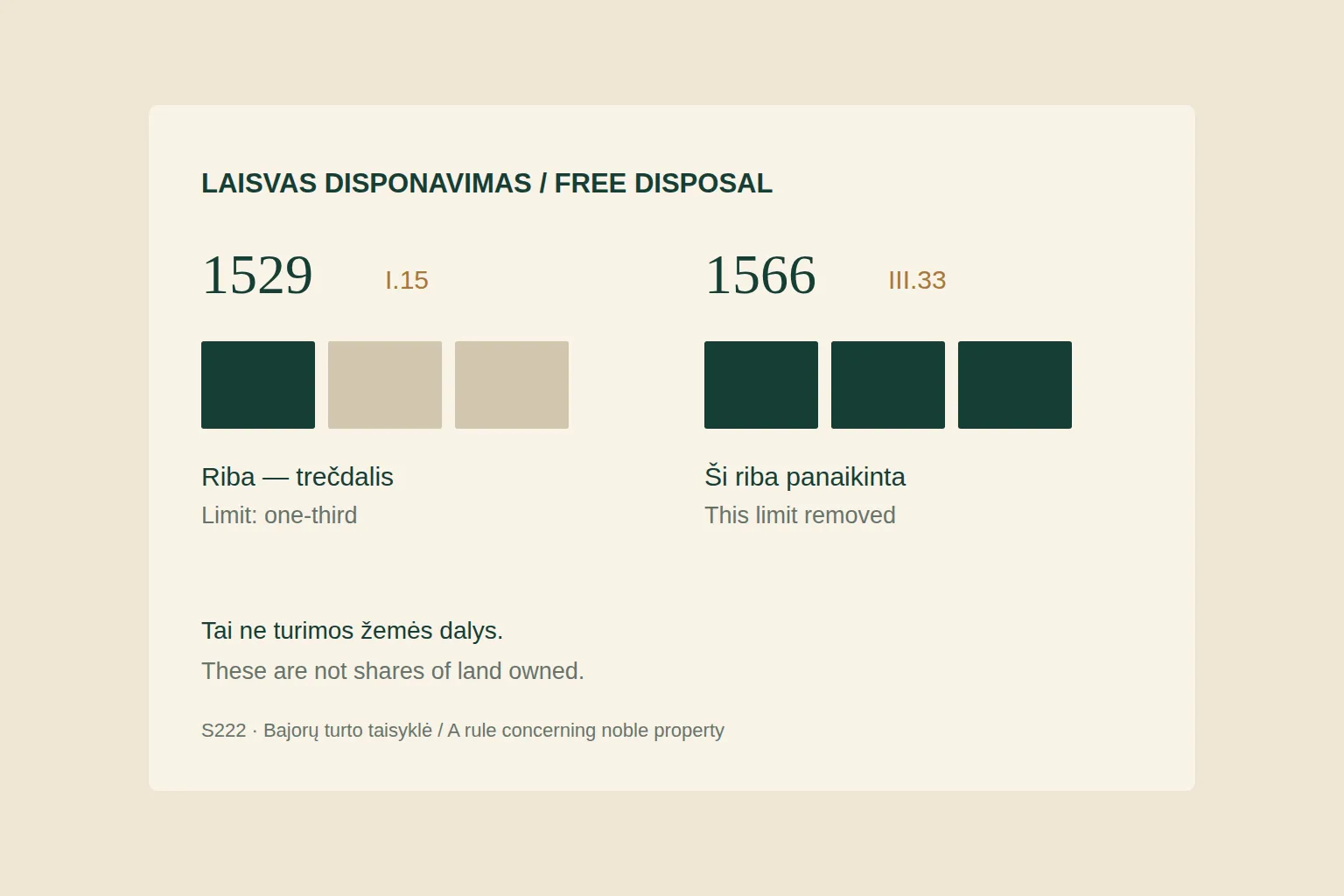
The 1529 and 1566 redactions set different limits on the disposal of property.
Vaičaitis compares section I, article 15 of the 1529 text with section III, article 33 of the 1566 text. In the First Statute, free disposal of immovable property was limited to one-third. The Second removed that restriction. S222
The rule defined how much property a noble could freely sell, pledge or give away. The one-third limit did not mean he owned only a third of his land. Removing it widened a noble’s freedom of action without making property rights equal for all inhabitants. S222
Based on: S222
2.11
Widows, orphans and representation
Legal protection extended beyond the nobles who held electoral rights.
Vaičaitis discusses provisions for representing widows, orphans and poor noble defendants. This protection did not amount to equal political or inheritance rights for women and men. The passage discussed does not specify inheritance shares. S222
Based on: S222
2.12
Free status and dependence
Protective provisions coexisted with unequal status.
Vaičaitis identifies a prohibition on enslaving a free person in section XII, article 7 of the 1566 text. The provision protected free status within the period’s society of estates. It did not itself abolish peasant dependence or establish universal personal liberty. S222
Based on: S222
2.13
Vilnius also had its own legal order
Magdeburg law and municipal courts did not disappear when the Statute was approved.
Mindaugas Klovas and Antoni K. Urmański study Vilnius’s judicial autonomy. Self-governing burghers used municipal courts and Magdeburg law. This order coexisted with the Statute: a single code did not govern every inhabitant of the Grand Duchy in the same way. S223
Municipal courts heard disputes and recorded transactions, wills and guardianship matters. Court books therefore document more than offences. They also preserve traces of property, families and everyday agreements. S223
Based on: S223
2.14
When jurisdictions overlapped
The town’s rights needed defence and renewed confirmation.
Klovas and Urmański describe clashes between municipal, castle and ecclesiastical jurisdictions. A privilege supplied a legal basis for defending a court’s authority, yet disputes over the right to judge continued. S223
During the judicial reform, Vilnius sought to protect its autonomy. Sigismund Augustus’s privilege of 16 January 1566, discussed by the researchers, reconfirmed the town’s rights. This dates a municipal guarantee rather than a new redaction of the Second Statute. S223
Based on: S223
2.15
Separate law after the Union of Lublin
The union of 1569 did not abolish Lithuania’s Statute.
Kiaupienė stresses that distinct legal and political cultures continued within the shared Polish–Lithuanian state. The Statute helped define Lithuania’s legal sphere, giving it significance for the polity’s place within the common political order. S221
That place was subject to political negotiation. Drafting the Statute and the Sejm’s work were bound up with arguments over the polity’s position. In Kiaupienė’s study, making law also emerges as a way of shaping the political order. S221
Based on: S221
2.16
The Latin text of 1576
The Second Statute was rendered into Latin after the union.
Kiaupienė discusses the 1576 translation attributed to Augustinas Rotundas. The translator condensed the original while retaining the articles’ content. An appended historical narrative also helped support a political view of Lithuania’s place within the shared state. S221
Based on: S221
2.17
The 1588 publication
The Third Statute was printed in Vilnius.
Visuotinė lietuvių enciklopedija (VLE), Lithuania’s general encyclopaedia, identifies the Mamoničiai press. The Third Statute comprised 14 sections and 488 articles. The printed edition began a new stage in the code’s circulation. S225
Based on: S225
2.18
1588 and 1589
Approval and commencement have different dates.
VLE dates approval to 28 January 1588 and commencement to 6 January 1589. The Statute takes its name from the approval year. S224
Based on: S224
2.19
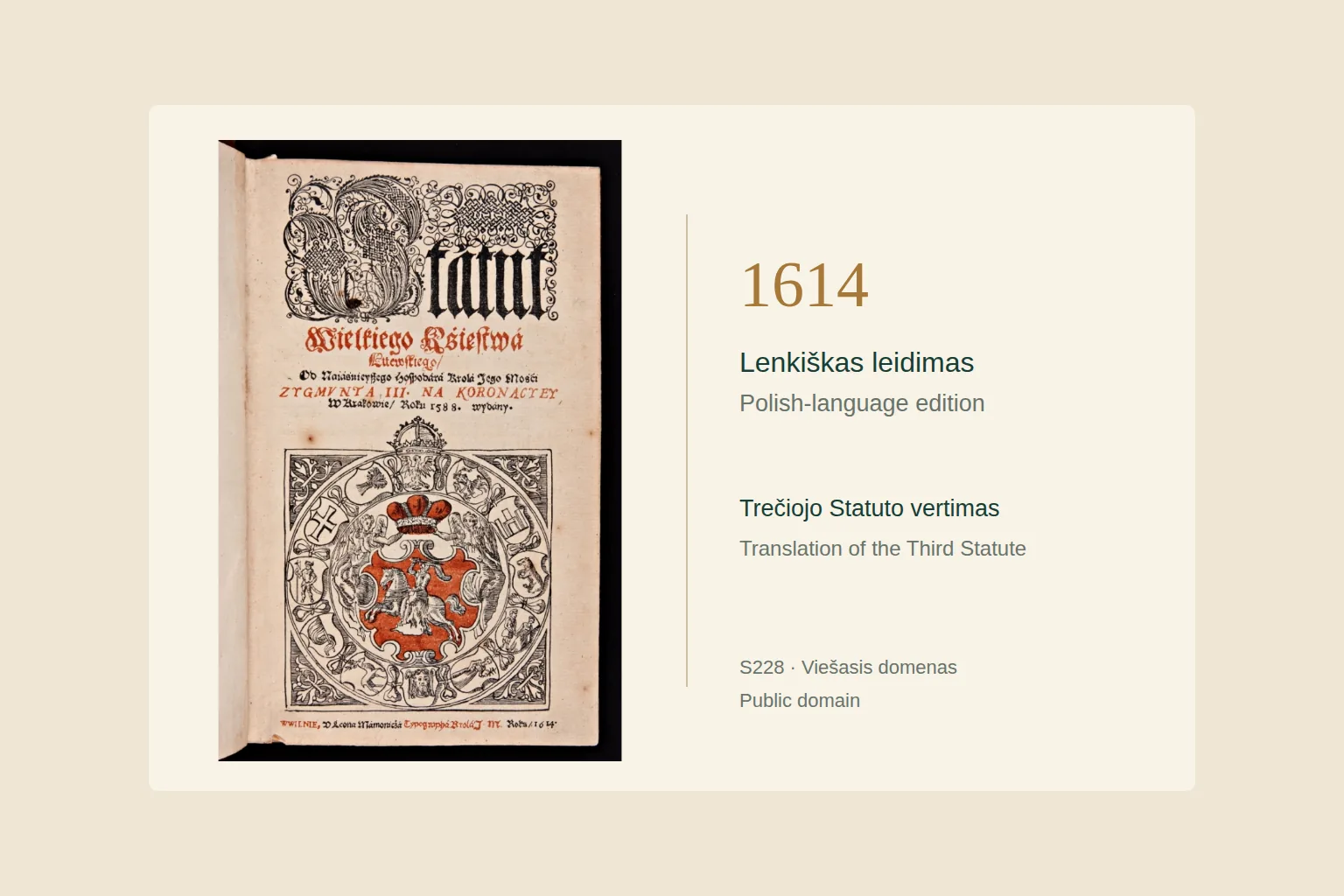
A Polish-language edition
The Third Statute was later published in Polish.
VLE dates the first Polish editions to 1614. The illustration shows a title page bearing the same date in the Commons catalogue. This is an edition of a translation of the Third Statute, rather than a fourth redaction. S225 S228
2.20
1840: validity ends
In Lithuania, the Statute remained valid until 1840.
VLE dates the end of the Statute’s validity in Lithuania to 7 July 1840. Its legal continuity extended beyond the partitions. This date concerns Lithuania; it is not applied to all territories that once belonged to the Grand Duchy. S224
Based on: S224
2.21
Kojelavičius and Jurginis
Jurginis’s introduction accompanies Kojelavičius’s history.
Writing in the seventeenth century, Kojelavičius places the ordering of laws under 1530 and describes agreement from all estates. In the later edition’s introduction, Juozas Jurginis links the Statute’s significance with landowning power. These are perspectives from two periods. S7
Based on: S7
2.22
Between legal text and people’s lives
The Statute prescribed rules; other records help reveal how they worked.
Vaičaitis focuses chiefly on the code’s provisions, while Klovas and Urmański also examine disputes over judicial authority. Provisions defined the intended order; privileges and court records reveal how people defended their rights and what they contested. S222 S223
The Statutes’ history brings together the making of law and people’s unequal opportunities to use it. Alongside questions of political autonomy stand the appointment of a judge, a land transaction and a town’s efforts to defend its court. S221 S222 S223