2.1
Conversion moved at different speeds.
A ruler’s baptism can be dated to one day. Personal belief, parish life and religious change across a realm cannot.
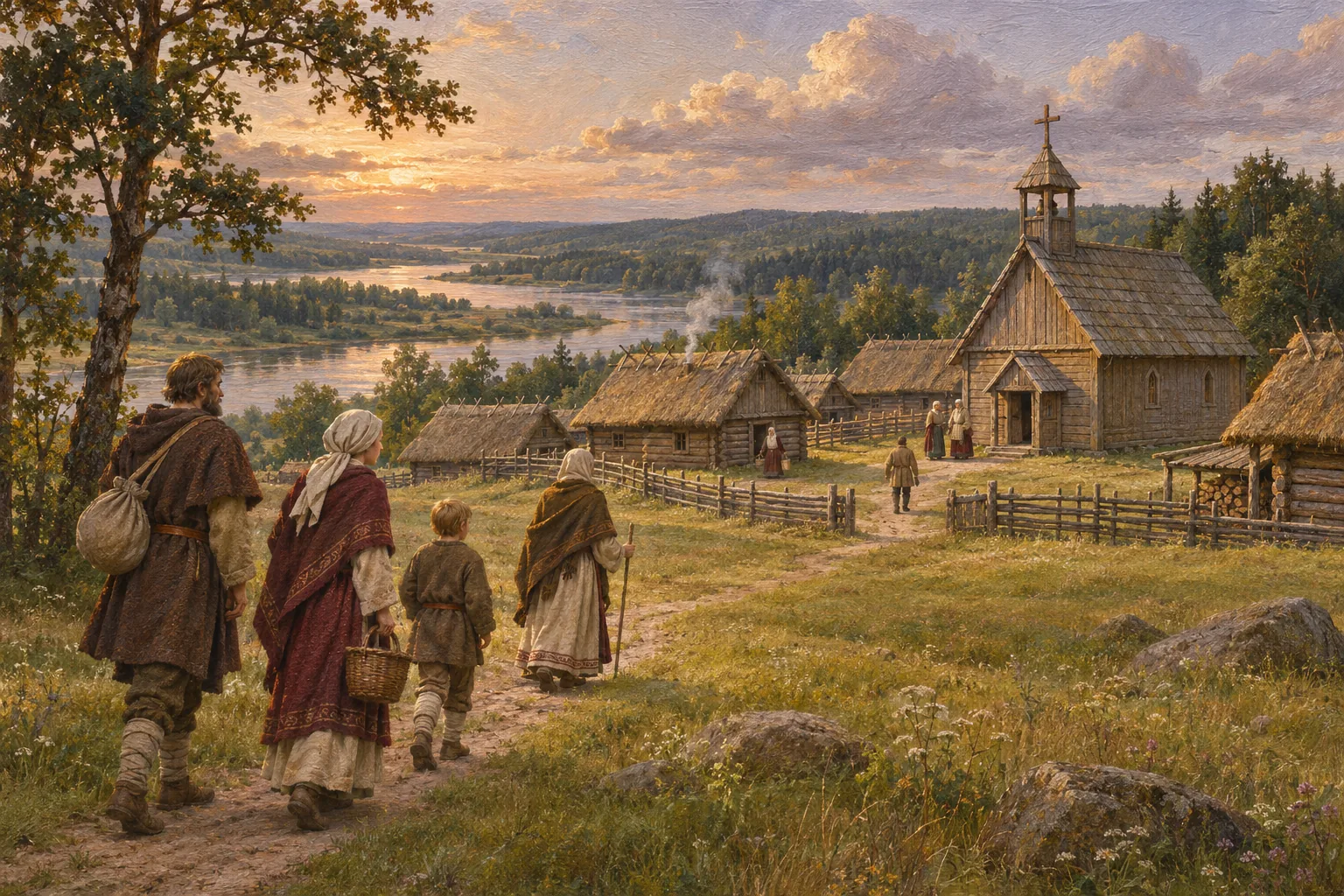
In 1387, Jogaila brought his conversion programme to Vilnius. The Šapoka-edited history describes the gatherings, ceremonies and church foundations that marked this public turning point. It also recounts older practices surviving afterwards. The ruler’s decision needed lasting support: people to teach the faith and local institutions to carry on after the celebrations. S6
Samogitia lay outside the programme of 1387. The history edited by Šapoka recounts a royal visit in 1413, the establishment of a bishopric and parish foundations. Individual baptisms, episcopal authority and an accessible church brought related changes that did not necessarily happen together. S6
Christians already lived in the realm’s Rus’ territories before Jogaila, with Orthodox communities, Church institutions and traditions of writing. Here, Lithuania’s conversion means the establishment and spread of Catholic authority and institutions in Lithuanian territories. Across the wider realm, it took place among people who already knew different forms of Christian life. S6
Writing about the sixteenth century, the 1936 history still describes widely scattered churches, shortcomings in clerical training and work and limited religious knowledge among some inhabitants. Its broad assessment cannot tell us what every person believed. It does, however, bring a practical problem into view: founding a parish did not ensure that a priest could regularly reach its people. S6
Based on: S6
2.2
Faith crossed political boundaries.
Missionaries, merchants, princely relatives and townspeople formed different connections with Christianity before the official conversion.
The Šapoka-edited history places early missions among neighbouring rulers’ ambitions and local resistance. Adalbert’s death in 997 belongs to the mission history of Prussia and the wider Baltic region. Such encounters could be dangerous, but the episode alone cannot tell us how far missionaries travelled or how other Baltic communities received them. S6
In Livonia, the 1936 narrative follows merchants, clergy, settlers and armed protectors into a history of conquest. They travelled and acted alongside one another, although their work differed. Trade, preaching and a military order’s campaign created different encounters with Christianity. A Christian arriving near Lithuania might be a neighbour, a visitor or a political opponent. S6
Jonaitis connects urban burials predating 1387 with Christian, particularly Orthodox, communities. His archaeological interpretation combines several indicators: one grave good or burial orientation does not establish each person’s faith. S86
Christianity also entered princely families along different paths. The Bychowiec Chronicle tells of Mindaugas’s son Vaišvilkas becoming an Orthodox monk. The Šapoka-edited history follows Algirdas’s efforts over metropolitan authority in the Rus’ territories. These connections predated the official Catholic programme, and could develop outside Roman authority. S19 S6
2.3
Baptism opened a path to kingship.
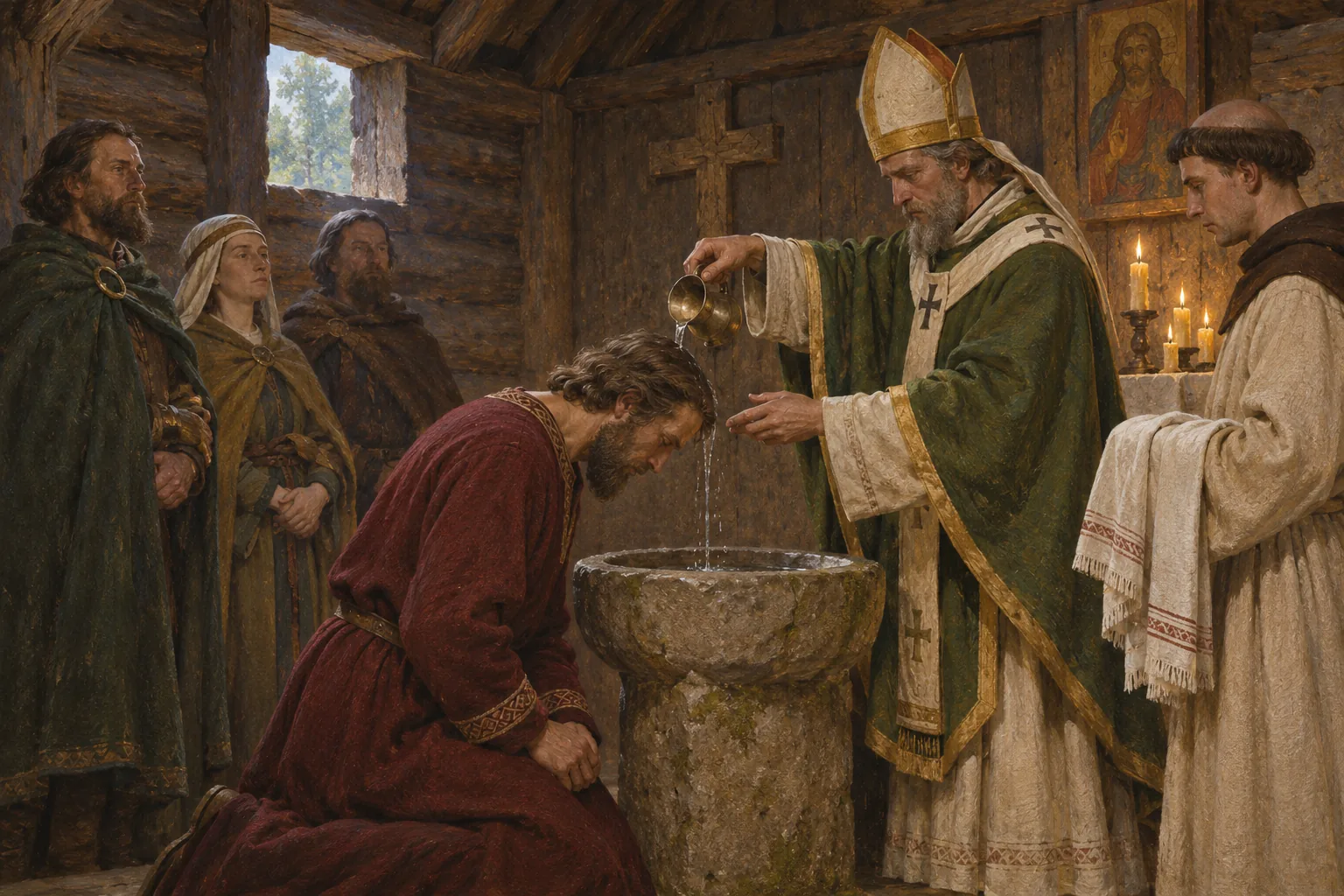
Mindaugas’s baptism in 1251 and coronation in 1253 belonged to one political change of direction, but were separate events.
Facing internal conflict, Mindaugas sought an agreement with the Livonian Order. The Šapoka-edited history connects his baptism with the search for allies and security: a Catholic ruler could seek a different standing among Christian powers. Diplomacy, shifting alliances and the pursuit of a crown are easier to follow in these sources than his private belief. S6
Papal approval came on 17 July 1251. The 1936 history separates this decision from the coronation ceremonies of 1253. Negotiations and Church decisions lay between the promise of kingship and the ceremony itself. Mindaugas’s baptism brought the Lithuanian ruler into a relationship with Rome and raised the question of how to establish a bishopric. S6
Kojelavičius tells the story with a larger ceremonial scene. He places baptism under 1252 and associates the coronation with Naugardukas and a gathering of nobles. His seventeenth-century narrative offers its own chronology and setting. Those details preserve a distinct account of the occasion, rather than an exact plan of the event. S7
Jasas, writing in the 1971 commentary, proposes April or May 1251 for the baptism of Mindaugas and Morta. The Šapoka-edited history allows late 1250 or early 1251. These accounts support the broad landmark of 1251 more readily than a precise day; neither passage settles exactly when the baptism took place. S19 S6
2.4
A bishopric needed more than a title.
Mindaugas’s baptism raised questions about who would govern the new Church and what would sustain it.
Who would the first bishop answer to: Riga or the pope? The Šapoka-edited history connects the dispute with the Lithuanian ruler’s autonomy. Subordination to a neighbouring Church centre and direct protection from Rome offered different possibilities. Baptism created new relationships, while leaving the parties to contest who held authority within them. S6
Bishop Kristijonas received lands in Samogitia, but the 1936 history describes his position as insecure and dependent on the Order’s support. The donation gave him a written claim. Reaching people and collecting income were further challenges, shaped by warfare, local interests and rival authorities. His bishopric still had to establish a presence on the ground. S6
The same history treats Kristijonas’s withdrawal and Vitas’s appointment as separate events. Its authors remain unsure whether Vitas ever reached the territory assigned to him. An appointment could give a bishop a title while leaving little trace of his local work. These early episcopal names tell us less about where functioning parishes could be found. S6
Kojelavičius compresses the beginnings, calling Vitas Lithuania’s first bishop. The Šapoka-edited history spends more time separating appointments and questions of jurisdiction. Their accounts arrange the early Church differently. Behind the names and titles lay a continuing practical difficulty: bishops needed the opportunity and support to stay and work in the places entrusted to them. S7 S6
2.5
An alliance broke; belief became contested.
The rupture between Mindaugas and the Order and later portrayals of his religion are different questions.
Samogitian resistance helped turn Mindaugas against the Order. The Šapoka-edited history describes pressure on him to join the fighting and the alliance’s collapse. The military break is clearer than the religious one: the account supplies no surviving formal renunciation of faith. Later writers would give their own explanations of what the rupture meant for his baptism. S6
The Bychowiec Chronicle transmits an accusation that Mindaugas’s baptism was deceptive. It says he continued sacrificing and observed the omen of a hare met while hunting. Within this Christian narrative, the episodes expose a false convert. They tell us how the narrator judged him, while leaving his household practices and his own understanding of the rites harder to reach. S19
Jasas’s commentary examines damaged divine names and difficulties in translating the passage. Even identifying the gods in its list requires interpretation. The account of sacrifice and the effort to decipher its transmission therefore belong to different layers: a medieval narrative has reached us through a text that cannot supply an exact thirteenth-century pantheon unaided. S19
Kojelavičius builds a moral story around the reversal. Concealed traditional rites lead through fear and anger to apostasy. Writing in the seventeenth century, he gives emotions a role he could not have witnessed. Alongside the other accounts, his version shows how contested the memory of Mindaugas’s religion became; it does not settle one universally accepted day of renunciation. S7
2.6
Gediminas invited Christians in; his own baptism did not follow.
Gediminas’s letters combined promises about trade, settlement and worship. His own baptism did not follow.
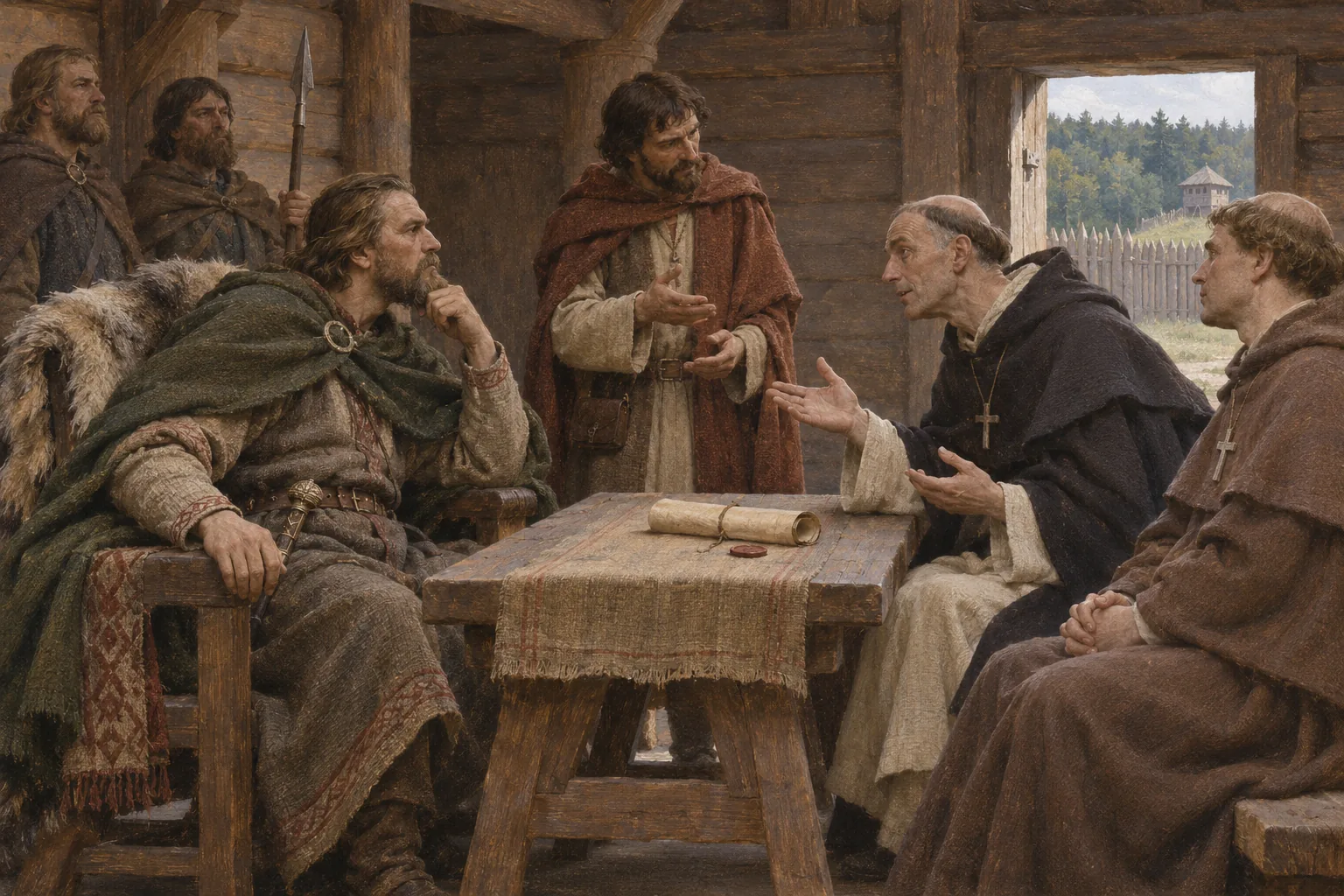
Gediminas approached the pope in 1323 while seeking different relations with Christendom. In the Šapoka-edited history, his letters complain about the Order and describe Christians already active in Lithuania. He presented his realm to readers whose support might help limit warfare and create new ties. The letters themselves were part of that diplomacy. S6
Gediminas’s invitations to merchants, artisans and clergy tied the growth of towns to royal policy. Foreigners were offered a place in the realm, and Christians their churches. People and goods could move without the ruler himself being baptised. Different religious communities could strengthen towns and government while relying on the protection of the prince. S6
When the embassy arrived in 1324, Gediminas denied having promised baptism. The Šapoka-edited history calls his explanation about a scribe evasive and discusses opposition within Lithuania. The two layers offer different answers: the reported royal words deny an original promise; the later historians infer a change of position under changed circumstances. S6
Kojelavičius gives a firm answer of his own: Gediminas never intended to leave ancestral belief. The reconstruction of 1936 is more complicated. Yet both leave room for the contacts created by the letters. Christians could enter Lithuania and bring their networks with them while the supreme ruler remained outside the Catholic Church. S7 S6
2.7
Baptism became a negotiating condition.
Under Kęstutis and Algirdas, conversion repeatedly returned to diplomacy, connected with security, territory and ecclesiastical authority.
The Šapoka-edited history reads Kęstutis’s promise of 1349 as a tactical move amid warfare and the search for outside help. Negotiating conversion could bring terms that force alone had failed to secure. A promise at the negotiating table still left baptism ahead of the ruler, and did not yet impose a religious obligation on every inhabitant. S6
Kojelavičius tells a separate story for 1351: war brings Kęstutis into captivity, baptism is expected, and he escapes. The pressure of imprisonment gives the promise its setting. This episode should remain distinct from the negotiations of 1349. In the historian’s telling, escape overturns the arrangement and links religious choice with the prince’s freedom. S7
Negotiations with Charles IV in 1358 brought different demands. The Šapoka-edited history describes proposals for a territorial settlement and relocation of the Order, both tied to possible conversion. Their scale shows what was at stake. They remained proposals: imagining a different frontier was easier than persuading the parties to establish it. S6
Algirdas also dealt with Church authority in the Orthodox territories. The 1936 history connects his interest in a metropolitan with political advantage in the Rus’ regions, even as negotiations over Catholic baptism continued in the west. His policies crossed several Christian worlds. A baptism left uncompleted in one setting does not account for the realm’s other Christian relationships. S6
2.8
Three ceremonies changed the ruler’s position.
Promises in 1385 led to Jogaila’s baptism, marriage and coronation, before a conversion programme reached Lithuania’s inhabitants.
Jogaila had promised baptism to the Order in 1382. The Šapoka-edited history distinguishes that agreement from the later Polish arrangement, which brought different partners and resources. More than a ceremony’s location changed. Conversion now belonged to a partnership involving the Polish crown, rather than the route offered through the Order’s supremacy. S6
In the Kreva promises of 1385, baptism formed part of a wider marriage arrangement. The Šapoka-edited history also lists captives, financial obligations and the ruler’s territories. Kojelavičius presents the change as the beginning of an enduring union. These commitments set out what was to happen; people in Lithuania still awaited the conversion programme. S6 S7
For 1386, the Šapoka-edited history and Jasas give three dates: baptism on 15 February, marriage on 18 February and coronation on 4 March. Kojelavičius instead dates baptism to 16 February. Each rite changed Jogaila’s position in a different way. He joined the Catholic community, married and became king of Poland. S6 S19 S7
The Bychowiec Chronicle brings Jogaila, Vytautas and their circle together in a compressed account of baptism and kingship. It captures a dynastic turning point without recording a full calendar. The king’s personal baptism still left much to do in Lithuania. Ceremonies, property and people were needed to turn his decision into a continuing programme. S19 S6
2.9
Conversion became public royal business.
In 1387, gatherings, baptismal ceremonies and ecclesiastical decisions gave Jogaila’s promise a visible form.
Jogaila’s return begins the public conversion programme in the Šapoka-edited history. People gather in Vilnius for instruction and baptism, with royal authority and resources behind the undertaking. The account follows its beginnings in a particular place. Beyond the gathering lay a realm whose inhabitants could not all share one day of conversion. S6
The 1936 history describes people baptised in groups, the names they received and gifts of woollen clothing. These details give the royal undertaking a practical setting, although they leave individual responses largely unknown. Their distribution alone cannot tell us why each person came or what they understood afterwards. S6
Jan Długosz also portrays Jogaila as a teacher in his account of 1387. The king knows the inhabitants’ language, explains belief and prayers, and distributes clothing. Groups receive shared baptismal names. These motifs already appear in this earlier account, though the reasons for seeking baptism come from the writer rather than the converts themselves. S140
Kojelavičius sets an even livelier scene on a riverbank. Groups receive shared names, tens of thousands undergo baptism, and the story explains rivers called Šventoji. His total of 30,000 belongs to this transmitted narrative. So does the river-name explanation: the seventeenth-century account cannot independently establish how every river with that name acquired it. S7
The Bychowiec Chronicle also briefly recounts the beginnings of Church institutions, naming Motiejus as Vilnius’s first bishop. Jasas separately discusses the dates and Andrius’s role, because the chronicle’s short account brings together events from different periods. The scale of activity in 1387 remains an open question. Combining scenes and numbers from different later authors would still not produce an exact diary of events. S19 S6
2.10
The new faith needed explaining.
A ceremony brought people together. Teaching needed speakers their listeners could understand.
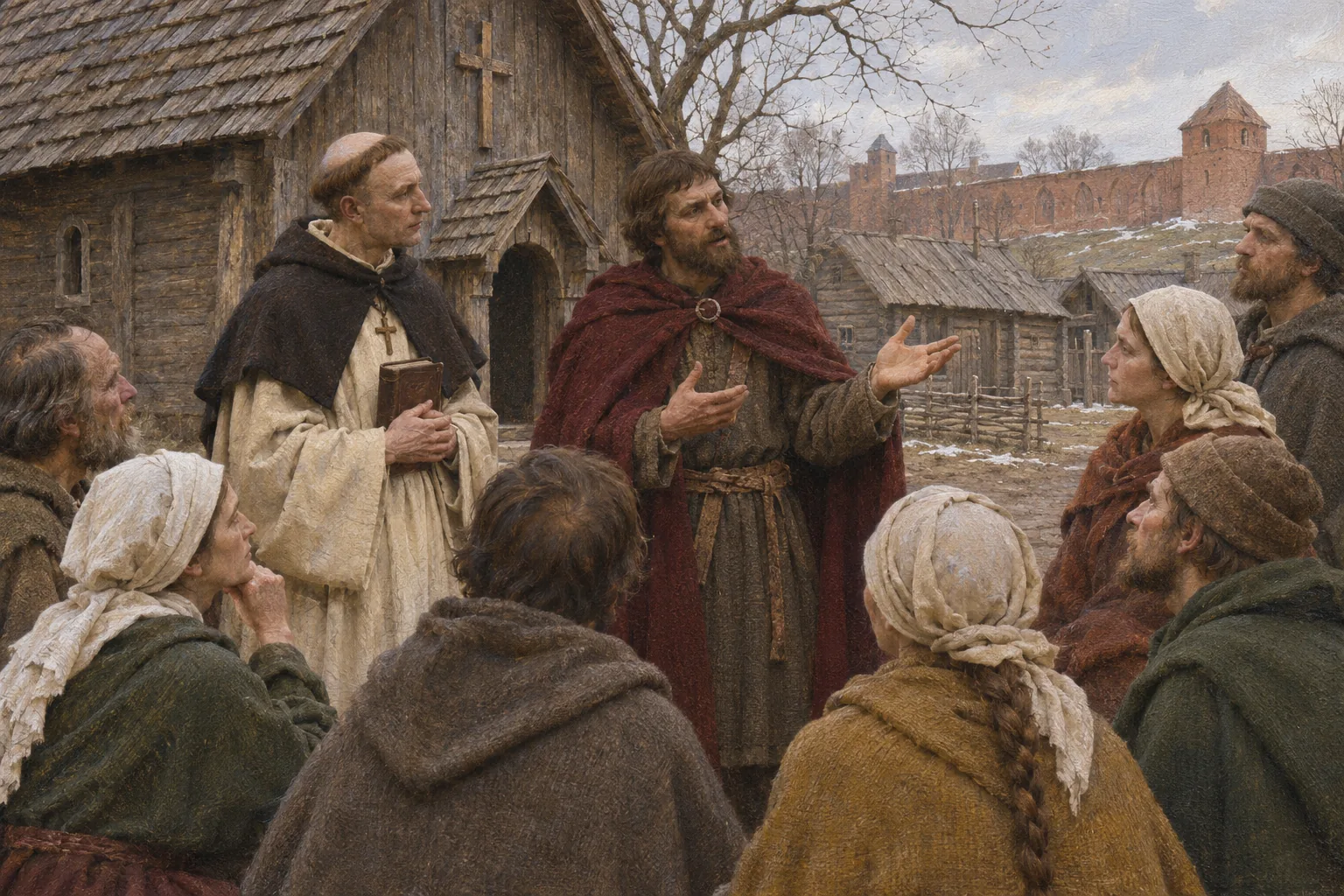
Clergy arriving to teach the new faith did not always know Lithuanian and needed help. The Šapoka-edited history also distinguishes their backgrounds and abilities: being foreign did not invariably mean being unable to speak the language. The shortage was practical, but varied from person to person. No single description fits every priest or teacher. S6
Kojelavičius gives Jogaila a teaching role when suitable clergy are scarce: the ruler explains belief in Lithuanian. The scene credits him with helping spread the faith and brings the language problem into view. Listeners needed more than unfamiliar words to understand how the new account of God, humanity and ritual differed from the one they knew. S7
The language problem returns in the Samogitian accounts. Both the Šapoka-edited history and Kojelavičius make the two rulers teachers, recognising the importance of speaking to local people. A prince or king could help during a visit. Once he left, however, parish teaching depended on people who could remain and work among the inhabitants. S6 S7
Jurginis returns to the problem in his 1989 introduction to Kojelavičius, discussing language, social estates and Daukša’s preface of 1599. His commentary is a separate voice from the seventeenth-century narrator. The later defence of language helps trace enduring difficulties in teaching, although it cannot recover what individual listeners in Vilnius understood in 1387. S7
2.11
A grove became a place of religious encounter.
Fire, trees and snakes appear in conversion narratives through symbols and plots chosen by Christian writers.
In Kojelavičius’s account, fire is extinguished, groves are felled and revered snakes are destroyed. These actions show the Christian God overcoming older customs. The historian shapes the encounter around that victory, giving it a vivid religious meaning. His scene does not provide the archaeological layout of a particular sanctuary. S7
Jerome injures his leg while destroying an image of Perkūnas, then receives a miraculous healing. Kojelavičius makes danger and recovery a lesson in the new faith’s power. The episode belongs to his Christian miracle narrative. It supplies neither a medical record of the injury nor an independently established date for the encounter. S7
Beresnevičius examines the Roman divine comparisons and Christian conventions through which Długosz describes older religion. Local belief reaches us in an outsider’s vocabulary. In this reading, the Roman names reveal an effort to explain another faith; they cannot by themselves identify an exact local pantheon or tell us how every sanctuary was equipped. S12
Kojelavičius gives Samogitian listeners a voice through an elder’s conclusion about powerless gods and a dispute over creation. The ruler answers, and the narrator explains what the crowd supposedly understands. These teaching scenes stage a clash between explanations of the world. Their conversations reach us as structured narrative, rather than directly recorded speech. S7
2.12
Conversion left different documents.
Acts concerning the bishopric, nobles, religious obligations and Vilnius addressed different aspects of the new settlement.
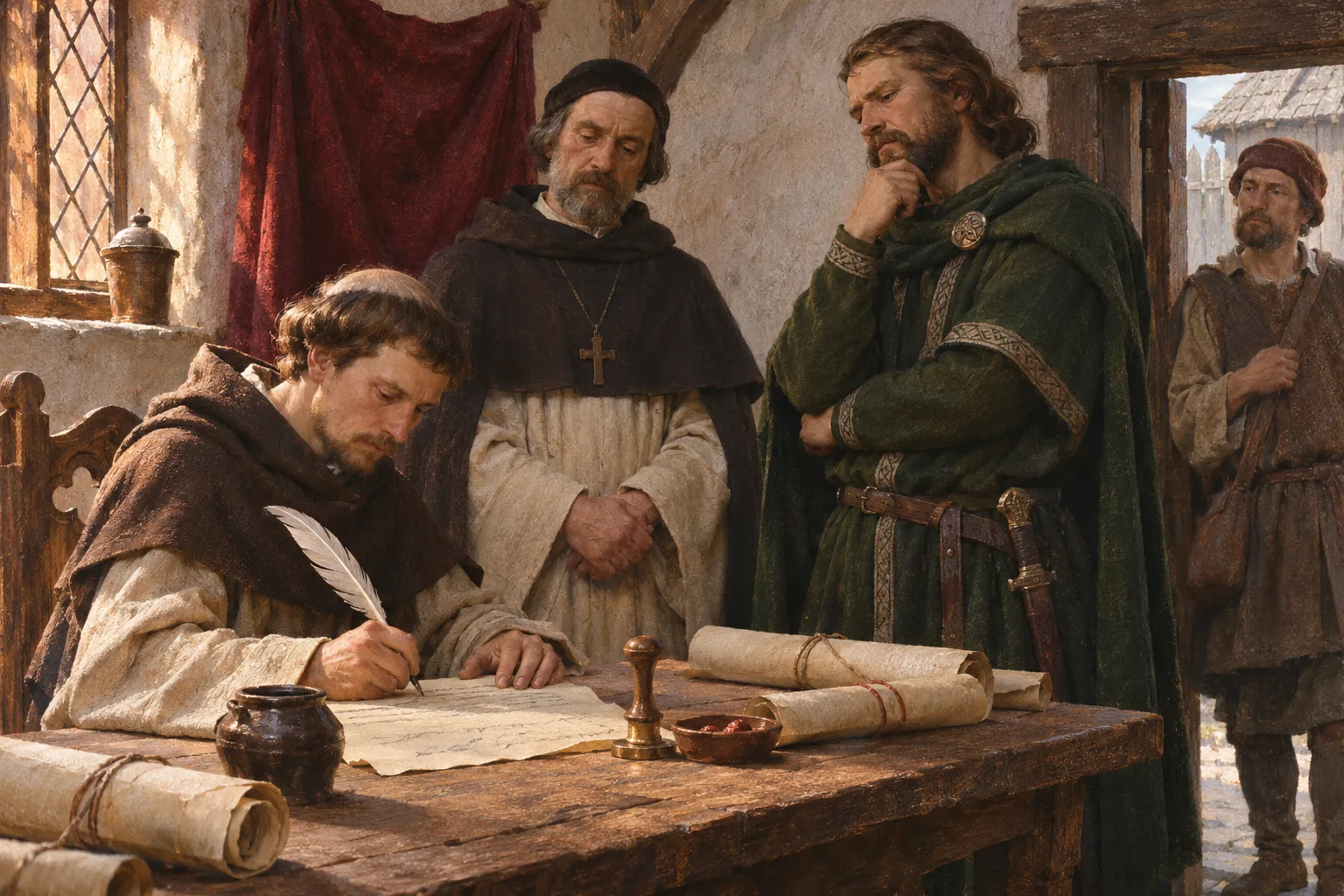
The act of 17 February 1387 gives lands, revenues, settlements and part of Vilnius to the church and intended episcopal seat. The donation was intended to provide material support for buildings and continuing ministry. It also established a new holder of property and rights. The Catholic institution needed resources that would last beyond its foundation ceremonies. S100
The act of 20 February concerns noble property rights; that of 22 March concerns Vilnius’s municipal rights. Baronas and Rowell distinguish these documents. S80
The act of 22 February deals separately with religious obligations and mixed marriages. It mentions compulsion and exempts church property from burdens. Alongside provision for the bishop, the ruler set rules for conduct under Catholic authority. The text records the order he wanted those under his rule to follow. S100
The Šapoka-edited history follows the new ecclesiastical and noble rights as part of a wider institutional change. Its beneficiaries had different needs and gains. A bishop received support for his Church, a noble obtained confirmation of rights, and a town acquired a legal framework. The ceremonies of conversion thus had a continuing history in law and property. S6
2.13
A priest needed housing and income.
Documents record the lands, people and resources that would support the Church’s daily work.
The bishopric’s endowment was intended to provide income and accommodation for continuing service, going beyond a solemn promise of belief. The 1932 editors distinguish versions A and B and later additions to the text. That history matters when reading its list of possessions: all entries cannot be assumed to belong, unchanged, to a single original document. S100
At Obolcai, the charter of 1 June 1387 provides plots for a priest, vicar and clerk, a lake, honey, tithes and the right to a tavern. These grants show how local ministry was to be sustained, without reconstructing its buildings exactly. The preamble links lasting faith with instruction that required more than a visiting preacher. S100
On 12 March 1388, Urban VI ordered Bishop Dobrogost to examine whether the site was suitable for a cathedral and its endowment adequate. If so, the episcopal seat was to be established and Andrius transferred from Seret. The pope acted through a conditional mandate. Petitions and reports needed someone to investigate them and carry the Church’s decisions into effect. S100
The letter of 17 April praises Jogaila for building and protecting churches and urges him to continue. Its editors had no original and discuss how it survived through later sources. The congratulations record what Rome was told about the king’s work. They do not turn each praised report into a separate papal investigation of people’s belief. S100
Based on: S100
2.14
Rights gave religion new weight in daily life.
Conversion became connected with property, obligations and family choices. Benefits and pressure appear within the same sources.
Catholic noble rights expanded around property in the Šapoka-edited history, while military service and castle duties remained. Changing religious affiliation could help a noble protect and pass on possessions without ending obligations to the ruler. These were particular rights within a hierarchy, rather than modern uniform citizenship or release from royal demands. S6
The act of 22 February commits Jogaila to drawing and compelling Lithuanian people of both sexes in his Lithuanian and Rus’ dominions into Roman obedience. Its mixed-marriage provision also specifies bodily penalties. The royal programme included commands alongside gifts and preaching; the text’s pressure and its actual enforcement remain distinct questions. S100
The document also regulates mixed marriages, bringing particular confessional situations under royal and Church authority. The provisions address defined mixed marriages between Catholics and Orthodox Christians. These rules reached into family relationships, but the written order leaves their application harder to follow. It supplies no record of every marriage case or proof of uniform enforcement across the realm. S100
Catholic affiliation again affected access to some rights and offices in the Horodło arrangements of 1413. Kojelavičius celebrates friendship and equality while keeping communion with Rome as a boundary; the Šapoka-edited history stresses selection. New ties opened among nobles on religious terms, leaving some other influential people outside them. S6 S7
2.15
A Catholic ruler governed more than Catholics.
Christian life in the Rus’ territories neither began in 1387 nor ended when the ruler became Catholic.
Algirdas had already made metropolitan authority a political concern. The Šapoka-edited history follows his government in the Rus’ territories and his dealings with local Church institutions. Jogaila therefore entered an established Christian world when he was baptised. Orthodox communities had their own histories and authorities before a Catholic programme arrived from the ruler. S6
The 1936 history draws a sharp distinction between the religious worlds of Lithuanian and Rus’ lands. It helps describe their institutions, although individual families crossed its broad dividing lines. Marriage, kinship and movement connected the different communities. The realm was larger and more varied than either its Catholic ruler’s baptismal setting or any single population group. S6 S19
Catholic privileges and restrictions on mixed marriages gave religious difference a place in law. Orthodox life nevertheless continued. The Šapoka-edited history follows its institutions and proposals for bringing the Churches together. Those proposals required communities that were still functioning and had representatives of their own; Catholic rules had not simply abolished them. S6 S100
The Bychowiec Chronicle explains Algirdas’s religion through marriage and tells how he accommodated the faith of others. Family choices shape conduct in this dynastic tradition, rather than a surviving baptismal document. Plans to unite Churches also need to remain distinct from political agreements between Lithuania and Poland: similar terms could describe quite different purposes. S19 S6
2.16
The region was more than a negotiating object.
Samogitia remained outside the programme of 1387. Its inhabitants’ resistance changed both royal agreements and the circumstances of conversion.
Samogitia is explicitly left outside Jogaila’s programme of 1387 in the Šapoka-edited history. Its later conversion became entangled with the Order’s territorial claims. Rulers promised the region in agreements, but its inhabitants did not always accept those terms. Granting it on paper and establishing authority over the people living there were separate challenges. S6
The 1936 narrative connects the uprising of 1409 with local discontent and help from Vytautas’s men. For inhabitants, power took tangible forms: castles, hostages, obligations and limits on movement. Religious teaching came entangled with those experiences. Whoever claimed to govern could demand labour, collect revenue and decide the terms under which people lived. S6
The settlement of 1411 tied possession of Samogitia to the lifetimes of Jogaila and Vytautas. The Treaty of Melno in 1422 settled the frontier later. Victory at Grunwald had therefore left questions open. As rulers and diplomats disputed the territory’s future, they also contested who would direct its religious life. S6
The Bychowiec Chronicle tells of liberation through a battle at Palanga and redemption of a pledge. Jasas challenges that explanation and corrects the chronology. Samogitians act decisively in the chronicle, but its account of the road to freedom differs from a reconstruction based on treaty documents. Both the story and the commentary need to remain visible. S19
2.17
A short visit became a larger story.
The picture of conversion in Samogitia in 1413 comes through later narrators. Its scenes and documentary foundations receive different readings.
In the Šapoka-edited history, Jogaila and Vytautas make a short visit to Samogitia, teach because suitable clergy are scarce, and arrange baptism for initial groups. The authors stress the limits of their brief work: it could not reach everyone at once. This traditional beginning remains separate from the establishment of lasting Church institutions that followed. S6
In Długosz’s account of 1413, Jogaila sails along the Nemunas and Dubysa into Samogitia. The king extinguishes sacred fire, orders groves felled and teaches belief himself because the visiting clergy cannot speak Samogitian. The writer gives words to both ruler and listeners. They belong to a literary conversion scene, rather than a directly recorded conversation. S140
Kojelavičius fills the mission with requests, gifts, threats and damage to sacred places. His listeners encounter persuasion and power together. They watch, doubt or agree as the story unfolds, making the scene more complicated than a sermon quietly received. Their reactions, however, come through the voice of a seventeenth-century narrator. S7
The Bychowiec Chronicle draws conversion and the bishopric into a short account that praises Vytautas as a second apostle. Jasas separates 1413 from 1417 and notes a parallel with Długosz’s praise of Jogaila. Credit shifted with the telling. Different rulers took the leading role as writers placed religious change within dynastic memory. S19
Baronas questions the detailed 1413 picture and distinguishes the better-documented mission of 1417. S80
2.18
The region’s complaint reached the church council.
Samogitian representatives argued that their relationship with Christianity could not be left solely to the Order.
Baronas distinguishes the delegation’s arrival in 1415 from presentation of its appeal in February 1416. S80
The Šapoka-edited history quotes the delegation’s complaint about seized land, lost liberty and poor religious instruction. It also accuses the Order of forcing conquered people into hard labour. Samogitian representatives challenged the Order’s claim to speak for them. Their complaint argued a case and did not independently verify every charge, but it brought people from the region into public political debate. S6
The 1936 history follows the bishops sent to Samogitia, their work and Motiejus’s appointment. Jasas dates the foundation to 1417. The new institution was meant to sustain what a short royal visit could not: a local Church with resources and people working among the inhabitants. Religious activity now had a continuing centre of authority. S6 S19
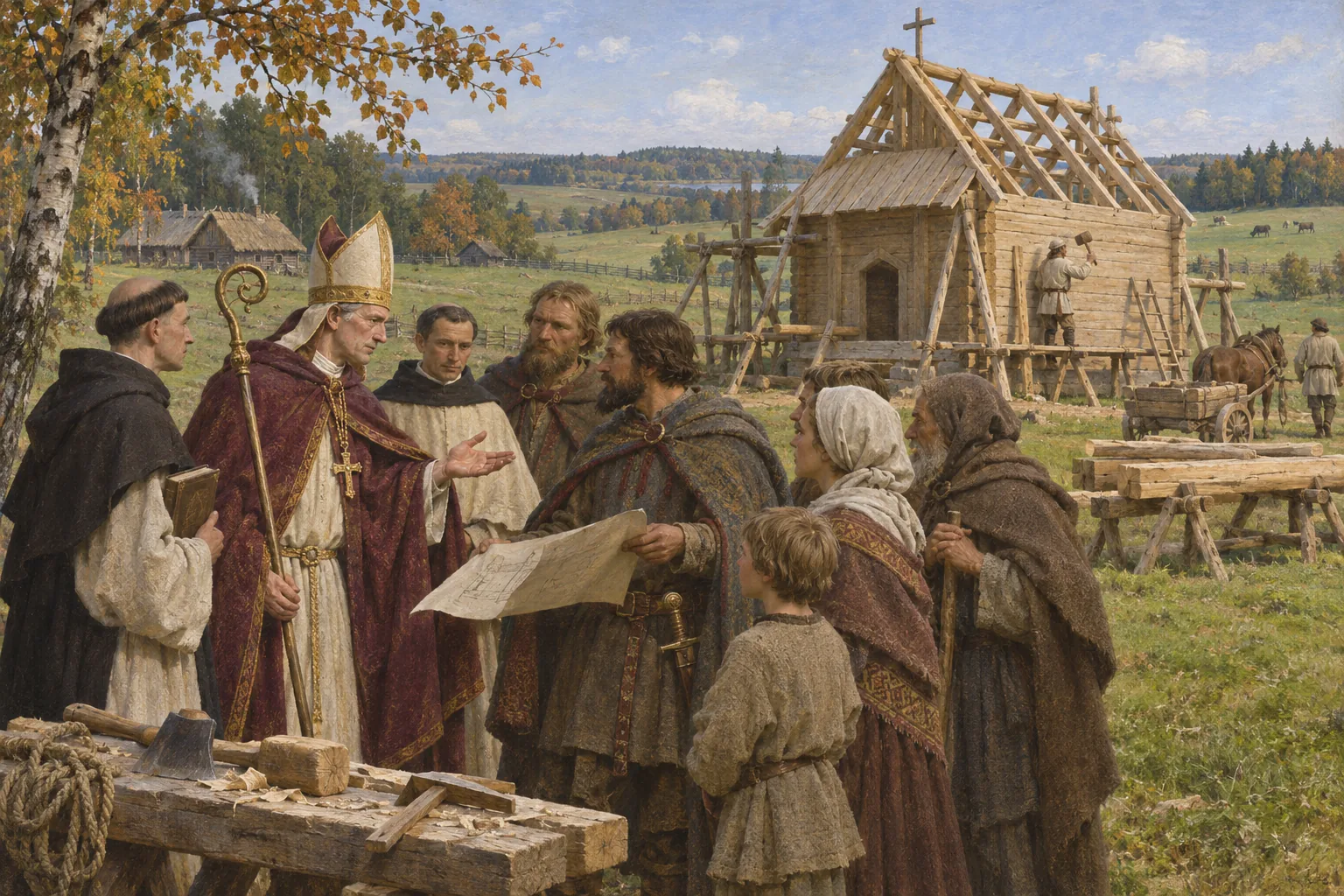
Varniai became the episcopal centre. Here, Medininkai names the Samogitian locality, not the place of the same name in eastern Lithuania. In the Šapoka-edited history, cathedral, parish churches and land grants belong to a wider process of foundation. The map’s place name represents the bishop’s authority and resources as well as a church building. S6
2.19
A list of churches was not a dense network.
Parishes needed resources and people able to reach communities, teach, conduct services and continue after the rulers left.
The Šapoka-edited history names seven early parish churches and a separate eight in Samogitia. Its lists reconstruct how the network began. A church’s mention and an exactly documented foundation day are different kinds of evidence. S6
Długosz lists seven parish churches: Ukmergė, Maišiagala, Nemenčinė, Medininkai, Kreva, Obolcai and Hajna. The names locate his account in particular places. Listing the churches, however, does not supply seven surviving foundation charters from 1387. S140
Baronas questions whether all seven churches listed by Długosz were founded in 1387. His study distinguishes the Obolcai charter from later attestations elsewhere; documentary silence alone does not prove that those churches did not yet exist. S101
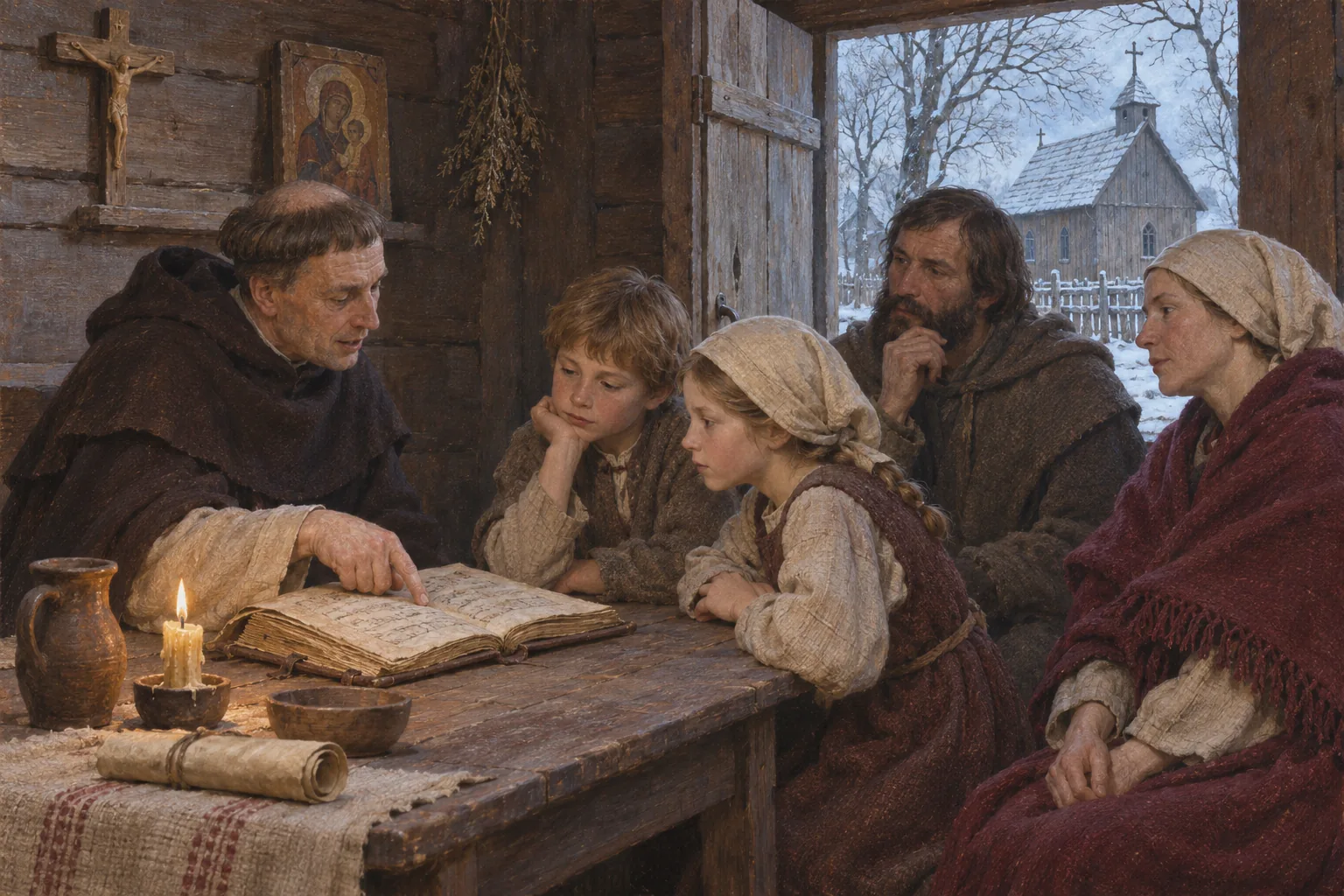
The Šapoka-edited history connects clerical training with the renewal of Kraków’s university in 1400 and with elementary church schools. Churches needed trained people as well as buildings and land. Teaching, writing documents and conducting services all required preparation. Shortages of clergy and difficulties with language continued to limit work away from the centres. S6
The same book describes Jadvyga’s Prague college project as another attempt to train clergy for Lithuania. Money and housing would support study, but the project also needed students and a stable environment. A funded plan could not ensure they would immediately come. Their journeys and education were part of building the Church’s future. S6
2.20
Those who used a sacred place defended it.
Jerome’s account, discussed by Beresnevičius, reveals people for whom a grove was a place to seek help.
Beresnevičius follows a grove-felling missionary into Piccolomini’s account, itself based on Jerome of Prague’s oral report. The act provokes local resistance. The story has passed through several tellers, so its encounter cannot be recovered as a transcript of one day. It nonetheless brings forward people whose sacred place mattered in their daily lives. S12
Women in the narrative go to Vytautas after losing their grove, where they had sought divine help with the weather. Men later join the complaint. For these people, replacing a tree with a building would not replace that relationship. Beresnevičius reads their appeal through a community’s need for sacred power and help within reach. S12
Within the story, Vytautas stops the missionary and sends him away. Beresnevičius places the ruler between the spread of a new religion and the concerns of his subjects. The complaint changes what happens. This scene gives local people a part in the outcome without showing that rulers protected every traditional sacred place in the same way. S12
The account leaves the deity unnamed. Beresnevičius considers Perkūnas because the appeal concerns weather, while retaining uncertainty. Piccolomini’s work appeared posthumously in 1477. That publication date does not date the defence of the grove, and the later suggestion of a divine name cannot fill the gap in the transmitted report with certainty. S12
Based on: S12
2.21
Church teaching did not reach everyone equally.
Later accounts describe uneven instruction and changing customs, without reducing everyone’s belief to one label.
In Beresnevičius’s account, sparse parishes, too few clergy and language barriers shaped religious change. Church institutions could be established before regular teaching reached all inhabitants. Remote communities might still struggle to reach them. This is his scholarly explanation of uneven change, rather than a separate measurement of access or belief in every settlement. S12
Beresnevičius turns to sixteenth-century writers who wanted customs corrected. The royal letter of 1547 belongs to their later world, far removed from Jogaila’s ceremonies. Its condemned behaviour cannot simply be carried back to 1387. The report also tells us what its sender and the religious authorities of that time wanted to address. S12
Pekulas’s visitation of 1579 gives Beresnevičius another example of uncertain knowledge. A priest had heard that some people kept older practices, yet could not say where they were. Hearsay and uncertainty survive together in the report. It shows the difficulty of finding out who practised what, rather than establishing a whole village’s shared belief. S12
Daukša’s catechism of 1595 offers Beresnevičius a different kind of evidence: instruction about conduct to avoid. Such a prohibition cannot inventory everyone’s actions. Read alongside parish history, however, it shows continuing arguments over correct belief and the place of older customs. Conversion had left religious authorities with work they still thought necessary. S12
Based on: S12
2.22
Institutions and paths of belief changed.
Conversion changed royal relationships, law and religious authority, while people’s religious lives developed unevenly.
Beresnevičius distinguishes older religion’s institutions from the elements that survived them. Stories and practices could change once elite support and former cult structures were gone. A familiar custom surviving does not mean the whole system remained untouched. Nor does the loss of institutions erase the sacred relationships that continued to matter in people’s lives. S12
The Šapoka-edited history follows the bishops, privileges, schools and clerical training that gave the new Church staying power. Institutions managed property, taught the faith and sought to regulate daily life. Their influence varied with resources and how readily they could reach people. They brought more enduring changes than simply renaming old ceremonies. S6
The Bychowiec Chronicle places the Goštautas family at the beginning, with a first Catholic and friars brought to Vilnius. Jasas’s commentary points to earlier clergy, confused identities and legendary elements. The family gained a place in the memory of conversion through this origin story. Other townspeople, missionaries and local communities had paths it did not encompass. S19
Conversion brought decisive moments separated by long stretches of change. A ruler received new rites, a charter assigned land, a bishop organised work; individuals learned the new faith or kept familiar customs. Beresnevičius allows change and continuity to coexist. Earlier belief did not end in the same way, on one final day, for everyone. S12 S6