
1.1
A world where thunder has a voice.
Thunder, fate and household fire took the forms of deities or mythical beings in different periods. Here are fourteen of their portraits.
Who forged the sun? Who allotted a person’s fate, guarded the household fire or mysteriously increased its stores? Lithuanian songs and legends tell of such things, as do chronicle notices, early lists of gods and accounts of custom. Recorded in different periods, they help researchers understand an older worldview. S12 S14
Deities attested early appear here alongside mythical beings recorded much later. “Ancient” does not mean that all fourteen belonged to one pantheon, worshipped alike at the same time. A medieval writer, a nineteenth-century storyteller and a modern mythologist speak about belief in different ways. We will hear each voice separately. S12 S17
1.2
Dievas: the sky and an old man at the door.
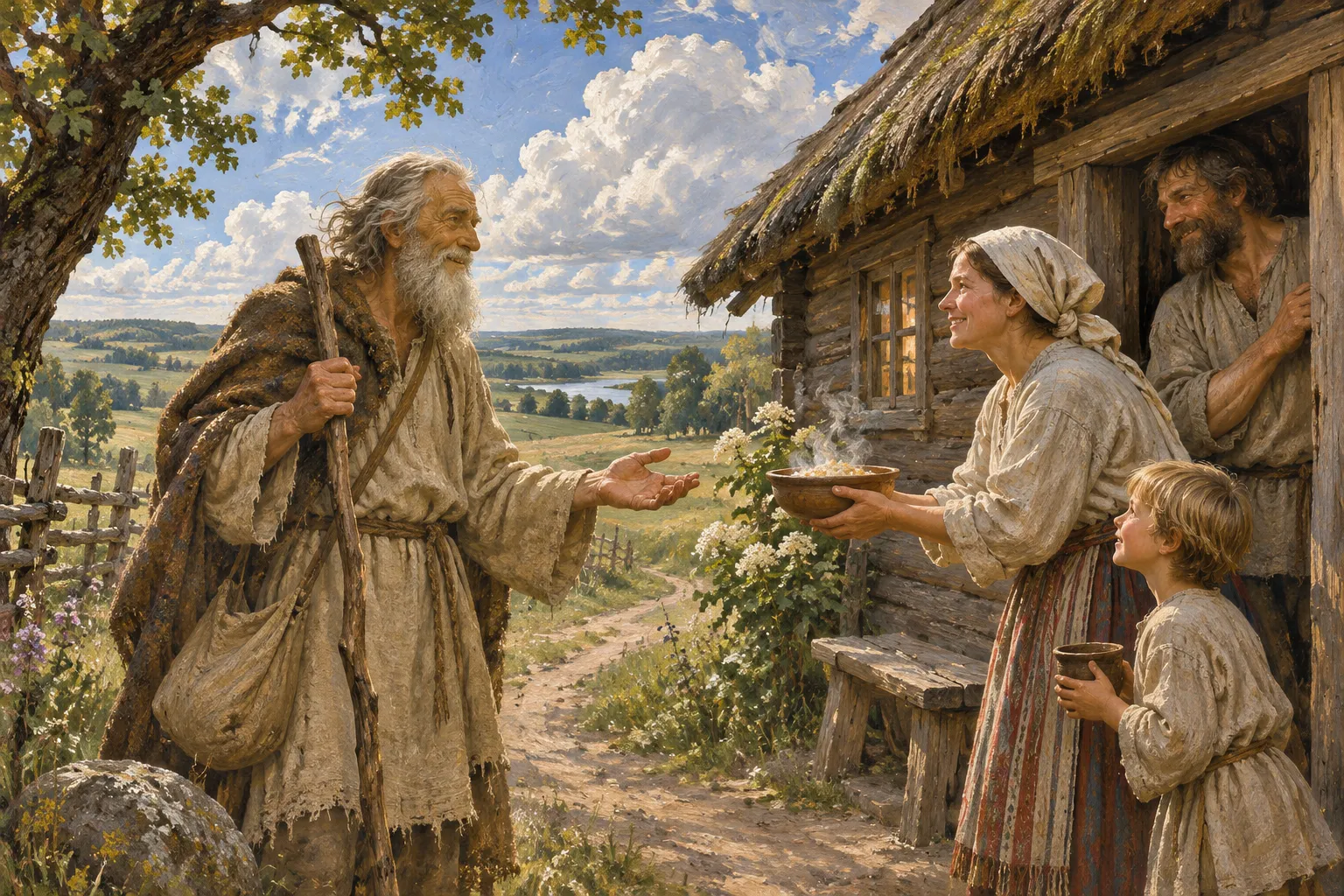
Scholars reconstruct a Sky God from early names; in legends, Dievas also appears as a travelling old man.
Dievas can mean a deity in general, while in Christian usage it means God. Beresnevičius distinguishes a Sky God in the older religion and connects him with Andajas and Nunadievis in thirteenth-century sources. The connection between the names is the scholar’s; the brief chronicle notice does not tell a deity’s full life story. S12
In legends, Dievas may walk the earth as an old man. Welcoming or rejecting a humble visitor becomes a test of character, and the stranger’s power emerges afterwards. The folkloric Dievas discussed by Beresnevičius protects order and justice, but his portrayal is already interwoven with a Christian storytelling environment. S12
An old man with a staff helps us imagine the encounter in a legend. His image cannot tell us how thirteenth-century Lithuanians depicted their highest deity. What matters in the story is the unrecognised guest: someone arrives along an ordinary road whose true identity will emerge later. S12
Based on: S12
1.3
Perkūnas: storm power and the defence of order.
The thunder god connects an early written name with abundant later stories.
Perkūnas’s name survives in a thirteenth-century interpolation into the Slavonic translation of Malalas’s chronicle. There the deity is explained through thunder. Beresnevičius also connects Perkūnas with Diviriksas in another chronicle, but that is the scholar’s identification rather than a direct record of Perkūnas’s name. Later legends tell far more than the brief early notice. S12
Jan Długosz explains older religion through Roman gods, comparing Perkūnas with Jupiter and transmitting the local name Perkun. He links fire with Vulcan, woods with Diana, and snakes with Aesculapius. These comparisons explain customs and support his Roman-origin story. He is not passing on a list of gods made by the worshippers themselves. S140
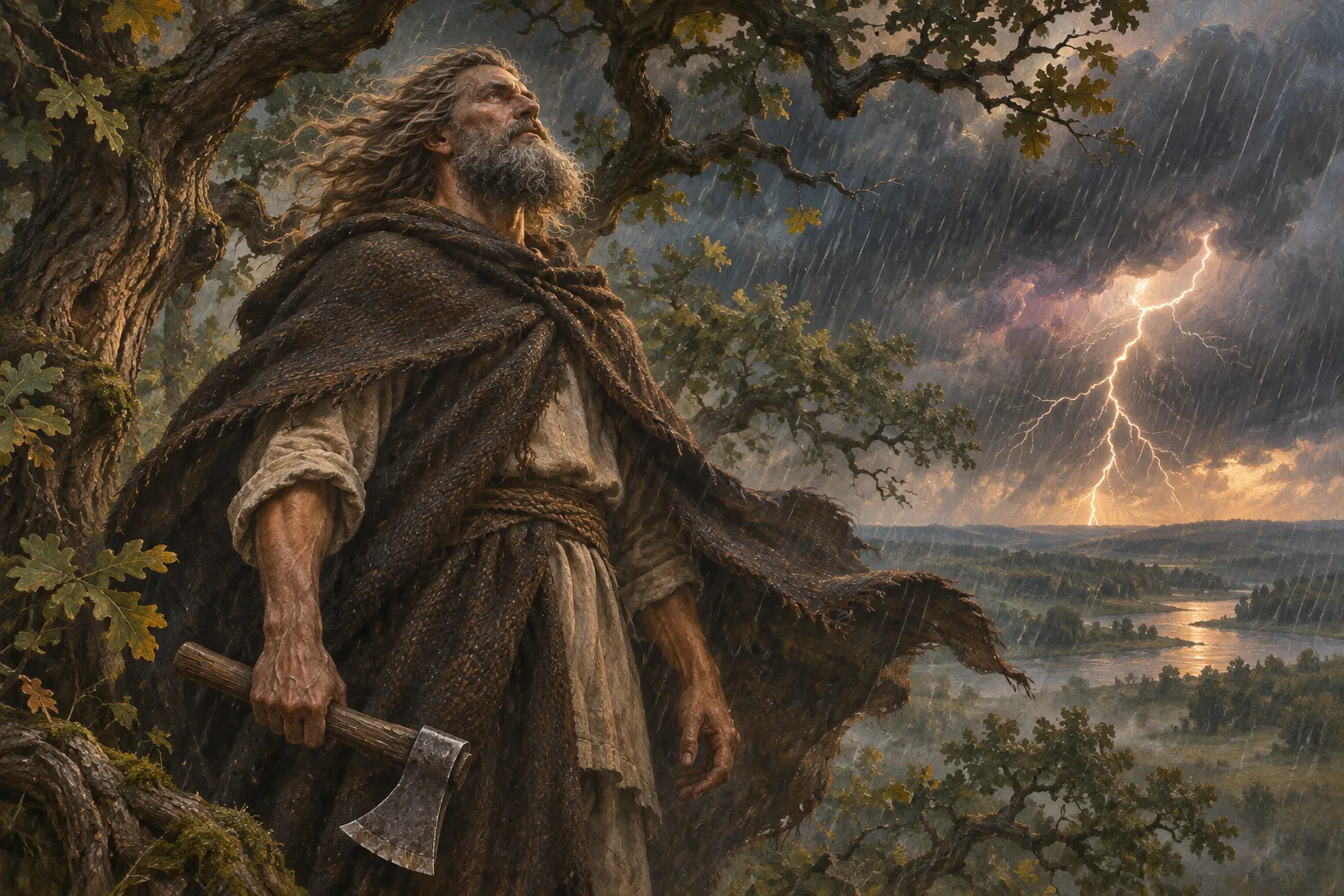
One striking legend motif is the enmity between Perkūnas and the devil. The devil hides beneath trees or stones while the thunderer pursues him. Some storytellers explain that the devil stole his implement; others describe cleansing the world of evil. Even this familiar narrative therefore has more than one explanation. S12
The axe, stern face and stormy sky in the illustration draw on folklore. In legends, Perkūnas sometimes helps God; Beresnevičius sees Christian influence here. The older thunder figure survives, while his relationship with others in the story changes. S12
1.4
Velnias: a maker, rival and trickster.
The devil of legends can create, spoil, labour and be outwitted.
Velnias changes roles in Lithuanian stories. Beresnevičius connects him with earth, the underworld, wealth and the dead, while also discussing his Christian demonisation. The form Velinas is used for an older mythological layer. It does not mean that every legend preserves the name of a separate god. S12
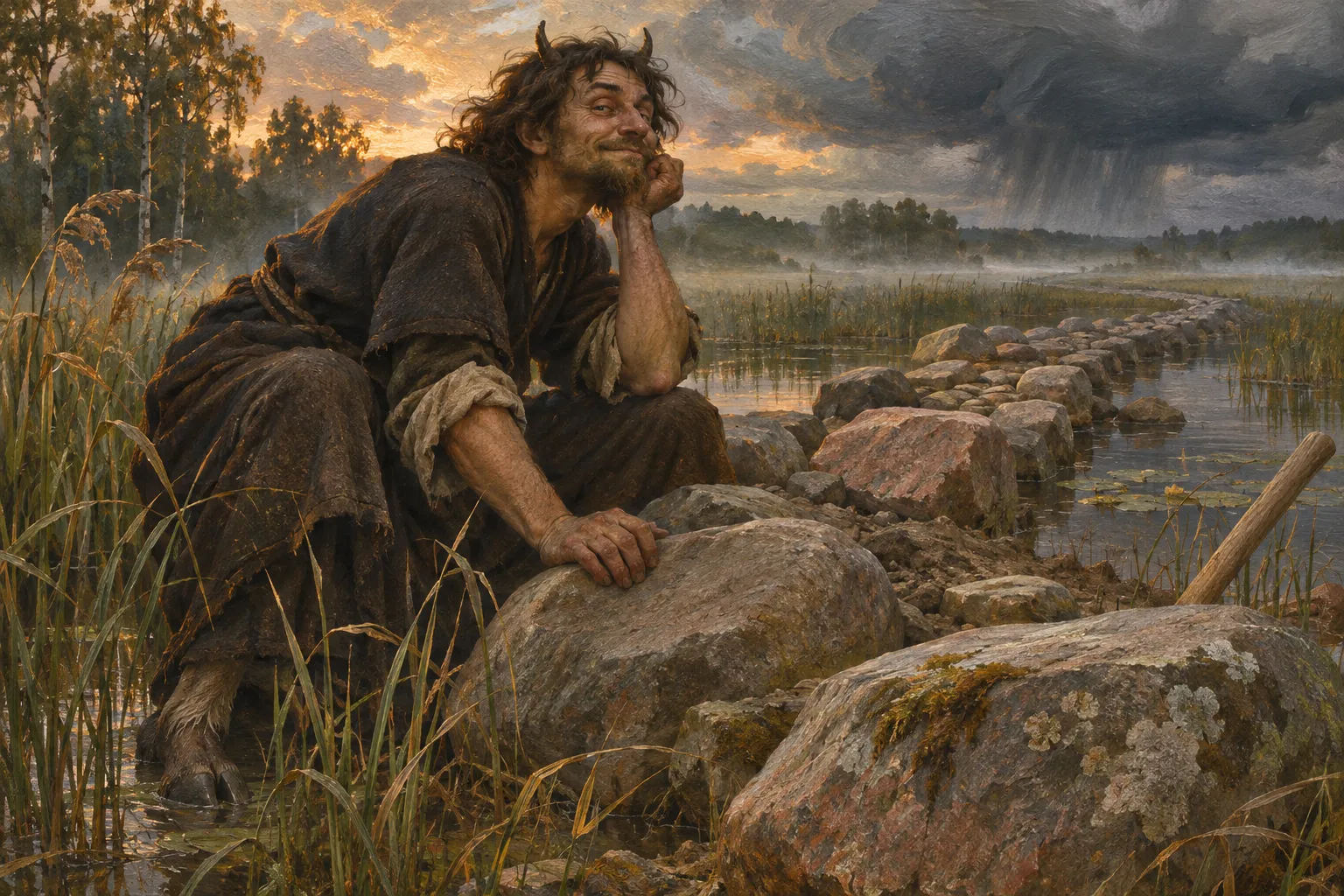
In creation legends, God sends the devil to fetch earth from primordial waters. The task becomes a contest: attempts to conceal or alter something explain marshes, stones and uneven ground. In the variants analysed by Beresnevičius, he is both helper and disruptor; some even call God and the devil brothers. S12
Velnias can transform a landscape, yet human cunning or the force of Perkūnas can defeat him. His labours and defeats reveal the same contradictory character. The stones and marsh in the illustration evoke the legends; his face, clothing and unfinished causeway are artistic choices. S12
Based on: S12
1.5
Teliavelis: the smith who forged the sun.
In a medieval text, a smith forges the sun and casts it into the sky.
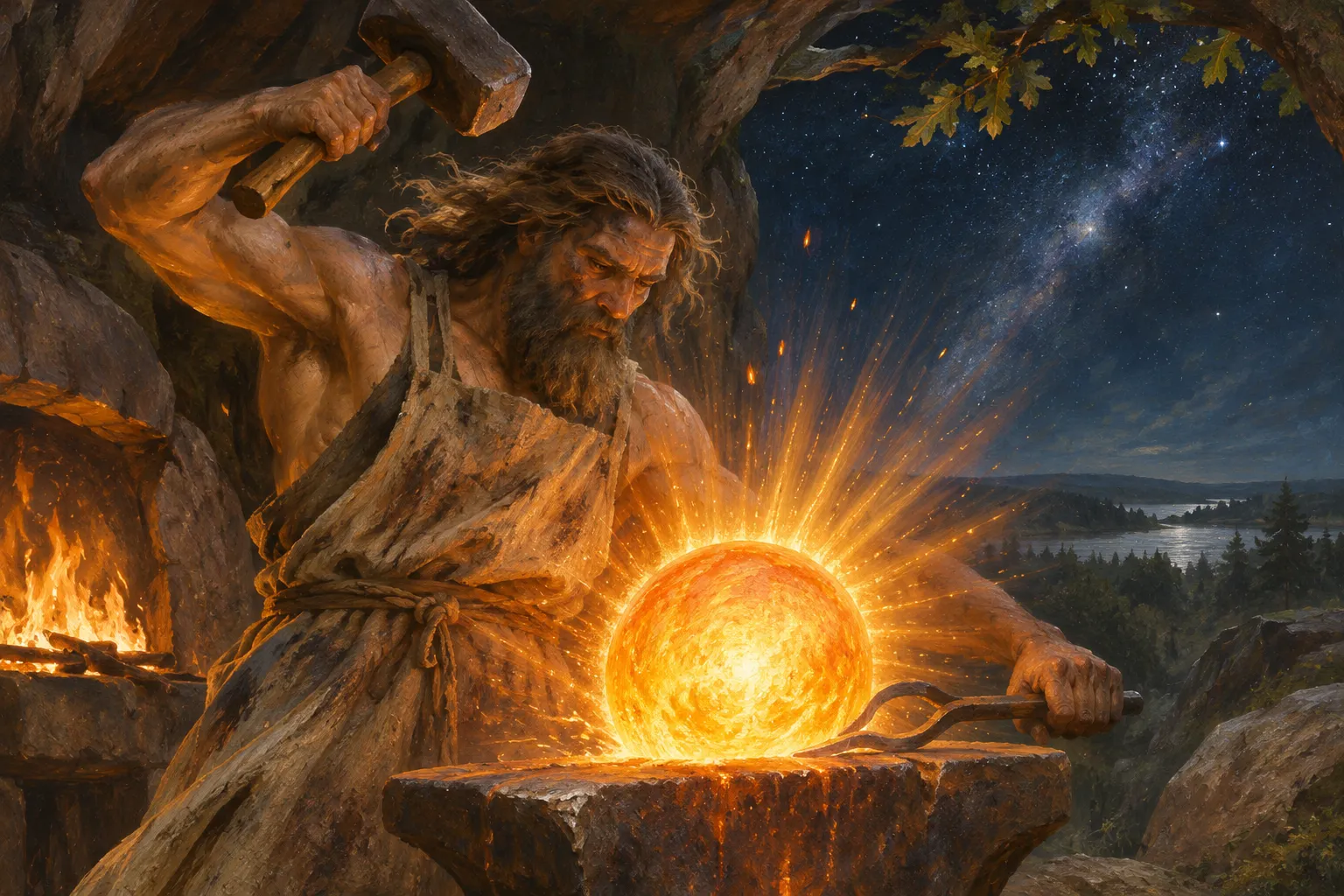
Teliavelis forges the sun and casts it into the sky: so tells the interpolation into the Slavonic translation of Malalas’s chronicle, associated with the entry for 1261. The smith’s labour is a myth transmitted in a medieval text. It is not a direct account of Lithuanian religion by the sixth-century author Malalas himself. S12
With a tool and strength, a smith makes what lights the world each day. An ordinary craft becomes an act of creation. Beresnevičius considers Teliavelis’s connections with Velnias and smithcraft, but cautions against equating him with the devil of folklore. Resemblances exist; they do not establish that the figures are identical. S12
The sun is forged once. The notice does not describe its being made anew each year; in the concluding commentary to Gimbutienė’s book, Beresnevičius criticises that extension. The painting depicts one mythical moment at the forge. The workshop and the smith’s appearance were invented for the illustration. S14 S12
1.6
Medeina: the forest boundary and the world of animals.
Early names suggest a deity of woodland and hunting, without preserving a full life story.
Medeina is named in the chronicle notice of the gods worshipped by Mindaugas, under the date 1252. A nearby passage describes a hare whose crossing of the hunters’ path could stop them from entering the forest. The source does not fully explain how the name and the sign connect. Beresnevičius also considers whether the “Hare God” arose from the writer’s misunderstanding. S12
Another thirteenth-century text describes Žvorūna as a female dog. Beresnevičius thinks Medeina and Žvorūna are probably names for the same deity. That is his reconstruction. The sources themselves use different names and do not directly say “Medeina is Žvorūna.” S12
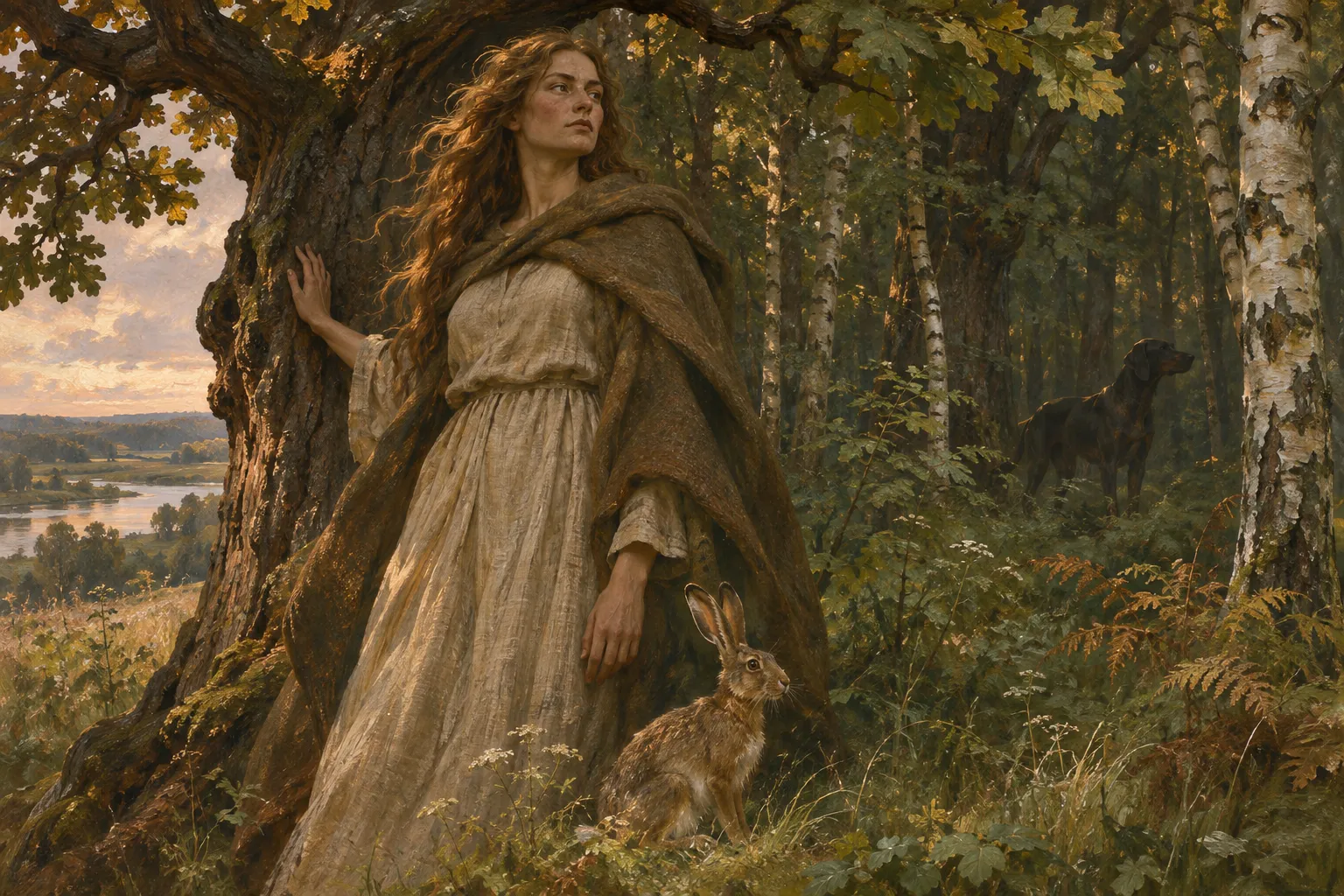
The woodland, hare and distant dog in the portrait recall different testimonies. Their combination is the artist’s. We have no securely identified ancient image of Medeina of this kind from which to reconstruct her face, clothing and complete set of attributes. S12 S17
1.7
Žemyna: the earth that sustains.
Fertility expresses human dependence on soil and the life within it.
In the beliefs discussed by Gimbutienė, Žemyna is both a deity imagined as female and the living earth itself. Grain, growth and respectful treatment of soil are associated with her. Kissing the earth or prohibiting its mistreatment reveals a relationship in which the sustaining environment has dignity and responds to human actions. S14
In prayers and ritual accounts from later centuries, people ask for grain to grow, greet the earth and pour out part of a drink to her. The records cited by Gimbutienė tell of farmers’ relationship with their surroundings. But ceremonies recorded in the seventeenth or nineteenth century cannot be placed in the thirteenth without further evidence. S14 S12
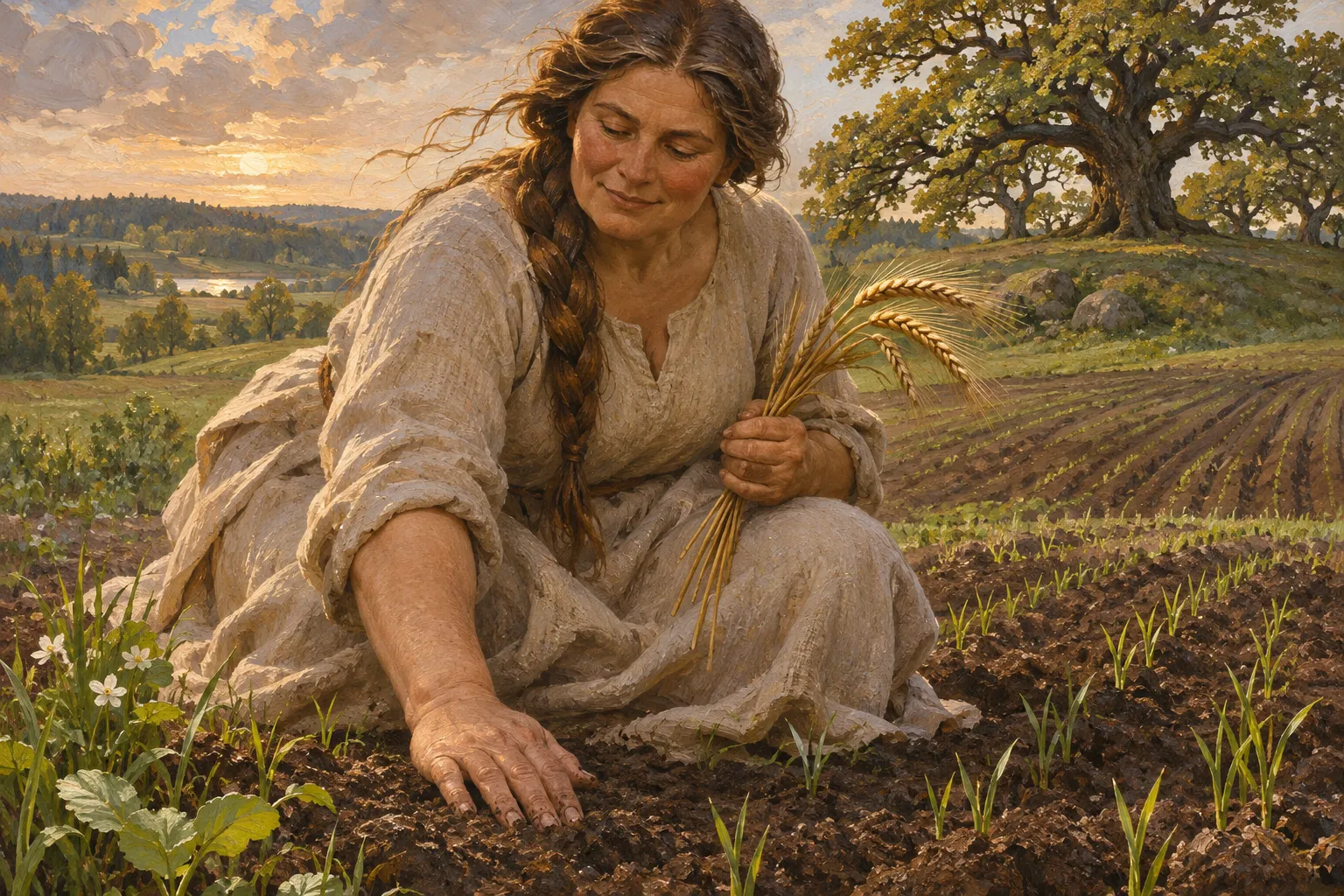
Gimbutienė connects Žemyna with ancient goddesses and cycles of life. In the book’s concluding note, Beresnevičius points out that her prehistoric framework remains a hypothesis. The painting’s guardian of soil and grain is therefore symbolic; archaeology has not established such a portrait of the goddess. S14
1.8
Gabija: the fire addressed as a presence.
The household hearth can be sacred fire and a personified guardian.
Gabija’s world is within everyday fire: it warms and cooks, yet can destroy a home if neglected. Gimbutienė describes covering embers with ash, “feeding” the fire and addressing it with requests for peace. Sacredness appears through care, restraint and close coexistence with a dangerous force. S14
Gabija can also name the fire itself. Pranas Skardžius, whose essay appears in the third volume of Lietuvių mitologija, treats it as a solemn name for fire. Vilnius University’s etymological database likewise records the meaning of sacred household fire. Respectfully addressing a fire and depicting it as a woman are two different readings of the name. S17 S51
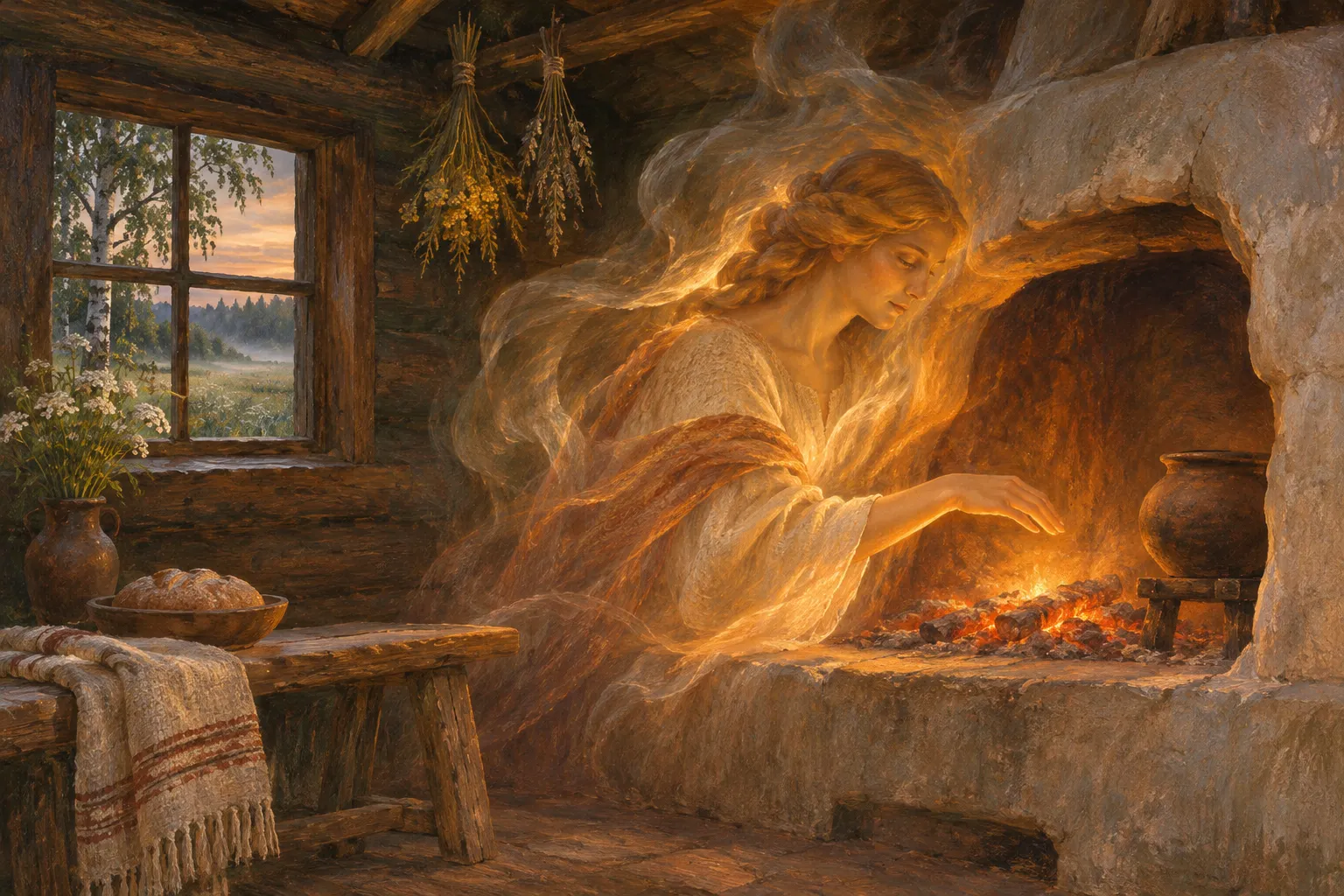
A woman’s outline barely emerges from the hearth light in the illustration. The image leaves both readings open: fire can be a familiar living presence, without every family sharing the same image or story of its origin. S14 S17
1.9
Laima: the life allotted.
In stories of birth and destiny, fortune is more than a lucky accident.
Laima, also Laimė, is associated with birth and the share of life allotted to a person. Gimbutienė discusses seventeenth- and eighteenth-century dictionaries and accounts alongside later folklore. In her material, destiny concerns not only prosperity or success, but the length and difficulty of life and the possibility of escaping misfortune. S14
One or several beings appear at a child’s birth and pronounce its destiny. Can what has been spoken still be changed? These stories raise that question. Beresnevičius discusses Laima as a power of fate difficult to appease, whose place cannot be explained by a list of divine duties. S14 S12
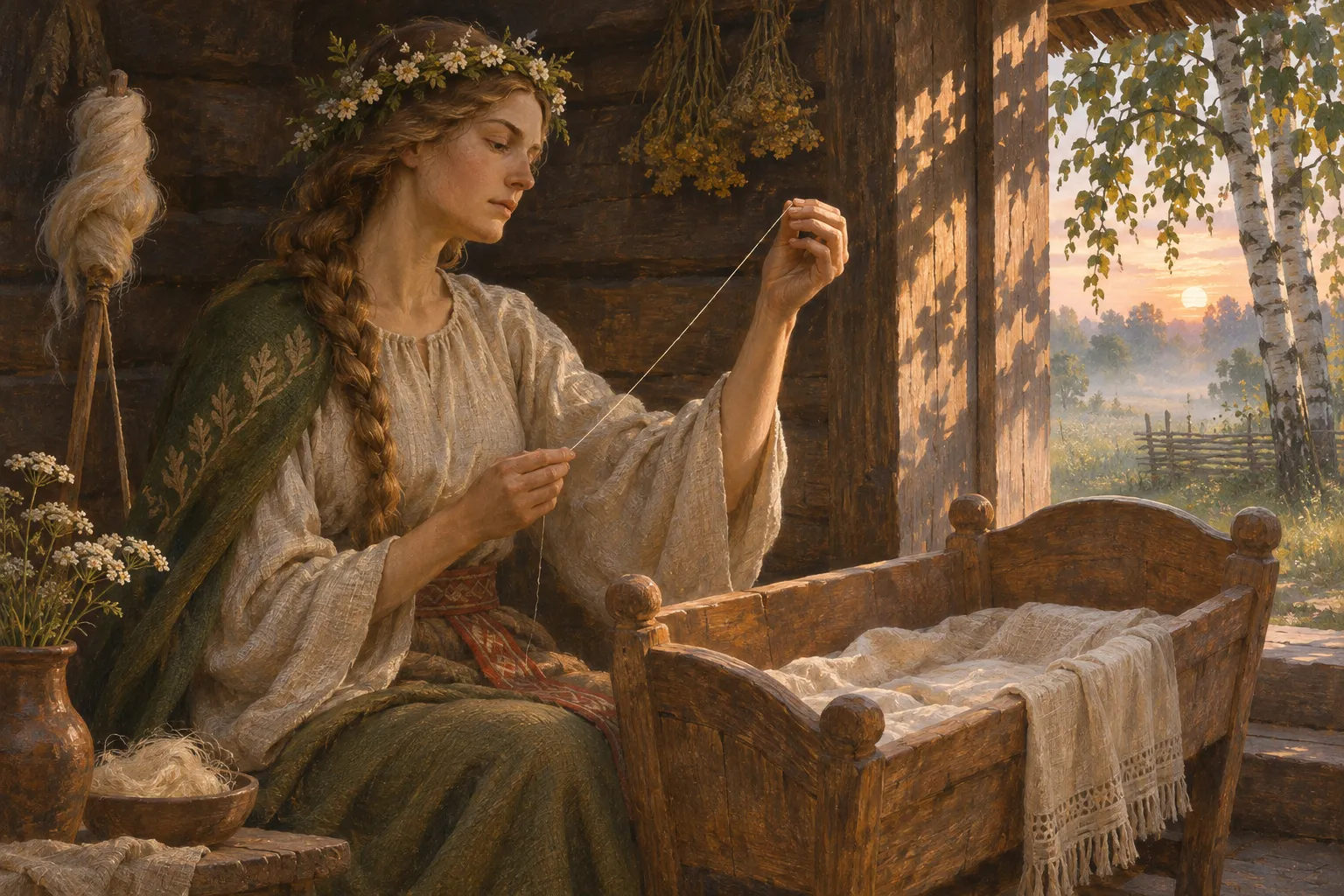
The thread in the portrait stands for the course of an allotted life: a poetic metaphor. Gimbutienė develops a broader interpretation of spinning symbolism, but the book’s concluding commentary questions the basis of some such generalisations. Laima’s appearance and the room were also invented for the illustration, rather than reconstructed from an ancient image. S14
1.10
Saulė: light, mother and a figure in song.
The personified sun cannot be contained in a single origin myth.
In songs and mythical stories, Saulė has human relationships and feelings. Beresnevičius discusses the maternal Saulė in Lithuanian songs. Gimbutienė draws many celestial family and wedding images from Latvian songs. The distinction matters: Latvian accounts help us compare related traditions, but they are not records of Lithuanian narratives. S12 S14
Teliavelis forges the sun and casts it into the sky. In songs, she acts as a person. These different accounts do not make up a single continuous biography of Saulė. They show how many meanings people gave to the light returning each day. S12 S14
Our Saulė above the fields is a contemporary artistic personification. The maternal gentleness of her light helps convey a poetic image, but does not establish the existence of an ancient statue with this appearance, this clothing or a solar family tree shared throughout Lithuania. S14

1.11
Mėnuo: the changing neighbour in the sky.
Lunar phases and human fortunes meet in beliefs and song narratives.
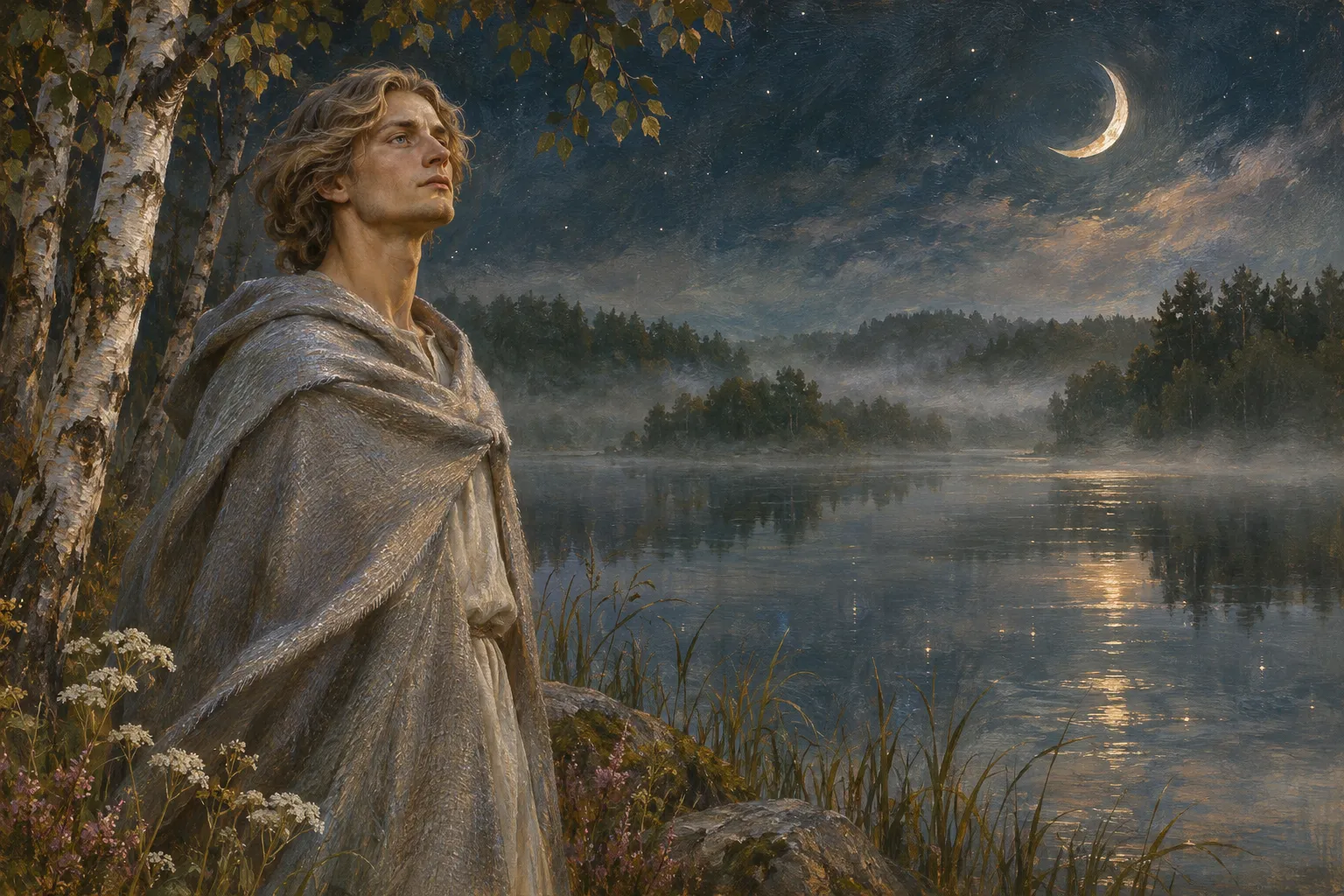
Mėnuo, or Mėnulis, becomes someone to speak to in Lithuanian beliefs. People addressed the young moon with requests for health, beauty or well-being. Gimbutienė discusses these appeals and the hopes linked with the moon’s changing phases: its appearance matters in human life. S14
In a song in Liudvikas Rėza’s 1825 collection, Mėnuo marries Saulė and then falls in love with Aušrinė. An angry Perkūnas splits him. A particular publication preserves this familiar story; its date does not tell us when the story first arose. S14
Rėza’s mythological songs also have an editorial history. Bronė Stundžienė explains why that history calls for a critical reading. The wedding remains a song narrative, rather than an exact account of every ancient Lithuanian’s beliefs. The silver Mėnuo in the painting is our poetic interpretation. S52 S14
1.12
Laumė: gift and danger beside the water.
The worker of the night may help humans, but her kindness has limits.
In legends recorded later, laumės appear beside water, washing, spinning and weaving. Gimbutienė’s survey portrays them as extraordinarily capable: in a short time they accomplish labour beyond human ability. They may arrive in groups and look human, while belonging to another realm with rules of its own. S14
Help can become danger when humans break those rules, attempt deception or ignore a prohibition. Stories of children, gifts and unfinished work join care with fear. This ambiguity makes a laumė difficult to reduce to a kindly fairy: her generosity is inseparable from her power to punish. S14
Laumė and Laima have similar names, but their stories differ. Laumė chiefly works and encounters people in legends; Laima allots fate. Researchers explore connections between them, while each has a separate portrait here. The river and linen in Laumė’s painting recall her work. S14 S12

1.13
Aitvaras: wealth with a troubling companion.
A fiery flying being brings both plenty and unease in stories.
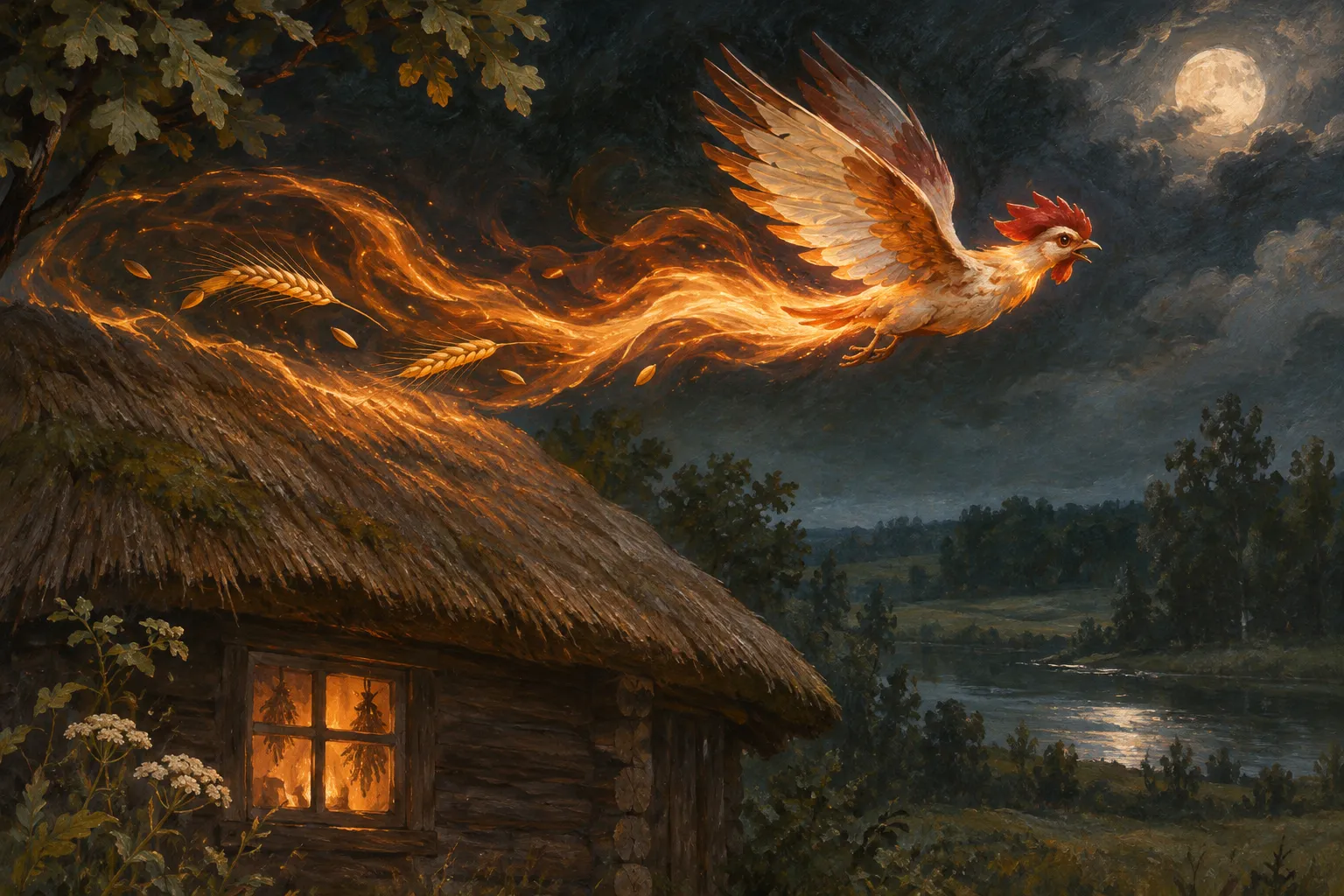
An aitvaras may appear as a bird or a fiery, serpentine flying being. Gimbutienė gathered legends of a rooster, an unexpectedly adopted chick and a light at night. The stories change its shape; together they do not describe one exact animal. S14
Food, grain or money begins to appear for its keeper. The relationship is uneasy: stories require the helper to be fed, threaten misfortune when it is displeased and make escape difficult. In one account retold in the book, the keeper moves away and burns the old house, only for the unwanted companion to travel with him. S14
Gimbutienė connects the aitvaras with a broader interpretation of life and fate. In the book’s concluding commentary, Beresnevičius objects to placing it among the great ancient deities. Here it remains a being of legend, and the fiery bird above the roof is one possible form rather than a single canonical image. S14
Based on: S14
1.14
Kaukas: a small bearer of plenty.
In kaukas stories, a tiny piece of straw can hold great abundance.
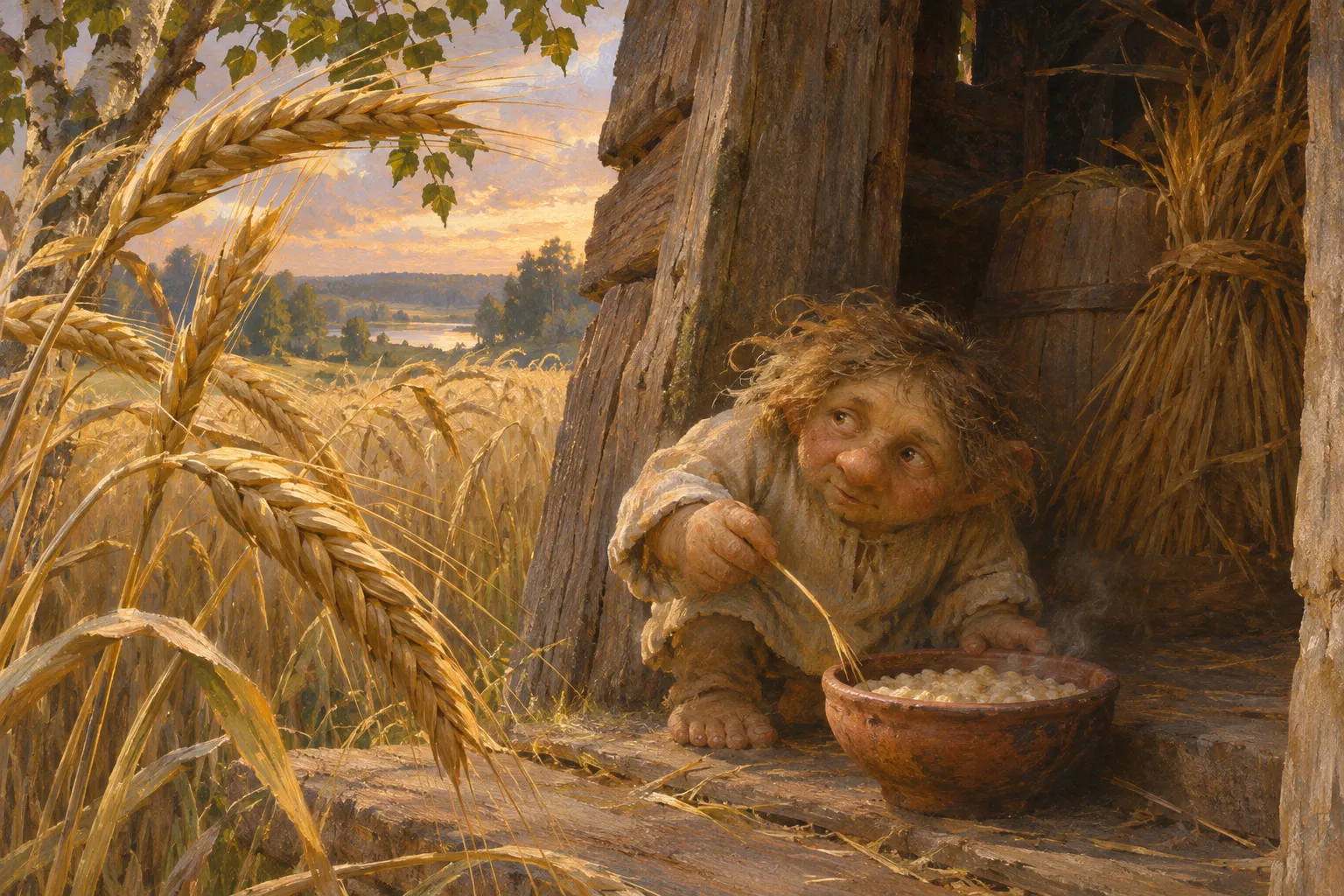
The kaukai discussed by Gimbutienė are small helpers associated with household well-being. Accounts may portray little human figures or round creatures whose form is less definite. Their gift is abundance: a piece of hay or a few grains carries more value in the story than its size would suggest. S14
Householders accept the kaukai’s gift, feed them and clothe them in small flax shirts. Drawing also on Greimas’s analysis, Gimbutienė describes a reciprocal relationship. Abundance is not unconditional: to keep a helper, people must meet its needs too. The story resembles an agreement. S14
Beside the barn, the kaukas has a piece of straw and a food bowl. We chose this appearance for the illustration from motifs in the stories. The names and roles of kaukai and aitvarai sometimes overlap, so no fixed classification into “species” applies everywhere. S14 S12
1.15
Giltinė: the white visitor at life’s boundary.
Death in later folklore may appear quietly and in human form.
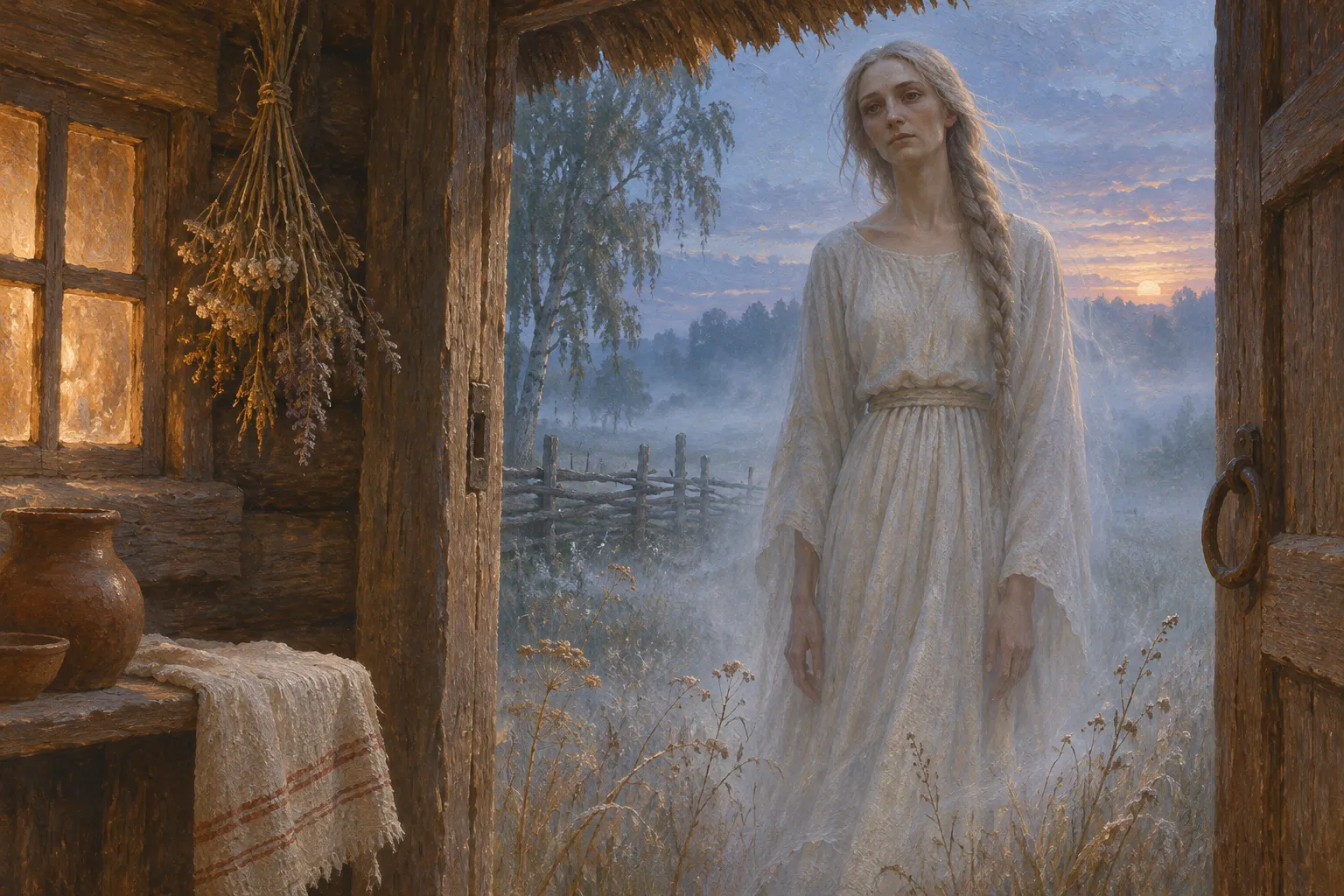
Giltinė personifies death. Gimbutienė discusses late nineteenth-century beliefs and stories published in 1903 in which she appears as a tall, thin woman dressed in white. In some variants her poisonous tongue brings death; in others, the crucial sign is the visit of the unknown woman herself. S14
In one account included in the book, three women in white announce when they will come for a man. In another, an old man hopes to outwit Giltinė with shears. Such variants make it possible to speak of an inevitable ending through encounters and negotiation, even when the outcome cannot be changed. S14
Gimbutienė proposes connecting Giltinė with very early archaeological images of women. That is her interpretation: an artefact does not supply Giltinė’s name. The illustration chooses a restrained white visitor from later legends. It does not reconstruct the documented appearance of a prehistoric death goddess. S14
Based on: S14
1.16
Myths also live through change.
Names and stories remain valuable even when their histories differ.
A list of gods preserves what a particular writer recorded. A family’s legend shows how people understood their world. A scholar tries to trace connections between such fragments. Their accounts answer different questions, and their disagreements help reveal how the tradition changed. S12 S17
In Długosz’s Vilnius conversion account, Znicz denotes the priest tending the fire. The passage describes a person, so the word supplies no additional god here. Nor do the Roman comparisons establish that all fourteen figures described in this article formed one pantheon at the same time. S140
Fourteen portraits offer just one path through a much wider mythological world. Each has its own illustration created today. The source perspectives below let us ask what the text preserved and what its interpreter or artist added. S12 S14 S17