1.1
Between the Nemunas, lakes and forests
Written sources call the communities of these southern Baltic lands Yotvingians and Sudovians. Their history continues beyond conquest.
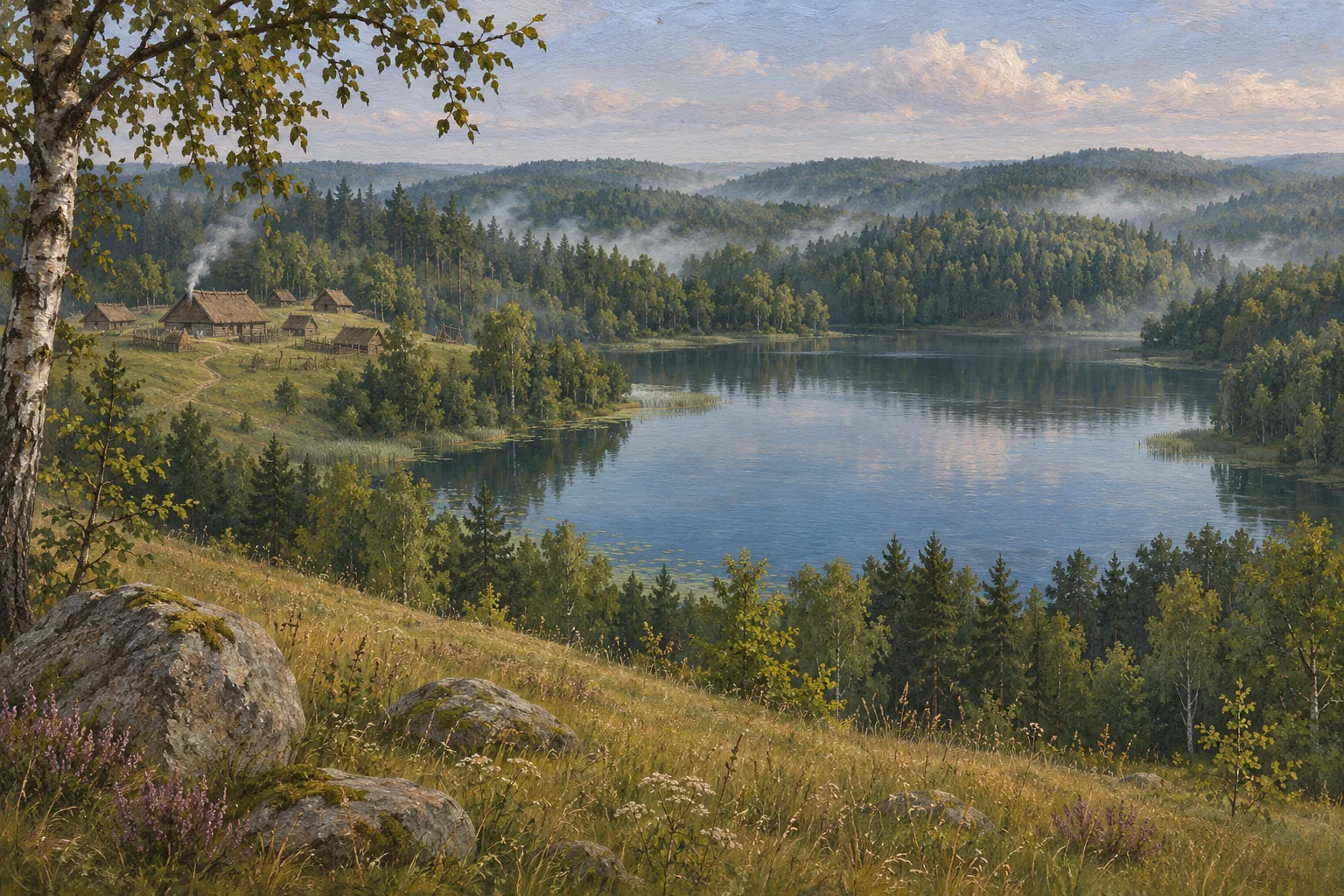
The 1936 history edited by Adolfas Šapoka places Yotvingian settlements on the left bank of the Nemunas, around Suwałki and far to the east. It describes people living in drier clearings among forests and wetlands. S6
Mazovians, Poles and the people of Volhynian Rus’ lived to the south. The routes connecting communities also carried armies. Several centres of power competed around these southern Baltic lands. S6
Peter of Dusburg’s account of the late thirteenth century follows Sudovians who submit to the Order, move to Sambia or flee to Lithuania. Conquest breaks their political order, but households and people on the move remain in the narrative. S107
1.2
Yotvingians, Sudovians, Dainava
Different accounts give this country different names. Each name has its own history of use.
The history edited by Šapoka places Sudovians and Yotvingians together. The Bychowiec Chronicle calls Traidenis ruler of the Yotvingians and Dainava. Each name has a place in its author’s account; none alone fixes the country’s boundaries for every period. S6 S19
In 2023 Tomas Baranauskas challenged a model of four sharply divided groups. His study stresses overlapping written names rather than assuming that each denoted a separate tribe. S137
Dainava enters this story through the chronicle’s title for Traidenis, while Sudovia appears in the Order’s wars. Keeping those names visible preserves the relationships different writers described, even when later histories gather them under one heading. S19 S107
1.3
A country whose borders are disputed
Older histories extend Yotvingian lands far to the east and south. This is a historical reconstruction rather than a surveyed tribal frontier.
From Merkinė, the 1936 history extends Yotvingian settlements along both banks of the Nemunas towards Naugardukas, Slanimas and Brasta. Its broad geography closely connects the southern Balts with later Lithuania and reflects the synthesis’s view of Lithuania’s past. S6
The same history describes southern rulers advancing towards Gardinas, Naugardukas and Slanimas before the Lithuanian state grew strong. Settlements, military reach and demands for tribute overlapped. A campaign did not necessarily bring lasting control of an entire country. S6
The synthesis admits that archaeological finds do not readily reveal a people’s ethnicity, then argues more confidently for population continuity. Both positions occur in the same book. A find’s location alone cannot identify the medieval community that left it. S6
Based on: S6
1.4
Everyday life between campaigns
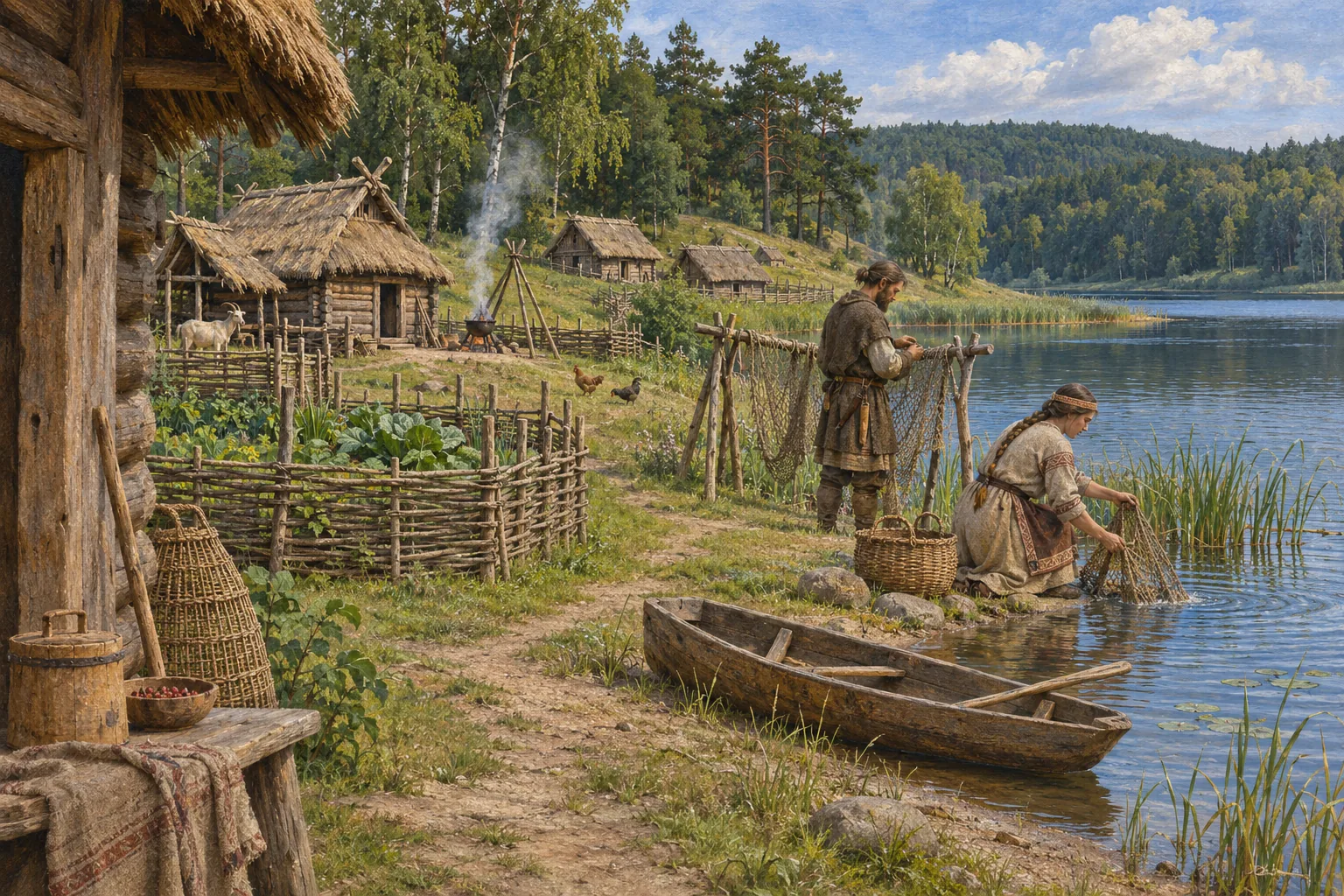
Riders and commanders dominate the campaigns. The history edited by Šapoka also describes the people cultivating land, keeping animals and living near water.
In its general account of Baltic livelihoods, the history describes the work of cultivating a wooded landscape. This gives the Yotvingian story a wider setting, rather than documenting the contents of each household. S6
Fields remained part of a world of woodland and water in this account. Alongside livestock, the history mentions hunting, fishing, honey and wax. These livelihoods occupy less space in war chronicles, yet sustained life between campaigns. S6
The history places southern Baltic settlements in drier forest clearings. Its scattered communities give the inhabited country a broader shape than a single fort or one commander’s following. S6
Based on: S6
1.5
Work that sustained a household
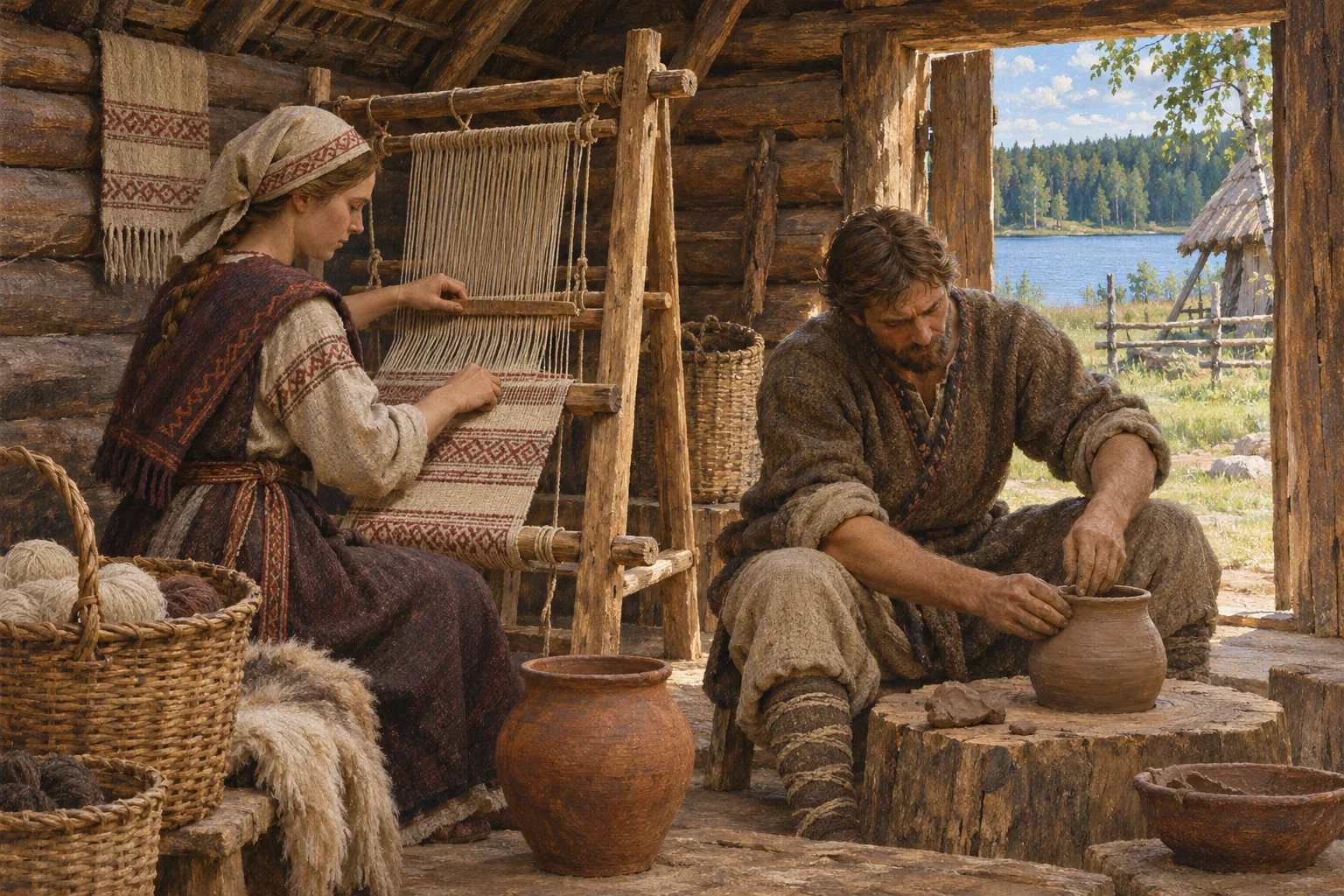
Food, clothing and exchange connected communities both on the land and farther afield. War occupies only part of the general account of Baltic livelihoods.
The history edited by Šapoka describes woodland products and amber exchanged for salt, iron, weapons and cloth. This is a general picture of Baltic trade, connecting local resources with distant supplies. It does not put every listed object in every Yotvingian farmstead. S6
Marija Gimbutienė describes iron parts of a second–third-century wooden ard from the Šveicarija cemetery near Suwałki. She connects nearby Osinki with the cemetery; these early sites provide no plan of a thirteenth-century settlement. S11
Cultivation, exchange and woodland resources belong together in this general account of Baltic life. Household work reached beyond the farmstead, bringing local products into contact with goods from elsewhere. S6
1.6
Forts and their people
Chronicles often notice a fort when it comes under attack. Life around it appears only in glimpses: inhabitants, possessions and the terms of surrender.
Dusburg’s defenders of Kymenovia negotiate for their lives and possessions. They promise to accept baptism in return for surrender terms. The chronicler follows a community’s future as well as the fall of a fort. S107
A later episode names Jedetus, a captain from Kymenovia, submitting with his people. Another captain, Scurdo, leaves for Lithuania. Their choices differ even within the chronicle’s account of defeat. S107
A fort and the people around it share a history, but not necessarily a fate. Those who survive its fall may move, negotiate terms or seek another ruler. The loss of a stronghold leaves more of their story to tell. S107
Based on: S107
1.7
Different traces of burial
Cemeteries reveal practices scarcely mentioned in war chronicles. One burial rite cannot describe every Yotvingian.
At Mosiężysko, Ludwika Jończyk studies twelfth–thirteenth-century dispersed cremation burials. Human bones, pottery and damaged metal objects reveal a practice that a picture of barrows alone would miss. S136
Jończyk cautions against matching historians’ boundaries to archaeological distributions. Her findings concern one site, without establishing a uniform rite across the country. S136
Based on: S136
1.8
An outsider’s account of souls
An outsider’s report of the soul survives alongside questions about its meaning.
Gintaras Beresnevičius discusses Wincenty Kadłubek’s claim that Yotvingians believed souls returned in newborn bodies. He considers possible borrowing from classical literature and notes the lack of another such account. S12
Jan Długosz links Yotvingian courage to the hope that songs would preserve their deeds after death. Writing under 1264, he explains the fighters’ behaviour without giving the words of a surviving Yotvingian song. S140
The history edited by Šapoka turns to material remains for evidence of past life and burial customs, while acknowledging how difficult it is to identify people from those traces. Archaeology also leaves questions unanswered. S6
1.9
Raids, tribute and reprisals
Polish, Mazovian and Volhynian Rus’ rulers operated along Yotvingian lands. Raids and reprisals shaped relations with these southern neighbours.
The history edited by Šapoka describes Yotvingian raids followed by neighbouring rulers’ reprisals. Polish rulers seek Volhynian help. In this account, pressure comes from several directions before the Order’s later advance. S6
Albertas Vijūkas-Kojelavičius places a campaign by Roman in 1200 and describes troops from conquered lands joining his army. The sequence belongs to a seventeenth-century history; its dating is retained as that author’s account. S7
The Yotvingians raid, suffer attacks, pay tribute and resist it in these older histories. They live among neighbours whose interests change. The same ruler can become a partner in one conflict and an enemy in another. S6 S7
1.10
An alliance against Mindaugas
In the mid-thirteenth century, some Yotvingians joined Mindaugas’s opponents. His ambitions did not determine their choices.
In the history edited by Šapoka, Yotvingians join the alliance against Mindaugas in 1249–1250. Tautvilas, Erdvilas, Vykintas, Danielius, Samogitians and the Livonian Order stand alongside them. Their interests converge for a time across Baltic and Christian allegiances. S6
The Bychowiec Chronicle says that Vykintas won Yotvingians and some Samogitians over with gifts. At Voruta, men with short spears appear among Tautvilas’s forces. The chronicler gives that weapon to these Yotvingians in this encounter, without describing the equipment of every warrior. S19
Rimantas Jasas explains in the 1971 edition that the chronicle’s Mindaugas material draws on the Hypatian tradition. Their agreement therefore cannot count as two independent witnesses. The scene gives Yotvingians a political role within an alliance. S19
1.11
The Komatas battle in different accounts
Kojelavičius singles out a commander named Komatas and his death. His ending is stark, yet even this account leaves survivors.
Among the events of 1264, Kojelavičius describes raids towards Lublin and Mazovia, followed by Bolesław the Chaste’s invasion of Yotvingija. Komatas leads an assault and dies. Other warriors take the places of the fallen until none remain alive on the narrator’s battlefield. S7
Kojelavičius then declares an entire people destroyed, yet describes cultivators fleeing to Lithuania and others forcibly baptized under Polish rule. His own ending includes survivors beyond the battlefield. S7
Surviving Yotvingians return in his later Traidenis story and a war episode placed in 1282. The earlier battle’s dramatic ending cannot also serve as a census. S7
In his account under 1264, Długosz names the commander Komiat, with Comath in parentheses, and dates the battle to 23 June. The commander dies attacking the Polish formation. Though the author describes the destruction of almost an entire people, he then mentions surviving cultivators and wounded men. Some come under Bolesław’s rule; others join the Lithuanians. Even after this ending to the battle, people remain alive in his text. S140
1.12
The Order’s campaigns in Sudovia
In Peter of Dusburg’s chronicle, the conquest of Sudovia unfolds through the choices of particular leaders and inhabitants. Submission and baptism are closely connected.
Dusburg describes Ludwig of Libencele bringing Cantigerda and his people to the Order. Its master sends them to Sambia. Military submission leads towards a new allegiance and baptism in the chronicler’s telling. S107
Kymenovia’s defenders also accept terms protecting lives and possessions in exchange for conversion. Told to go to Sambia, they kill their guide the next day and take another route to Lithuania. Events escape the outcome the Order intended. S107
Ludwig’s group reaches Sambia and receives baptism, according to the same chapter. Relocation within the Order’s lands and flight from its control sit side by side. Conquest sends people on different journeys. S107
Based on: S107
1.13
A leader changes course
Kojelavičius and Dusburg give similar-sounding names to leaders in differently arranged stories. Combining the accounts requires care.
Kojelavičius introduces Skomantas as ruler of Samogitia, leading forces into the Kulm country and later appearing with Samogitians and Sudovians. His history links the Sudovian war with wider resistance. The title of Samogitian ruler remains his claim. S7
In Book III, chapter 206, Dusburg calls Scumandus a powerful, wealthy captain in Crasima. Repeated attacks drive him to Rus’ with family and friends. He returns, but renewed attacks lead to his submission with his household. The paragraph gives no precise date. S107
Kojelavičius later places Skomantas among nobles who accepted Christianity and moved to Prussia. He then leads Prussian forces towards Gardinas. Changing allegiance changes the side on which he fights; his story remains distinct from that of the Komatas who died earlier. S7
1.14
The chronicle gives Traidenis a country
The Bychowiec Chronicle draws Yotvingian lands into a ruling dynasty’s story. The 1971 edition places a different interpretation beside that narrative.
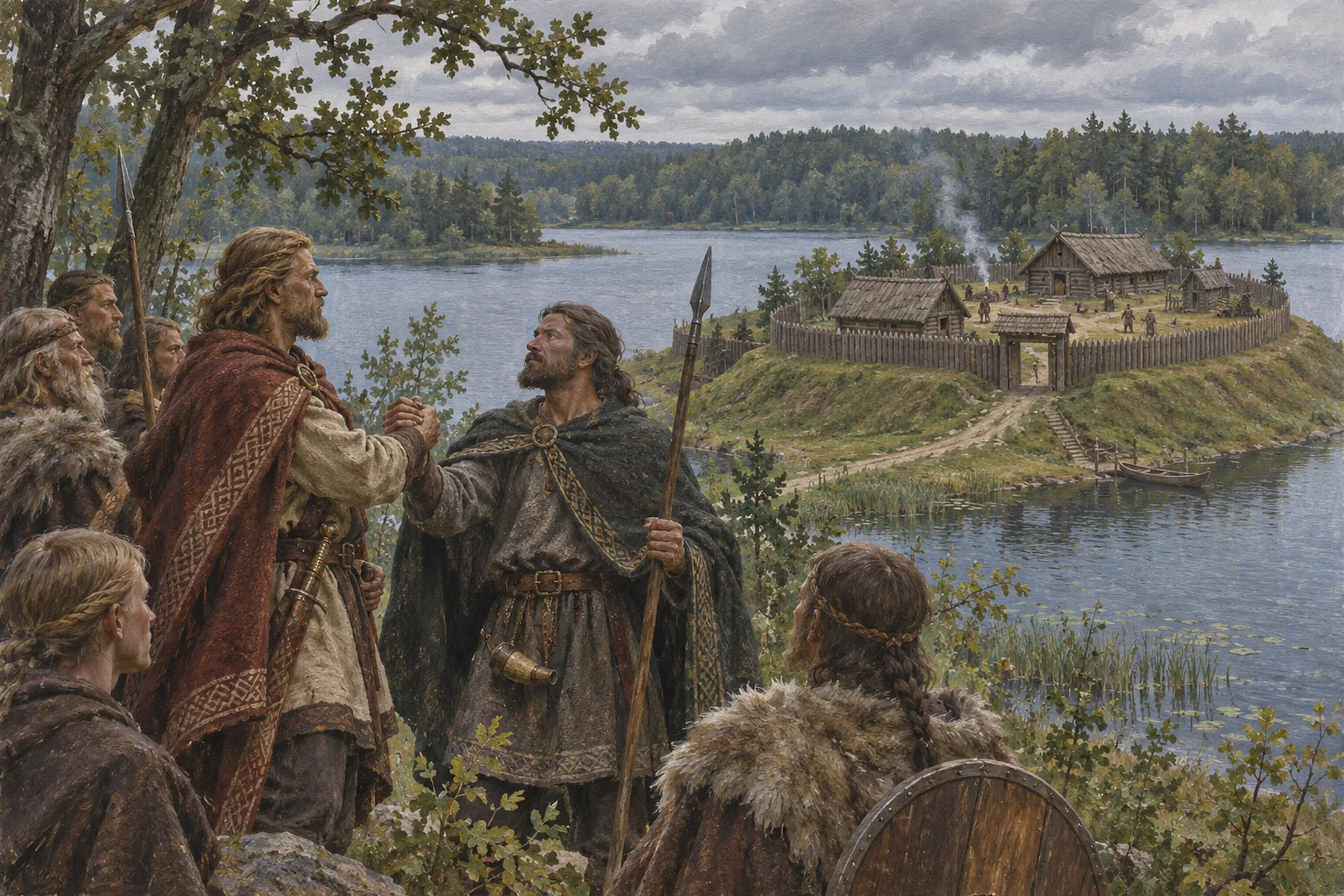
The Bychowiec Chronicle’s Narimantas learns that the Yotvingian princes have died. He receives the country without a battle and assigns its people to his brother Traidenis as tribute-paying subjects. Traidenis becomes ruler of the Yotvingians and Dainava, founds Raigardas beside the Biebrza and fights neighbouring peoples. S19
Kojelavičius expands this story under 1281. He describes the recovery of the country from the Poles, with Yotvingians abandoning Polish rule, and makes Raigardas Traidenis’s new fortress. His later telling is related to the chronicle tradition, rather than an independent record of construction. S7
Writing in 1971, Rimantas Jasas finds no reliable attestation of Narimantas’s rule. He places Raigardas on a lake peninsula and connects the foundation tale to a report of Danielius seeing an existing fort. His commentary also stresses the settlement of refugees on Lithuania’s frontier. S19
1.15
The end of political independence
In 1283 Dusburg opens a new stage of his war narrative: war against Lithuania. His preceding account of Sudovia’s defeat does not erase all its people.
In Book III, chapter 214, Jedetus submits with his household and a large group of both sexes. Scurdo takes his people to Lithuania in the same chapter. Only after describing these survivors does the chronicler conclude that Sudovia lies deserted. S107
Chapter 216 opens with 1283 and war against the Lithuanians. The chronicler presents one subjugation as complete and turns to another front. This boundary in his narrative supplies no date for the death of the last Yotvingian. S107
Jasas describes the campaigns of 1278–1283 as destroying Yotvingian political organization. His interpretation separates that political ending from the lives communities continued elsewhere. S19
1.16
People cross new borders
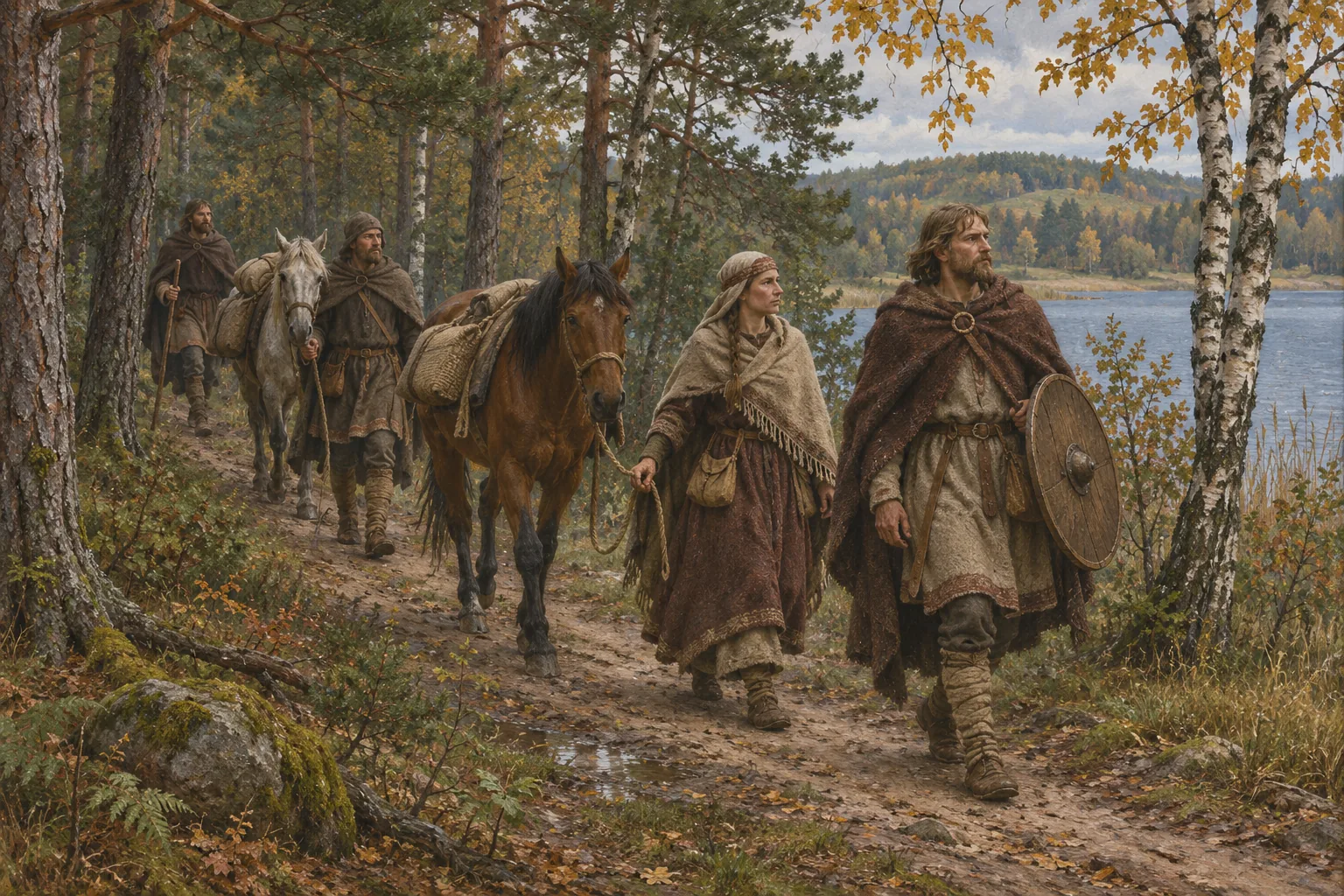
Submission, flight and relocation take people in different directions. The accounts follow them into Lithuania and Sambia.
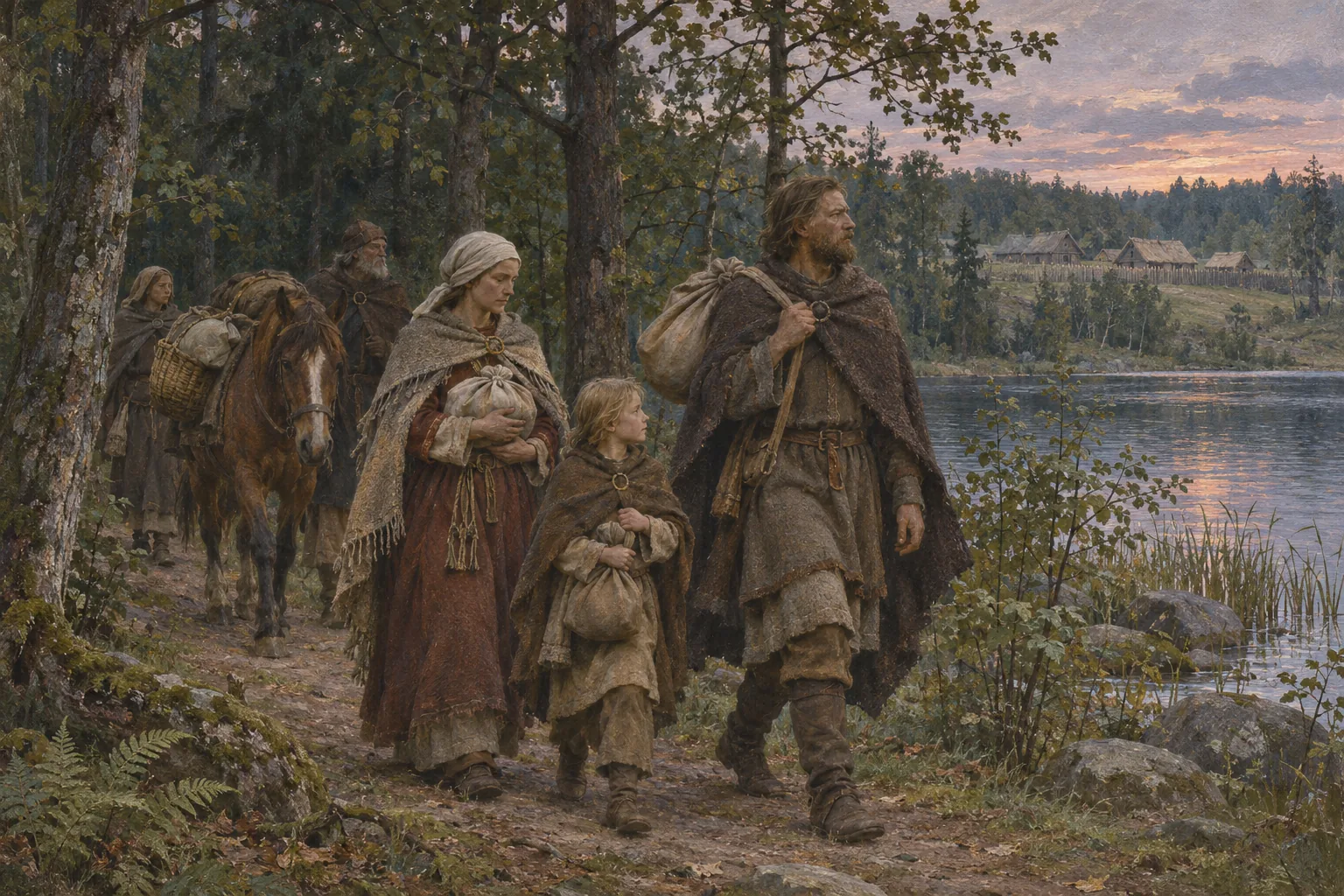
The Order’s master sends some people to Sambia in Dusburg’s account; others evade that destination and flee to Lithuania. Their routes reflect coercion as well as escape. Departure does not mean the same choice for everyone. S107
The history edited by Šapoka describes Traidenis receiving people fleeing the Order and settling them on the Volhynian frontier to strengthen its defence. Refuge offered protection and served the ruler’s policy. The passage concerns Prussian refugees generally, without identifying each person as Yotvingian. S6
Jasas names Gardinas and Slanimas as places where Traidenis settled Prussians and Yotvingians. A new home brought allegiance and a defensive duty. These reports preserve survivors, without tracing their descendants to the present. S19
1.17
The Sudovian name in a later text
The Sudovian name survives conquest in later sources. One influential text speaks from another region and another age.
Rolandas Kregždys examines the German Sudovian Book, conventionally dated to about 1520–1530. He discusses possible blending of Western Baltic traditions in the Samland customs described there. This is not a surviving medieval book written in the Yotvingians’ native language. S138
Dusburg names leaders, households and destinations in accounts of war, baptism and relocation to Sambia. These movements help follow people after conquest. The passages read here contain no account in their native language. S107
1.18
A country’s name returns
Historians shaped Yotvingian memory; cultural projects draw on it today. Each belongs to its own time.
In the 1845 “Būdas”, Simonas Daukantas invokes the Yotvingians when discussing courage and freedom. He dates their choice of death over Polish servitude to 1250. His historical and ethical account differs in date from Kojelavičius’s Komatas story. S20 S7
In January 2025, the Lazdijai Cultural Centre and Punsk municipality announced a joint heritage project, including a proposed Yotvingian learning space at Rudamina Crafts Centre. This is a dated plan; the announcement does not confirm completion. S139
Older writers repeatedly end the country’s story with a battle, yet leave cultivators fleeing, households relocating and leaders changing allegiance in their own accounts. These surviving people are also part of the Yotvingian legacy. The loss of a political order did not make every person disappear. S7 S107 S19