2.1
A childhood known through later stories.
Jogaila’s exact birth year is uncertain. His family and the succession of 1377 provide firmer starting points.
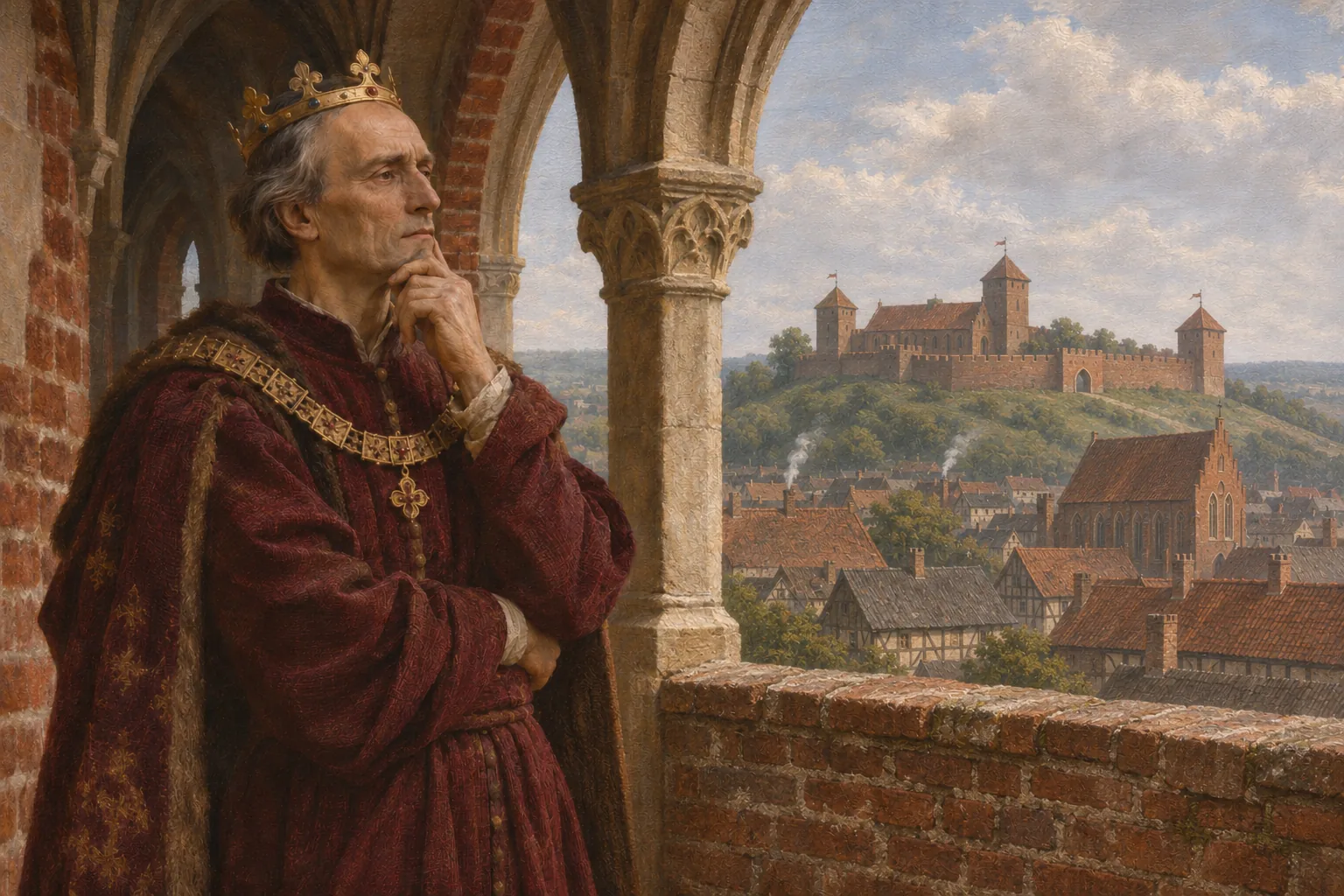
Jogaila was a son of Algirdas and Julijona. In the large princely family described by the Bychowiec Chronicle, birth alone did not secure supreme authority. Brothers held separate lands, gathered supporters and could challenge one another’s standing. These family relationships shaped the life of the future king of Poland from the beginning. S19 S6
The Bychowiec Chronicle, recorded in the sixteenth century, says Algirdas loved Jogaila most among his sons. Its account explains the inheritance of Vilnius through a father’s affection. That later explanation lends legitimacy to Jogaila’s succession, though it supplies no childhood records, secure birthday or exact age. S19
The same chronicle describes Jogaila and Vytautas as close from youth. Their fathers, the brothers Algirdas and Kęstutis, are said to have agreed who would inherit their authority. The later conflict therefore becomes the breaking of a family partnership. The story of friendship gives no direct record of promises between the young men. S19
Jogaila inherited Algirdas’s authority in 1377. The history edited by Šapoka begins his political career with that succession, but an inheritance still had to be secured. Jogaila needed arrangements with the other branches of the family, a distribution of territories and enough supporters to hold his position. S6
2.2
Many lands looked towards Vilnius.
Jogaila inherited a realm whose territories shared neither one language nor one faith nor identical local interests.
Algirdas had ruled far beyond the Lithuanian lands. Polotsk, Briansk and other principalities of Rus’ had their own dynastic traditions and Orthodox communities. Jogaila’s brothers who ruled there had considerable resources of their own: revenue, soldiers and connections beyond the grand duke’s court. They could pursue policies rather than simply carry out orders from Vilnius. S6
War with the Teutonic Order dominated the western frontier. Defending castles and mounting retaliatory campaigns exhausted communities. A treaty might spare some territories while leaving others exposed, and Kęstutis’s Trakai region did not always face the same pressure as Jogaila’s lands. Peace for one ruler could bring new danger to his relative. S6
The 1936 history sees a generational divide: older rulers had spent decades fighting, while younger men sought other diplomatic possibilities. This interpretation places Jogaila’s choices within the pressures facing his realm. It remains the historians’ explanation, rather than his recorded political programme or evidence that every younger prince shared his outlook. S6
Little emerges from these accounts about Jogaila’s schooling, childhood household or earliest religious experiences. His later circle is easier to see: his mother Julijona, brother Skirgaila, cousin Vytautas and uncle Kęstutis. These relatives brought different lands, loyalties and religious backgrounds into the decisions he faced. S6 S19
2.3
An inheritance his uncle accepted.
When Algirdas died in 1377, Jogaila succeeded as grand duke. Kęstutis initially accepted the new ruler.
Kęstutis initially helped Jogaila secure his inheritance. An experienced ruler with a base in Trakai, he could have been a formidable rival; instead, he recognised Algirdas’s son. The history edited by Šapoka connects his support with the brothers’ earlier cooperation and the closeness of their sons, Vytautas and Jogaila. For the moment, the family avoided open war. S6
In the Bychowiec Chronicle, the fathers arrange the succession beforehand and expect their sons to continue governing as partners. This orderly family story explains the new ruler’s legitimacy. Kinship would soon prove less effective at settling practical questions: who could negotiate with the Order, direct campaigns or distribute the inherited territories? S19 S6
Jogaila also had his own court. His mother, brothers and close advisers play important roles in the 1936 history. Their influence did not remove his responsibility as ruler: treaties were concluded in his name, and their consequences affected his authority. S6
Before a Polish crown became possible, Jogaila had urgent problems in Lithuania. He needed to hold Vilnius, reach terms with his brothers and work with Kęstutis. His later success in Kraków can overshadow these precarious beginnings: more than once, his hold on Lithuania came close to collapse. S6
2.4
Kinship did not prevent rivalry.
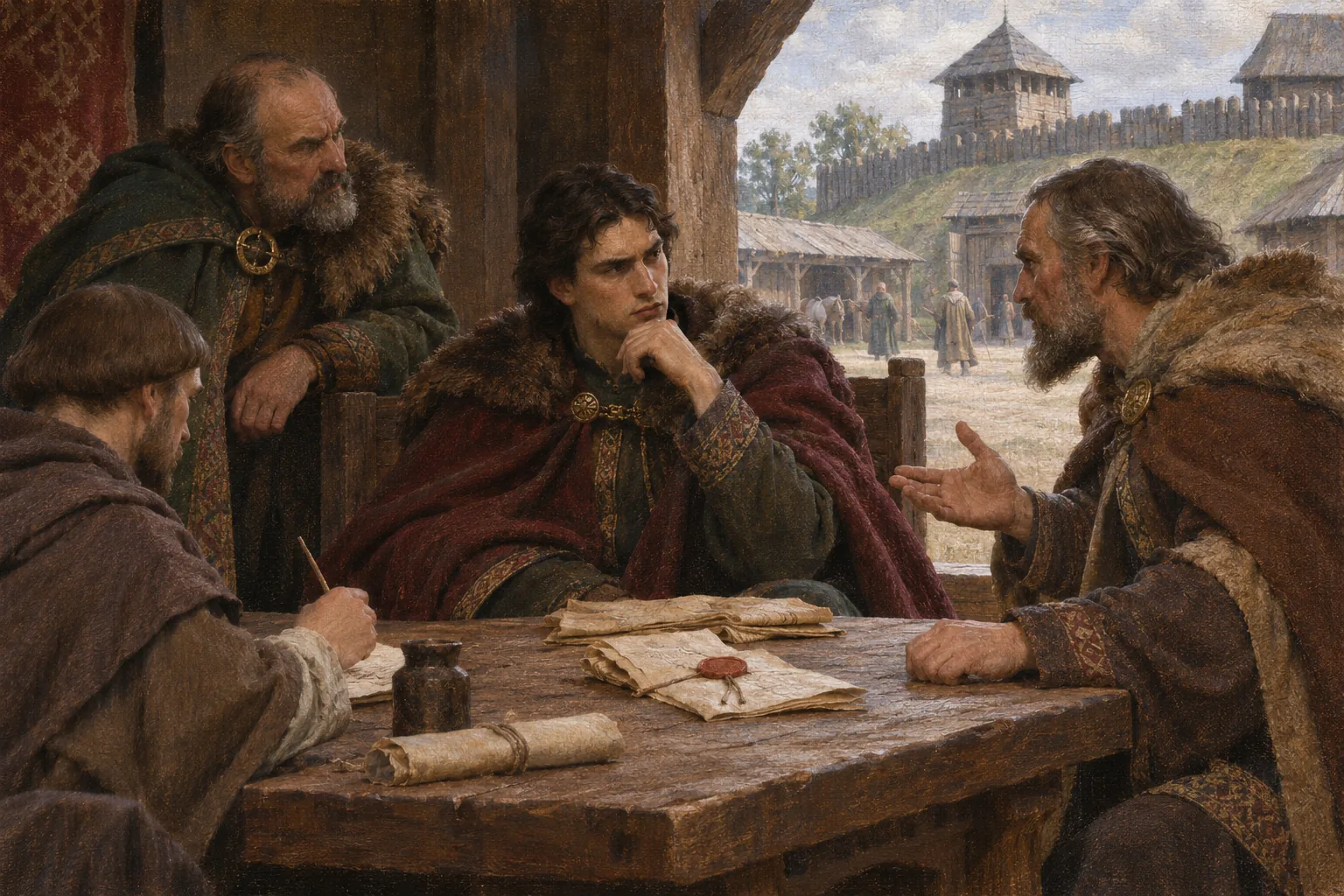
Jogaila’s older brothers had their own supporters and policies in the east. Their territories could become bases of resistance to Vilnius.
Andrius of Polotsk resisted Jogaila’s position more openly than Kęstutis had. The 1936 history connects Andrius with Moscow and Livonia, while Dmitrijus of Briansk also appears in Moscow’s political orbit. A dispute within the dynasty drew neighbouring powers into the struggle over who would rule from Vilnius. S6
A prince established in Polotsk could call on local supporters to resist being replaced by another relative. Jogaila would encounter this difficulty again when trying to accommodate Skirgaila and Vytautas. A promise of land was only useful if he could obtain the territory and deliver it. S6
Jogaila appears in the account of Kulikovo as Mamai’s ally, yet he did not join the battle in 1380. The history edited by Šapoka places his absence within the political circumstances. It leaves open what he intended: staying away does not by itself show that he secretly favoured Moscow or foresaw the outcome. S6
Kojelavičius, writing in the seventeenth century, makes discord among princes central to his account of Polotsk. The history edited by Šapoka also depicts Jogaila’s eastern authority as unsettled. His brothers could use their territories and connections with neighbouring powers to turn a family dispute into a wider political crisis. S7 S6
2.5
Peace for some, war for others.
The agreements of 1379–1380 protected Jogaila’s and Kęstutis’s lands differently; the secret Dovydiškės treaty deepened their distrust.
The Trakai truce of 1379 and the agreement with the Livonian Order in February 1380 left parts of Lithuania outside their protection. In the 1936 history, these uneven terms are central to the growing conflict. While one ruler secured relief along his frontier, his relative’s communities could still come under attack elsewhere. S6
Jogaila negotiated with the Teutonic Order at Dovydiškės in 1380 without Kęstutis’s knowledge. The meeting took place during a hunt, outwardly an ordinary princely gathering. According to the history edited by Šapoka, the terms even allowed Jogaila to appear to help his uncle without breaking his agreement with the Order. Such an arrangement threatened the trust on which their partnership rested. S6
Vytautas attended the hunt too, although the 1936 account considers it likely that he knew nothing of the secret agreement. His presence need not mean he took part in the negotiations. The distinction helps explain how trust between the cousins might have survived while the partnership between Jogaila and Kęstutis was breaking down. S6
Kojelavičius and the Bychowiec Chronicle tell the secret negotiations as a story of betrayal, casting Jogaila in a harsher light. The history edited by Šapoka gives more space to Julijona, Skirgaila and Vaidila. These accounts differ over how the crisis developed; none records Jogaila’s private thoughts or a conversation heard firsthand. S7 S19 S6
2.6
Vilnius changed rulers twice.
Kęstutis deposed Jogaila in 1381. The following year Jogaila recovered the city and renewed the struggle for Trakai.
Kęstutis seized Vilnius and arrested Jogaila. After finding evidence of the secret agreement, he assumed the grand-ducal authority himself. Vytautas interceded for his cousin. In the Šapoka-edited history, that intervention helps explain why the deposed ruler survived and retained territories from which he could act again. S6
Jogaila lost Vilnius but kept a territorial base and the chance to gather supporters. Where that base lay differs between the accounts: the 1936 history names Vitebsk, while the Bychowiec Chronicle and Kojelavičius emphasise Krėva. He remained a prince capable of returning to the struggle, as the following year would show. S6 S19 S7
Jogaila’s supporters recovered Vilnius in 1382 while Kęstutis was away. Rimantas Jasas discusses Hanul’s role and the June coup in his commentary on the chronicle’s 1971 edition. The history edited by Šapoka emphasises merchants’ interest in peaceful trade. It offers commercial advantage as an explanation for support, without establishing that every townsman held the same view. S19 S6
The struggle moved on to Trakai. Jogaila held Vilnius again, but Kęstutis still had authority and supporters, with Vytautas beside him. Both sides could raise troops, and possession of the towns had not decided the war. An offer to negotiate brought them to a meeting that would change the conflict altogether. S6 S19
2.7
A death with disputed responsibility.
Kęstutis and Vytautas were arrested after coming to negotiate. Kęstutis died in captivity at Krėva in August 1382.
Kęstutis and Vytautas came to negotiate under assurances of safety, yet both were arrested. Kęstutis was taken to Krėva and died soon afterwards. His death removed a powerful rival for Jogaila. It left a question on which the accounts disagree: who had ordered it? The political benefit alone does not supply the answer. S6 S19
The Bychowiec Chronicle names men from Jogaila’s household as Kęstutis’s stranglers. Some names in its published list appear in square brackets: the 1971 editor explains that they were added from another recension of the chronicle. The list thus combines manuscript traditions and leaves the full chain of command unresolved. S19
Kojelavičius is explicit: in his narrative, Jogaila sends the killers. The history edited by Šapoka also describes murder, but leaves Jogaila’s own responsibility unresolved and considers Skirgaila’s role. The disagreement concerns the fatal decision itself, not merely how harshly each writer judges the ruler. S7 S6
Jan Długosz accuses Jogaila directly: men from his circle kill Kęstutis on his orders after an arrest that broke sworn assurances of safety. The narrator also reproaches Kęstutis for bringing his son to the negotiations. This fifteenth-century accusation predates Kojelavičius’s account. It still cannot resolve the dispute over Jogaila’s responsibility on its own. S140
The 1936 history records, and rejects, an explanation that Kęstutis had killed himself. His death left a deeper rupture in the family. Vytautas now had to secure his own survival before he could bargain over territories. The memory of his father’s death would remain part of his relationship with Jogaila. S6
2.8
Vytautas returned to the struggle.
Vytautas escaped captivity, obtained the Order’s support and pushed Jogaila towards a new settlement in 1384.
In the escape story, Ona helps Vytautas leave prison disguised in women’s clothing. The history edited by Šapoka has him depart with his wife. Once free, he could challenge Jogaila again. He found insufficient help in Mazovia and turned to the Order, which gained a claimant whose cause could be used to pressure Vilnius. S6
Jogaila had also made heavy concessions to the Order. In the Dubysa agreements of 1382, he promised territory, conversion and limits on his freedom to act. Vytautas accepted onerous terms in exchange for assistance as well. The history edited by Šapoka shows both rivals prepared to promise Samogitia, though neither a signature nor a promise made its communities submit peacefully to the Order. S6
An offensive backed by the Order reached Trakai and Vilnius in 1383. Vilnius held, but Vytautas was gaining supporters. Jogaila needed to win some of them back and keep his cousin from becoming a lasting ally of the enemy. Reconciliation followed in 1384: Vytautas returned to Lithuanian politics with some, though not all, of his demands met. S6
Vytautas received the Hrodna and Brest regions and Lutsk. Trakai remained with Skirgaila, whom Jogaila proposed to move to Polotsk before returning it to Vytautas. Peace therefore depended on an unfulfilled promise. The cousins joined in attacks on the Order’s castles, but the unresolved claim to Trakai helped draw them back into war later. S6
Based on: S6
2.9
Negotiations opened the way to a crown.
The Polish succession and Jadvyga’s marriage offered Jogaila another route into the world of Christian kings.
Louis’s death left Poland’s elite to settle both the succession and the future ruler’s marriage. The history edited by Šapoka explains Jogaila’s candidacy through the interests of those negotiating. Lithuania’s ruler offered a possible partner against shared opponents and a way to end earlier conflicts. His conversion would also change his relationship with western Christendom. S6
Marriage offered Jogaila a crown, resources and diplomatic connections that could strengthen his dynasty. To rule Poland, however, he would need the cooperation of its magnates. The 1936 history often explains his later decisions through this tension: family ambitions had to be pursued within terms accepted by his political partners. S6
The Bychowiec Chronicle explains the Polish invitation differently: the Poles supposedly wanted protection from Jogaila’s power and raids. As Jasas points out, the story also confuses Jadvyga’s parentage and earlier suitor. It preserves a Lithuanian dynastic memory of the invitation, with a different emphasis and factual problems of its own. S19
Envoys, negotiations and agreement among those around the ruler prepared the way for the marriage. The document of 1385 recorded promises already discussed; it was not a scheme Jogaila suddenly devised alone. His relatives and Poland’s political community helped shape the arrangements that would take him to Kraków. S6 S99
2.10
Promises whose meaning remains disputed.
The Kreva act of 14 August 1385 confirmed Jogaila’s promises concerning marriage, conversion and relations with the Polish Crown.
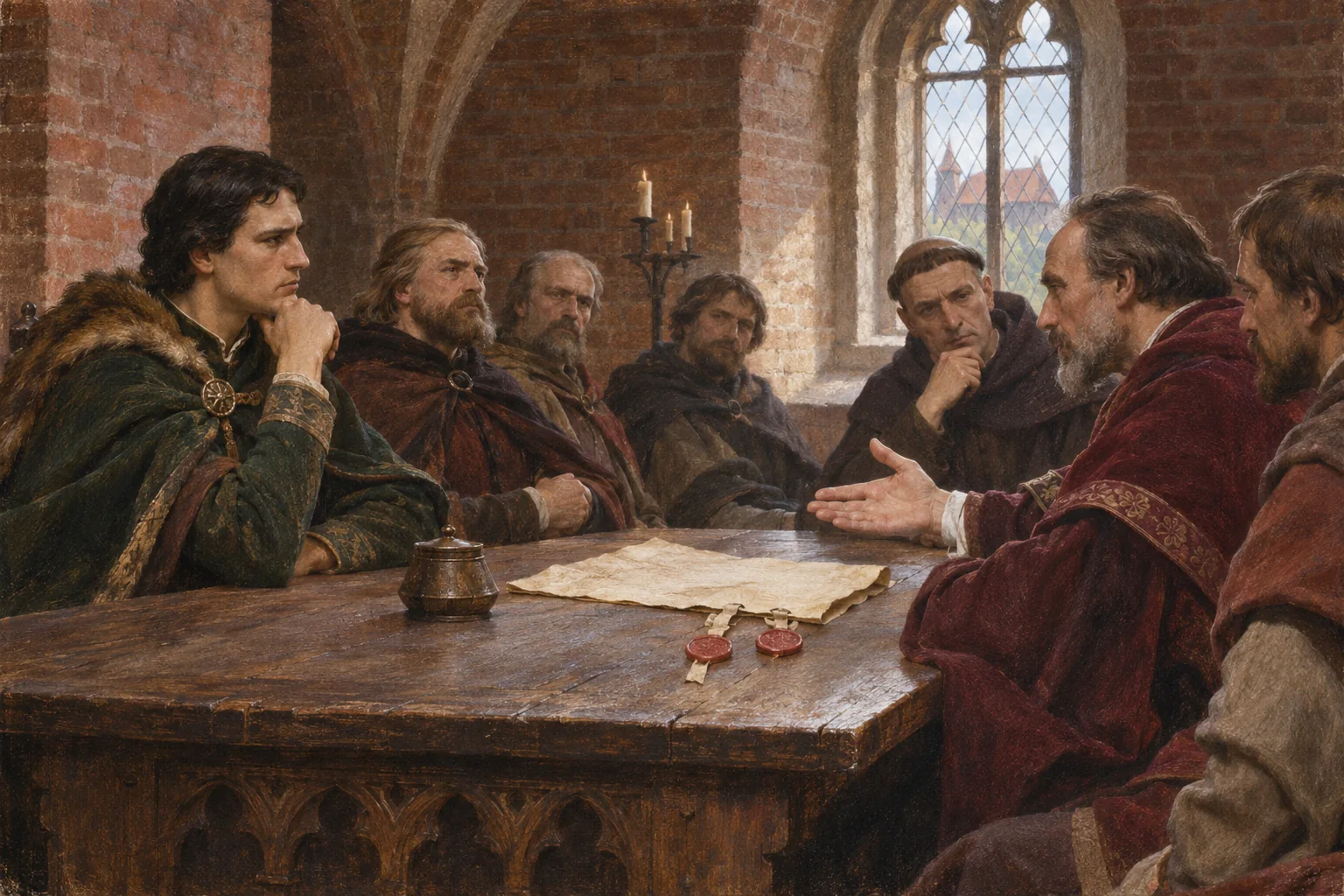
The document confirmed promises carried by envoys: Catholic baptism, marriage to Jadvyga and the use of Jogaila’s resources for agreed purposes. These promises reached beyond the marriage itself. Jogaila’s territories and relatives stood behind the promises, and the named princes gave them the backing of his dynasty. S99
Among the promises were 200,000 florins connected with the previous Austrian marriage arrangement, recovery of Polish losses and the release of Christian captives. The history edited by Šapoka presents the terms as the result of negotiation. Money, territories and prisoners all needed agreement before the marriage could become politically acceptable. S99 S6
The promise to attach Jogaila’s Lithuanian and Rus’ lands permanently to the Polish Crown remains the most disputed. Its Latin verb is applicare. Much turns on how that word is understood, but a translation alone cannot explain how power was subsequently exercised. Later events and documents are needed to follow what became of the commitment. S99 S6
The 1936 history treats Kreva as the confirmation of negotiated promises and traces the later relationship through dynastic interests. Kojelavičius places greater weight on an enduring union. These readings reflect the writers’ different periods. Neither an instant disappearance of Lithuania nor a modern alliance of equal states captures the arrangements they describe. S6 S7
2.11
The kingdom already had a ruler.
Jadvyga ruled Poland before she married Jogaila. Her own authority continued alongside his kingship.
Jadvyga was already a crowned ruler when Jogaila arrived. The National Archives in Kraków dates her coronation to 16 October 1384. She retained authority in her own right after their marriage, issuing documents and using seals in her own name. S98
The history edited by Šapoka follows the Polish magnates’ interests and the difficulties left by Jadvyga’s earlier betrothal. Its account explains the bargaining around the marriage, while saying little that can establish her private feelings. Later stories of love and sacrifice gave her life a romantic shape without preserving her own testimony. S6
Marriage brought Jogaila to the Polish throne; staying there required continued cooperation with the local elite. The 1936 narrative makes this particularly clear after Jadvyga’s death. Both spouses had authority and connections of their own, and their political positions did not always rise or fall together. S6
Jadvyga also supported plans for education. The history edited by Šapoka describes a project to train Lithuanian clergy in Prague. Churches needed people able to teach and serve their communities. Alongside the ceremonies of conversion came the less visible work of preparing teachers and priests. S6
2.12
The name Władysław and the Kraków throne.
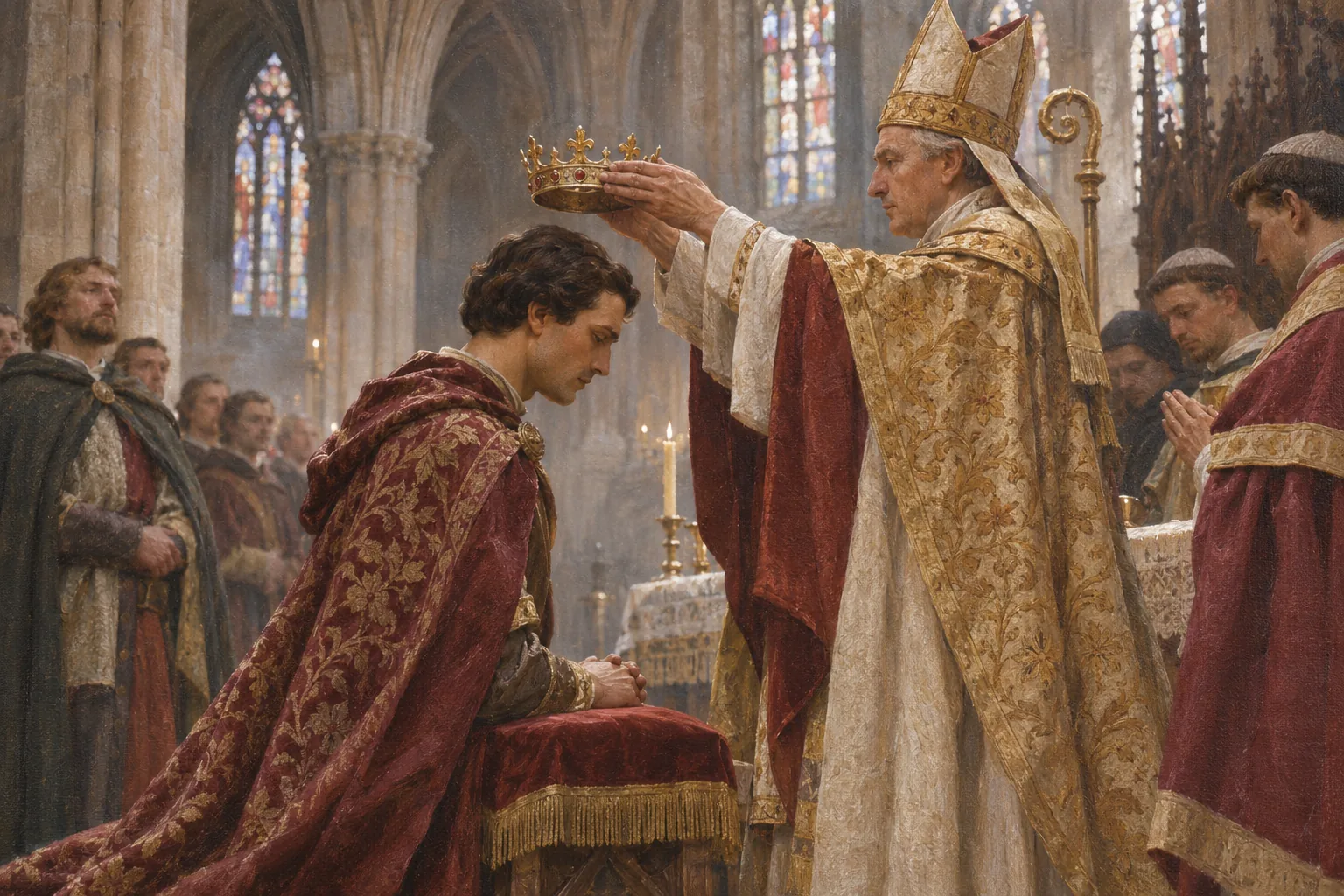
Early in 1386, Jogaila received Catholic baptism, married Jadvyga and was crowned king of Poland.
The Šapoka-edited history dates the baptism to 15 February, marriage to 18 February and coronation to 4 March. His baptismal name, Władysław, became part of his royal identity. These ceremonies changed Jogaila’s position among Christian rulers without dissolving his relationships within the Lithuanian dynasty. S6
Kojelavičius dates the baptism to 16 February. Jasas gives 15 February in the chronicle’s 1971 commentary. The accounts therefore differ by one day. Baptism, marriage and coronation also took place on separate dates. S7 S19 S6
The Polish crown brought Jogaila into a kingdom with established magnates, a Church and political customs of its own. The 1936 history follows his repeated negotiations with these partners. Kingship enlarged his opportunities and resources, while adding to the people whose cooperation he needed. S6
Jogaila kept his claim to Lithuania, but a court in Kraków made governing it more difficult. Much of his time would now be spent elsewhere. Relatives who acted for him, oaths of loyalty and further agreements helped bridge the distance. His supreme authority did not mean that he personally directed government in every territory. S6
2.13
The king brought his new faith to Vilnius.
In 1387 Jogaila took part in Lithuania’s conversion programme. It did not cover the whole realm; Samogitia’s conversion began later.
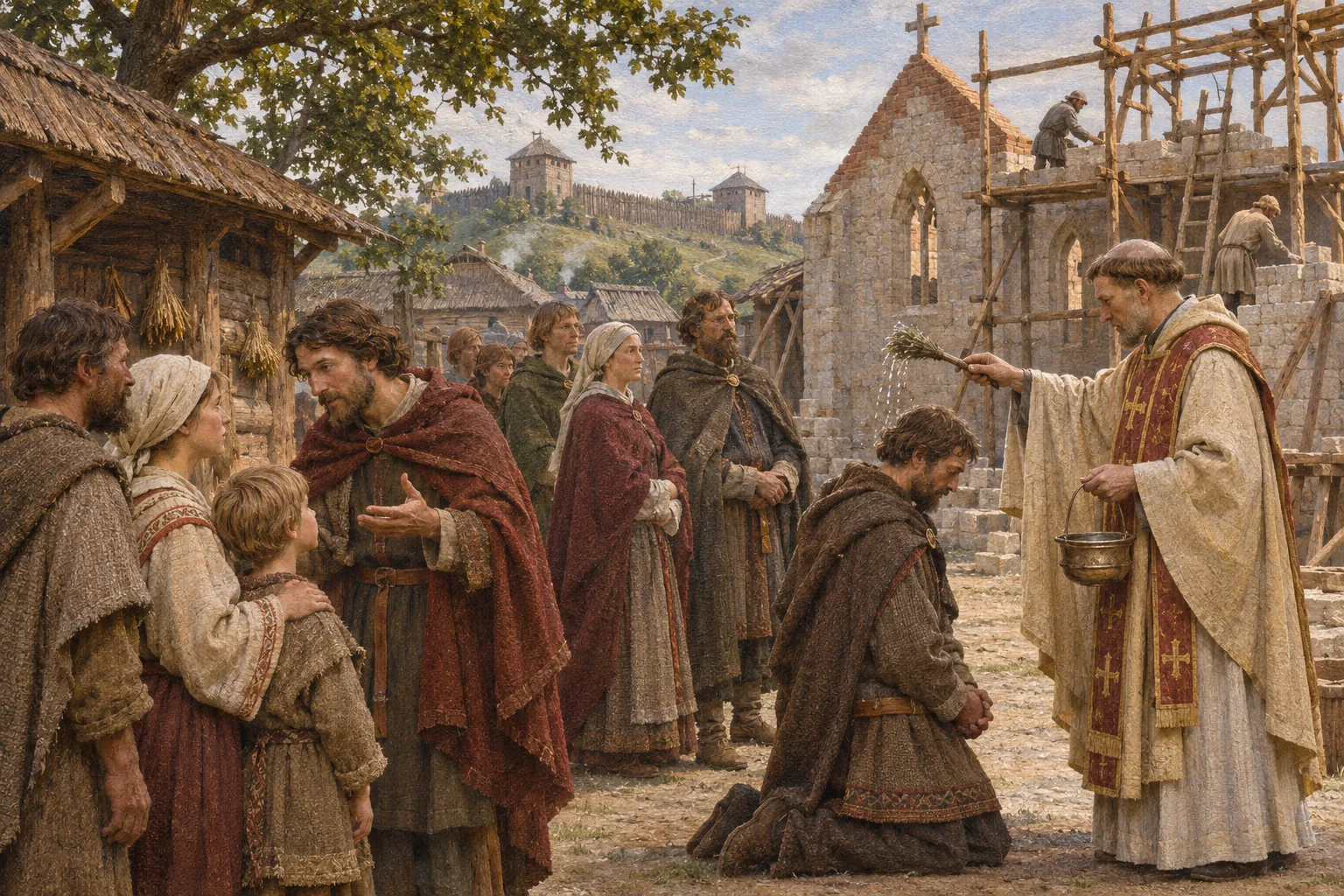
Jogaila returned to Lithuania as a Catholic king. The history edited by Šapoka describes gatherings in Vilnius, baptisms and explanations of the new faith. The ruler publicly supported a major religious change. What happened in those ceremonies, however, cannot tell us how quickly customs changed in every household. S6
Language made the work harder. In the 1936 account, incoming clergy could not explain their teaching intelligibly to everyone, and Jogaila helped them communicate. Kojelavičius also has him explain belief in Lithuanian, adding Christian miracle motifs to the story. The language difficulties and the later writer’s religious imagery remain distinct parts of the accounts. S6 S7
The older narrative describes clothing distributed as gifts and people grouped for baptism. These details give the ruler’s undertaking a tangible form, without telling us how consistently the baptised observed church teaching afterwards. Catholic institutions and familiar religious customs changed at different speeds. S6
Many inhabitants of the realm’s Rus’ territories were already Orthodox Christians before 1387. Samogitia’s conversion was still to come. The Vilnius ceremonies therefore concerned a Catholic settlement backed by Jogaila, with consequences that would unfold unevenly across a realm of different faiths and communities. S6
2.14
Conversion brought privileges and new institutions.
Conversion was accompanied by church privileges, noble rights and Vilnius’s municipal charter.
Baronas and Rowell discuss four acts of 1387: for the bishopric on 17 February, nobles on 20 February, religious obligations on 22 February and Vilnius on 22 March. The customary grouping of three privileges does not include every document. S80
Church lands and exemptions gave the new institution a material footing in the realm. The history edited by Šapoka describes clergy who needed support and churches that needed property and protection. Royal decisions created new arrangements for holding land and exercising jurisdiction, changing the conditions under which nearby communities lived. S6
Catholic nobles received privileges, including rights discussed in the 1936 history in connection with property and marriage. Religious affiliation mattered: the same terms did not apply to everyone. Orthodox Christians formed a substantial part of the realm, and the restrictions placed on them in particular matters did not remove all their rights. S6
Vilnius’s municipal charter was distinct from the bishopric’s endowment and noble privileges. S80
2.15
Jogaila governed through his relatives.
From Poland, Jogaila maintained his claim to supreme authority in Lithuania. Relatives he trusted handled government in his absence.
Skirgaila became Jogaila’s main support in Lithuania. Oaths from princes and the allocation of territories were intended to safeguard the king’s paternal inheritance. The history edited by Šapoka places these arrangements within a system of family rule. From Kraków, Jogaila needed people able to settle local disputes and organise defence in his absence. S6
Skirgaila’s responsibilities are described differently across the sources. The 1936 history links his appointment with 1387; Jasas discusses a broader succession of governors. His powers emerge from what he did and the authority delegated to him. The accounts do not give him a fixed job description comparable to a modern government office. S6 S19
Vytautas had less reason to welcome the arrangement. His claim to Trakai remained unsettled, while Skirgaila appeared better placed to gain opportunities and the king’s attention. The reconciliation of 1384 had allowed Vytautas to return without restoring his family’s former position. Rival supporters and competing territorial claims kept the grievance alive. S6
Jogaila had obligations to both men. Removing Skirgaila risked weakening his own support; refusing Vytautas risked another war. The eventual compromise with his cousin grew out of these competing loyalties and the failure of the existing settlement to hold. Renewed friendship alone would not have resolved the distribution of power. S6
2.16
Jogaila made room for Vytautas.
After another civil war, the settlement of 1392 gave Vytautas government of Lithuania while preserving Jogaila’s claim to supremacy.
Vytautas failed to change the balance of power in Vilnius in 1389. He fled to the Order a second time and received its military assistance, bringing outside troops back into the struggle. For Jogaila, the renewed war exposed how little security his arrangements for governing Lithuania had provided. S6
The history edited by Šapoka describes mounting pressure to settle and the mediation of Henry of Mazovia. Jogaila now accepted a possibility he had previously resisted: Vytautas could govern Lithuania. Skirgaila would lose influence, but separating Vytautas from the Order offered a way to end the civil war. S6
At Astrava in 1392, Vytautas gained practical government of Lithuania while Jogaila retained his claim to supremacy. Their different positions survived the settlement. Jasas distinguishes office from title, leaving room for the further negotiations through which Vytautas’s authority developed. His later independence cannot all be placed at this single moment in 1392. S6 S19
Several surviving documents attest the Astrava settlement. The Šapoka-edited history discusses Ona’s guarantee to Jadvyga of 5 August 1392; in another document of the same day, Ona gave a guarantee to Jogaila. Vytautas’s undertaking to Jadvyga also survives, while his document to Jogaila is identified as lost. The book’s source discussion reports no information about a document issued by Jogaila himself. S6
2.17
Loss and defeat brought new negotiations.
Jadvyga’s death and Vytautas’s defeat at the Vorskla changed the cousins’ positions. They renewed their arrangement in 1401.
Jadvyga and her infant died in 1399. The history edited by Šapoka follows the political uncertainty that accompanied Jogaila’s bereavement. He had entered the Polish kingdom through his marriage; now he had to maintain his place on the throne without Jadvyga. The account traces the dynastic consequences without preserving his private words of grief. S6
Vytautas suffered defeat at the Vorskla in the same year. The 1936 narrative links the subsequent settlement to both cousins’ need for clearer terms. Jogaila wanted a partner in Lithuania, and Vytautas sought recognised self-government. Their family relationship and earlier reconciliations had not provided lasting guarantees. S6
The Vilnius–Radom arrangements confirmed Vytautas’s government for life and envisaged reversion to Jogaila and his heirs after his death. The Polish nobles’ promise not to settle a new royal election without the Lithuanian side’s knowledge also showed reciprocal obligations. Future succession became a matter to be negotiated publicly. S6
Nobles from both lands joined the rulers in these arrangements. Their participation broadened the settlement, although the political communities involved still differed greatly from those of later periods. In his introduction to the 2019 edition of Narbutas, Petrauskas cautions against seeing a later parliamentary system already in place in 1401. S6 S8
2.18
Samogitia brought the rulers towards war.
Samogitian resistance and disputes with the Order eventually brought Jogaila’s and Vytautas’s policies together in a common campaign.
Lithuanian rulers repeatedly promised Samogitia to the Order, but its communities continued to resist. The history edited by Šapoka gives that resistance a decisive role in preventing concessions on paper from becoming settled rule. Jogaila’s earlier promises belonged to a struggle whose outcome also depended on people living in the region. S6
The rebels of 1409 burn the Order’s castles and drive its men from Samogitia in the history edited by Šapoka. Vytautas sends nobles to assist them, and Jogaila declares his support for Vytautas. The book also describes the Order intercepting grain sent after a poor harvest. Control of food shipments and the frontier added fresh suspicion to an already fragile relationship. S6
Narbutas describes the intercepted ships at greater length, including allegations that weapons had been carried with the grain. His 1839 narrative shows both sides justifying their actions as war approached. It records the accusation without independently establishing that arms were smuggled as alleged. S8
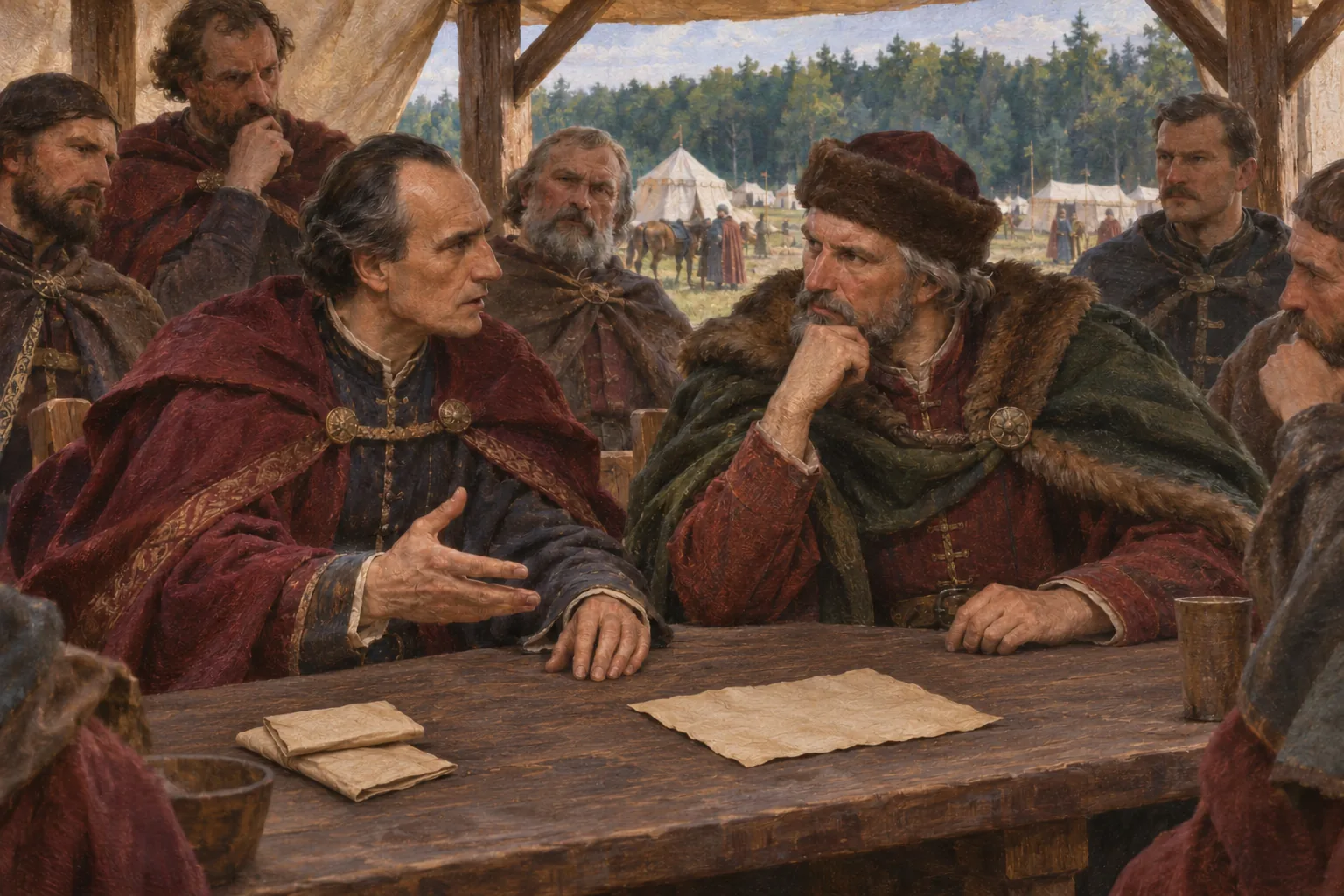
The campaign of 1410 brought together forces travelling from different territories. The history edited by Šapoka emphasises their meeting near Czerwińsk. Jogaila, king of Poland, and Vytautas, ruler in Lithuania, had turned their political cooperation into a coordinated campaign. They could fight together while retaining different interests for the years ahead. S6
2.19
The king in battle and in its retellings.
The victory of 15 July 1410 marked a turning point in Jogaila’s reign. Writers describe his role in sharply different ways.
The Šapoka-edited history assigns supreme command to Jogaila and a particularly active battlefield role to Vytautas. It distinguishes overall command, leadership of individual contingents and personal fighting. The account does not reconstruct the sequence of every order. S6
Kojelavičius presents Jogaila as devout and describes the Lithuanian withdrawal and eventual victory within a Christian understanding of events. Faith helps explain the outcome in his seventeenth-century history. The prayer scenes convey that meaning, while leaving unanswered who issued particular battlefield orders and when. S7
In the Bychowiec Chronicle, Vytautas appeals for help while Jogaila remains at Mass. The chronicle gives the battle’s date as 1412 and places Lithuania’s ruler at the heart of the victory. Its dramatic exchange preserves a distinct dynastic memory; it cannot be spliced into other narratives as though all recorded the same conversation. S19
Petrauskas traces the merging of different traditions in Narbutas’s account and separately criticises an anecdote taken from Grunau. A detailed narrative can still contain later invention or reshaping. Jogaila’s part in the victory remains significant even where the sources do not allow a reliable reconstruction of every moment. S8 S6
2.20
Victory in the field did not settle the war.
The siege of Malbork and the Peace of Toruń in 1411 exposed the limits of what could be achieved after Grunwald.
Jogaila’s and Vytautas’s forces advanced towards the Order’s capital after the battle. There, a strong fortress still had to be taken. The history edited by Šapoka recounts the unsuccessful siege of Marienburg, now Malbork. Heavy losses on the battlefield had weakened the Order without destroying its institutions or its bases of power. S6
Why Vytautas left the siege is explained differently by older writers. The 1936 history considers whether the Order’s complete collapse might have strengthened Poland too much. It offers a political interpretation, without recording a secret agreement between the rulers. Keeping an army in the field also placed practical limits on the campaign. S6
The Peace of Toruń in 1411 returned Samogitia to the Lithuanian side for Jogaila’s and Vytautas’s lifetimes. Narbutas reproduces that condition. The settlement brought a political gain but left the frontier’s longer future uncertain. Negotiations, legal proceedings and further fighting followed. S6 S8
The Treaty of Melno in 1422 marked a later stage of the same struggle. Grunwald had weakened the Order militarily, but Jogaila still faced years of diplomacy and further agreements. Battlefield victory offers one image of his reign; the work of turning it into a settlement continued long afterwards. S6
2.21
Noble families entered the partnership.
The Horodło arrangements of 1413 connected royal succession, Lithuanian government and sections of the Catholic nobility in both lands.
At Horodło, rulers and nobles made several related agreements. The history edited by Šapoka discusses their obligations, offices and consultation over succession. The relationship between Jogaila and Vytautas now had broader support among noble families. How fully each provision was accepted and put into practice remains a separate question. S6
Forty-seven Lithuanian Catholic noble families entered Polish heraldic clans. Sharing coats of arms gave their new ties a public symbol and political significance. Access was selective: many inhabitants and influential families in the Grand Duchy were Orthodox, and the arrangements did not give every noble the same rights. S6
Kojelavičius writes of friendship and equality at Horodło, while retaining the Catholic boundaries of the agreement. Narbutas sees Lithuania taking an important step into European political life. The history edited by Šapoka worries more about later cultural consequences. Each draws a different assessment from the same set of documents. S7 S8 S6
The ties between noble families could help Jogaila secure arrangements that reconciliation with Vytautas alone could not guarantee. Men who held land and could gather political support needed to recognise a future successor. Their greater involvement also constrained the ruler: the dynasty increasingly had to negotiate with these communities of nobles. S6
2.22
Samogitian voices reached Constance.
Conversion and frontier disputes took the struggle to a church council. Samogitians joined Jogaila’s and Vytautas’s diplomacy by presenting their own complaint.
Jogaila and Vytautas travelled to Samogitia in 1413 to begin public conversion activity. The history edited by Šapoka describes a short visit complicated by language difficulties. Their presence gave royal support to a longer undertaking. A bishopric and functioning parishes would follow, bringing a more sustained change to local religious life. S6
The Council of Constance gave the Samogitian dispute an international audience. The 1936 history describes the region’s delegation presenting a complaint against the Order’s government. Samogitians now gave public testimony alongside the rulers’ diplomacy. They argued their own case and challenged the Order’s account of warfare and conversion. S6
Frontier disputes outlasted the council. The history edited by Šapoka follows arbitration, conflicting decisions and the rulers’ refusal to accept an adverse outcome. Jogaila needed envoys, legal arguments and contacts with the pope and other rulers. Military success had left questions of rights and territory still to be contested. S6
In the east, Lithuanian authority depended on local princes and changing alliances. Much of this policy belongs to Vytautas in the history edited by Šapoka. His campaigns did not all originate as orders from Jogaila in Kraków. The partnership had two centres of power, each with its own interests, local allies and demands on its ruler’s time. S6
Based on: S6
2.23
Life at court, work at the writing desk.
Jogaila’s court needed clerics, students and people who could prepare documents. Later historians also preserved stories of the ruler’s habits and character.
Kojelavičius describes a ruler who dressed modestly, ate moderately, bathed often, hunted and gave generously to petitioners. Writing in the seventeenth century, he shaped these habits into a moral portrait. His Jogaila is courteous and resilient, but sometimes hesitates over decisions because he dislikes disappointing those who ask for help. The historian did not witness this court life himself. S7
Długosz both praises and reproaches Jogaila. His king dresses modestly, drinks water, bathes frequently, rewards people and cares for widows and orphans. Yet the same author condemns excessive spending, a passion for hunting and neglect of public affairs. The narrator’s moral judgements shape this portrait; it should not be treated as a verified account of the king’s daily routine. S140
Hunting and Lithuanian servants at the Kraków court also appear in the history edited by Šapoka. Its authors read these details as signs of Jogaila’s attachment to his homeland. They portray a king still drawn to Lithuania’s people and forests, combining accounts of his habits with their own interpretation of what those habits meant. S6
Jogaila renewed the University of Kraków in 1400. The 1936 history stresses its importance for Lithuanian students, especially future clergy. Churches and government needed people who could study, read and handle documents. The university helped train them. S6
Privileges, oaths and promises confirmed in writing preserved the results of negotiations. The Kreva act recorded who had promised what. The people who prepared such documents contributed to government, even when their names went unmentioned in the narrative. The royal document bound Jogaila; the ruler did not necessarily compose its Latin sentences himself. S99 S6
2.24
The dynasty’s future remained uncertain.
Jogaila married four times. Family life was inseparable from succession during his reign, though it cannot be reduced entirely to that question.
Jogaila’s wives were Jadvyga, Ona of Celje, Elzbieta Granowska and Sofija Alšėniškė. Their names mark distinct stages in his family life. The familiar story of Jogaila and Jadvyga leaves much of those women’s lives untold. S96
The history edited by Šapoka records the loss of the infant from Jogaila’s first marriage and a daughter from his second; it gives the third marriage no heirs. Its brief dynastic account explains why sons mattered to the succession. It tells us less about the women’s lives or the daughter’s political significance, and family relationships extended beyond the search for a male heir. S6
Vytautas helps choose Sofija as a bride in the Bychowiec Chronicle. A comparison between sisters gives the account the shape of a family anecdote. Jasas points out chronological difficulties in the tradition. Its royal matchmaking scene preserves a later memory, including dialogue supplied by the narrator rather than recorded by a participant. S19
Narbutas retells the anecdote but questions the claim that Vytautas expected Jogaila’s marriage to remain childless. He finds no support for that suspicion. The qualification comes from the romantic historian himself: even while exploring political designs behind the marriage, he declines to accept every motive earlier writers had assigned. S8
2.25
An heir’s birth did not secure a throne.
Sofija and Jogaila’s surviving sons, Vladislovas and Kazimieras, gave the dynasty a future that still required political recognition.
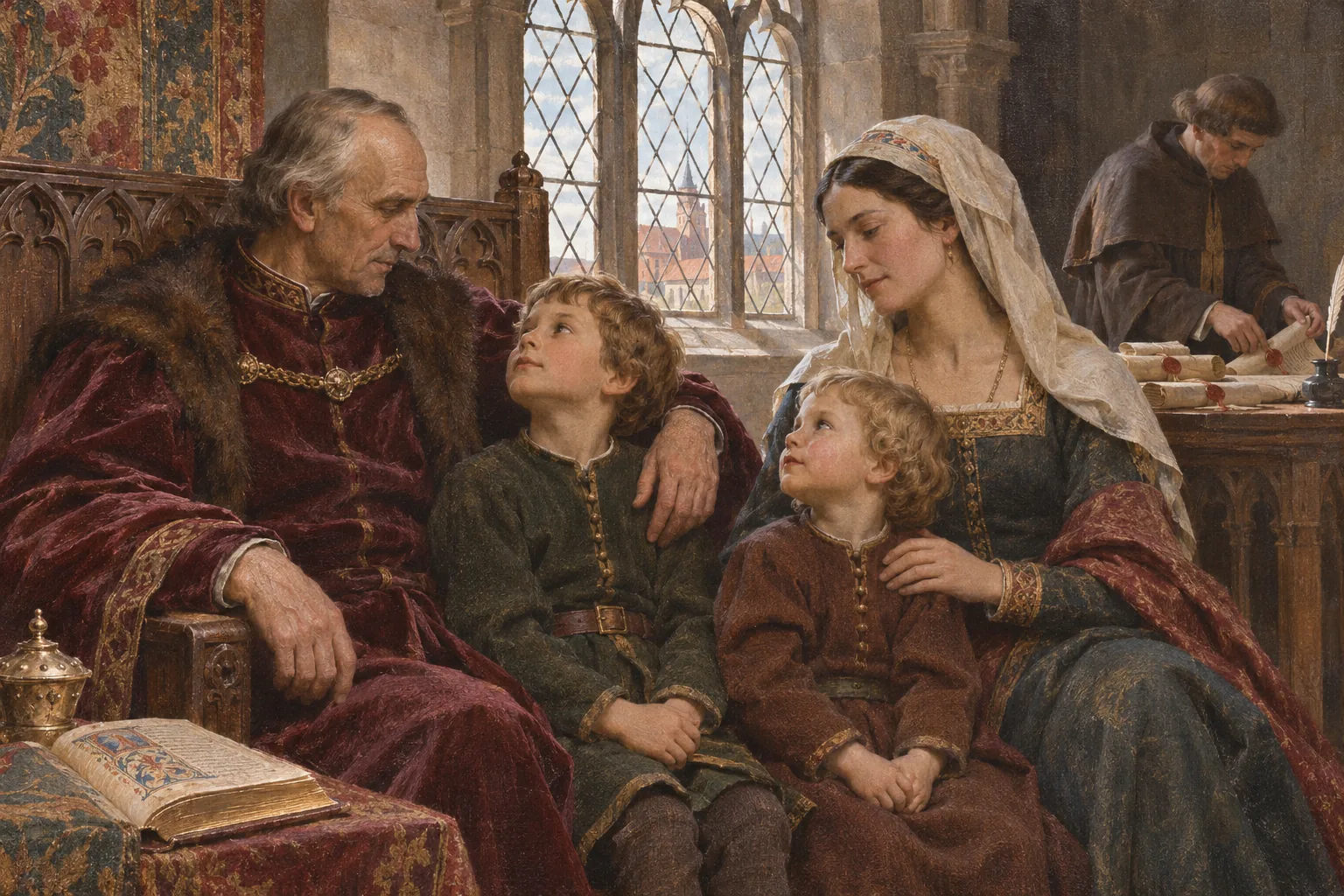
Vladislovas was born in 1424 and Kazimieras in 1427. The history edited by Šapoka follows these surviving sons towards their later thrones. Its dynastic summary concentrates on the children who became rulers; this is not a complete register of births. S6
A son’s birth did not guarantee his election as king. Jogaila needed the Polish nobility to agree to choose one after his death. The 1936 history links their recognition with further privileges. Negotiations over the royal family’s future gave nobles another opportunity to defend and enlarge their rights. S6
Lithuania’s succession also remained unsettled. After Vytautas died, Švitrigaila became grand duke; Jogaila did not simply install one of his sons from Kraków. The history edited by Šapoka explains the choice through the Lithuanian nobility’s autonomy. The king retained influence, but family claims needed more than his own declaration to prevail. S6
Kazimieras was later chosen to rule Lithuania and afterwards became king of Poland. The 1936 account follows Lithuanian nobles choosing a separate ruler in their own circumstances. Their decision helped shape the dynasty’s future long after its founder could control it. Earlier promises alone did not determine which of his descendants would rule. S6
Based on: S6
2.26
A crown tested the cousins’ partnership.
In 1429–1430, the proposed coronation of Vytautas reopened the question of Lithuanian autonomy and Jogaila’s dynastic rights.
A crown for Vytautas, proposed at the Lutsk meeting, would have changed his standing. In the history edited by Šapoka, Jogaila agrees at first and then draws back as the Polish elite opposes it. The disagreement reaches beyond personal jealousy. A new kingdom would raise questions about existing agreements and who would eventually inherit Lithuania. S6
The Bychowiec Chronicle credits Jogaila with proposing the crown. Jasas connects the proposal to Sigismund in his 1971 commentary and examines Jogaila’s changing stance. Sigismund, then King of the Romans, sought a different regional balance. Supporting Vytautas also put pressure on Jogaila’s arrangements with Poland’s political community. The accounts differ over who took the initiative. S19 S6
Narbutas follows the preparations and disagreements at length. Jogaila still travelled to Lithuania: protest had not brought the cousins’ relationship to an end. They continued negotiating, trying to repair personal relations and seeking terms both could accept. Narbutas’s detailed explanations of their motives remain a later writer’s interpretation of those efforts. S8 S6
Vytautas died without a crown in 1430. The history edited by Šapoka returns to the unresolved relationship between a grand duke’s authority and the claims of Jogaila’s family. The cousins had sustained a functioning realm without agreeing on a future acceptable to everyone. The failed coronation did not settle who could decide Lithuania’s succession. S6
2.27
The nightingales remained in the story.
Jogaila died in 1434. Later writers linked his final illness to nightingales, giving different accounts.
The encyclopaedic biography gives 1 June 1434 and Horodok near Lviv, the date and place used here. Kojelavičius instead supplies 30 May and Hrodna; his account of the final illness differs from the modern biographical chronology. S96 S7
Kojelavičius places the weary ruler at a window, listening to nightingales before falling ill. He follows the illness with concern for a son, reconciliation with magnates and preparation for a Christian death. The seventeenth-century historian gives Jogaila’s life a carefully shaped ending, without supplying a medical record or directly recorded final words. S7
Długosz begins the nightingale story at Medyka. Jogaila goes into the forest to listen on a cold evening; later, fever strikes him at Gródek, today’s Horodok. The narrator links the birdsong habit to the ruler’s pagan past, then closes his life with a scene of Christian reconciliation. The translation gives the last day of May, differing from the 1 June date used here. The story does not establish a medical cause of illness. S140
The history edited by Šapoka also tells the nightingale story and places Jogaila’s death outside Lithuania. Its estimate of roughly eighty-five years follows an older birth chronology. Birdsong gives the king a tender final portrait, although the differing versions leave both his precise cause of illness and his age uncertain. S6
Jogaila was buried in Kraków, and the young Vladislovas succeeded him in Poland. Political struggles in Lithuania continued in changed circumstances. The relationships built during the king’s lifetime survived him: his son still needed the assent of influential people, while the family claims Jogaila left behind continued to shape politics. S6
2.28
One ruler, different portraits.
Jogaila’s legacy includes the consequences of his decisions and later arguments about what they meant for Lithuania and Poland.
Conversion, shared victory and a lasting dynasty all figure in the history edited by Šapoka. Its authors nevertheless place strong emphasis on the later Polonisation of Lithuania’s nobility. Writing in 1936, they set the fourteenth-century ruler at the beginning of a long national story whose cultural consequences became visible only over the centuries that followed him. S6
Kojelavičius values restraint, generosity, devotion and endurance. His portrait gives Jogaila virtues where the interwar history finds a troubling lack of resolve. The contrast reflects different questions. One writer judges a king’s moral character; the other considers how his decisions shaped the later history of a nation and state. S7 S6
The Bychowiec Chronicle often brings Jogaila into view through Vytautas. This Lithuanian dynastic perspective can leave less room for his work in Poland. Narbutas expands this Lithuanian dynastic tradition and draws on other accounts. Later portraits differ partly because their authors chose different episodes and judged the consequences of Jogaila’s actions from different historical vantage points. S19 S8
Jogaila’s enemies became partners, relatives fought and reconciled, and new agreements revised old promises. He kept the Polish crown and left sons who carried on his dynasty. Lithuania retained a political community of its own, whose future required more than the decision of a single king, even one who claimed supreme authority there. S6