1.1
Mothers and a surviving language
In the preface to Būdas, Simonas Daukantas finds language carried forward at home, in words passed on by mothers.
In Būdas senovės lietuvių, kalnėnų ir žemaičių, published in 1845, Daukantas sets a living language against things lost from the past. He compares it to a lingonberry remaining green through frost. His image speaks of survival, rather than an unchanging language. S20
Daukantas credits mothers in woodland homes with preserving the language. His exemplary mother sends a child out into the world with reminders of decent conduct and home. Through this scene, rather than a conversation recorded in a particular family, he places everyday speech alongside written accounts. S20
In his discussion of manners, Daukantas offers examples of greetings, enquiries about health and ways to open a request. Words in his account have an occasion and an addressee: they welcome another person and begin a conversation. He supplies neither a separate date nor a named informant for every expression. S20
Based on: S20
1.2
A linguistic name
Gimbutienė defines the Balts through language.
Marija Gimbutienė defines the Balts by linguistic and ethnographic criteria rather than political borders. River names and loanwords help her investigate their earlier distribution and contacts with neighbouring peoples. S11
Based on: S11
1.3
Three related languages
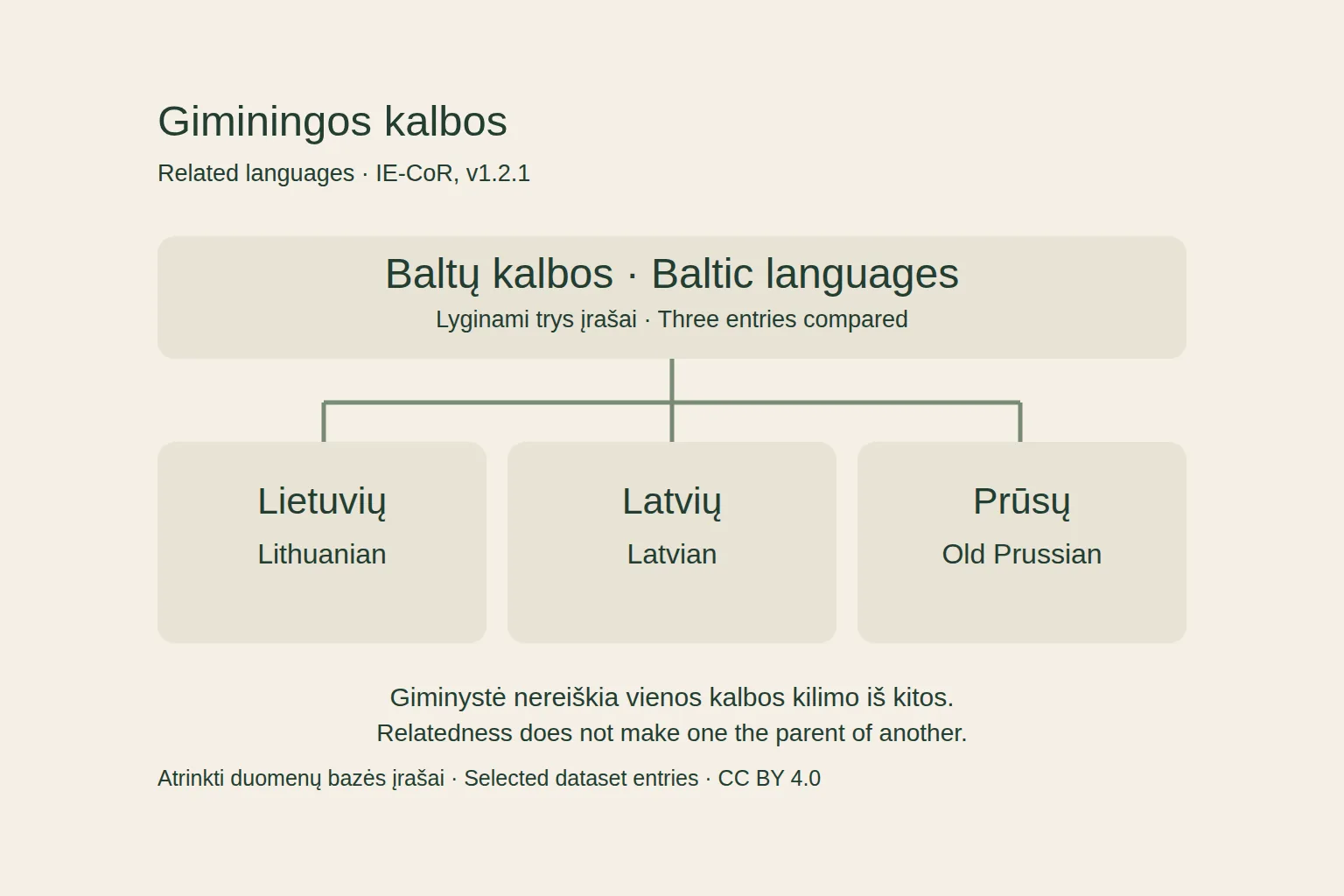
The IE-CoR database compares Lithuanian, Latvian and Old Prussian words as part of the Indo-European inheritance.
IE-CoR, the Indo-European Cognate Relationships database, places these three languages in the Baltic group. Its Lithuanian and Latvian records represent standard varieties; its Old Prussian material comes from historical writings. Information about the sources accompanies each comparison. S168
The database identifies cognacy through shared inheritance. Borrowing is considered separately: neighbours can adopt a word without beginning to speak the same language. This distinction makes room for questions about both a shared linguistic past and later encounters. S168
Based on: S168
1.4
Relationships in two rows of words
The words for smoke and sun offer a concrete view of the forms compared in IE-CoR.
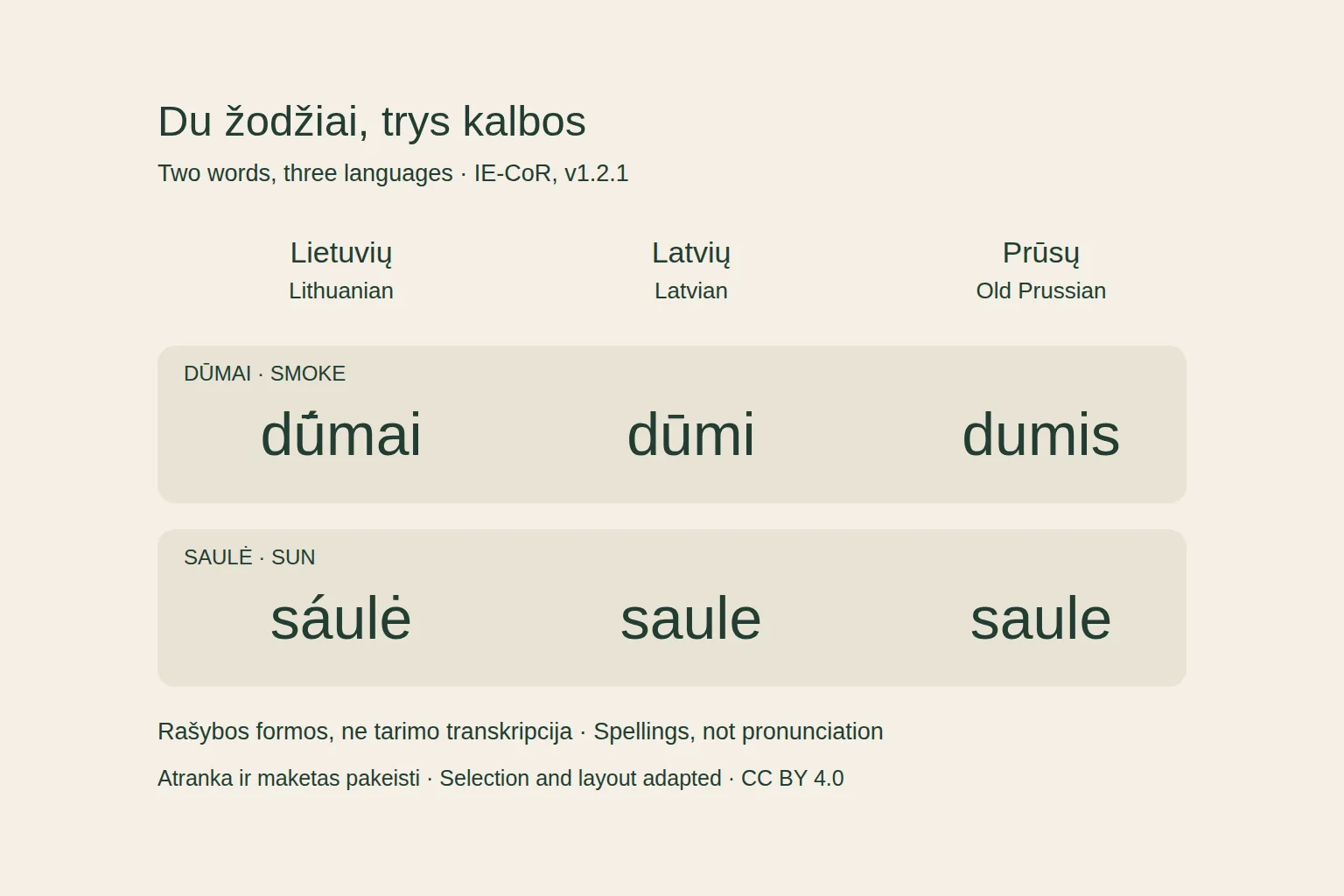
For the meaning "smoke", the database gives Lithuanian dū́mai, Latvian dūmi and Old Prussian dumis. Its Romanised orthography is retained, with all accent and length marks. The Old Prussian form dumis carries no additional marks. S168
The second row contains Lithuanian sáulė, Latvian saule and Old Prussian saule. IE-CoR assigns these forms to one cognate set and the smoke terms to another. The sets connect words through shared inheritance, rather than deriving one present-day language from another. S168
The identical Latvian and Old Prussian spellings saule do not determine pronunciation: the forms supplied are not phonetic transcriptions. The table compares meanings, rather than case or number forms. The words need not match in every grammatical detail. S168
Based on: S168
1.5
Standards and a collection of historical writings
Each language name stands for a particular selection of material.
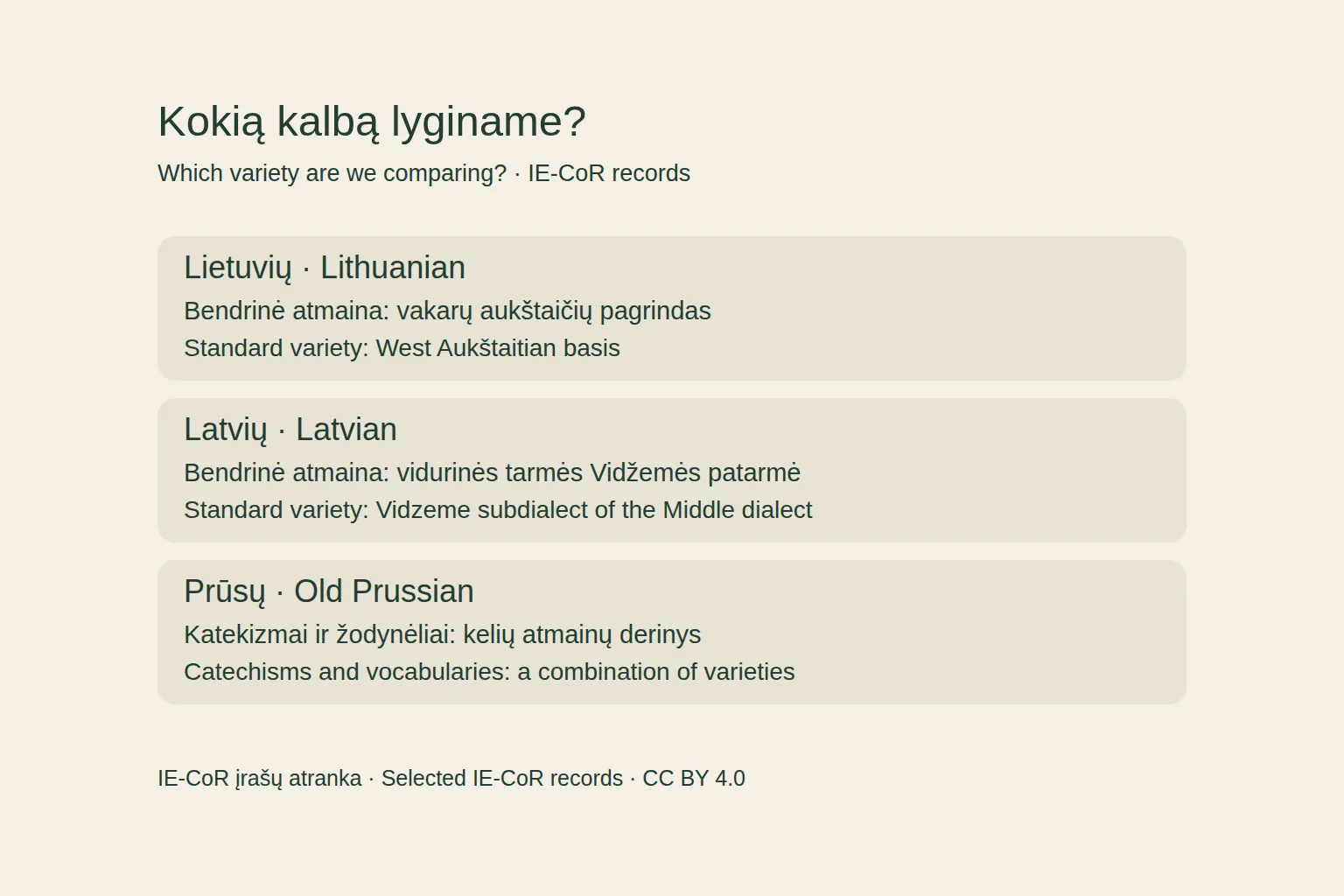
The IE-CoR Lithuanian entry describes the standard language, whose dialectal basis is West Aukštaitian. Its Latvian entry identifies the standard variety and its basis in the Vidzeme subdialect of the Middle dialect. These are selected varieties for comparison, rather than the full dialect diversity of either language. S168
The Old Prussian entry has a different basis: three catechisms, the Elbing vocabulary and the Grunau vocabulary. The description itself calls this combination a compromise across slightly different dialects. It represents language attested in different writings, rather than a single Old Prussian standard. S168
Thus dū́mai and dūmi enter the comparison from standard varieties, while dumis comes from a historical source collection. Languages with present-day norms stand alongside material preserved in writing. S168
Based on: S168
1.6
Where does the scheme end?
Kardelis examines the basis of traditional classification.
The traditional scheme places Old Prussian in West Baltic, Lithuanian and Latvian in East Baltic. Curonian and Yotvingian textual traces are disputed; Semigallian and Selonian evidence is chiefly names. Kardelis questions whether traditional sound criteria establish these poorly attested varieties as distinct languages. S166
Based on: S166
1.7
Prayers in an older book
An inscription on an old book’s page raises its own dating question.
The abstract of Jurgis Lebedys and Jonas Palionis’s 1964 article discusses Lithuanian prayers discovered in 1962, handwritten in a copy of Tractatus sacerdotalis printed in 1503. The authors argued that the inscription preceded Mažvydas’s 1547 book. The year 1503 dates the printed volume, not the handwriting precisely. S170
Based on: S170
1.8
Mažvydas’s book in Königsberg
The first Lithuanian book was printed in Königsberg in 1547.
Vilnius University Library describes Martynas Mažvydas’s catechism, printed in Königsberg in 1547, as the first Lithuanian book. It included a primer and hymns with musical notation. This date marks the history of the printed book, rather than the beginning of spoken Lithuanian. S25
Based on: S25
1.9
Daukša in 1595 and 1599
Daukša’s books bring Lithuanian printing to Vilnius.
Mikalojus Daukša’s catechism, issued in Vilnius in 1595, was the first book printed in Lithuanian in the Grand Duchy of Lithuania. Vilnius University Library also presents his 1599 Postil, translated from Jakub Wujek’s work. First worldwide and first in the Grand Duchy are distinct milestones in book history. S169
Based on: S169
1.10
Catechisms and continued speech
Old Prussian writings and later speakers left different traces.
Vytautas Mažiulis discusses two Old Prussian catechisms from 1545 and one from 1561, based on Sambian dialects. Later reports about speakers conflict. His account allows for family use into the eighteenth century; these reports establish no precise extinction year. S109
Based on: S109
1.11
Aukštaitian and Samogitian
Lithuanian dialects are distinguished through linguistic features.
The Institute of the Lithuanian Language distinguishes Aukštaitian and Samogitian dialects. Their treatment of ie and uo matters, alongside other phonetic and accentual features. Girdenis and Zinkevičius’s 1966 classification is not a map of medieval political boundaries. S40
Based on: S40
1.12
What one conjunction can tell us
Norbert Ostrowski investigates Baltic language contact through the Lithuanian conjunction beĩ.
In his 2017 article, Ostrowski begins with a word that joins other words. Beĩ is particularly suited to closely associated concepts: father and mother, day and night. His "natural coordination" describes that conceptual closeness, rather than a prohibition on joining the same things with ir. S167
Ostrowski asks where this conjunction occurs, what it connects and how it differs from ir. Early Lithuanian texts supply his evidence: differences between writers allow him to investigate both its distribution and its work within a sentence. S167
Based on: S167
1.13
Two postils, different frequencies
Ostrowski’s comparison reveals a contrast between Daukša’s and Bretkūnas’s texts.
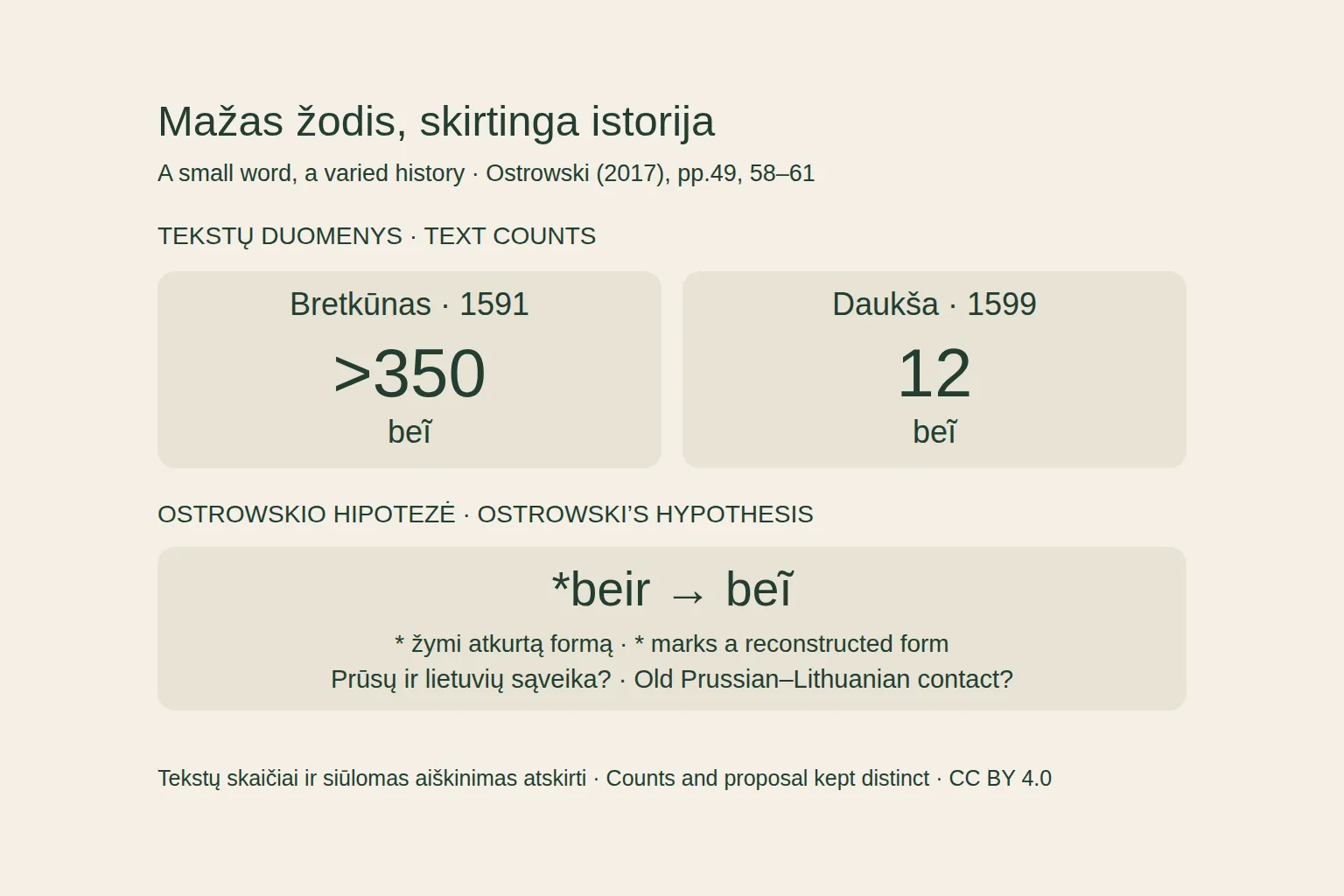
Ostrowski counts 12 occurrences of beĩ in Daukša’s 1599 Postil. In Jonas Bretkūnas’s similarly sized Postil of 1591, he finds well over 350. The figures belong to these books; they do not measure how often all Lithuania’s inhabitants used the word in speech. S167
Ostrowski finds no beĩ in the first part of Sirvydas’s Punktai sakymų, published in 1629. Yet a dictionary entry present by 1642 leads him to consider whether Sirvydas knew the conjunction passively. S167
Ostrowski associates greater productivity of beĩ with Lithuania Minor and proposes testing this pattern in old texts against dialect evidence. He asks how closely these writers’ usage matched the speech around them. S167
Based on: S167
1.14
When a new participant enters the story
In Bretkūnas’s examples, beĩ can do more than join a pair of nouns.
Ostrowski discusses sentences in Bretkūnas’s narratives where beĩ introduces a new participant or marks a turn in the story. In the examples he compares, ir instead continues a sequence of events. His concern is not simply the conjunction’s presence, but its place within the narrative. S167
In these early examples, the conjunction’s position helps explain how sentences relate. The frequency of beĩ and its narrative function therefore become separate research questions. The usage Ostrowski analyses is not made into a rule for every Lithuanian sentence. S167
Based on: S167
1.15
Between bè, ir and reconstructed *beir
Ostrowski’s account of the word’s origin begins with earlier researchers’ explanations.
To explain the origin of beĩ, Ostrowski first discusses earlier accounts involving an added -i and analogy. He proposes a merger of bè "and" with additive ir "also". He reconstructs the intermediate form as *beir; the asterisk marks a reconstructed word, rather than a spelling read in a manuscript. S167
The next step in his proposal is reduction of the reconstructed form to beĩ. He associates the innovation with a bilingual Old Prussian–Lithuanian setting. This is a contact hypothesis that he does not regard as unambiguously established; it does not demonstrate a direct loan from Old Prussian. S167
Based on: S167
1.16
Words sung and gathered
In Daukantas’s account, language accompanies travel, work and gatherings before entering collections.
In Būdas, Daukantas describes singing during travel, work, rest and gatherings. A song in his account is more than a separate composition: it belongs to what people are doing. His portrayal of custom connects his own present with an imagined ancestral past. S20
Daukantas mentions Liudvikas Rėza’s song collection of 1825. He then points to Simonas Stanevičius’s collection, issued in Vilnius in 1829. Words passed from voice to voice enter a book within his account, one that another writer can cite. S20
Daukantas gives no date for every singing occasion or identity for every singer. He is concerned with a broader picture of custom and with collecting songs. Writing cultural history in Lithuanian, he wants to preserve what people can still hear. S20
Based on: S20
1.17
What a person without letters can do
Daukantas connects literacy with the opportunity to learn.
Daukantas mentions men who, he says, make remarkable clocks despite not knowing their letters. He also describes a painter unable to read who prepares colours from river stones for church pictures. He presents these examples as an argument about human ability. S20
His reproach falls on wealthy and clerical patrons who failed to support learning. In his account, inability to read does not mean lack of talent. Through particular examples, he challenges any judgement that would measure a person’s capacities by reading alone. S20
These individual examples provide no literacy percentage for the country. They raise another question: who has the opportunity to learn? Daukantas’s cultural history makes room for both speech passed on by mothers and the ingenuity of a craftsman unable to read. S20
Based on: S20
1.18
An appeal to gather what people still say and sing
Daukantas does more than draw on spoken words: he asks people to collect them.
Explaining his working method, Daukantas mentions earlier writings and proverbs still in use. He seeks to identify passages in written sources and support his interpretation with a living saying. He addresses the reader as a possible contributor who might supply what he has left unsaid. S20
Elsewhere he urges people who know the language to gather surviving material, especially songs, and draws attention to customs near the Courland border. In his 1845 book, this is a task for the future. The collection the historian needs still has to be made. S20
Words preserved by mothers meet the book being written by the author. Daukantas wants each to support the other: to record songs and sayings still in use, and draw on them in his cultural history. S20
Based on: S20