2.1
Vilnius passes to Algirdas.
Algirdas’s reign began with a struggle for power within the Gediminid family.
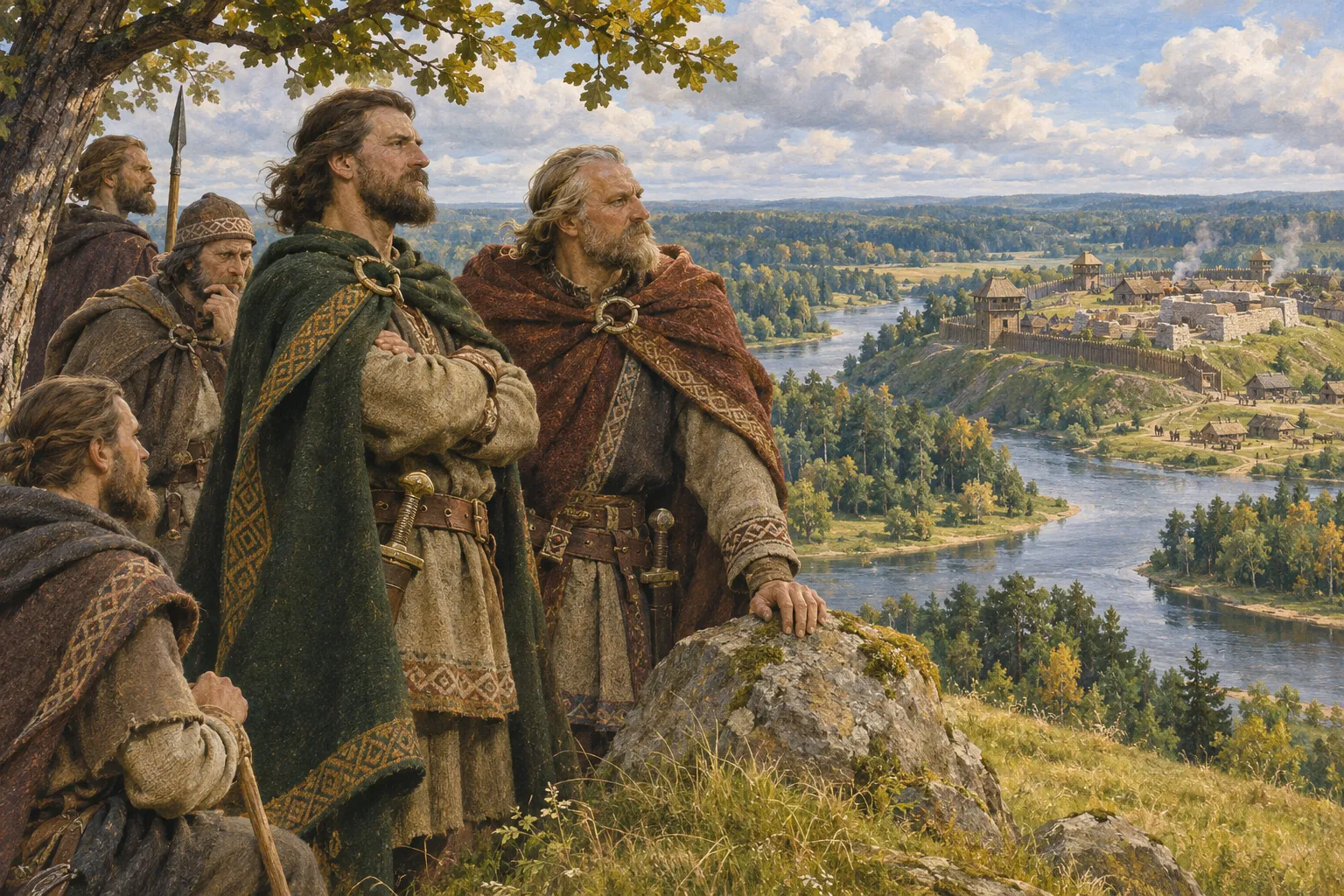
After Gediminas’s death, his sons ruled different lands, while Vilnius passed to Jaunutis. Holding Vilnius alone did not secure the unconditional obedience of his older brothers. They faced attacks by the order and had to support Liubartas in his struggle for Volhynia. Relations between the brothers shaped policy across the state. S6
In 1345 Algirdas and Kęstutis overthrew Jaunutis. Kęstutis seized Vilnius and handed it to Algirdas, who became grand duke. Power changed hands through a coup rather than an agreed succession. Jaunutis later reconciled with his brothers and received Zaslavl to rule. S6
Algirdas had already ruled in Krėva and Vitebsk and formed ties with the princes of Rus’ before establishing himself in Vilnius. As grand duke, he could draw on that experience in wider affairs. He now had to protect his own lands and coordinate the actions of many members of the dynasty. S6
Based on: S6
2.2
The grand duke and his brother.
Working together, Algirdas and Kęstutis could attend to both the western defences and the lands of Rus’.
Algirdas was grand duke, while Kęstutis ruled Trakai and lands along the western frontier. Kęstutis bore much of the burden of fighting the Teutonic Order; Algirdas devoted more attention to Rus’. The brothers ruled within one state, undertook joint campaigns and supported each other. S6
The brothers also relied on ties across the Gediminid family: Liubartas’s struggle in Volhynia, relatives’ lands and dynastic marriages. Local princes had interests of their own, which had to be reconciled with Vilnius’s ambitions. Broad authority did not mean equally direct control over every territory. S6
Based on: S6
2.3
Raids continued on both sides of the frontier.
During Algirdas’s reign, the war with the order was not decided by a single battle.
The order’s forces marched into Lithuanian lands from Prussia and Livonia, while Lithuanian armies attacked its territories. Soldiers devastated the countryside, drove away livestock and took captives. Villagers also paid for the decisions of rulers and knights: their homes and supplies lay in the path of war. S6
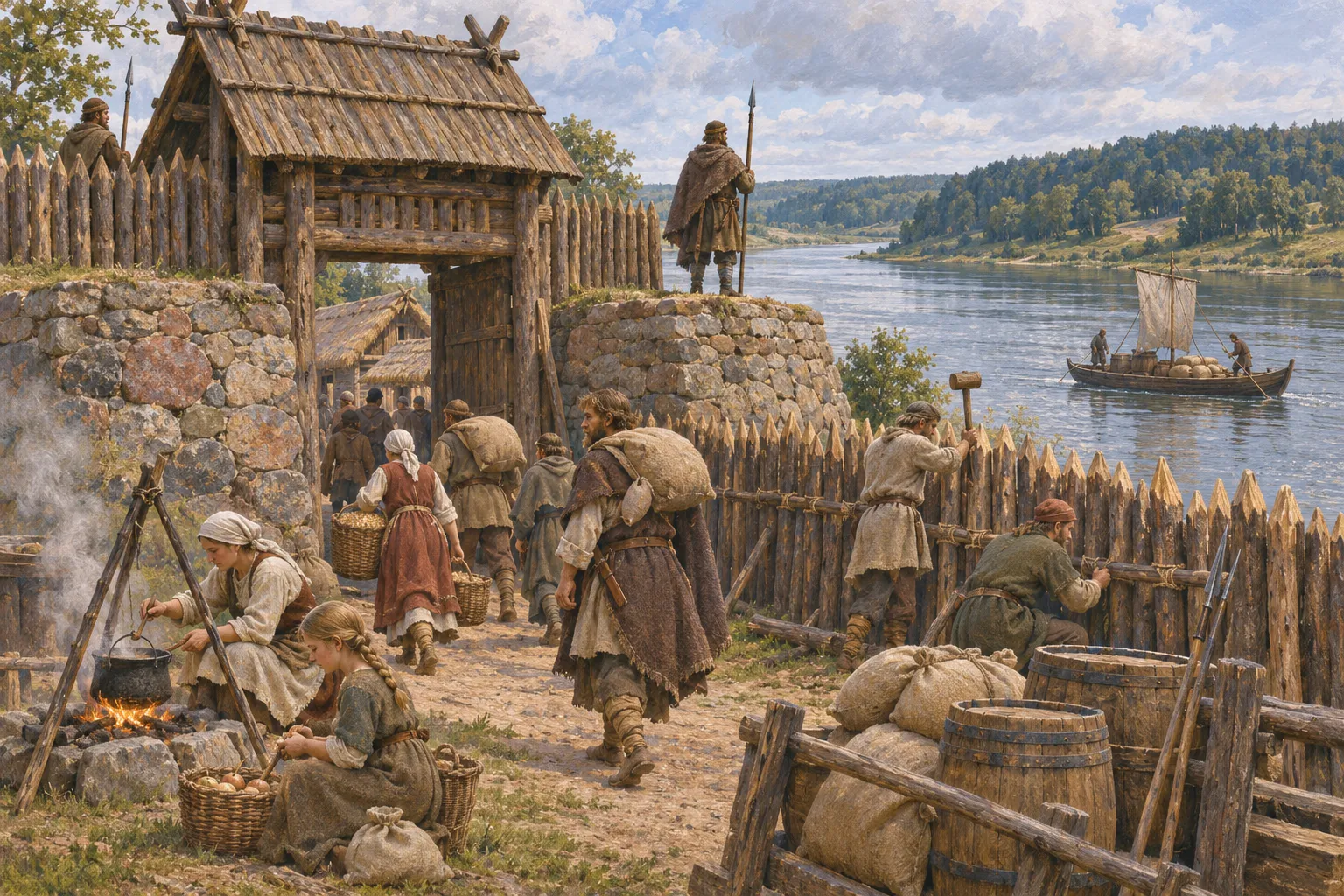
Castles along the Nemunas guarded routes and faced repeated attacks. A ruined castle could be rebuilt, but defending it took a garrison, supplies and labour. Losing a stronghold did not always change the border for long, and a successful raid did not guarantee that conquered land could be held. S6
The battle of Strėva took place in 1348 and Rudau in 1370. The 1936 synthesis questions the scale of victories and army sizes reported by the order. It describes a Lithuanian withdrawal at Rudau but does not treat it as the destruction of the state’s military capacity. Neither side won an unbroken series of victories in this war. S6
Based on: S6
2.4
The fall of Kaunas revealed the cost of war.
In 1362 the order destroyed an important Lithuanian stronghold by the Nemunas and Neris.
Kaunas Castle guarded an important route into the interior. The order’s army besieged it in 1362. Kęstutis’s son Vaidotas led the garrison. The defenders resisted, but the castle was destroyed and Vaidotas taken captive. Algirdas and Kęstutis lacked the forces to save it. S6
Taking the castle did not give the order lasting control of the wider country. Fighting over the Kaunas area and new fortifications continued. Defending the frontier took sustained effort: after losing one foothold, the defenders needed another and a way to return. S6
Based on: S6
2.5
Dynastic claims collided in the southwest.
Helping Liubartas hold his lands brought the brothers into conflict with Polish interests.
Several rulers claimed the inheritance of Galicia and Volhynia. Liubartas, brother of Algirdas and Kęstutis, ruled part of Volhynia, while King Casimir the Great of Poland also asserted inheritance rights. Family ties drew the Gediminids into prolonged wars and negotiations. S6
Algirdas and Kęstutis supported Liubartas, but could also negotiate with Poland over Lithuania’s baptism. Relations shifted as rulers dealt with territories, garrisons and alliances. Friends and enemies did not form a fixed list throughout Algirdas’s reign; their interests kept overlapping. S6
Based on: S6
2.6
Algirdas strengthens his rule in the south.
Victory at Blue Waters is associated with firmer control in Kyiv and Podolia.
Algirdas strengthened his authority in the Dnieper and Desna basins. Local princes, the Lithuanian dynasty and the Golden Horde all had interests there. Alongside the western war, the struggle for Chernihiv, Bryansk and other lands formed part of a wider contest over the political inheritance of Rus’. S6
The 1936 synthesis dates Algirdas’s victory over Tatar forces at Blue Waters to 1362. It links the campaign to firmer control of Kyiv and the establishment of Algirdas’s son Vladimiras in the city. Ruling Kyiv gave the dynasty an important base in southern Rus’. S6
Karijotas’s sons, the Karijotaičiai, established themselves in Podolia. Their ties reached Lithuania, local rulers and Poland, so expansion did not bring a uniform system of government. A relative’s territory could be linked to Vilnius while its prince still made political choices of his own. S6
2.7
Moscow became a formidable rival.
Competing for influence in Rus’, Algirdas reached the approaches to Moscow.
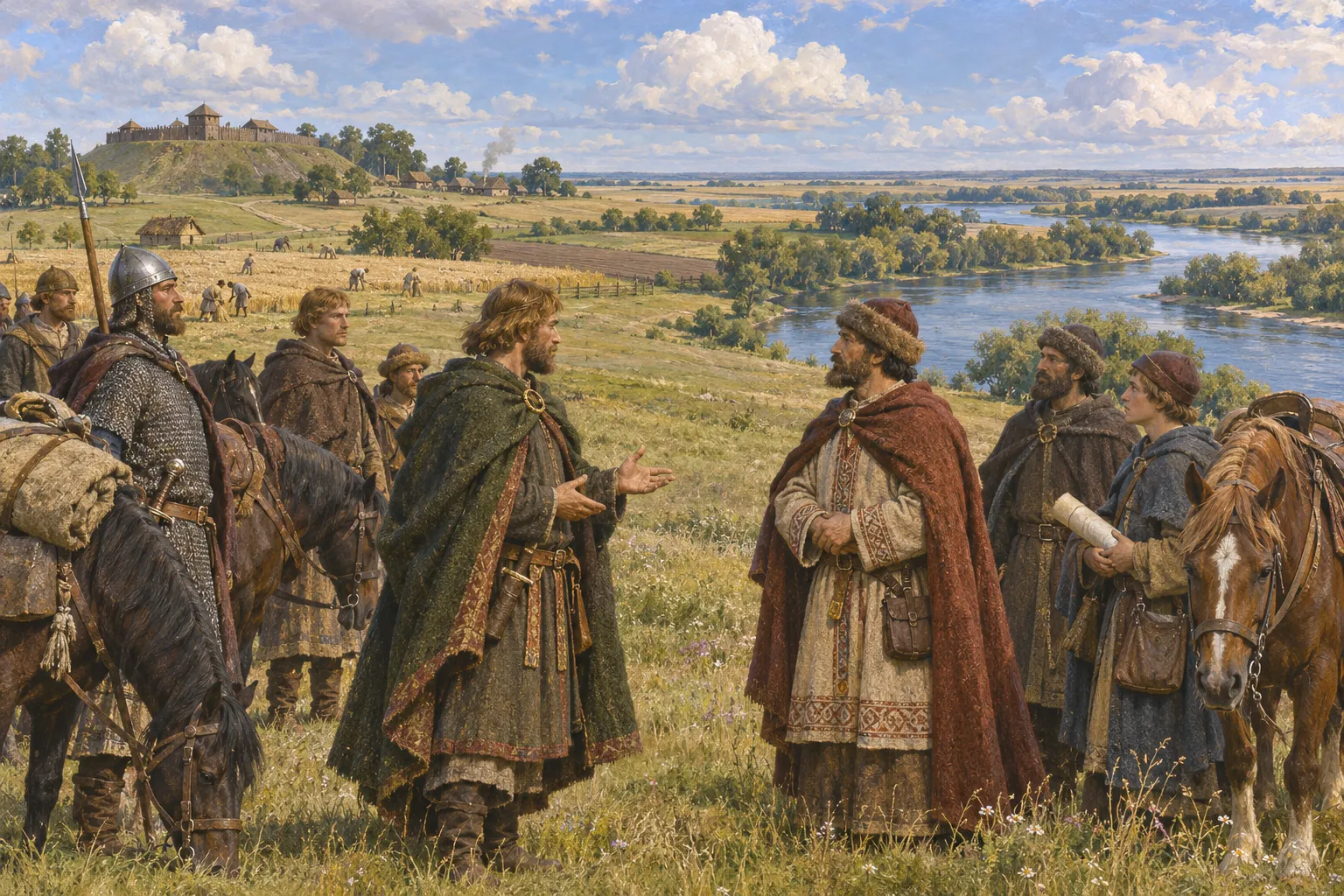
Algirdas’s second wife Julijona connected him to Tver. Supporting Prince Mikhail of Tver, he campaigned against Moscow in 1368, 1370 and 1372. He did not capture it; the Treaty of Lyubutsk followed in 1372. S34
War with Moscow also showed the limits of Algirdas’s power. Kinship brought allies, but supporting them took campaigns and resources also needed in the west. The later Bychovco Chronicle turned a Moscow campaign into a legend of almost unconditional triumph. It tells of princely glory rather than clarifying the military chronology. S6 S19
2.8
Different faiths within one state.
Algirdas ruled lands with different traditions and religions.
Algirdas’s family ties connected him to the Orthodox principalities of Rus’. His wives came from there, and some of his sons ruled lands of Rus’ and were Orthodox. Different faiths shaped both foreign relations and life within the dynasty itself. S6
Church authority also mattered in politics. Algirdas sought to keep the religious centre of his Orthodox subjects from depending on a metropolitan operating in Moscow’s political orbit. Through ties with Constantinople and efforts to secure a separate metropolitanate, he pursued influence in Rus’, much as he did through marriages and military alliances. S6
The 1936 synthesis describes Algirdas as tolerant of other faiths. A medieval ruler needed the loyalty of different communities, whose relationships with him could rest on different terms. Their presence and places of worship did not amount to a modern system of equal rights for everyone. S6
Based on: S6
2.9
Baptism talks concerned land and security.
Negotiations over baptism also concerned territory, security and the order’s position.
In 1358 Algirdas and Kęstutis discussed baptism with representatives of Emperor Charles IV. The brothers set extensive territorial conditions and demanded that the Teutonic Order leave the Baltic region. They tied their conversion to wider political changes. The talks failed to produce an agreement or baptism. S6
Contact continued even during war. Drawing on Wigand of Marburg’s account, Beresnevičius discusses Algirdas’s invitation to leaders of the order to dine at his court. He sees chivalric conduct and mutual recognition in the episode. Courtesy at court did not make war harmless or end its violence. S12
2.10
A large state and a disputed inheritance.
When Algirdas died in 1377, the next generation of the dynasty had to settle the succession.
Algirdas died in 1377. The history edited by Šapoka recounts his cremation according to older funerary rites. Later accounts do not, however, establish an undisputed burial site or an exact picture of the funeral: they are not direct observations of the ceremony. S6
Jan Długosz tells of Algirdas’s cremation in a grove called Kokiwejtos near Maišiagala. The ruler’s finest horse, costly clothing and a silver-gilt belt burn with him. The episode adds detail to the writer’s broader account of older customs. The named place and funeral goods belong to this later narrative; they do not establish an archaeologically verified grave of Algirdas. S140
Jogaila succeeded him, and Kęstutis initially recognised his nephew’s authority. Algirdas’s older sons also claimed the inheritance, however. Andrius, prince of Polotsk, began opposing Jogaila. The partnership between Algirdas and Kęstutis could not ensure the same cooperation in the next generation. S6
Under Algirdas, Lithuania maintained its western defences and greatly extended the dynasty’s rule in Rus’. It also had more interests to reconcile: frontier castles, regional princes, different church communities and the ruler’s large family. The generation of Jogaila and Vytautas inherited all of them. S6