2.1
A city documented later than it began
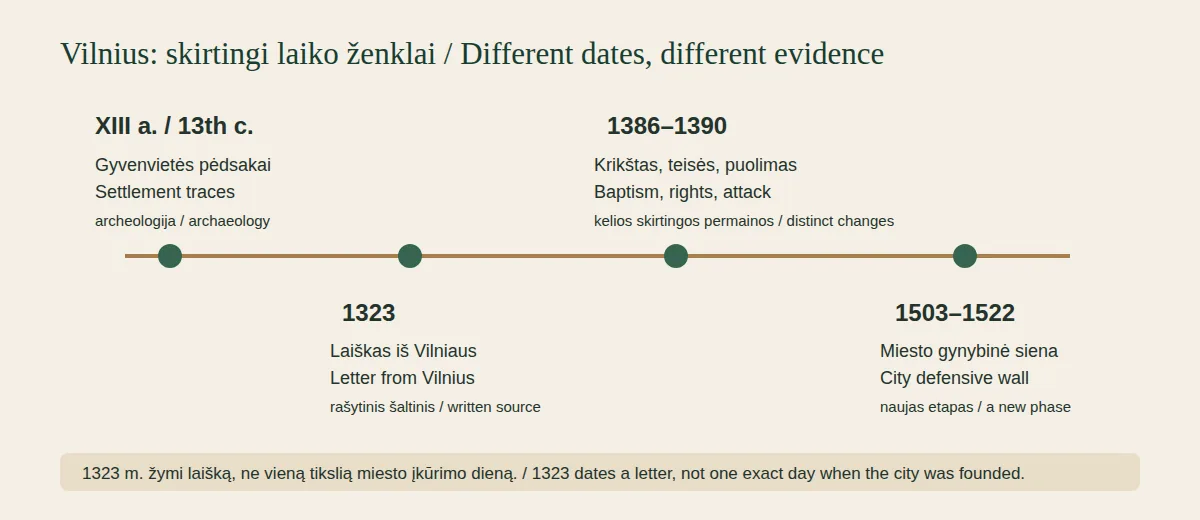
Vilnius enters the written record clearly in 1323. But a city does not begin on the morning a surviving document is dated: archaeological layers show people living and building here earlier.
Researchers have found traces of late 13th- and early 14th-century timber structures within today’s Old Town. At T. Kosciuškos Street 1, the building timber was felled in the springs of 1313–1315. That helps date construction, but it does not tell us when the first people settled in the city. S152
So 1323 securely marks an early written reference, not an undisputed foundation date. The distinction matters: the document records a ruler’s letter and his city, while archaeology reveals the place’s development beneath the ground. S88 S152
2.2
A setting that shaped the city
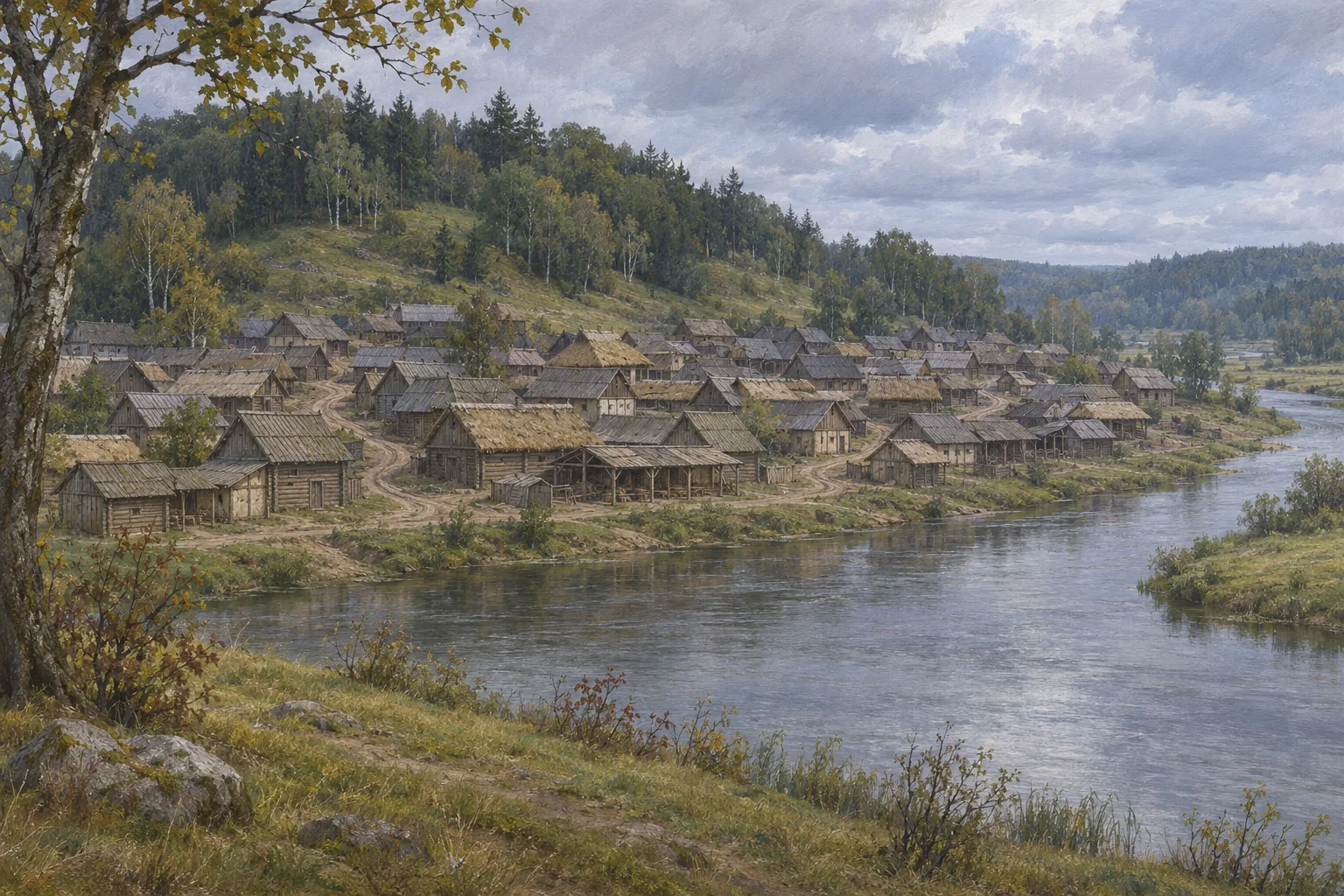
Vilnius grew among hills, the Vilnia valley and the Neris. The setting offered water, routes and natural high ground, while also forcing residents to adapt to slopes, wet ground and the river channel.
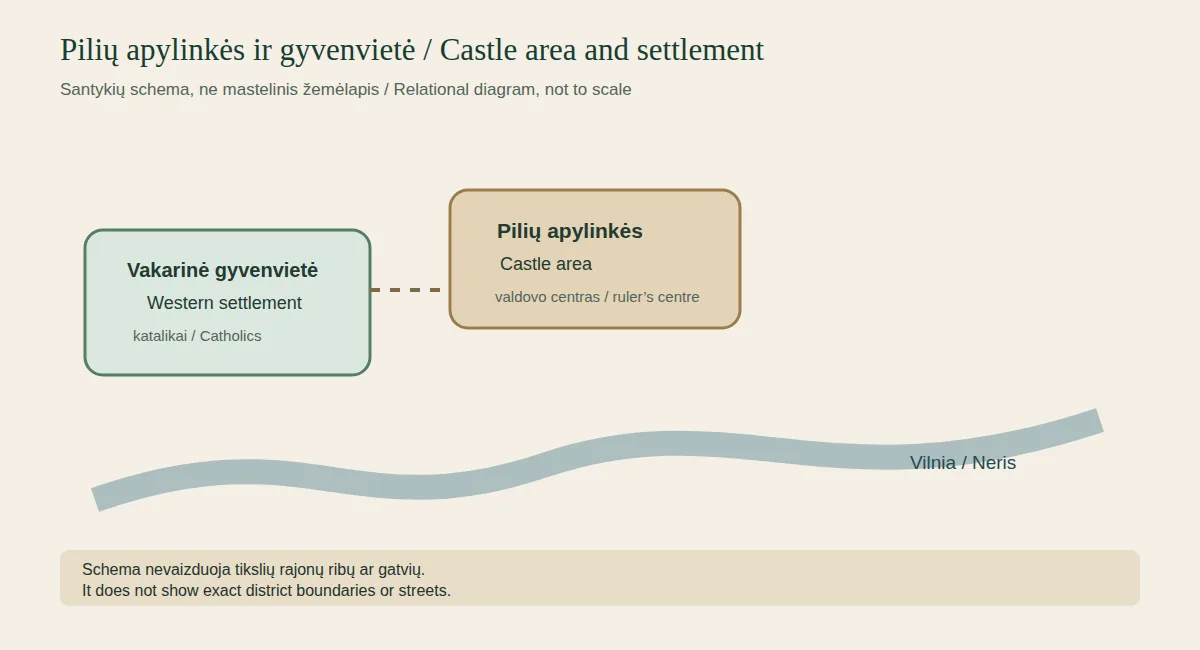
Oksana Valionienė compared today’s Old Town street network with district evidence and archaeological layers. This makes it possible to propose a model of urban growth, but a present-day street does not by itself prove a medieval boundary. S189
Based on: S189
2.3
In the ruler’s letter, Vilnius is already a city
On 25 January 1323, Gediminas wrote from Vilnius and called it “our city” in his letter.
The ruler invited craftsmen, merchants, farmers, soldiers and clergy to Lithuania. It was a political invitation, not a list of newcomers or a city-foundation document. S88
The surviving parchment copy is held in the Latvian State Historical Archive. The copy, the letter written in 1323 and the translation read today are three different things. S88
Based on: S88
2.4
High ground for defence and rule
Vilnius’s castles were not a single building. The Upper Castle stood on Castle Hill, the Lower Castle buildings gathered at its foot, and the Crooked Castle is associated with Bald Hill. Their histories are reconstructed from different archaeological and written evidence.
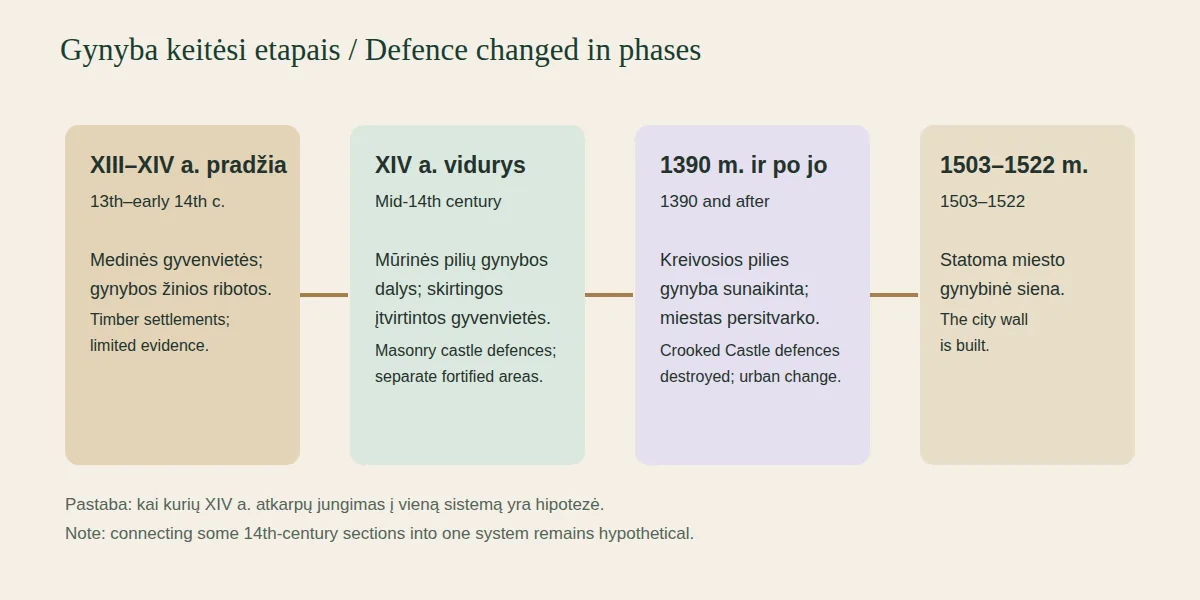
The masonry Upper Castle was probably built in the 14th century; masonry defensive rings had developed in the Lower Castle area by the mid-14th century. Earlier settlements at the hill’s foot seem to have been largely timber-built, but evidence for their precise defences is limited. S182
The castles brought together the ruler’s residence, defence and urban life. Roads, yards and buildings around them changed over time, so today’s castle view should not be treated as a fixed medieval plan. S182 S152
2.5
A timber-built city left fewer traces
Many early Vilnius buildings were made of timber. They decay more readily than masonry walls, but soil can preserve their traces: dated wood, floors, pits and household waste can help reconstruct activities.
At T. Kosciuškos Street, researchers found timber-building traces from the late 13th to early 14th century, followed by later sequences of floors, a stove and artefacts. Every find has its context: an object in a filled pit was not necessarily used in the room beside it. S152
An archaeological layer is not a frozen photograph of one day. It can combine building, repair, fires, pits and later soil movement, so archaeologists date individual events and distinguish observation from interpretation. S152 S182
2.6
Pilies Street and the market
Pilies Street gradually linked the castle area with growing settlements.
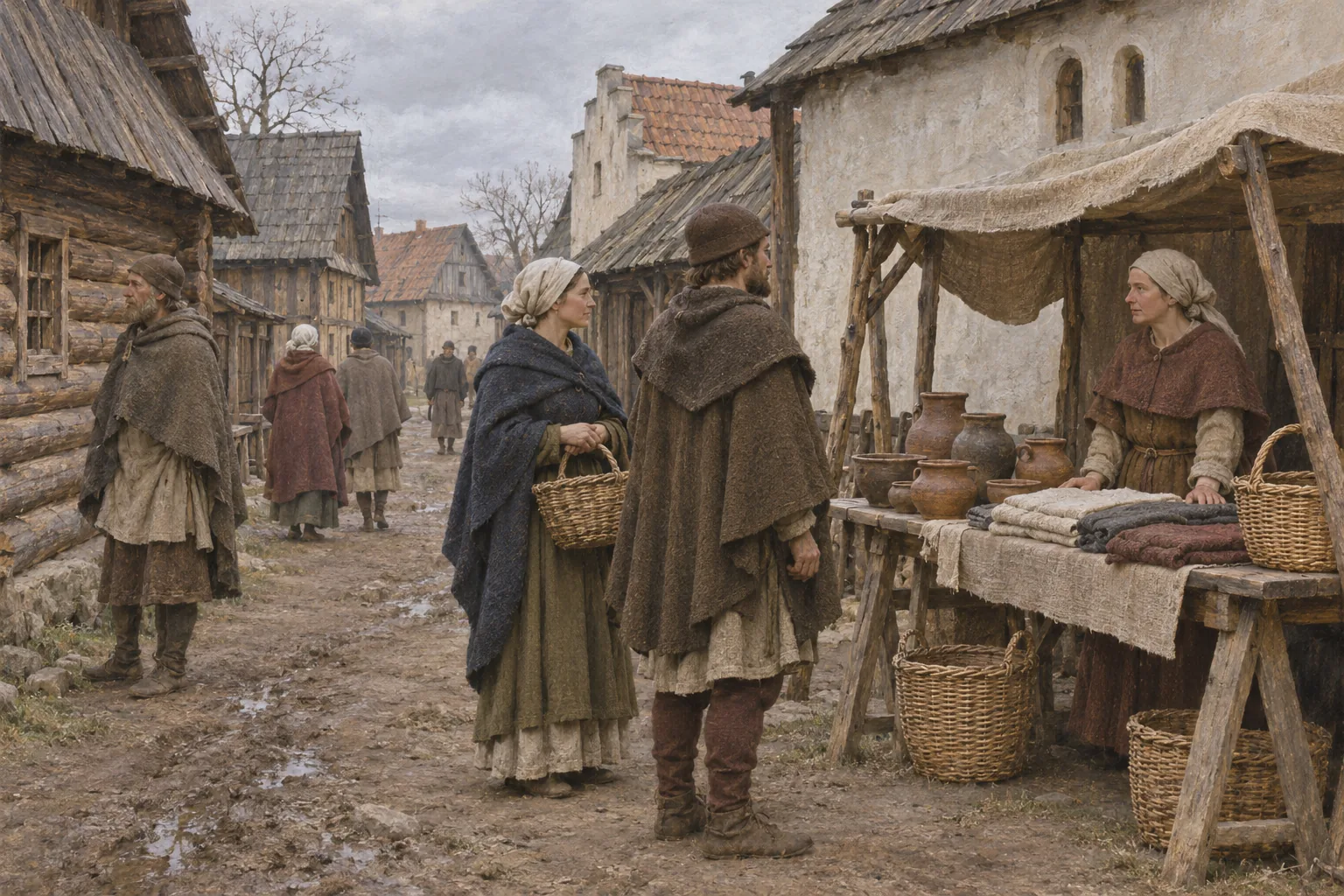
Irma Kaplūnaitė links the street’s earliest stretch to the castle area and its later growth to a route south. In her reconstruction, the town hall and central market took shape in the first half of the 15th century. This is a scholarly model, not a surviving plan. S184
Based on: S184
2.7
An Orthodox community in eastern Vilnius
Archaeologists have studied an Orthodox cemetery in the eastern Old Town.
Rytis Jonaitis associates the cemetery’s burial practices with an Orthodox community. “Civitas Rutenica” may refer to this part of the city, but its boundaries and the community’s beginnings remain uncertain. S183
Based on: S183
2.8
Church dates reveal a changing city
A Catholic community lived in Vilnius during Gediminas’s time, though the beginnings of particular churches cannot always be dated precisely. Clergy and friars were active here before Jogaila’s baptism in 1386.
St Nicholas Church in the western Old Town is attested before 1387 and is considered the first Catholic church outside the castle precinct. This indicates that the western settlement already drew Catholic merchants and craftsmen. S186
The dates of the Franciscan church and monastery remain disputed: researchers have proposed anything from the first half of the 14th century to the beginning of the 15th. The 1421 consecration is an important marker, but it does not tell us when an earlier community or first building began. S186
Based on: S186
2.9
Did the church mentioned in the 1323 letter stand in Vilnius?
Gediminas’s 1323 letters mention Franciscans and Dominicans, and one passage long encouraged the belief that a Dominican church already operated in Vilnius. Newer research shows why that conclusion needs scrutiny.
Darius Baronas compared the wording of the letters and their recipients. The letter addressed to the Dominicans themselves does not mention a Dominican church; he therefore argues that such a church probably did not yet exist, even if Dominican friars may have been near the ruler. S187
It is a useful example of how a document’s purpose matters. Mentioning an institution does not necessarily mean its building already existed; a diplomatic text could present the state as its author wanted it to be seen. S187
Based on: S187
2.10
One potter’s workshop
A potter’s workshop found on Subačiaus Street offers evidence of one Vilnius craft.
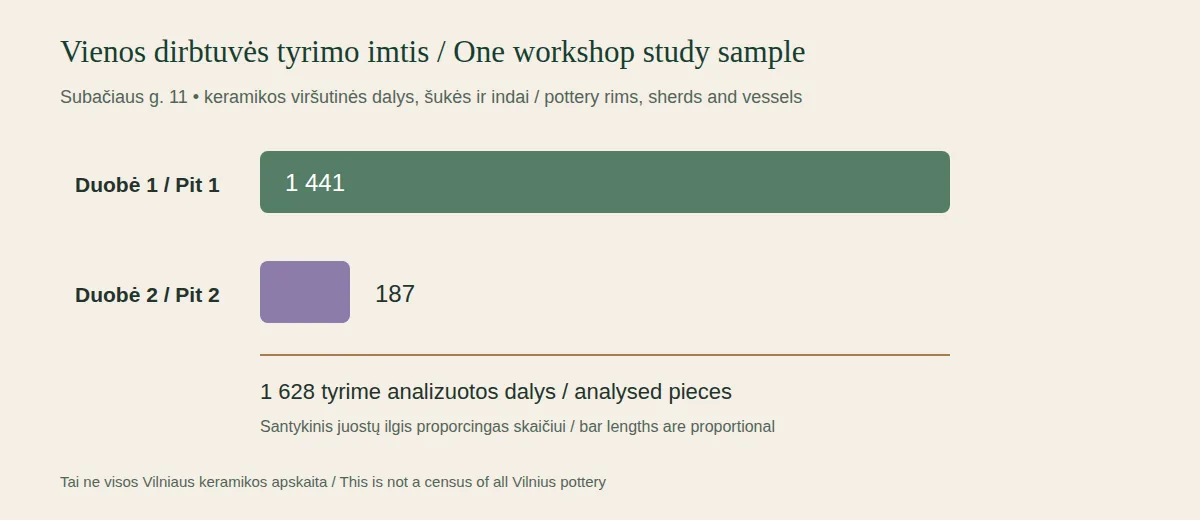
Valionienė analysed 1,628 pottery sherds from two pits. Their forms resemble one another but differ; the workshop dates to the 14th–15th-century transition. This sample does not show production across the whole city. S185
Based on: S185
2.11
Faith and language
Sources show religious diversity, but not a list of the city’s languages.
An Orthodox cemetery and Catholic churches point to distinct communities. They do not tell us which languages people spoke at home or in the market. S183 S186
2.12
Jogaila’s baptism in 1386
Jogaila was baptised in 1386; Vilnius’s privileges and Magdeburg rights belong to 1387.
These dates should not be compressed into one day when the city changed. The ruler’s baptism and the later legal arrangements for Vilnius were separate, though related, events. S96
Based on: S96
2.13
Vilnius’s rights and self-government
Vilnius received Magdeburg rights in 1387, and part of the city was assigned to the bishop.
Jogaila’s February privilege lists plots, houses and landmarks, including St Nicholas Church and the Franciscan house. It helps reconstruct how the ruler allocated urban space, but does not let us place every feature on a modern map without debate. S186
Magdeburg rights established a system of municipal self-government, but did not remove the ruler’s authority or social distinctions. New institutions joined networks of residents that were already in place. S186
Based on: S186
2.14
Fire and attack shifted the balance between settlements
At the end of the 14th century, Vilnius became a focus of warfare. The 1390 attack destroyed the Crooked Castle and nearby structures; parts of the city’s layout changed after the assault.
Girlevičius distinguishes the timber-and-earth defences of the Crooked Castle and its foothill settlement from the masonry castles. Archaeologists associate the 1390 attack and fire with particular parts of the city; the evidence does not show that all Vilnius was destroyed. S182
The city did not disappear after the attack. Residents and institutions adapted, and the later centre gathered in areas that now form the Old Town. “A castle destroyed” does not mean “all Vilnius destroyed.” S182
Based on: S182
2.15
The city wall
In 1503, Vilnius was permitted to build a defensive wall.
In Girlevičius’s study, the separate fortified areas and their connection into a broader system are a probabilistic reconstruction. The diagram here shows the development of defence and its uncertainties, not the exact layout of walls or gates. S182
In the early 16th century Vilnius received permission to build a city wall; construction ran from 1503 to 1522. This was a different phase from the 14th-century castle and settlement defences. S188
2.16
The Iron Wolf tells us about memory, not an event in 1323
The Iron Wolf story is often linked to Gediminas, but its written version is much later.
The Vilnius foundation legend comes through the 16th-century chronicle tradition. It records later political memory, not a confirmed dream in 1323. S89
Based on: S89
2.17
Archaeology dates individual events
One find cannot answer every question about a city’s history.
Dated building timber can tell us when a tree was felled; floors, stoves and pits record separate phases of use and construction. Each find must be read in the context of the layer where it appeared. S152
An archaeological model connects partial finds with terrain and written sources. It helps explain how the city developed, but remains open to revision when new research appears. S152 S182
2.18
Vilnius grew while its older layout kept changing
Vilnius did not grow all at once: its places and buildings changed over time.
By 1500, Vilnius brought together castles, settlements, workshops, trade routes and municipal institutions. It was varied and still changing. S152 S182
Residents adapted to rivers and hills, formed routes and rebuilt after conflict. New archaeological work may still add to this picture. S152 S182