2.1
More than one way of life
Homes in Vilnius, the bailey at Merkinė and the ruler’s surroundings reveal different medieval lives.
A farmer, an urban craftsperson and a member of the ruler’s retinue faced different demands in the thirteenth to fifteenth centuries. The collective history edited by Adolfas Šapoka in 1936 describes society through unequal rights and duties. Even nobles had very different means: one maintained armed servants, while another performed military service himself and met its costs. S6
Archaeologists uncovered remains of an early timber room in Vilnius, while plant and animal remains were recovered from Merkinė’s castle bailey. These are urban and castle settings to compare with rural homes, rather than portraits of every farming family. Each preserved its own part of life: floorboards and a stove in one place, grain and bones in another. S152 S155
The conditions of life changed across these centuries. Gediminas invited merchants and craftspeople to settle; towns later acquired rights of self-government, while some peasants faced tighter restrictions on leaving. Different places and generations need to remain visible within this changing world. S6
2.2
A room beside the Neris
In early-fourteenth-century Vilnius, a log building had a plank floor and a brick stove.
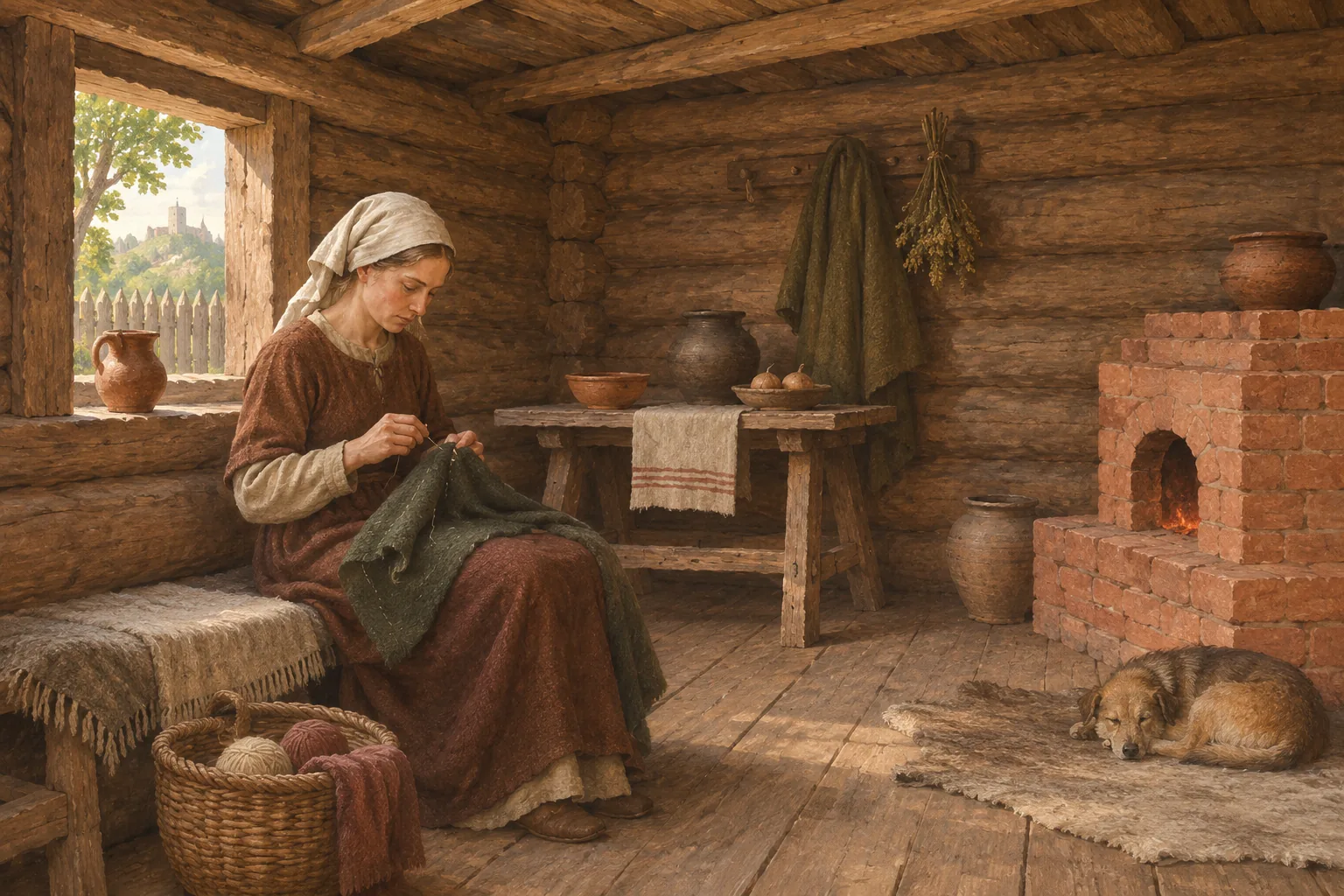
The room uncovered on T. Kosciuškos Street measured 3.6 × 3.2 m inside. It had a pine plank floor and a brick stove in the southwest corner. Atas Žvirblys associates its construction with about 1315. Here, part of a home in early Vilnius survives in a tangible form. S152
We do not know who moved into the building or how many people shared the room. Tree rings do narrow the construction date: the sampled trees were felled in the springs of 1313–1315. A particular phase of early Vilnius emerges from behind the broad label “medieval.” S152
Six regularly arranged holes were found in the floor. The researcher suggests a table, benches or sleeping platforms. The furnishings have not survived, and the positions of beds or windows remain uncertain. The room nevertheless had a firm plank floor and a corner occupied by a stove. S152
Based on: S152
2.3
Building on unstable ground
Builders beside the Neris faced wet, unstable ground.
A large timber-and-earth structure at the same Vilnius site dates to about 1323–1324. It incorporated logs, stakes and fill. Plants associated with wet conditions and the character of the deposits led Žvirblys to consider slope stabilization as its purpose. A defensive function also remains under discussion. S152
Poorly preserved boards may, the author cautiously suggests, have formed a plank road. Its direction and connection with the castle remain uncertain, leaving the wider street network unclear. This site first reveals how builders used timber and earth to alter an unstable riverside. S152
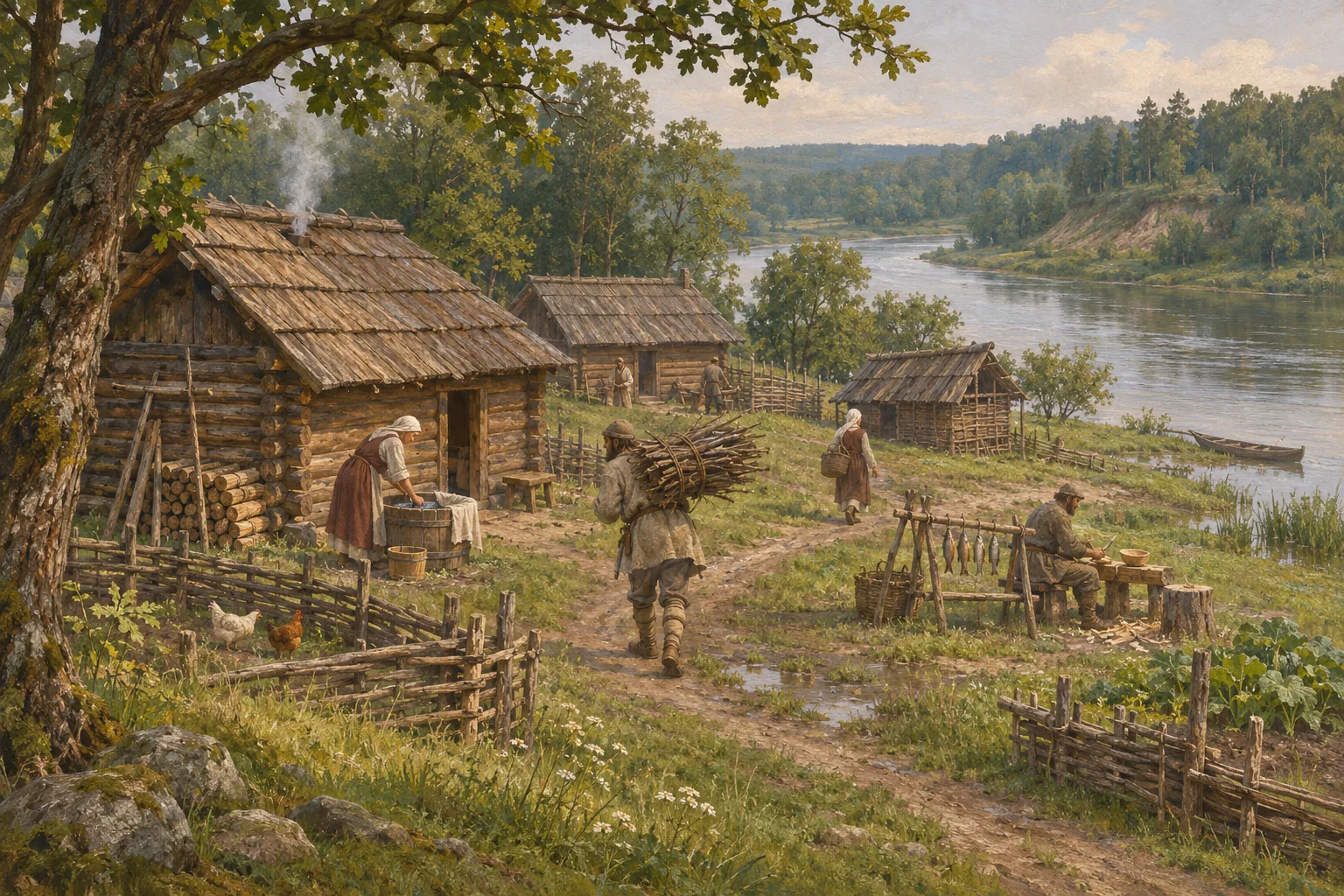
Excavated homesteads at Kernavė left traces of floors, walls, fences and paving. Andrius Janionis’s account shows the work invested in the surroundings as well as the house. Modern reconstructed yards help visitors compare these spaces, although building heights and parts of the roof designs had to be inferred. S115
2.4
Things left between the boards
Knife blades, a needle and leather scraps bring household objects into view.
In later layers of the same Vilnius building, assigned to 1330–1365, knife blades and a needle lay above or between floorboards. Pottery and scraps of leather occurred nearby. Traces of objects used at home remain, even though we can no longer name the people who held them. S152
A spindle whorl, footwear parts and buttons entered other deposits associated with destruction. They cannot form an inventory of objects present in the room at one moment. Instead, finds entering the ground in different ways reveal stages in the building’s life: use, loss and later disruption. S152
Wooden net floats and unglazed vessels from earlier fill broaden the picture. Household objects connected with the river, work and food. Yet material used as fill could have been brought from elsewhere. A findspot shows where an object survived, but not always where it was used. S152
Based on: S152
2.5
What grew around Merkinė
Charred cereals, peas and lentils survived in Merkinė’s castle bailey.
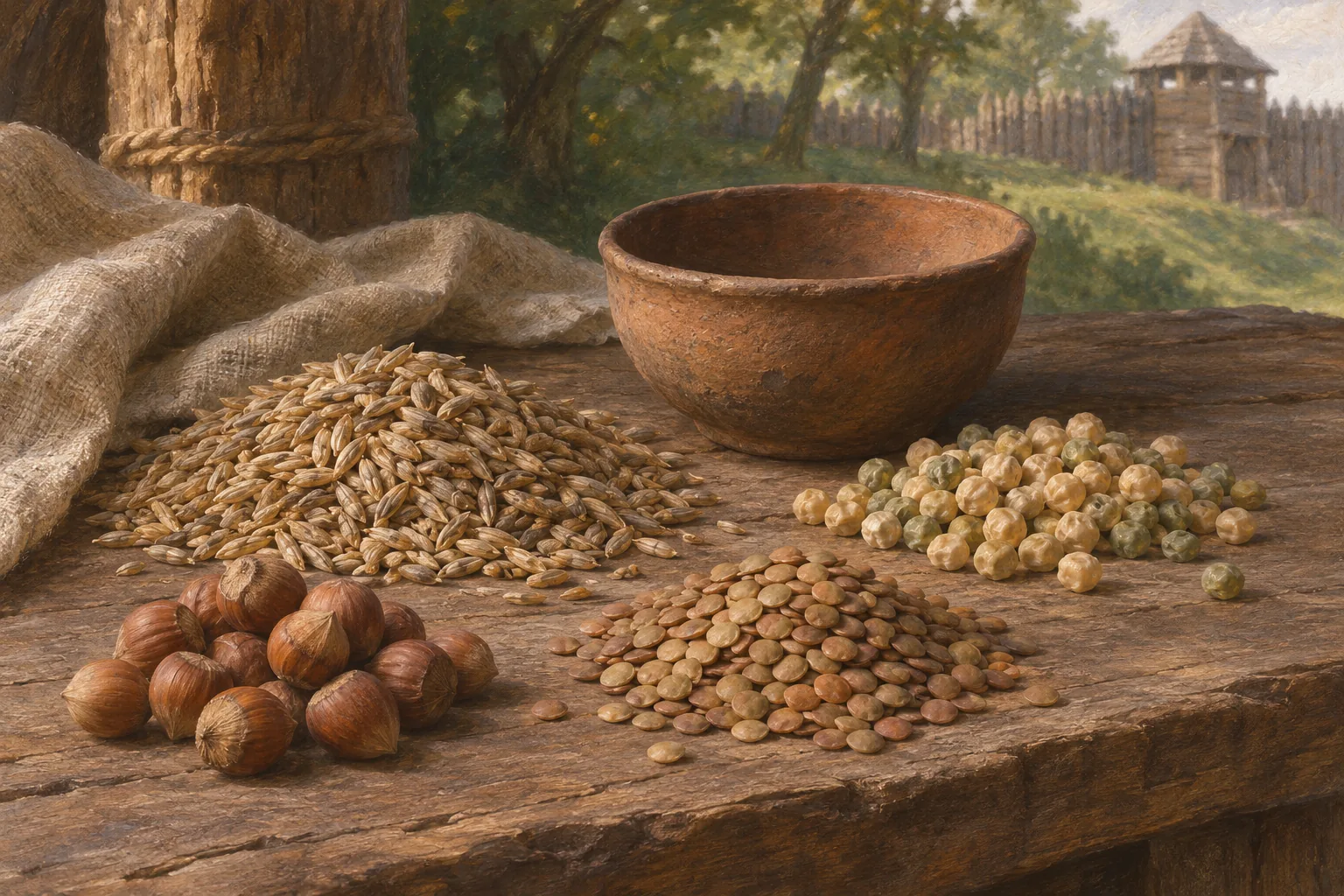
Rye was the most abundant identified cereal in samples from Merkinė’s castle bailey. Rūta Karaliūtė and her co-authors also identified wheat, barley, oats and millet, alongside peas and lentils. Several kinds of remains broaden the picture of cultivated plants beyond what one grain or an isolated vessel would leave. S155
The studied material spans the second half of the thirteenth century to the first half of the fifteenth, with different deposits assigned to different phases. The latest phase extends beyond the fourteenth century. These plants therefore do not form the stores of one harvest: time and their positions in the deposits separate them. S155
The surviving grain cannot tell us which dishes people prepared. It preserved neither recipes nor portions nor the number of people at a table. Cereals and pulses do, however, bring us closer to ingredients that had to be grown and gathered. S155
Based on: S155
2.6
Food from livestock, woods and rivers
The Merkinė finds connect plant foods with livestock and freshwater fish.
Cattle, pig and sheep or goat bones were identified at Merkinė. Later-fourteenth- and early-fifteenth-century contexts also contained deer and elk remains. They cannot establish a family’s daily meat portion, but they reveal several sources of supply: livestock and large game from the woods. S155
Remains of pike and catfish recall the setting at the confluence of the Nemunas and Merkys. Wooden net floats found in Vilnius also connect fishing with ordinary work. Water supplied resources in different places, though identifying a fish species does not reveal who caught, sold or shared it at home. S155 S152
Hazelnut shells and raspberry remains add to Merkinė’s food evidence. The finds cannot give an exact balance between plant and animal foods: many bones were too fragmented to identify. The surviving material still lets us place gathered woodland resources alongside cereal crops. S155
2.7
Dress
Fabrics differed in fibre and value.
The fourteenth- to early-sixteenth-century fabric fragments discussed in the study show the use of flax, hemp and wool. Gabija Surdokaitė-Vitienė discusses plain and twill weaves, bands and other textile traces. A fragment rarely recovers a sleeve, collar or full garment length. Yet choices made by its maker remain in the fabric itself: fibre, yarn and weave. S154
Researchers interpret a late-thirteenth-century pair of goatskin footwear from Vilnius Lower Castle as luxurious, perhaps worn indoors. Its owner and precise colour are unknown. S153
A fourteenth-century checked fabric fragment from Kurklintiškės cemetery may have belonged to a shawl or another covering. Its function remains uncertain, and such finds do not establish one outfit worn everywhere. The fragment itself broadens a picture of plain clothing: checks survive in the weave. S154
2.8
From fibre to fabric
Whorls, needles and fabric fragments reveal the long process from fibre to clothing.
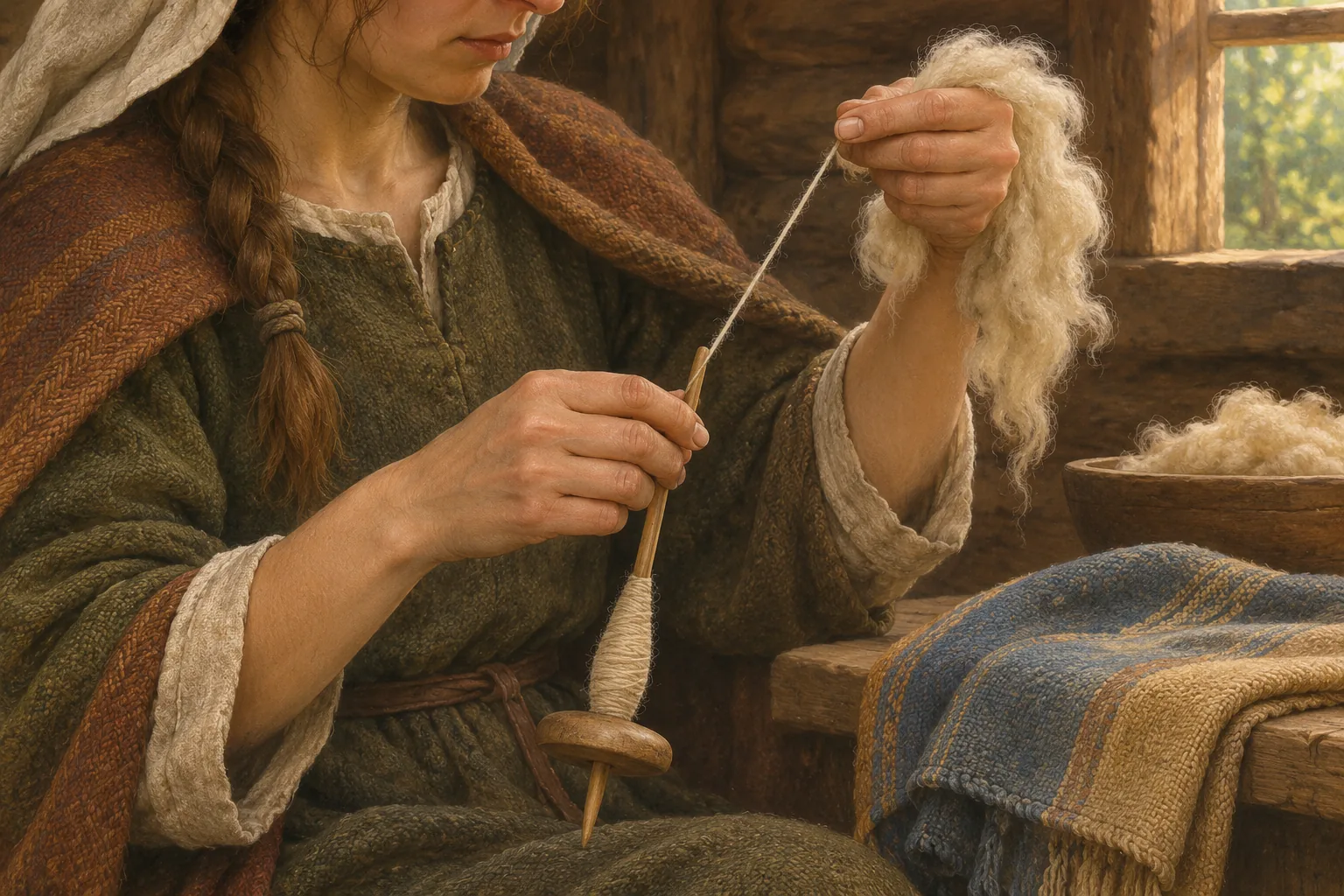
Before weaving, fibre had to be prepared and yarn spun. Whorls, needles and other tools connect textile production with domestic settings. The finds discussed by Surdokaitė-Vitienė reveal several stages of this work. A fabric’s value lay in more than its raw material: repeated processing stood between fibre and something that could be worn. S154
Bands could strengthen a garment’s edge while also decorating it. A few surviving examples cannot recover a household’s entire wardrobe, but they show the importance of small details. Weaving involved more than making a large piece of cloth: different parts might require another yarn or technique. S154
Some textile tools are known from women’s graves. These contexts help researchers consider connections between work and gender, without showing that men never spun or sewed. Tools found at home preserve evidence of the work more securely than the identity of every person who performed it. S154
Based on: S154
2.9
Colours changed by burial
Both dyeing and a long burial changed the appearance of cloth.
Archaeological cloth often looks brown, but that colour was not necessarily chosen when it was made. Soil, moisture and decay affect fibres and dyes. Surdokaitė-Vitienė emphasizes that an object’s present appearance cannot simply be transferred to the time when someone wore it. S154
The study discusses local and imported materials for dyeing. Fabrics could be coloured, even when a particular fragment’s original hue cannot be recovered. Neither brown-looking finds alone nor a single bright palette can encompass all the clothing people once wore. S154
Cloth also reached people through trade. Locally prepared fibre, purchased fabric and a costly gift belonged to different parts of the same world. A simple scrap cannot establish a luxurious garment, just as silk at court cannot stand for the clothing of a rural worker. S154
Based on: S154
2.10
In the yards of Kernavė
A homestead could serve as both a home and a workshop.
Janionis describes traces of different crafts in Kernavė’s homesteads. Bone and antler working, the use of birch bark and material linked to jewellery bring us closer to people making objects for themselves and others. Alongside walls and floors survive traces of work that distinguished one yard from another. S115
Smithing is also considered among Kernavė’s craft traces, although this interpretation is less secure than some others. One yard cannot represent workshops throughout Lithuania. It does allow a close look at a particular place where people’s work left raw material, tools or production remains. S115
Reconstructed homesteads at Kernavė now let visitors experience a proposed arrangement of space. Roof-structure remains were found in only one house. Building heights had to be chosen, while some rafter and roof details drew on analogies. The living archaeology described by Janionis allows practical trials of making and building. These modern experiments remain distinct from the surviving remains themselves. S115
Based on: S115
2.11
What the soil could support
Merkinė’s plants offer a way to examine farming adapted to local conditions.
The sandy soils around Merkinė suited some crops better than others. They do not represent every Lithuanian field, but they help explain local farming. The authors connect abundant rye remains with these conditions: farmers’ choices also depended on what grew better here. S155
The authors interpret the combination of autumn-sown and spring-sown crops with pulses as evidence of crop rotation. Different plants suggest more than one way of using the land. The study did not uncover complete field boundaries or a uniform sowing calendar. An interpretation of rotation is not proof that the same three-field arrangement existed everywhere. S155
Šapoka’s edited history presents agriculture as the main economic activity and emphasizes work disrupted by war. Its general claims about rudimentary tools or unmanured fields extend far beyond a single excavated site. The Merkinė study adds a range of crops and an interpretation grounded in a particular environment to that older overview. S6 S155
2.12
An economy beyond the ploughed field
Hay, honey, skins and fish connected household work with dues and the ruler’s needs.
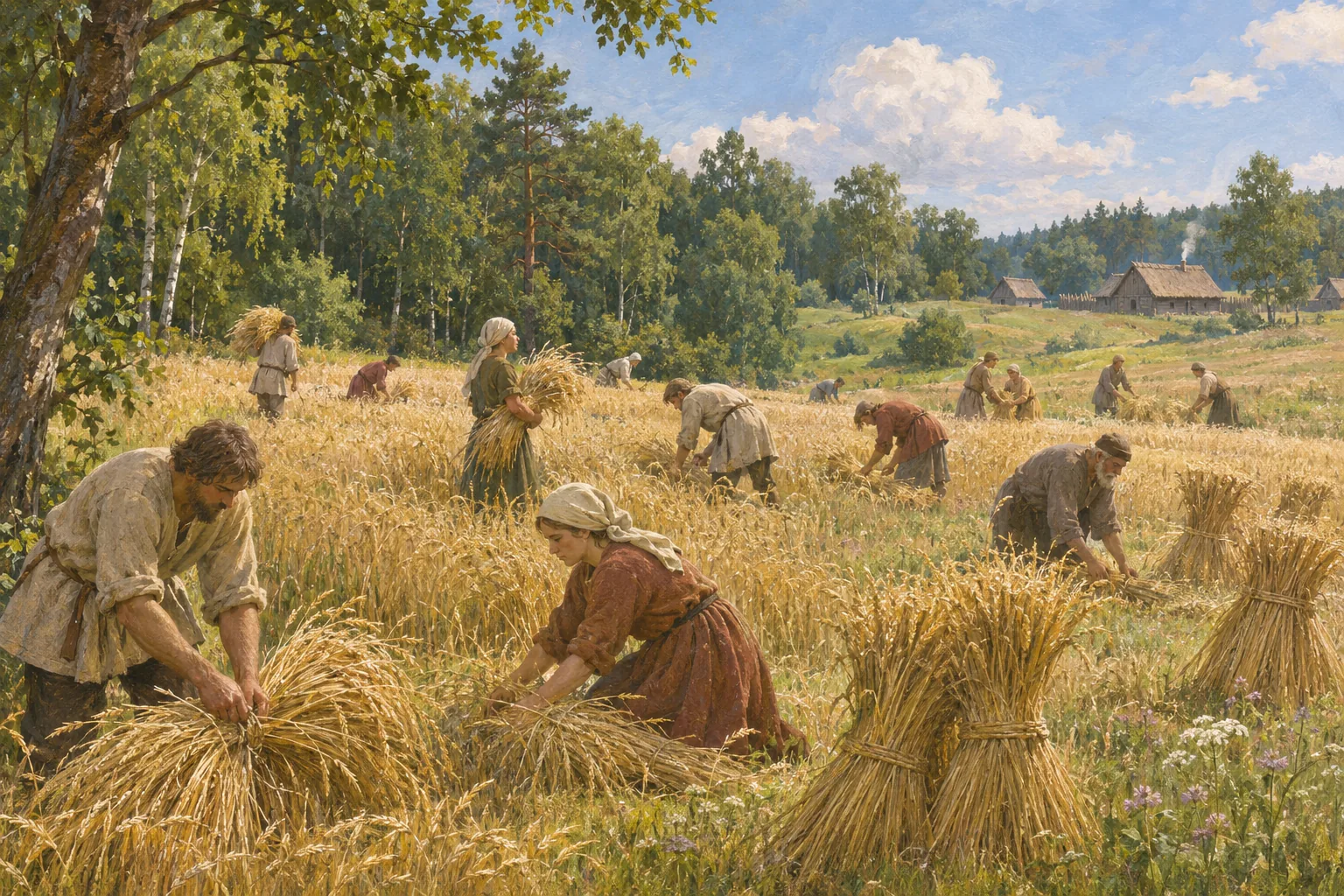
The 1936 history places livestock and their care beside cereal cultivation. Its accounts of dues include hay, animals and eggs. Household work therefore extended beyond gathering crops. Resources were needed for animals, people and those entitled to take a share of what the household produced. S6
The volume distinguishes beekeepers, fishers and people paying in skins by the products they delivered. Honey and wax, marten or beaver skins and fish were used beyond the home. They entered systems of dues and trade. These labels connect work with authority without proving that each person had only one occupation. S6
The ruler and military service required horses. The older synthesis mentions horse keepers tending studs and wheelwrights making carts and wheels. Journeys depended on this work. Behind a rider travelling with the ruler or on campaign stood people who had prepared animals and equipment. S6
Based on: S6
2.13
A share of the produce for the estate
Obligations could be met with more than money.
Grain, hay, livestock and eggs appear as dues in Šapoka’s edited volume. The general list does not specify each farm’s obligation. Yet goods owed had to be grown or gathered and delivered to the estate. The payer’s work was present both in the product and in getting it there. S6
Payments in silver appear beside dues in produce. Money and goods thus belonged to the same economic world. The volume’s account of exchange helps explain how different products could serve in payment. It does not show that everyone paid in the same way or that ordinary people never held coins. S6
Produce delivered as a due and food eaten at home leave different traces. Eggs in a dues list do not show how many a child received, while a payment in skins does not reveal a family’s clothing. Archaeological finds add evidence from particular places, though they too preserve only part of a household’s life. S6 S155
2.14
Beyond one’s own field
Castles, bridges and the travelling court needed the work of surrounding communities.
The older history lists castle and bridge building and road construction among peasant obligations. While someone worked there, their own field went untended by them. The volume does not establish the scale of these duties in each place, but it recalls another household demand: official structures and routes also needed community labour. S6
For a noble, military service required a horse, weapons and provisions. A wealthier man also brought and supported servants. Some carried out castle guard and repair duties through other people, while poorer nobles did them themselves. A shared social label thus covered very different experiences of work and expense. S6
Passing messengers needed horses and carts, while a visiting ruler required provisions for himself and his retinue. Šapoka’s edited history assigns these obligations to nobles too. The travelling court connected places, but its arrival meant different things: an encounter with authority for some, a duty to supply resources for others. S6
Based on: S6
2.15
Who could leave?
Peasant obligations and the right to move were not the same everywhere.
The 1936 history distinguishes free farmers from peasants dependent on land and a lord in Vytautas’s time. Free people also paid dues and performed services. Freedom did not mean a life without obligations. One difference concerned how far a person could decide where to live and whom to serve. S6
In its later discussion of social change, the volume singles out Kazimieras’s privilege of 1447. The ruler promised not to accept peasants who had fled noble estates into his own lands. This shows an agreement between authorities narrowing possibilities of escape. It does not make every peasant of the preceding centuries an identical serf. S6
The volume separately mentions slaves, including war captives, who worked on estates. They are not equated with all peasants. The older account follows changes in status and the convergence of different forms of dependence. People’s rights, work and ability to leave their homes were changing too. S6
Based on: S6
2.16
By river to other lands
Wax, skins and timber linked local work with distant buyers.
Šapoka’s edited history emphasizes Riga and the Daugava in Lithuania’s trade during the thirteenth and fourteenth centuries. Connections depended on more than distance. Relations between Riga, its archbishop and the Order could open or restrict a route. A travelling merchant also had to contend with decisions made by different authorities. S6
The account of Vytautas’s time brings the Nemunas and Kaunas into focus. Through trading centres, goods reached Königsberg and Danzig. In the east, Polotsk on the Daugava held an important position. These were connections of different parts of the Grand Duchy; the Nemunas route alone does not encompass all its trade. S6
Wax, skins, logs and worked timber figure prominently among exports. Salt, metal goods, fabrics and other merchandise came the other way. These connections place households within a wider world. The import of pepper, however, does not put it in every rural cooking pot. S6
Based on: S6
2.17
Cloth between workshop and market stall
Trade, crafts and rights of self-government came together in growing towns.
The 1936 history discusses Vilnius’s municipal rights of 1387 alongside the later growth of other towns. An urban resident’s relationship with authority could differ from a peasant’s ties to an estate. A privilege did not make all townspeople alike: wealth, occupations and legal positions also differed within a town. S6
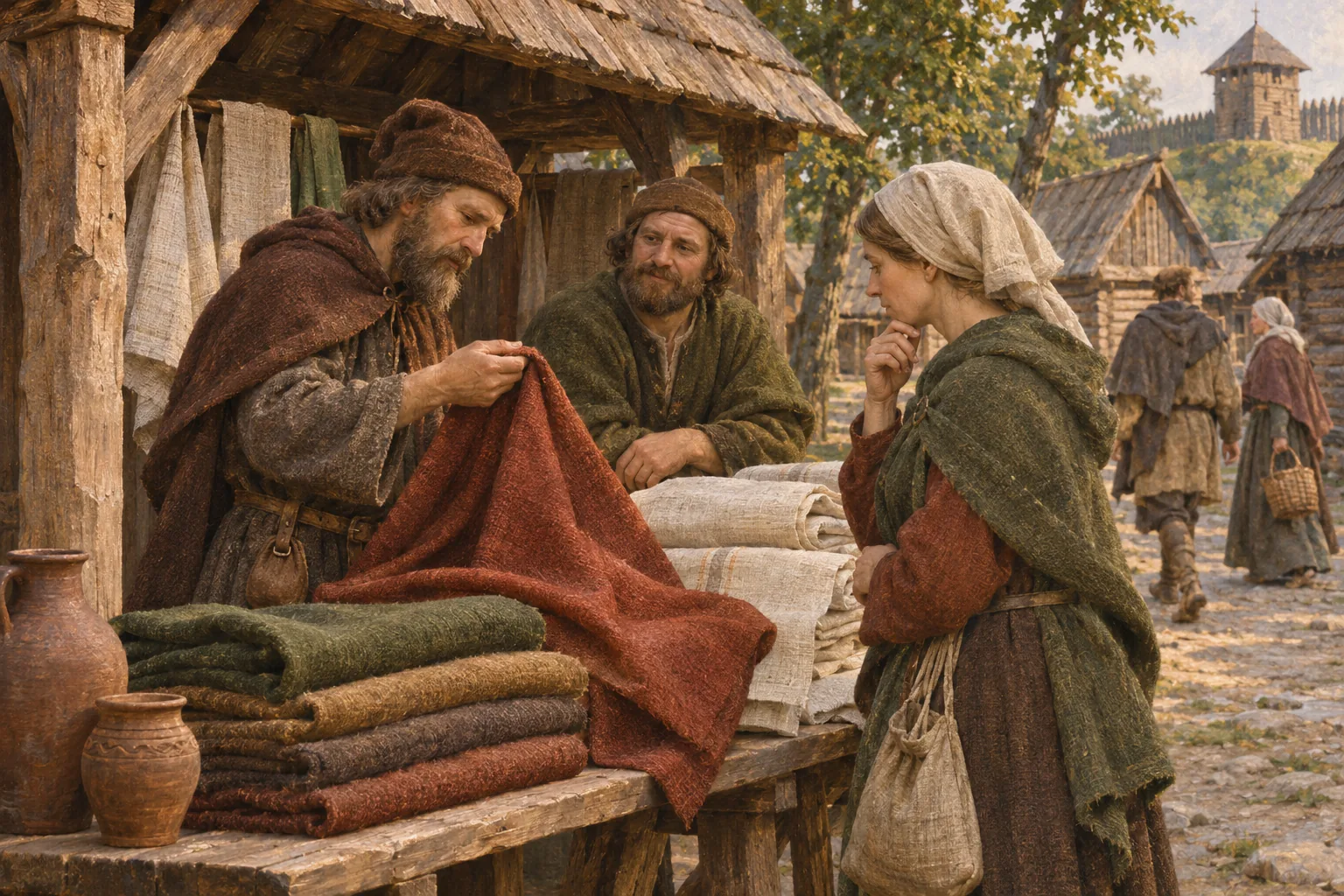
Cloth trading depended on quality and measure. Surdokaitė-Vitienė discusses complaints about inferior fabric and lengths cut too short. The disputes recall buyers for whom appearance was insufficient. Cloth had to be measured and assessed so that a buyer received what had been agreed. S154
The researcher identifies signs of more specialized wool-cloth production in fifteenth-century Vilnius. A privilege of 1432 concerns cloth shearing and finishing. This adds to the picture of domestic spinning: preparing yarn, weaving, finishing fabric and selling it could become distinct tasks. S154
2.18
Household work and family ties
Homes brought together people, possessions and skills passed between generations.
Archaeologists often recognize a household through traces of shared activities. The Vilnius room’s floor, stove, needle and knife blades make a living space tangible. Yet the finds do not list a family: how many relatives lived together, who was whose parent and who owned each object remain unknown. S152
Among nobles, land was tied to service. Šapoka’s edited history discusses inheritance, the ruler’s consent to transfers and marriage in relation to the continuation of military obligations. A family decision could have a public consequence: someone had to perform the duty attached to the land. These are noble arrangements, rather than marriage rules for every household. S6
In 1845 Simonas Daukantas pictured the home through work shared across generations. In his portrayal of the past, elders and children prepared wool and wound yarn, while women worked in fields as well as indoors. He combined earlier writers with customs of his own time. This is his account of an industrious household, rather than a description of one medieval family. S20
2.19
Traces of children
Small objects offer traces of the city’s youngest inhabitants.
Povilas Blaževičius and Šarūnas Jatautis compared fourteenth- to early-sixteenth-century Vilnius Castle footwear with evidence from the Bokšto Street cemetery, dated to the second half of the thirteenth through early fifteenth century. These samples cannot establish how many children lived there at one time. S157
Pieces of a leather ball came from the fill of an early-fourteenth-century timber-and-earth structure in Vilnius. A play object survived in a setting that also preserved ordinary utensils. Its owner is unknown. People of different ages could have used it, so the find identifies neither the players nor their rules. S152
In her review of Baltic child bioarchaeology, Alessandra Morrone distinguishes biological from social age. Teeth and bones help researchers assess growth; they do not by themselves say when a child began herding, making things or caring for someone younger. Childhood emerges through several kinds of traces, rather than the story supplied by one small object. S156
2.20
Learning at home and near the church
Household skills and teaching near the church followed different paths.
A needle, a whorl and surviving fabric point to work that required skill. Domestic textiles discussed by Surdokaitė-Vitienė recall the need to know a material and learn movements. The tool alone cannot tell us how old someone was when they first picked it up or who taught them. S154
In Daukantas’s account of 1845, children learn from an early age to twist cord, plait or knot and join older people’s work. He connects this picture with ideals of industry and endurance. The skills and ages he names are not direct observations of thirteenth- to fifteenth-century childhood; they also reveal the past he wished to celebrate. S20
The 1936 history connects teaching near churches after conversion with Latin reading, writing and service during worship. This was another route to learning, particularly associated with the Church’s needs. It did not encompass every child or establish a general literacy rate. Domestic work and schooling left different historical records. S6
2.21
What teeth and bones preserve
Children’s remains allow researchers to study growth without recovering every illness or family experience.
Tooth formation and bone growth help estimate biological age. Morrone discusses how these data extend children’s history beyond toys or written mentions. Biological development is not the same as a place in the household, however. Different communities could assign different responsibilities to people of a similar age. S156
Changes in enamel and bone can help investigate physiological stress. Similar signs arise for different reasons, and some change as a person grows. A single such change does not by itself establish a shortage of food, a particular famine or parental indifference. It needs to be read alongside other evidence about the remains and the person’s surroundings. S156
Children’s graves record lives cut short, while adult remains also represent childhoods survived. That difference affects comparisons. Burial practices, preservation, the part of a cemetery excavated and the methods used also influence how visible children become. A cemetery can reveal much about a community without automatically supplying health statistics for all medieval Lithuania. S156
Based on: S156
2.22
Supplying the ruler’s court
Resources supplied by other people’s work and costly gifts came together at court.
The ruler’s court needed provisions, horses, carts and people to prepare them. Šapoka’s edited history reveals this burden through the obligations of those around it. A splendid reception also had a less visible side: someone supplied produce, tended animals or arranged the retinue’s movement. S6
At the congress of Luck in 1429, Vytautas received rulers and envoys. The older synthesis emphasizes his hospitality without supplying an exact menu. This meeting at Luck Castle, in present-day Ukraine, was a diplomatic occasion. It does not represent an ordinary day in a Vilnius home or a Lithuanian village. S6
Luxury fabrics and silk in gifts linked wealth with political relationships. Court textiles discussed by Surdokaitė-Vitienė show what was available in this setting, unlike ordinary materials made at home. A costly gift also had a different purpose: it could express a relationship between the person sending it and the person receiving it. S154
2.23
The Church between household and ruler
Conversion created institutions and rights without giving everyone the same experience.
Šapoka’s edited volume connects the conversion of 1387 with the establishment of churches and a bishopric. Lands were assigned to support clergy and churches. Religious change thus also had an economic dimension: new institutions received property and rights, and their presence gradually changed local relationships. S6
Privileges distinguished the positions of Catholic nobles and Christians of the Eastern rite. The Grand Duchy did not have only one faith, and change in one region cannot stand for all its lands. A legal document reveals an officially imposed distinction more clearly than how every person worshipped at home. S6
The 1936 history itself gives different accounts of the pace of change. One passage emphasizes a swift turn to Catholicism; another describes earlier beliefs persisting. This tension remains visible. Church foundations, rights and people’s habits changed in connected ways, but not necessarily at the same time or speed. S6
Based on: S6
2.24
Work that war could interrupt
Harvests, obligations and raids did not always let households follow a rhythm of their own.
Merkinė’s grain has not preserved the success of each year or a recurring calendar of hunger. The plant assemblage does allow researchers to consider crop choices and adaptation to poorer soil. Farming here also depended on the environment people had to accommodate. S155
The 1936 synthesis emphasizes raids disrupting agriculture. Castle duties and military service also drew people away from other work. These obligations and dangers explain why rulers’ wars belonged to household history as well. Their burden must remain tied to places and periods, rather than turning every homestead into a village continually in flames. S6
Alongside the history of war survive other traces: plank floors in Vilnius, grain at Merkinė and workshop material from Kernavė. They bring us back to work that had to continue: building, growing and making. People in different places had different possibilities. Their objects, dues and service bring everyday life across these centuries into view. S152 S155 S115 S6