1.1
Saule and Šiauliai name the same battle.
A Swordbrothers’ expedition ended in a heavy defeat in 1236.
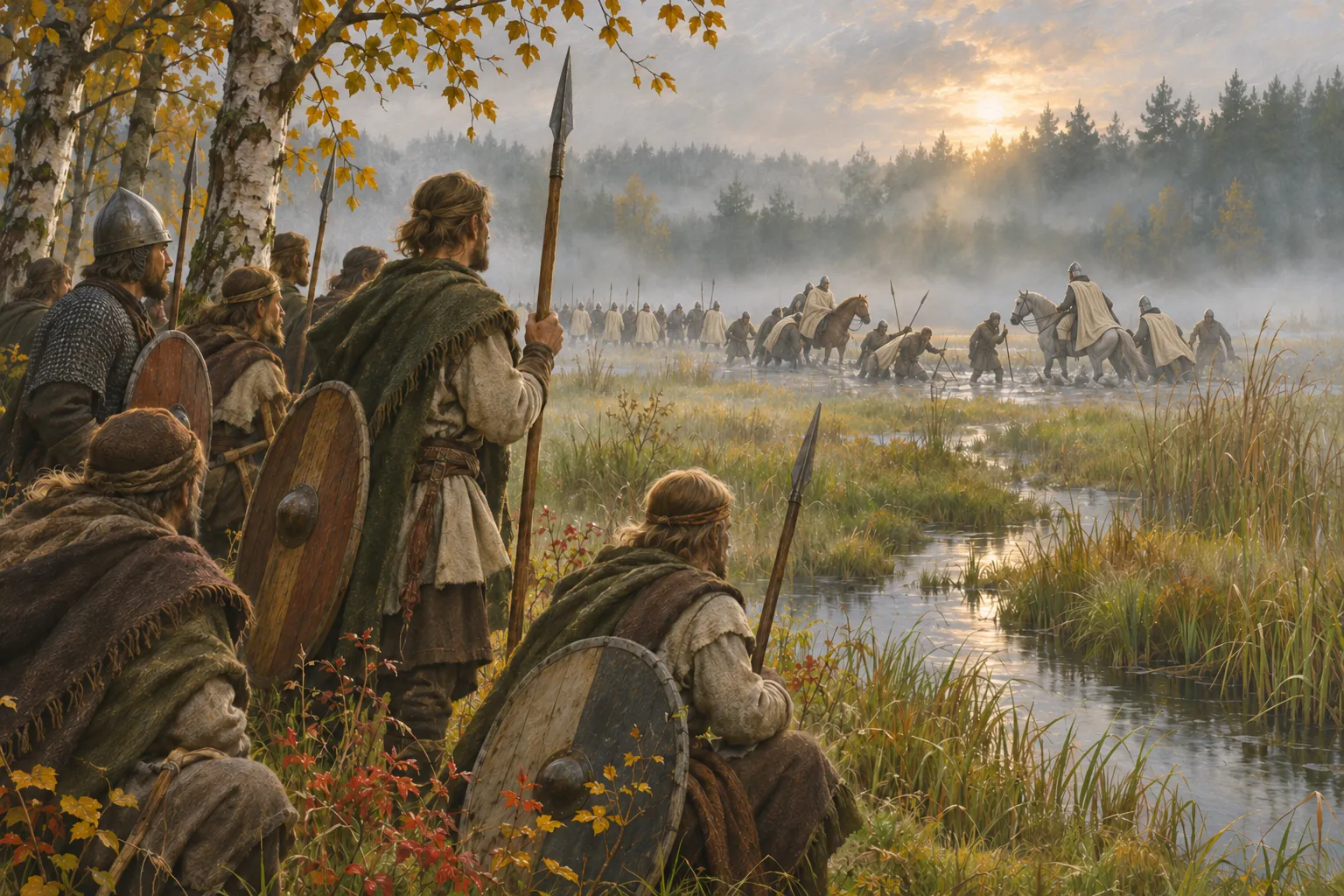
On 22 September 1236, Samogitians at Saule defeated the Swordbrothers’ army led by Master Volkewin. S36
Victory at Saule came before Mindaugas’s baptism and coronation. Authority in Lithuania was becoming more concentrated, while the Swordbrothers remained an independent order in Livonia. After defeat, they became the Teutonic Order’s Livonian branch. The battle accelerated that change, so the organisations before and after it must be distinguished. S6
1.2
The Swordbrothers’ troubles began before the campaign.
The expedition was intended to strengthen the Swordbrothers’ position.
The 1936 history recounts the Swordbrothers’ disputes with the bishop of Riga and earlier attempts to unite with the Teutonic Order. Their difficulties predated Saule. Victory over an external enemy could strengthen their authority, add resources and give them more weight in negotiations. S6
The synthesis links the campaign of 1236 to a proclaimed crusade and the arrival of knights in Livonia. Religious arguments for war mingled with the pursuit of territory and institutional power. More lay behind the battle than two commanders wishing to test their strength. S6
Based on: S6
1.3
Different forces in one army.
The Swordbrothers went on campaign alongside their supporters.
According to the Universal Lithuanian Encyclopedia (VLE), the expedition included brothers of the order, visiting crusaders and local auxiliaries. S36
In the synthesis, the invading army devastates the countryside until assembled Lithuanian forces block its path. The encounter was part of the wider campaign: an army that entered enemy territory still had to find its way back. S6
1.4
Marshy ground could undo an army’s advantage.
The battle account gives an important role to a stream and the marshy ground around it.
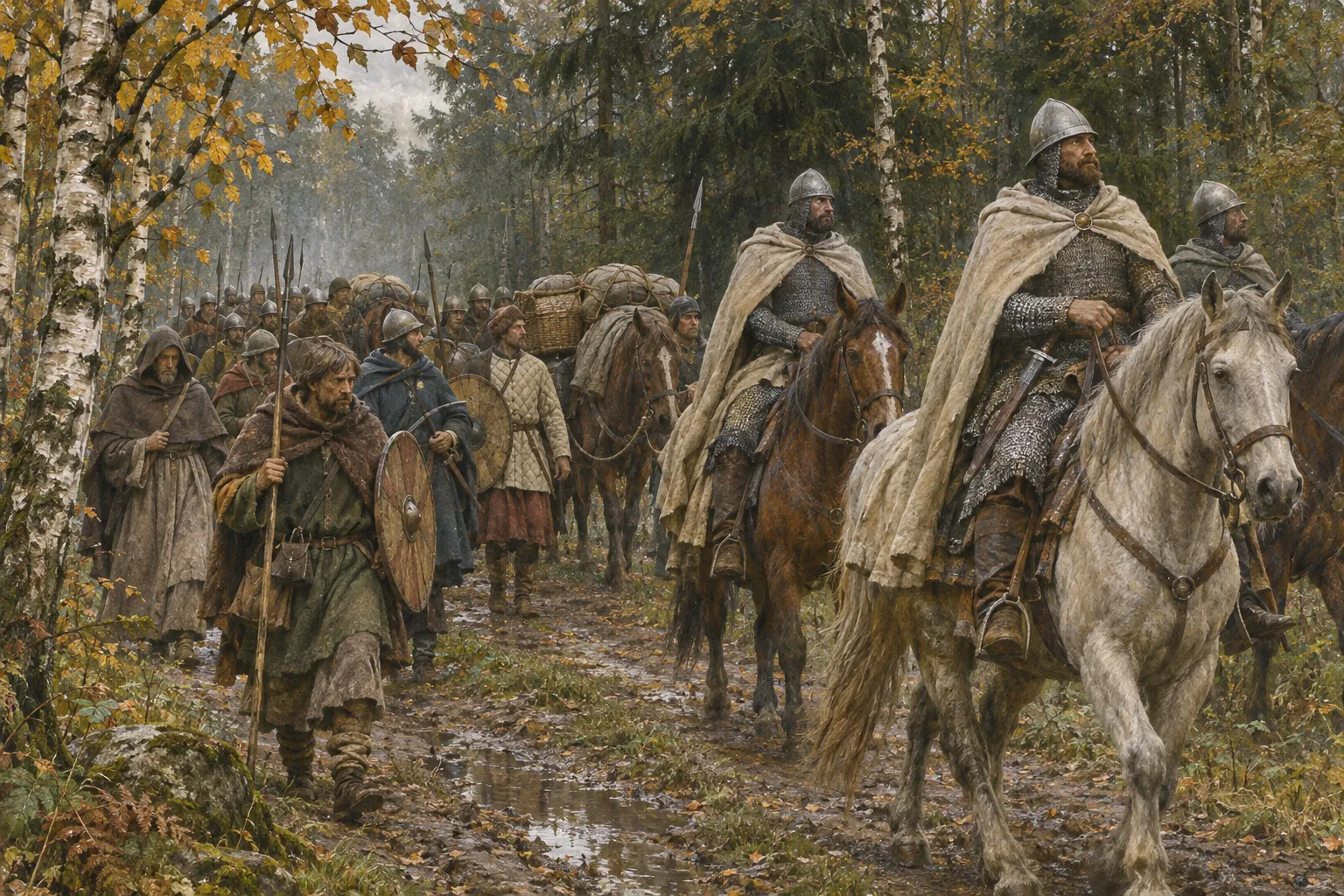
In VLE’s account, the returning army stops by a stream, where the crusaders are reluctant to fight on marshy ground. An attack begins the next day and ends in their defeat. S36
The 1936 synthesis treats the Lithuanian forces blocking the retreat as the decisive episode. A successful campaign also needed a safe return. The account does not trace every unit’s movements, so the illustration is not an exact battle plan either. S6
1.5
The Swordbrothers lost their leadership.
Defeat affected both the army and the order’s future.
Lithuanian forces won, while the Swordbrothers’ master and many other participants died. The synthesis edited by Šapoka stresses how severe the defeat was. Those reported losses should not, however, be read as an exact count of every soldier killed. S6
After the battle, the order struggled to pursue its previous policy with its own resources. The surviving Swordbrothers had to seek support within a larger military institution. The failure of one expedition changed how the war would be organised. S6
Based on: S6
1.6
Who commanded, and where was the battle?
Vykintas’s command and the exact battlefield remain questions of interpretation.
The 1936 synthesis first acknowledges that the Lithuanian commander is unknown. It then proposes Vykintas as the likeliest candidate. This is the author’s inference, not a surviving battlefield order. Mindaugas’s personal command cannot be treated as certain either. S6
Artūras Dubonis points out that the Livonian Rhymed Chronicle names no Lithuanian combatants. Vykintas’s command and the exact battlefield remain disputed rather than securely attested. S37
1.7
An independent order became the Livonian branch.
Defeat accelerated incorporation into the Teutonic Order.
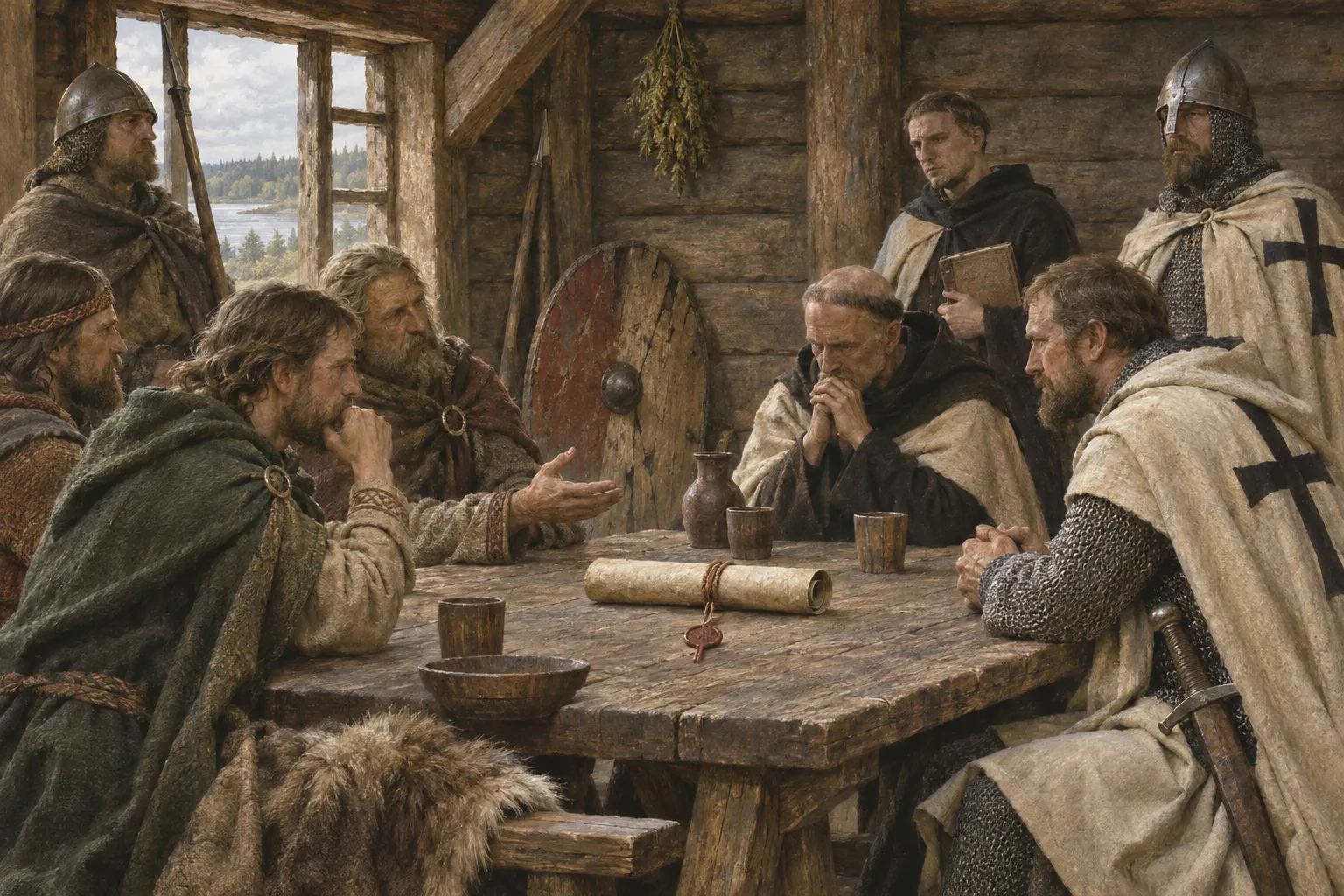
In 1237 the pope approved the incorporation of the surviving Swordbrothers into the Teutonic Order. Its Livonian branch continued under a provincial master who answered to the grand master. Saule ended the independent order’s history, but its military structure was taken over rather than erased. S6
Reorganisation also changed the political setting. Samogitia separated the order’s Prussian and Livonian territories, so it sought a land route between them. The war continued under a different organisation, while this territorial question remained central. S6
Based on: S6
1.8
How does the battle relate to state formation?
Saule belongs to a longer history of political concentration in Lithuania.
The synthesis links Saule to the strengthening of Lithuanian authority and Mindaugas’s rise. This forms part of its broader account of state formation. The battle’s outcome alone does not tell us exactly when Mindaugas took power or prove that every territory accepted the same political order at once. S6
Victory did not settle relations with neighbours or other dukes. Mindaugas’s baptism, coronation and later war with former partners were separate choices. Saule did not predetermine a straight path towards them. S6
Based on: S6
1.9
Two battles, different consequences.
Twenty-four years and a changed institutional structure separate Saule and Durbe.
In 1236 the independent Swordbrothers were defeated; at Durbe in 1260, combined Livonian and Prussian forces fought. The first battle was followed by incorporation in 1237. The second brought wider resistance and a change in Mindaugas’s policy. S6
The importance of both victories lies in the fighting and in what rulers, armies and communities did afterwards. The blow at Saule changed institutions and political decisions. That is why the battle’s story extends beyond the campaign itself. S6
Based on: S6