1.1
The Prussians before the Kingdom of Prussia
The Prussians were Western Balts. A later German state preserved their name, but not their language.
Prussian was a distinct language within the Baltic family, alongside Lithuanian and Latvian. Marija Gimbutienė places its speakers within the Western Baltic world. Their linguistic ties help explain shared features, but medieval Prussians were not simply Lithuanians under another name. Their lands, communities and political experience had histories of their own. S11
Written sources preserve several forms of the name. Gimbutienė discusses ninth-century Bruz, later Pruzzi and other spellings, suggesting that the name gradually spread. These outside references leave open what each community called itself and how many people identified with a wider Prussian name. The surviving labels alone cannot settle who they included. S11
The Order’s conquests expanded the territory called Prussia. The name later passed to a state under German rulers; by 1701 it belonged to a kingdom. This was a different political order and linguistic setting. Continuity in the name does not mean that all inhabitants of later Prussia descended from the ancient Prussians. S6 S11
Herkus Mantas lived in the thirteenth-century Prussian world, as the Teutonic Order built its authority around castles. His struggle was one episode in a longer history. The uprising grew out of lands and communities whose daily lives conquest transformed: their exchange networks, local authority, work and beliefs. S6 S11
1.2
Prussia was a country of many lands
Natangia, Sambia and Warmia were individual lands with communities of their own. They did not form a single state with unchanging boundaries.
Drawing on medieval names and archaeology, Gimbutienė lists Pomesania, Pogesania, Warmia, Natangia, Sambia, Nadruvia and Bartia. Her wider Western Baltic setting also includes Skalvia, Sudovia and Galindia. These names help locate the communities, although their relationships and extent changed over time. They describe historical lands, not fixed modern administrative divisions. S11
Rivers, lagoons, coastline and overland routes connected these lands. Sambia is especially important in the history of amber, while Natangia becomes prominent in the story of Herkus Mantas. Their history reaches from the sea to inland strongholds and farming settlements. An image of coastal warriors alone leaves much of that world unseen. S11
The 1936 history of Lithuania edited by Adolfas Šapoka distinguishes an early, narrower use of the Prussian name from the larger Prussia conquered by the Order. Gimbutienė focuses more on linguistic and cultural connections. Their lists reflect these different geographical and historical scopes; the same name does not cover exactly the same ground in each work. S6 S11
During the Great Uprising, individual lands chose their own leaders. That relationship between a local community and its commander is central to the story. Herkus Mantas led the Natangians; he was not king of all the Prussians. A shared enemy could bring neighbours together without removing local independence or establishing a single hereditary authority. S11 S107
1.3
Life around a hillfort
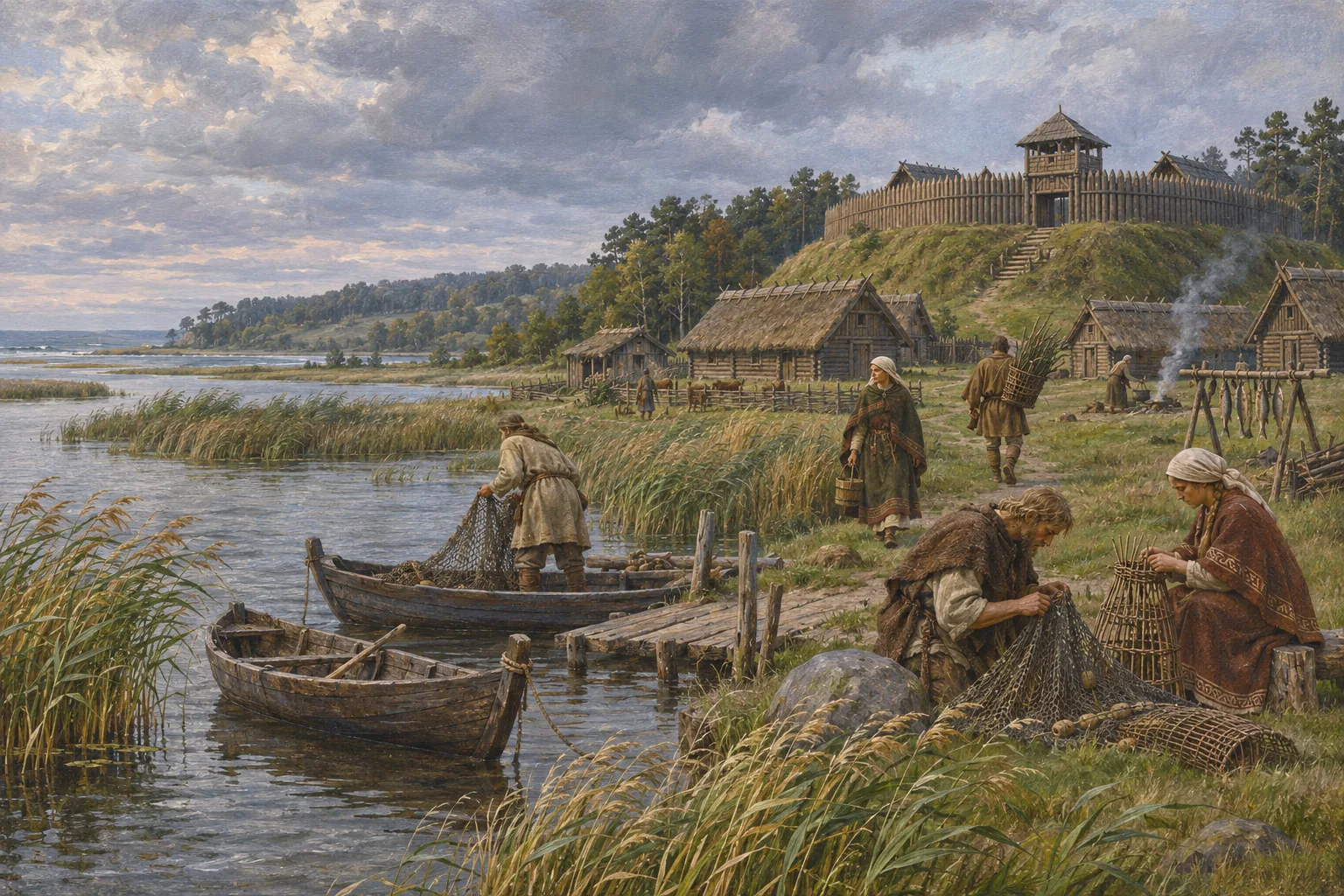
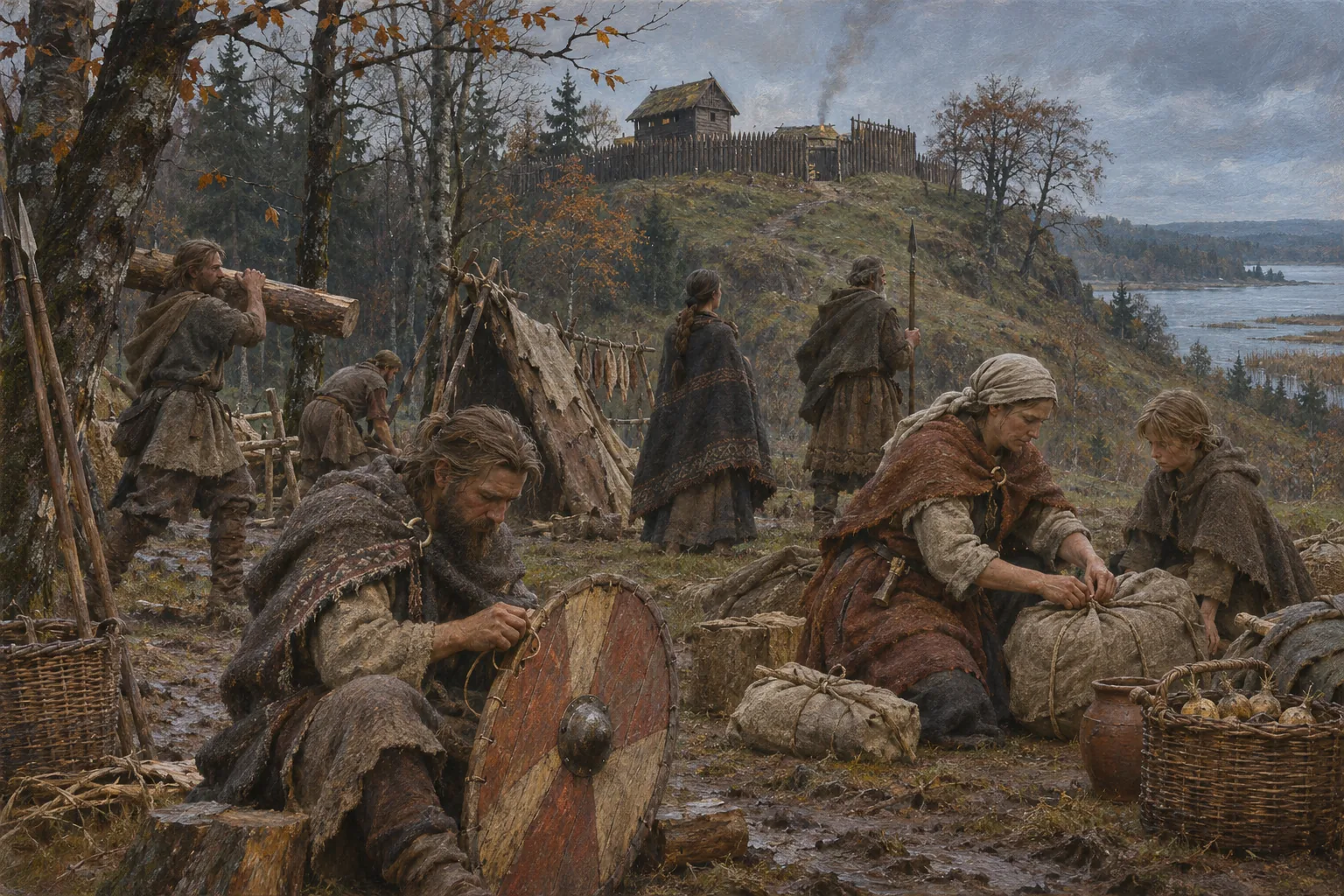
Behind the accounts of war lay cultivated fields, livestock, timber work and fishing. A stronghold depended on the work of surrounding settlements.
Gimbutienė connects early travellers’ towns and kings with fortified centres and local rulers. She also acknowledges how little is known about the layout of villages beside hillforts. Her interpretation places the stronghold at the centre of a surrounding community, offering protection without giving us an exact plan of every Prussian village. S11
The history edited by Šapoka describes Baltic livelihoods through farming, animal husbandry, beekeeping, hunting and fishing. It offers a broad account of Baltic life, rather than a record of one excavated Prussian household. Even at that scale, the range of work is clear: people had to supply food and materials as well as fight or collect amber. S6
Gimbutienė draws on Wulfstan’s account of rulers, wealthy people, poor people and slaves to discuss differences in wealth. She reads it as evidence of an already stratified society, with powerful local figures and their circles. The traveller gives no census, but his description challenges the idea that everyone lived alike, without structures of authority. S11
Customs and collective decisions helped govern local life. In the account of Adalbert’s mission, Gimbutienė draws attention to the community’s response and its law. There could be rules without a central kingdom. These local ties later helped mobilise people for war, although coordinating separate lands remained difficult. S11 S6
1.4
Amber travelled beyond the Baltic shore
Sambian amber connected the coast with distant lands long before the Order and Herkus Mantas.
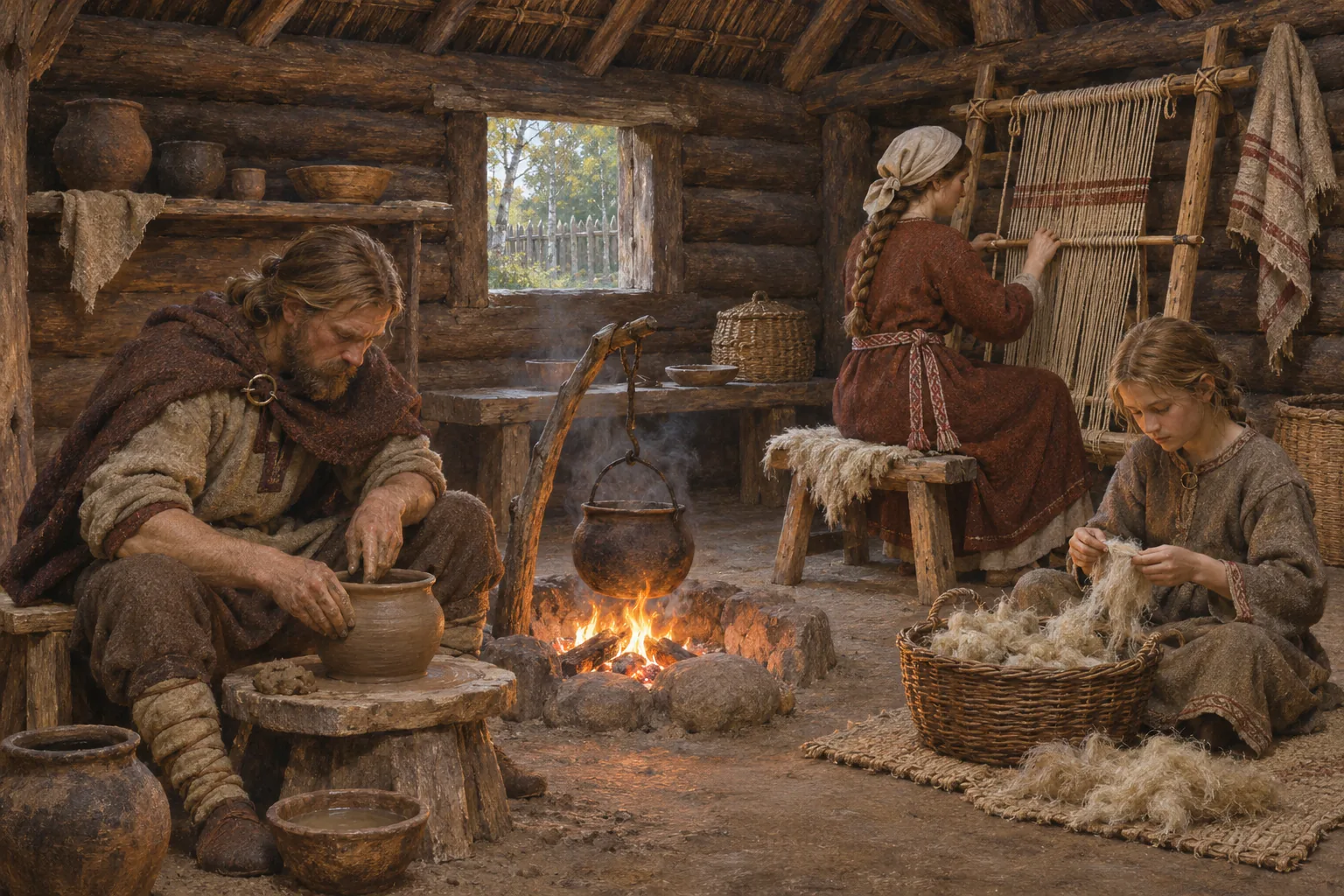
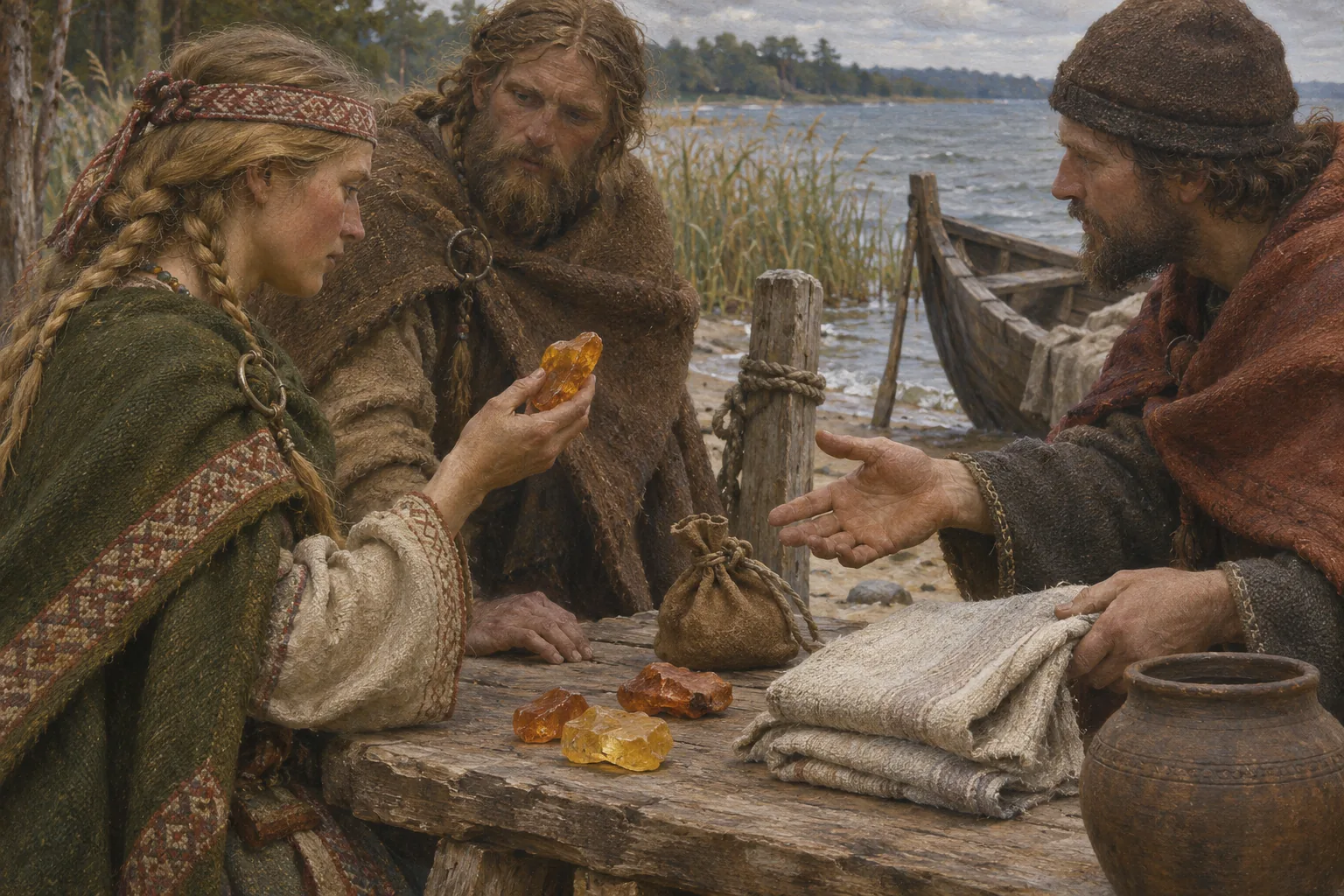
Gimbutienė locates major amber-collecting areas in Sambia, the lagoons and along the coast. From there, the raw material could travel toward the Vistula basin and farther south. Her account links coastal deposits, river routes and intermediaries with lands where amber became a luxury material. These journeys began long before the medieval uprising. S11
Her book retells Pliny’s account of an amber-buying expedition during Nero’s reign. It shows how far demand reached in the Roman imperial period, many centuries before Herkus Mantas. The episode tells us nothing directly about thirteenth-century trade; the Roman and medieval connections belong to different settings. S11
Gimbutienė contrasts imported Roman objects and coins with the small amounts of amber found in some local graves, linking this pattern to exports of raw amber. A Roman coin could be valued for its material or prestige. Finding one in Baltic lands does not establish the kind of monetary circulation found in a Roman town. S11
Amber moved through networks that changed over time, rather than along one road with an unchanging course. It was important, but other goods travelled too. Adam of Bremen’s account, discussed by Gimbutienė, describes Sambians exchanging furs for woollen clothing: a separate example of medieval trade. S11
Based on: S11
1.5
The coast was not a closed world
Merchants and settlers arrived, while objects and knowledge travelled. Maritime connections did not always mean conquest.
Scandinavian objects and burial practices appear around the Vistula, in Sambia and along the lower Nemunas. Gimbutienė connects them with trade, incoming settlers and possible integration into local communities. Kaup, also called Wiskiauten, provides particularly important evidence. The finds reveal contact, though not the native language of everyone buried there. S11
Gimbutienė stresses how little written evidence survives for Viking conquests in Prussian lands. A foreign weapon or ornament alone cannot show that newcomers ruled the country. It might have arrived through exchange, with an individual warrior or among people with mixed connections. Finds and written accounts together help distinguish these possibilities. S11
Adam of Bremen, cited by Gimbutienė, praises the Sambians for helping people in distress at sea, yet judges their religion from a Christian position. Hospitality, desirable goods and religious distance sit together in his account. His descriptions of the coast and its inhabitants carry all of these attitudes. S11
Local people made their homes on this coast, and others came to settle or trade. It was already part of a connected Baltic world before the Order expanded through its castles. Conquest transformed an inhabited landscape with established connections; the arrival of the first crusader was not the beginning of Prussian history. S11 S6
1.6
Sacred places and accounts across the centuries
Archaeology and written accounts offer different glimpses of Prussian beliefs. The texts come from different periods, and their narrators wrote for different purposes.
In Peter of Dusburg’s chronicle, Gimbutienė finds references to sacred woods, fields and waters. Religion is tied to the landscape and to prohibitions on disturbing it. Dusburg was also a priest of the Order: his account of local customs served a narrative about Christian mission and conflict with its opponents. S11 S107
Burial customs varied by region and period. Gimbutienė distinguishes cremation deposits in pits in Sambia from urns in Galindia, and also discusses horse burials. These graves do not reveal a single rite compulsory for every Prussian. They show how communities treated their dead, while leaving much of an individual’s beliefs and the names of their gods unknown. S11
Wulfstan, retold by Gimbutienė, describes the distribution of a dead person’s wealth through horse races. He also claims that cold could be created to preserve a body for a long time, an unusual detail that attracted later interest. The races and the claim about cold remain the traveller’s testimony; the account does not establish a supernatural ability. S11
The Treaty of Christburg of 1249 names Kurkas, written in Latin as Curche. Gimbutienė and Gintaras Beresnevičius link the reference to harvest and agricultural ritual, each developing an interpretation of their own. The treaty’s prohibition, archaeological objects and later images of a deity offer different kinds of evidence, rather than a single securely known Prussian pantheon. S11 S12 S108
1.7
Did the Prussians have one religious centre?
Romuva and the Krivė became some of the best-known names in Baltic religion. The authors of the supplied books interpret their meaning differently.
Gimbutienė sees a possible trace of religious hierarchy in Peter of Dusburg’s account of Romuva in Nadruvia. She emphasises the Krivė’s authority beyond a single community, while acknowledging that she cannot securely date the arrangement’s beginnings. Her reading joins the chronicle reference to a broader reconstruction of Baltic religion. S11
The history edited by Šapoka rejects that reading. It argues that medieval writers imagined a supreme priest and common religious centre through the familiar organisation of the Catholic Church. The work accepts local ritual specialists, but not a single priesthood governing the whole country. S6
Beresnevičius reconstructs a different possibility: a religious centre associated with Romovė or Rikojotas that may have moved toward Lithuania. He draws on authors from different periods, including Dusburg and Simon Grunau. The proposed movement is his comparative interpretation, not a contemporary account of a journey. S12
In his Būdas of 1845, Simonas Daukantas described a vivid sanctuary with an evergreen oak, a priestly setting and divine figures. He also questioned an inherited list of 51 high priests. His account belongs to nineteenth-century historical imagination, rather than providing a surviving sanctuary plan from Herkus Mantas’s lifetime. S20
1.8
From a missionary’s arrival to a network of castles
Christian mission and military conquest were connected, but did not operate in the same way. Both the newcomers and their means changed over time.
The missionary Adalbert died in Prussia in 997. The work edited by Šapoka connects his death with a violation of sacred space. Gimbutienė, discussing the mission narrative, gives more weight to local law, the community’s response and authority. The interpretations emphasise different aspects of the same encounter: a religious boundary or a community’s decision about an outsider. S6 S11
The history edited by Šapoka later introduces Christian, baptisms and efforts to obtain armed support for mission. Preaching becomes increasingly tied to military protection. Yet the baptism of a ruler or group did not amount to the whole country accepting a new religion and authority. S6
An invitation from Duke Konrad of Masovia brought the Teutonic Order; the 1936 synthesis places its first representatives around 1230. The Order could draw on wider European connections, incoming fighters and castle construction. A castle secured an occupied position, housed a garrison and supported further campaigns even when surrounding communities had not yet been permanently subdued. S6
Gimbutienė describes conquest and colonisation, sharply questioning the language of holy war. The history edited by Šapoka also gives castles, churches and settlers a prominent place. New authority changed who controlled the land and the position of local people. Resistance concerned religion as well as political and social order. S11 S6
1.9
1242–1249: an earlier wave of resistance
The Great Uprising was not the first attempt to throw off the Order’s rule. An earlier conflict had already brought warfare and a peace settlement.
The history edited by Šapoka dates the first uprising to 1242–1249. Gimbutienė sets it amid the Order’s advance from Pomesania and Pogesania toward the lagoon lands. People resisted while the new authority was still expanding. This was an earlier phase in a long struggle over Prussia, rather than a final battle for the whole country. S6 S11
The synthesis edited by Šapoka stresses how the Order recovered positions and brought in reinforcements from outside. A recurring pattern was already visible: local resistance disrupted the conquest, while external connections supplied new forces. Victories within the country did not cut off that support from abroad. S6
The Treaty of Christburg of 1249 addressed the position of converts as well as the aftermath of war. Prussians complained that the Order had restricted freedoms promised by the pope. The papal legate Jacob drew up a settlement recognising rights to own, inherit, sell and bequeath property. Those rights depended on Catholic faith, obedience to the Roman Church and loyalty to the Order. S108
The document requires Pomesanians, Warmians and Natangians to build churches, follow Christian marriage rules, use cemeteries and abandon specified older rites. It imposes tithes and military obligations too. These duties accompany the settlement’s rights. They describe the order its authors intended, without proving that it was enforced everywhere or brought lasting reconciliation. S108
Prussians must join expeditions armed according to their means, protect the Order’s rights, disclose treason and avoid conspiracy. The Order promises help recovering captives in return. The settlement seeks to turn former opponents into defenders of the new authority, regulating future military service alongside daily life, family and religion. S108
1.10
Defeat at Durbė opened an opportunity
The Battle of Durbė in 1260 weakened the Order and encouraged wider resistance. Prussian lands chose separate leaders for their uprising.
The history edited by Šapoka links Durbė to uprisings in Livonia and Prussia. The defeat showed that the Order’s forces could be overcome. Gimbutienė dates the second Prussian uprising to 1260–1274: years of local encounters, rather than a single uninterrupted campaign under one combined army. S6 S11
Peter of Dusburg says the Prussians saw that the preceding war had left the brethren short of men, horses and arms. He places the uprising’s beginning on the eve of St Matthew and calls it apostasy. His account preserves both the opportunity for Prussian resistance and the religious judgment of an Order priest. S107
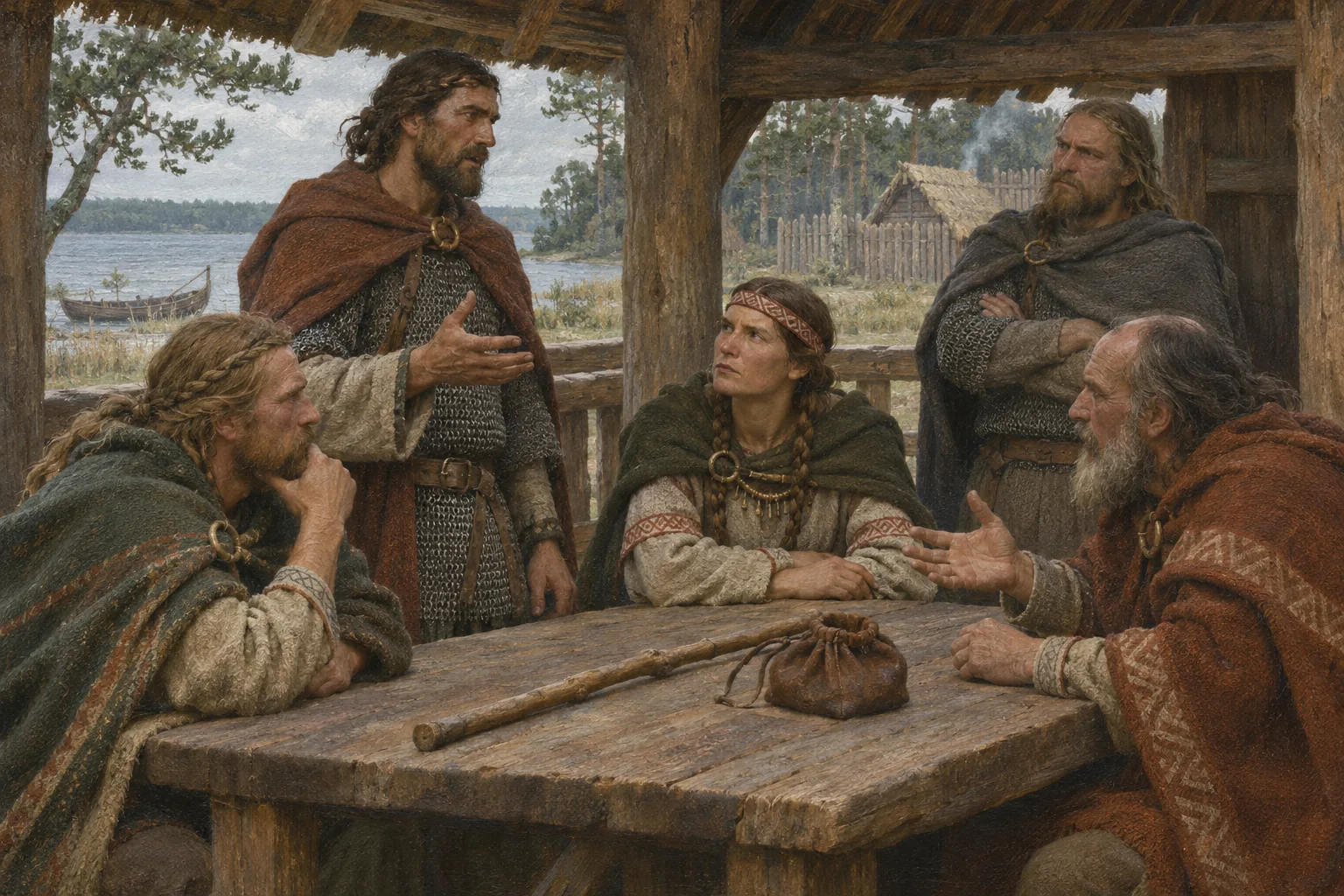
The chronicle names Glande for the Sambians, Herkus Mantas for the Natangians, Glappus for the Warmians, Auctumo for the Pogesanians and Diwanus for the Bartians. Gimbutienė gives the same list. Five lands were represented, showing how widely resistance spread. Neither list makes Herkus their overall commander or establishes regular meetings of one war council. S107 S11
Rebels destroyed castles and garrisons, although the Order’s strongest bases survived. The history edited by Šapoka also describes Samogitian help. Fighting crossed the boundaries of individual lands, while fresh forces could still arrive from the West. Early victories became a prolonged struggle for fortified positions and the surrounding countryside. S6
1.11
A Natangian leader who knew his enemy’s language
Peter of Dusburg names the Natangian commander as Henricus Monte. Scattered episodes offer glimpses of his childhood and connections.
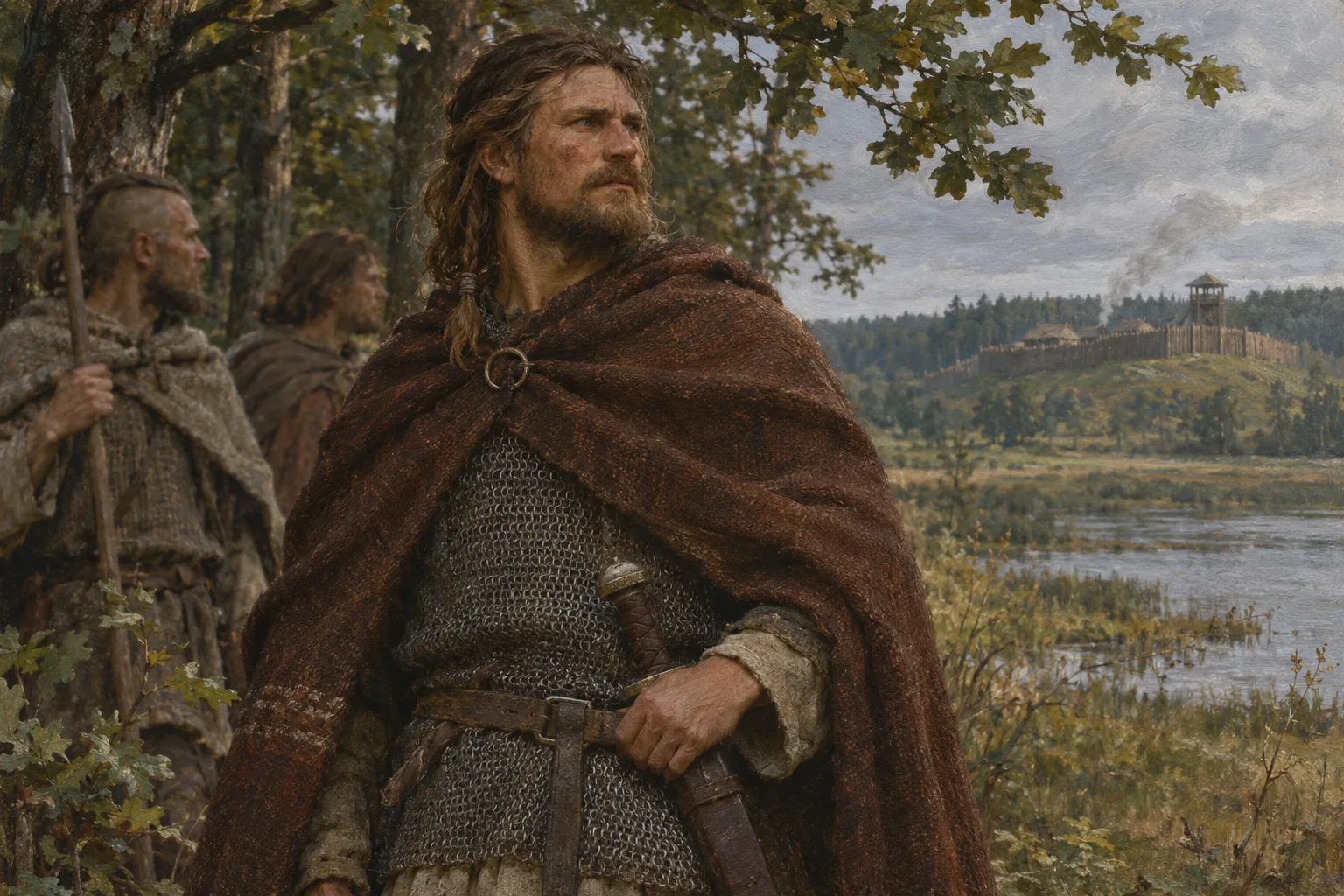
The chronicle says Herkus and other Prussians grew up among the brethren and learned German. Dusburg recounts how they used the language to draw Christians from hiding in woods and marshes. He condemns the act, yet his story also reveals how well some rebels knew their opponents’ world. S107
A captive links Herkus to Magdeburg. The burgher Hirzhals reminds him of help given there, and Herkus, according to the chronicle, saves his life twice. This concrete connection tells us more than general claims about education. It still leaves his school, age and length of any schooling unknown. S107
Herkus represents the Natangians in the list of leaders for 1260. The chronicle later names him in an attack on Königsberg castle and a campaign into the Kulm region. These episodes show his military role and authority, but leave much of his life unknown. The source contains no authenticated portrait, personal letters or account written by Herkus himself. S107
Based on: S107
1.12
1261: an attack on a divided force
At Pokarvis, the Natangians defeated part of an enemy force. Dusburg’s account follows the encounter without naming the commander of the battle.
Dusburg relates that fighters from Germany, including the lord of Reyder, joined the brethren in 1261. After devastating Natangia, they camped near the site of the later Brandenburg castle. The camp was therefore part of a campaign against the local population, rather than an army at rest in an otherwise peaceful setting. S107
The force divided. One group left on another raid; the other stayed near the place Dusburg calls Pocarwis. The Natangians attacked those left behind. The separation left the two groups unable to support each other immediately, and the men in camp had to fight alone. S107
Dusburg describes hard fighting, the death of the lord of Reyder, captives and men fleeing. The returning raiders could not rescue their companions and withdrew by another route. He records a Natangian victory over the incoming force. We have his account of the sequence here, rather than surviving reports from both armies to compare. S107
Herkus Mantas enters Dusburg’s story after the fighting, in the episode of the captive Hirzhals. The chronicle clearly places him in the wider Natangian uprising, but that chapter does not describe who commanded at Pokarvis. His presence in the next episode leaves his role at each moment of the battle uncertain. S107
Based on: S107
1.13
A prisoner, three lots and a white dove
After Pokarvis, Dusburg tells the story of a captive from Magdeburg. The account of war becomes a Christian martyr narrative.
A wealthy Magdeburg burgher, Hirzhals, is chosen for sacrifice when the captives draw lots. He asks Herkus Mantas to remember the help he once gave him in Magdeburg. Herkus releases him, then saves him again when the second lot falls on the same man. Amid the account of battle, the chronicle records an earlier personal debt between men now on opposing sides. S107
Chosen a third time, Hirzhals refuses rescue in Dusburg’s account and offers himself for the Christian faith. He is bound to a horse and burned. The scene is the chronicler’s account of violence, not a record of the participants’ conversations or a complete description of sacrifice in every Prussian community. S107
As the captive dies, a white dove is said to leave his mouth. Dusburg says Herkus and others later swore they had seen it. Their reported testimony gives the episode its meaning as martyrdom and miracle. It expresses the chronicler’s religious interpretation, without independently verifying a supernatural event. S107
The Hirzhals story passed into later historical writing. Kojelavičius retells the Magdeburg captive’s ordeal, the lots and two rescues, without naming Herkus in that passage. In his 1989 introduction, Juozas Jurginis examines how such stories reached later writers and shaped readers’ judgments. His commentary and Kojelavičius’s older narrative remain separate voices. S7
1.14
Why was a battlefield victory not enough?
The Order depended on castles and garrisons. Winning in the field did not spare Prussian forces the different demands of siege warfare.
The history edited by Šapoka describes early rebel victories while stressing that the Order’s strongest bases survived. Their garrisons could continue fighting and support renewed expansion. Taking the surrounding countryside did not remove a castle within it. Kojelavičius offers a different later account, listing Königsberg among the places captured. S6 S7
Dusburg names Herkus Mantas in an unsuccessful attack on Königsberg castle. The Natangian leader wounds brother Henricus Ulenbusch with a spear, then is struck by a servant’s smaller spear. Weakened, Herkus withdraws with his army without achieving his aim. S107
The Visuotinė lietuvių enciklopedija dates this attack to 1262. S111
The crossbow in the neighbouring episode belongs to a different story. In Herkus’s attack, the weapon is a spear, placing the leader close to his opponent in the account. Dusburg supplies dialogue too, but it is part of his narrative, rather than a surviving transcript recorded by the combatants. S107
Neighbouring peoples also became involved in the long war. The history edited by Šapoka describes Samogitian expeditions helping the Prussians and reinforcements arriving for the Order. These connections carried the fighting beyond one land. Outside help could decide an encounter without ending the enemy’s wider supply and support. S6
1.15
1263: the Order loses its regional commanders
Dusburg names Herkus Mantas directly in the Liubava account, then follows the Prussian withdrawal, the scattered pursuit and the return to battle.
Herkus enters the Kulm region with his force. Dusburg records booty, captives and buildings burned outside fortifications: a campaign into the Order’s territory that also struck the people living there. As the Prussians leave with their spoils, Master Helmerich gathers troops and pursues them into the land of Liubava. S107
Dusburg describes the Prussians resisting behind barriers, then fleeing as their pursuers scatter. When they see few men left around the banner, they return to the barriers and renew the fighting. The balance has shifted. The chronicle records no earlier order from Herkus to feign flight, so a deliberate plan remains a reconstruction. S107
Dusburg reports that Master Helmerich, Marshal Theodoric and 40 brethren died. His account stresses the damage caused by losing experienced commanders. Helmerich held the office of Prussian master, rather than grand master of the whole Teutonic Order. S107
The encyclopedic chronology dates the Battle of Liubava to 1263. S111
Dusburg ends his account of defeat with a hermit’s vision that gives the deaths the meaning of martyrdom. Kojelavičius later tells a story resembling the battle at Liubava, but sets it among legendary Lithuanian rulers and uses a different chronology. That later telling is not a second witness to the same commander’s orders. S107 S7
1.16
A war fought under several leaders
Herkus Mantas became the best-known name of the uprising. People in other lands fought under leaders of their own.
Glande, Glappus, Auctumo and Diwanus led communities of their own. Dusburg assigns them separate lands, and Gimbutienė uses the list to discuss local leadership. Each community had its own experience of the Order’s expansion. Their shared resistance brought several groups together, rather than placing them under one sovereign or making them Herkus’s entourage. S107 S11
Diwanus’s death has its own episode in Dusburg. The Bartian commander besieges Schonense, as the chronicle names it, and dies from a crossbow shot. His force withdraws. This siege and fatal wound are separate from Herkus Mantas’s attack at Königsberg; the two episodes do not describe one hero’s life. S107
The history edited by Šapoka treats the lack of a common state as a weakness against the Order. Gimbutienė focuses more on local organisation, authority and social hierarchy. They emphasise different aspects of political fragmentation: functioning community institutions did not require a single, centrally commanded army. S6 S11
The war exposed both cooperation and its limits. One land could win while another struggled; a surviving Order castle or fresh reinforcements could alter the local balance. The uprising collapsed through many such conflicts and the Order’s capacity to rebuild its strength, not simply through the death of its most famous leader. S6 S11 S107
1.17
Captured and killed
Herkus Mantas’s death is usually dated to 1273. Dusburg describes him being caught unexpectedly in a secluded place, rather than falling in a final battle.
Dusburg describes the Natangians in difficulty as Herkus retreats into the wilderness with companions. While the others hunt, he stays alone in a tent. At this exposed moment the chronicle brings his life to an end, far from the large encounters of the uprising’s earlier years. S107
According to Dusburg, Henricus de Sonnenberg, commander of Christburg, and Helvicus de Goldbach arrive with armed men and find Herkus. They seize him, hang him from a tree and pierce him with a sword as he hangs. The Order’s chronicler records this violent end without describing a public trial or negotiated surrender. S107
The encyclopedia gives the year 1273. Dusburg’s chapter supplies no precise date; it narrates the circumstances of capture. S111 S107
Herkus’s death falls near the end of the 1260–1274 uprising, but Prussian history continued. Elsewhere people were still fighting, fleeing or negotiating life under new conditions. His biography ends here; other sources follow what happened to his community and the wider country. S11 S6
1.18
Defeat transformed life without emptying the country
The uprising’s suppression in 1274 marked a major break. People died, were taken captive or fled, while those who remained faced a long process of adaptation.
Dusburg describes the brutal suppression in Pogesania: the Order’s forces burn and plunder, kill men and take women and children captive. They capture Heilsberg and impose what he calls peace. The chronicler’s own account preserves the suffering of civilians beneath that word. S107
Some Western Balts fled to Lithuania. The history edited by Šapoka describes Traidenis receiving newcomers and settling them along the Volhynian frontier. Rimantas Jasas, commenting on the Bychowiec Chronicle, separately discusses Prussian and Yotvingian settlements around Gardinas and Slanimas. His editorial account does not trace every refugee’s route or document the story of a single family. S6 S19
Gimbutienė describes newcomers settling among the surviving population, social inequality and gradual assimilation. She stresses the losses of conquest while tracing the language’s survival for centuries afterward. Political independence, ancestry and native speech changed at different speeds. The uprising’s end is only one date within these longer processes. S11
Alicja Dobrosielska’s study of thirteenth- and fourteenth-century Warmian families finds Prussians holding land, privileges and varied military obligations under the new order. Some served the Order or the bishop. These regional cases show differing outcomes, without making conquest peaceful or describing every Prussian’s position. S110
1.19
Prussian was spoken long after the uprising
Military victory did not change everyone’s language within a generation. The use of Prussian receded over centuries.
Gimbutienė traces Prussian speech for roughly four centuries after conquest, citing interpreters needed for preaching and late reports of people knowing the language. Baptism and rule by the Order, followed by other rulers, did not immediately silence the language of homes and communities. S11
Gimbutienė links language loss to prolonged assimilation and changes in population and rule. She places its end broadly around 1700 or the early eighteenth century. This is an approximate period of change: her account identifies neither a final speaker nor a securely established date of death. S11
Gimbutienė also points to regional and social differences. She describes western districts becoming Germanised faster than Sambia, where older inhabitants sometimes lived in compact communities. She especially associates language and custom with less privileged people. This explains the long process as she understands it, rather than accounting for every family. S11
Based on: S11
1.20
Catechisms preserved a language in retreat
Religious teaching left written texts in Prussian, centuries after the struggle of Herkus Mantas.
Vytautas Mažiulis identifies two catechism editions from 1545 and another from 1561. They served religious instruction that still needed a Prussian text. S109
Gimbutienė discusses vocabulary and catechism material associated with the fourteenth and sixteenth centuries, and interpreters helping with seventeenth-century sermons. These are different stages of writing and teaching, not evidence that Prussian books were printed in the fourteenth century. Written records and spoken language existed alongside each other, reaching communities in different ways. S11
The seventeenth-century reports discussed by Mažiulis disagree about the last Prussian speakers. The date of the final speaker’s death remains uncertain. S109
1.21
Grušas’s twentieth-century drama
In the twentieth century, Herkus Mantas also became a literary character.
The Maironis Museum of Lithuanian Literature presents Juozas Grušas’s Herkus Mantas, published in 1957. The book reflects later literary interest in the rebel leader. S112
The drama belongs to twentieth-century literature. Its characters and dialogue are artistic interpretations, rather than records of medieval conversations. S112
Based on: S112
1.22
Herkus Mantas on film
Herkus Mantas also reached the screen.
The Lithuanian Film Centre catalogs Herkus Mantas under 1972: director Marijonas Giedrys, screenwriter Saulius Šaltenis and lead actor Antanas Šurna. Its record lists awards in 1973. S113
Film critic Saulius Macaitis questions the common claim that the film adapts Grušas’s drama. Its plot and the actor’s face do not establish the medieval figure’s appearance or biography. S113
Based on: S113