3.1
A region without one timeless border
Lithuania Minor was a historical cultural region in Prussia; the interwar Klaipėda Territory covered only part of it.
Mažvydas’s Catechism was printed in Königsberg, while Klaipėda later brought several political and linguistic traditions together. Their histories reach beyond the borders of any single present-day region. Aistė Šiaulytė’s study of Klaipėda distinguishes the territory created after the First World War from the wider region of Lithuania Minor. S25 S206
Street names, official languages and people’s sense of belonging changed at different speeds. A government’s boundary on a map could not capture a community’s whole life. Lithuania Minor and the Klaipėda Territory mean different things in this account. S206
3.2
How the region was understood in 1936
Editor Adolfas Šapoka added the Lithuania Minor chapter to the 1936 Lietuvos istorija.
The chapter stresses Lithuanian continuity and Prussian–Lithuanian closeness. Interwar disputes shaped this interpretation; it is not a neutral account of origins. S6
Based on: S6
3.3
Language, faith and belonging
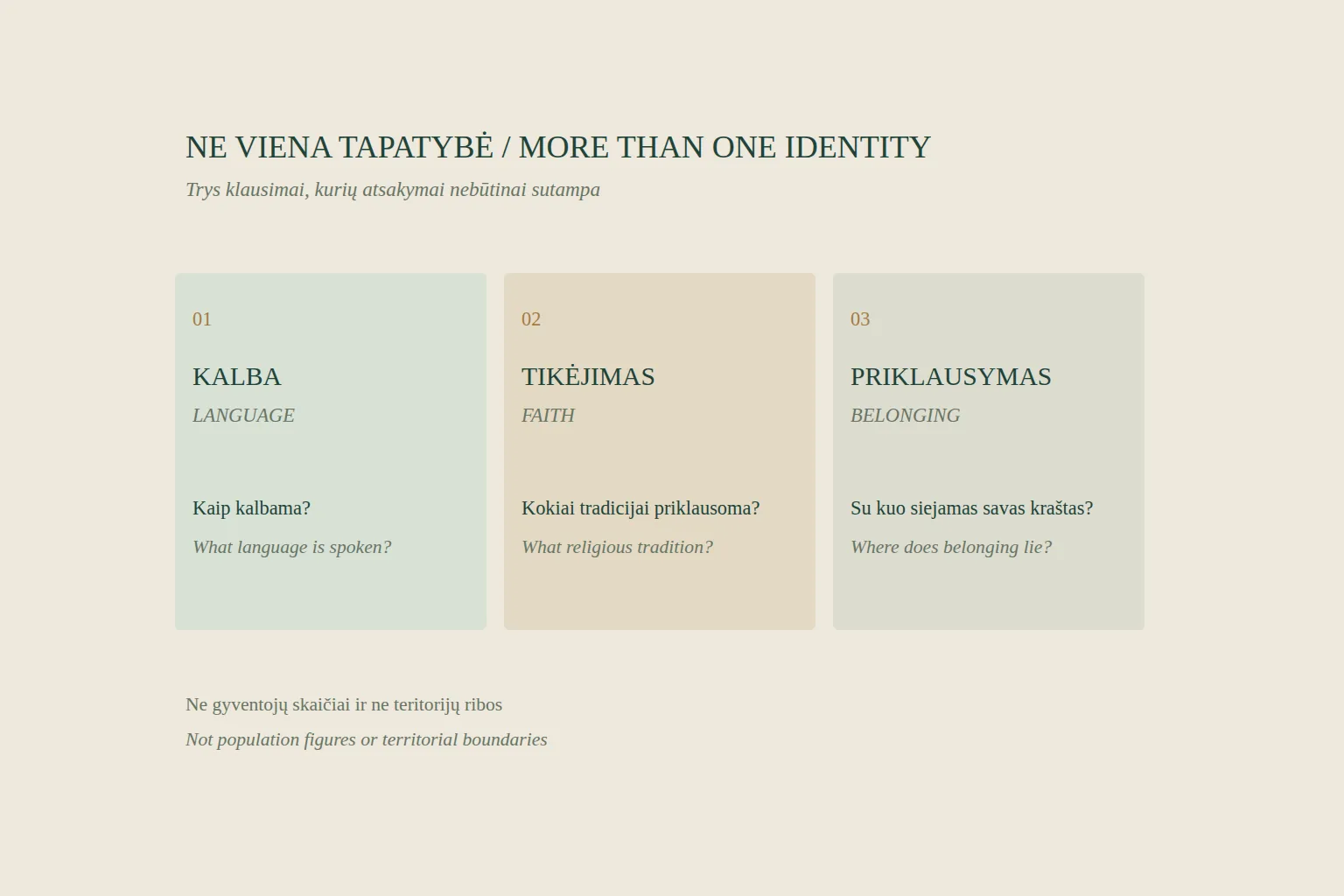
Language, faith and political allegiance shaped the lietuvininkai, or Prussian Lithuanians, and their attachment to the region.
Vygantas Vareikis describes people whose Lithuanian speech coexisted with Lutheran faith and loyalty to Prussia. Their attachment to the region did not fit a simple choice between German and Lithuanian. A Lithuanian speaker did not necessarily wish to belong to the Lithuanian state. S201
Based on: S201
3.4
The parish and the prayer meeting
Religious life helped sustain Lithuanian and a familiar way of life.
Žavinta Sidabraitė describes nineteenth-century prayer-meeting circles. Here religion was closely tied to language and customs. These commitments could differ from a national movement’s aims: protecting community life did not necessarily mean reshaping it around a new political ideal. S203
Johann Ferdinand Kelch wrote within this world. Religious imagery in his poetry also expressed Lithuanian self-awareness. Through reading, singing and comparing the present with inherited stories, the community explored its past. S203
Based on: S203
3.5
Königsberg, 1547
Mažvydas’s Catechism brought religious instruction and learning to read together.
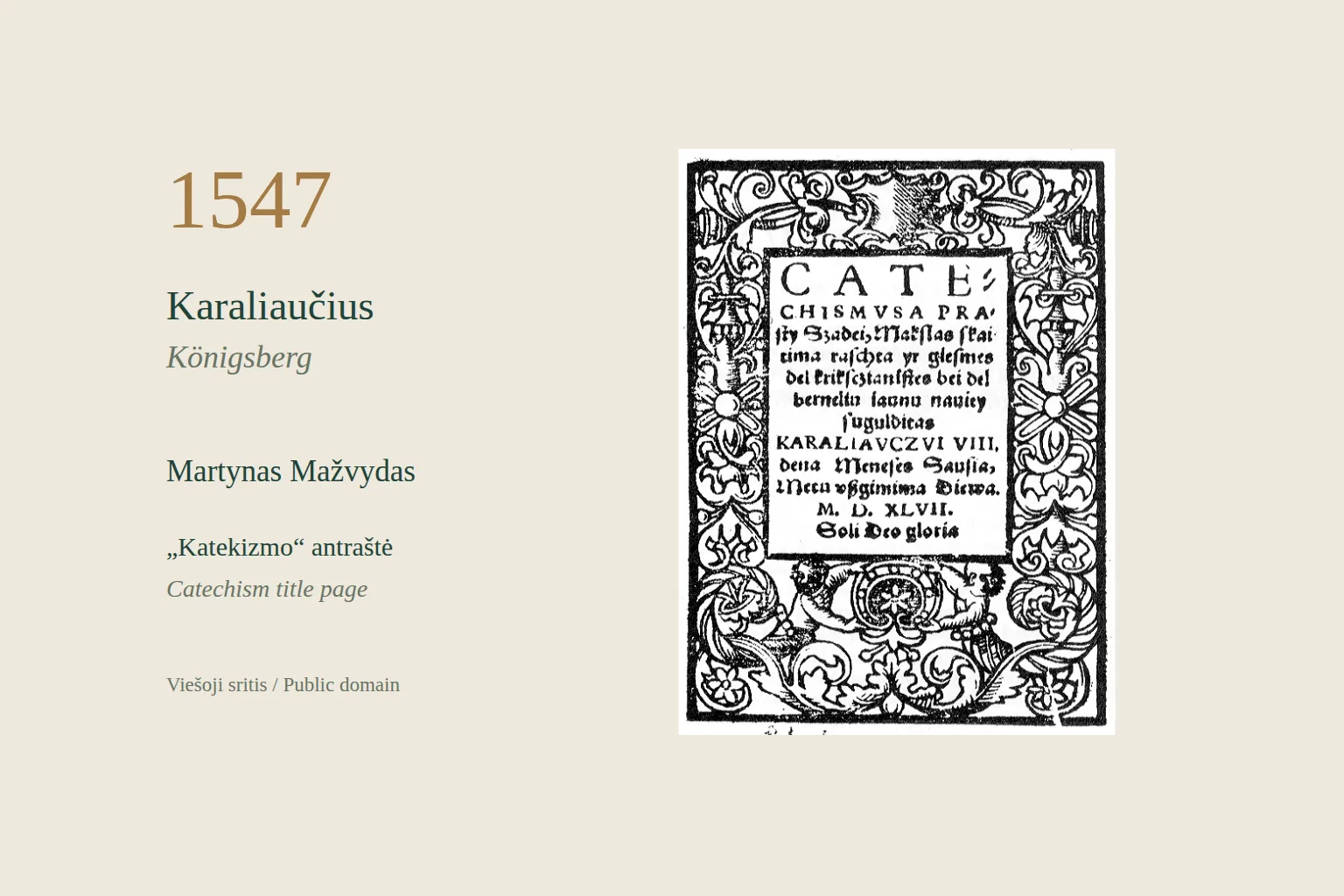
Vilnius University Library identifies it as the first printed Lithuanian book. Published in Königsberg in 1547, it combined religious texts with a primer and hymns with musical notation. Instruction, letters and sound met at the beginning of Lithuanian print. S25
The title names Christian teaching, reading and hymns. The dedication addresses the Grand Duchy of Lithuania: this Prussian publication was intended to reach beyond local readers. S199
3.6
A book enters the household
In the verse preface, Mažvydas urged households to teach both sons and daughters.
The primer sets out letters and syllables. The preface urges readers to understand the book and pass on its teaching at home. That was the book’s ambition; it does not tell us how many people could already read. S199
Based on: S199
3.7
Plague in one parish’s registers
The epidemic of 1709–1711 can be traced in the registers of Klaipėda’s St John’s parish.
Milda Kontrimė traced rising mortality, fewer baptisms and slow recovery in the records. Losses were greatest in 1710. These parish data cannot establish losses or the ethnic composition of the whole region. S202
Based on: S202
3.8
The year in Donelaitis’s poem
Spring in The Seasons begins with warming ground and retreating frost.
In Donelaitis’s verse, fields revive, snow and ice thaw, and greenery returns. Nature’s changes also stir people into action: later spring passages turn to fieldwork and sowing. Time in this world follows the rhythm of the land as well as the dates of rulers. S200
Barley, beans, buckwheat, oats, peas, hemp and flax give the poem’s world substance. They are not a crop inventory for every farm. The poet selects, teaches and judges rather than surveying the whole region’s agriculture. S200
Based on: S200
3.9
Rėza brings The Seasons to readers
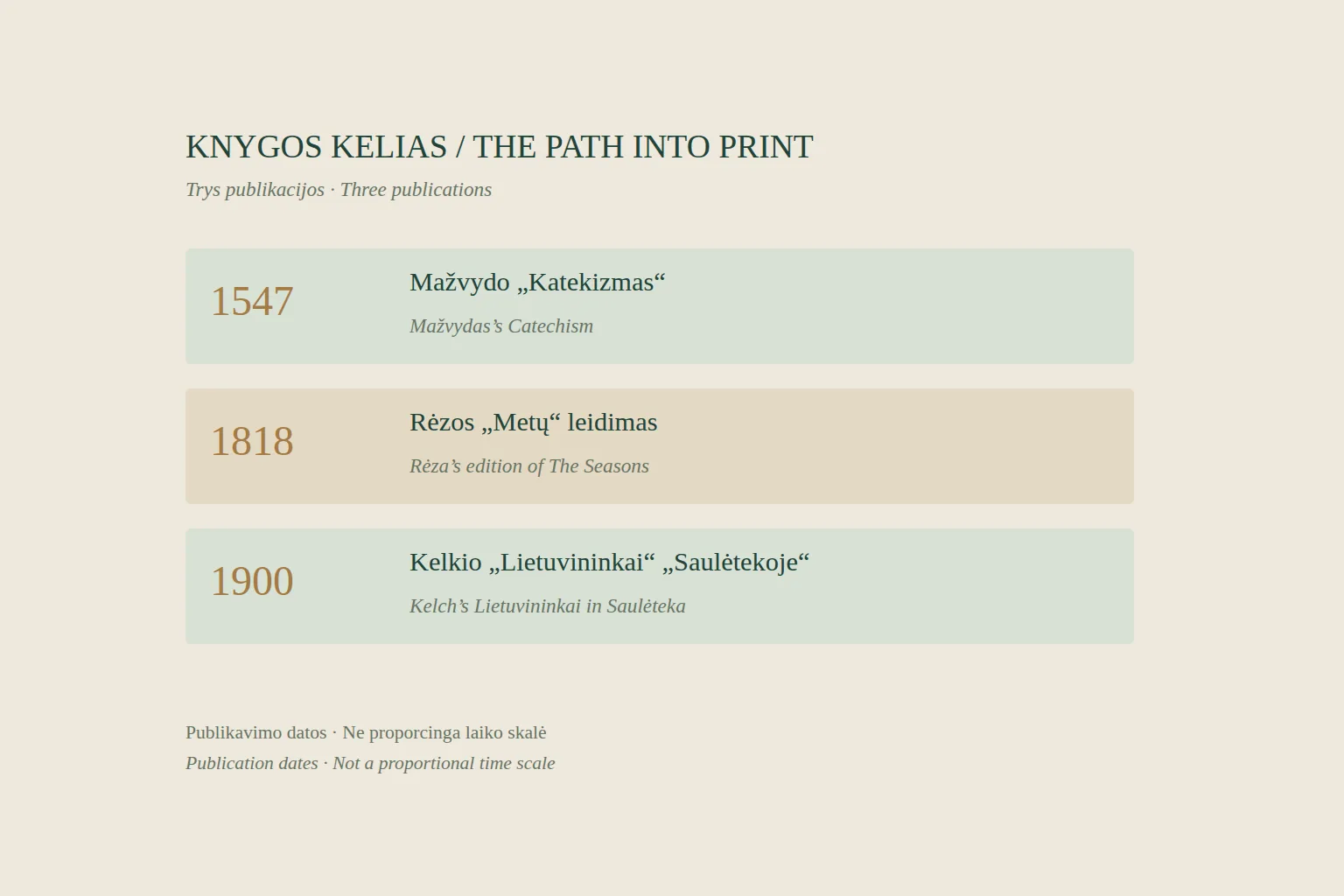
In 1818 Liudvikas Rėza published The Seasons with his German translation.
The CorDon overview distinguishes surviving manuscripts from later editions. Rėza added notes; nineteenth-century printings did not reproduce the manuscripts with complete fidelity. The poem reached readers through the work of an editor who selected and presented it. S200
Based on: S200
3.10
When innovation spoke German
Nineteenth-century modernisation also changed everyday life among the lietuvininkai.
Sidabraitė discusses economic and technical change and the association of urban innovation with German. Alongside official orders, people’s ideas of usefulness, modernity and ambition changed the linguistic environment. Defending Lithuanian could also mean resisting those changes. S203
Religious conservatism helped the community protect familiar bonds, making it more than an obstacle to nationalism. The researcher reads Kelch’s work in this setting and traces its relationship with Christian Gottlieb Mielcke’s earlier poem Pilkainis. S203
Based on: S203
3.11
An 1807 letter from Klaipėda
A royal letter of 22 March 1807 linked Lithuanian to future public service.
Liucija Citavičiūtė examines an instruction to support selected Lithuanian boys’ education. They were to prepare for public service while retaining their language and customs. Here, state needs and education for Lithuanian pupils were compatible. S204
Citavičiūtė reports in her study that the original letter had not been located. She uses a text published in 1894 and examines its circumstances. The document reaches us through that publication and modern research; the royal manuscript was not inspected for this article. S204
Based on: S204
3.12
The instruction and its implementation
A royal instruction and its implementation are separate historical questions.
Citavičiūtė discusses evidence from 1894 that scholarship support continued. The educational project continued beyond its beginnings. Yet assistance to selected pupils does not establish uniform practice in every school or universal language equality. S204
Later pressure in favour of German grew. It does not erase the earlier supportive initiative, nor does that initiative cancel out the later pressure. State decisions changed, and so did people’s opportunities. S204
Based on: S204
3.13
An origin story in verse
Kelch and Mielcke tell the community’s past in different ways.
Sidabraitė compares the poets’ images of ancestry, Christianity and historical change. Through them, the community spoke about itself. Ancestral journeys and ancient scenes have a literary voice here; they are not archaeological maps of settlement. S203
Kelch’s Lietuvininkai appeared in Jankus’s Saulėteka in 1900. A poem expressing religious and historical self-awareness entered the periodical press. Tradition and a newer publishing format met on the same page. S203
Based on: S203
3.14
People on a postcard
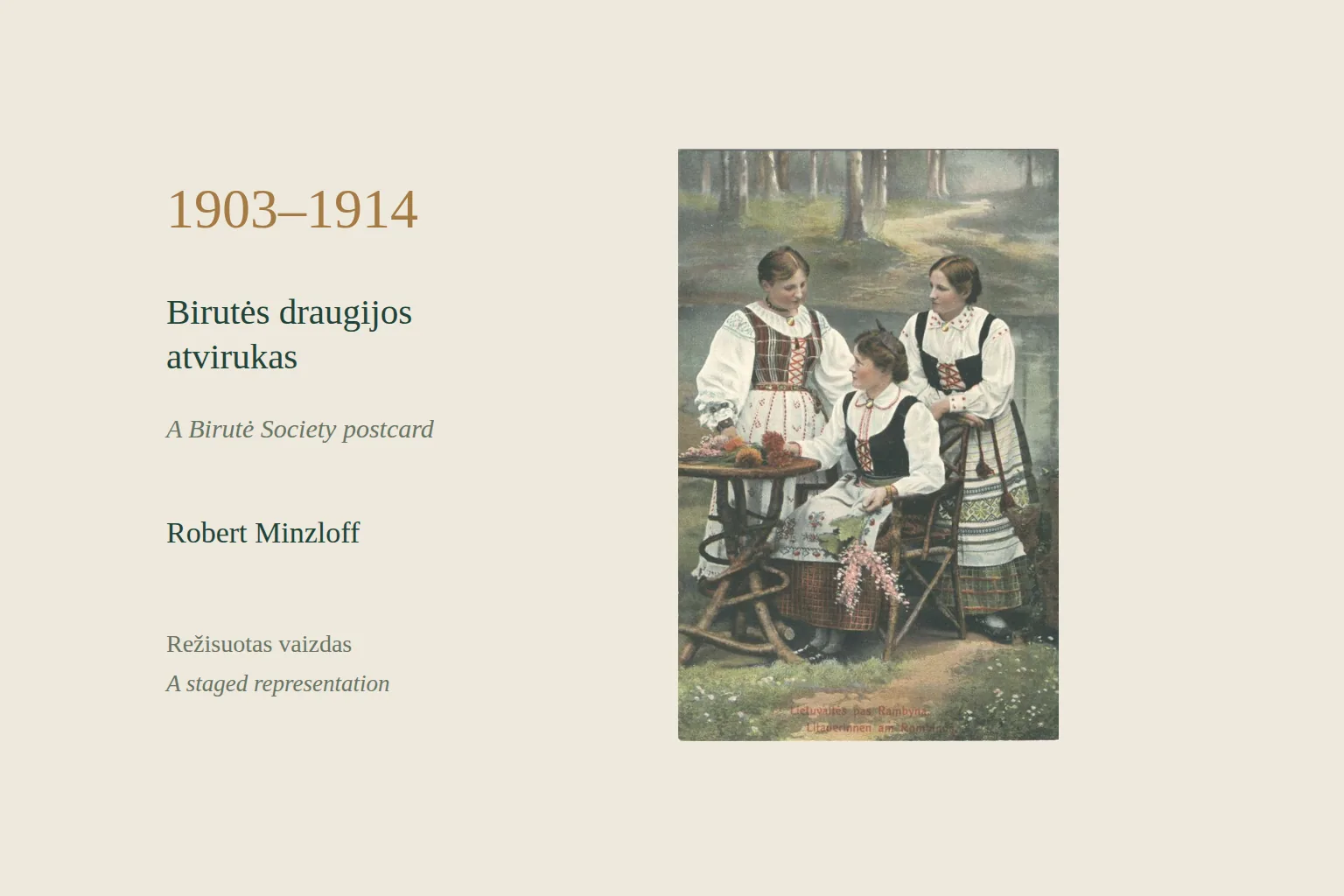
A postcard dated 1903–1914 presents a deliberately composed image of Lithuanian identity.
The postcard attributed to Robert Minzloff shows three Birutė Society members in national dress, flowers and a carefully arranged scene. This staged image records how Lithuanian identity was presented at the time. It does not represent all lietuvininkai’s daily lives or show medieval dress. S209
Based on: S209
3.15
A 1918 statement, a later symbol
A statement adopted in Tilžė on 30 November 1918 called for Lithuania Minor to join Lithuania.
The War Museum names 24 council members as signatories. Their document expressed a political aim; the signatures do not amount to a vote by all the region’s inhabitants. S212
The Šilutė Hugo Šojus Museum’s essay distinguishes the restrained 1918 statement from the ornate 1936 poster. The familiar later presentation does not reproduce the document’s appearance in 1918. S213
3.16
The Klaipėda Territory becomes a separate question
After the First World War, the Klaipėda Territory acquired a separate political history.
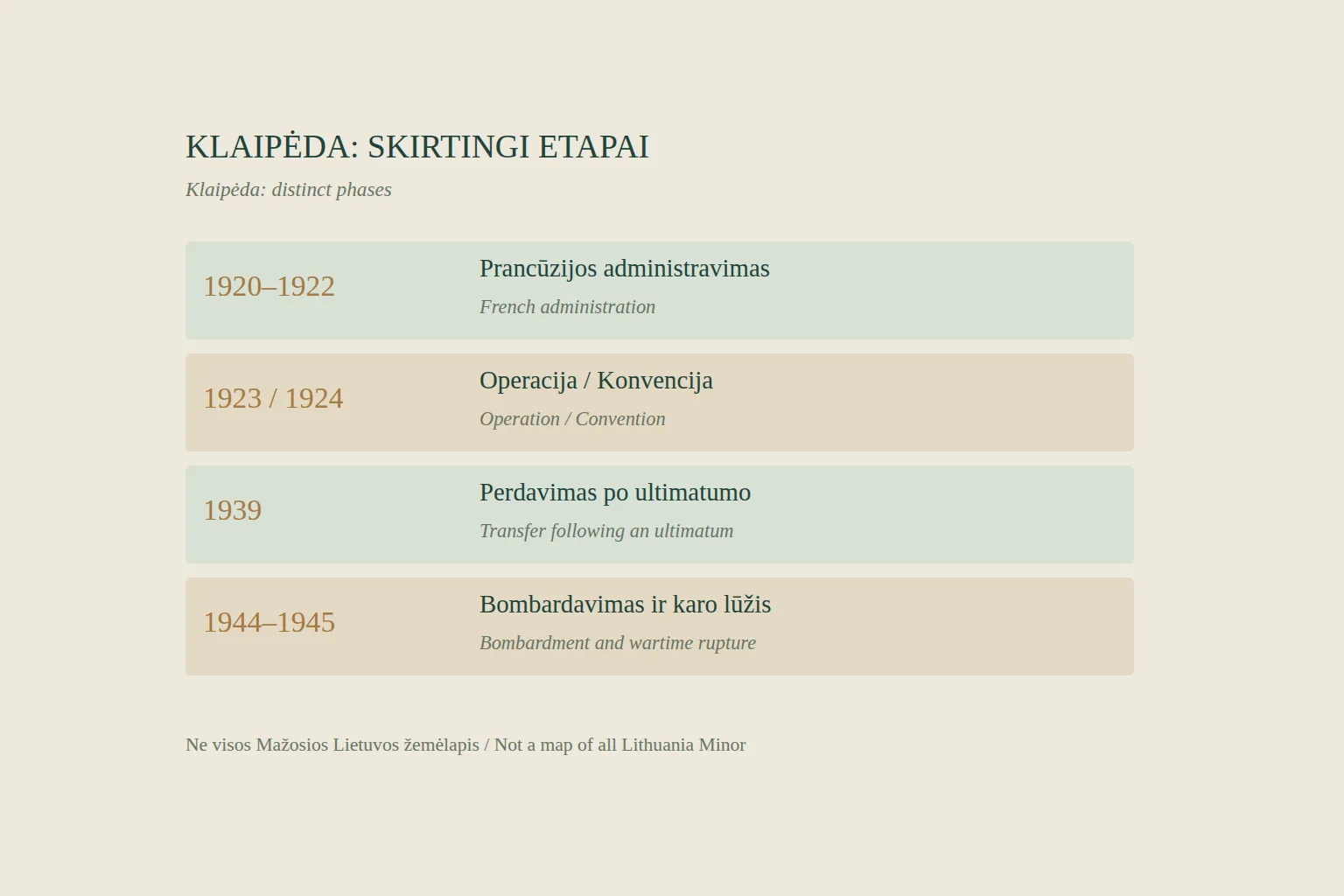
Šiaulytė discusses the territory separated after the Versailles settlement, its French administration and its later incorporation into Lithuania. These changes concerned part of Lithuania Minor. They did not bring the whole historical cultural region under one state at the same time. S206
The town already had its streets, familiar names, languages and human ties. A new government entered this living setting. The street names analysed in the study show how political changes reached the names used in everyday urban life. S206
Based on: S206
3.17
1923 and two accounts of it
Taking control of Klaipėda and securing its diplomatic settlement were separate events.
Vareikis describes the 1923 operation as organised by Lithuania’s government and armed forces, not solely a spontaneous local uprising. The name “uprising” leaves its planning unexplained. S210
The museum distinguishes two stages: military action in January 1923 and the international Klaipėda Convention of 8 May 1924. S207
3.18
Two languages on one street
Lithuanian and German met on interwar Klaipėda’s street signs.
Šiaulytė discusses the equality of both languages under the regional statute and bilingual street signs. Everyday habits did not always follow the rules. Even after a street name was translated, people might keep using its familiar older name. S206
A footnote describes Germans, Lithuanians and Jews who emphasised regional attachment as Memelländer. The category crosses national origins. In this context, “Memelländer” does not always stand in for another national label. S206
Based on: S206
3.19
An ultimatum and wartime rupture
A German ultimatum changed the Klaipėda Territory’s fate in 1939.
The museum marks the transfer to Germany with the treaty of 22 March 1939. Persecution, war and the 1944 bombardment of Klaipėda followed. The Red Army entered on 28 January 1945. S207
Based on: S207
3.20
The postwar region south of the Nemunas
The postwar history of the Königsberg region must be distinguished from Klaipėda’s.
Miłosz J. Zieliński examines the emerging Kaliningrad region. After destruction and mass flight, the remaining German residents faced restrictions and forced removal to the Soviet occupation zone in Germany. Incoming Soviet settlers formed a different society. S205
This study does not cover the fate of every resident of Lithuania Minor or separate lietuvininkai victims from losses among the German population. Kaliningrad and the Klaipėda Territory are also different territories. These distinctions matter when describing the loss of communities. S205
Based on: S205
3.21
Place names change too
New place names helped transform the inherited cultural landscape.
Zieliński discusses Soviet renaming and settlers’ relationship with the territory. An old name connected a place to an earlier story; a new one gave it a different public history. This belonged to a wider postwar transformation alongside population replacement. S205
Buildings could survive while their occupants, uses and names changed. A town’s present appearance cannot reveal all its earlier connections. Traces of former communities also remain in writing, memories and individual lives. S205
Based on: S205
3.22
Songs endure as the community changes
The lietuvininkai’s singing tradition later lived on in a changed setting.
Lina Petrošienė distinguishes wartime deaths, evacuation, emigration, deportation and the arrival of new residents. Later ensembles adopted regional songs and kept in touch with surviving local people. The songs were heard again, but that alone does not establish an unbroken continuity of the earlier community. S211
Based on: S211