1.1
Across today’s border.
Curonian history connects the coasts of present-day Lithuania and Latvia.
Curonian lands stretched along the coasts of present-day Lithuania and Latvia. The Lithuanian National Museum’s catalogue introduction places the tribe’s formation on the southeastern Baltic coast in the fifth and early sixth centuries, and its flourishing in the ninth to twelfth centuries. S45
Cemeteries, hillforts and finds help trace how Curonian lands changed. Gimbutienė describes a Baltic community with distinctive objects and customs, connected to neighbours across the sea. The distribution of those finds does not, however, map the whole tribe’s political borders at any one moment. S11
1.2
Small objects reveal a people.
A brooch, pin or sword hilt can tell us more than a later imagined warrior portrait.
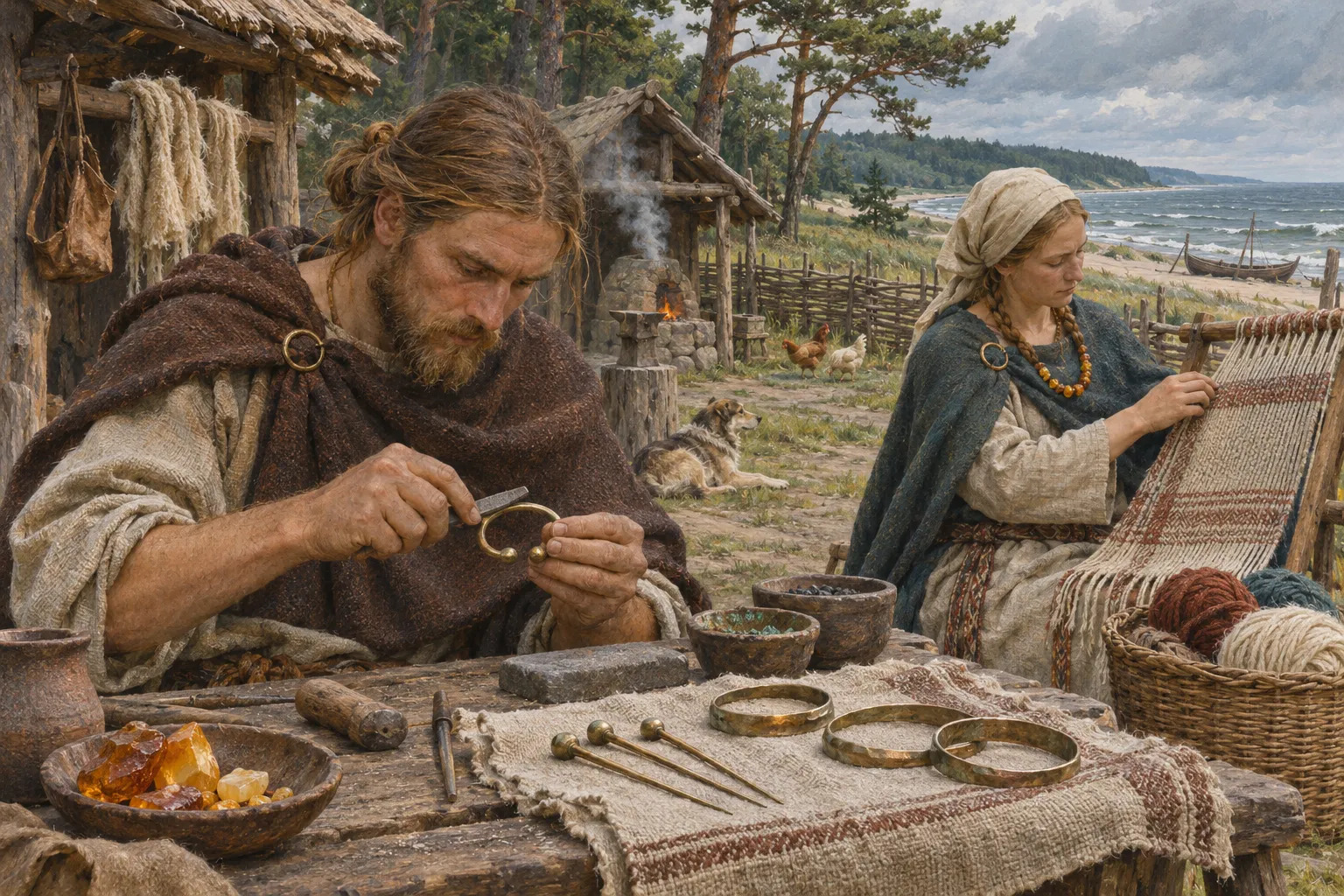
Curonian cemeteries at Laiviai, Kiauleikiai, Pryšmančiai and elsewhere in western Lithuania hold a wealth of finds. Gimbutienė uses them to trace ornament shapes, changing burial customs and local craftsmanship. Clothing, weapons and the objects chosen for burial visibly mattered to these communities. S11
Her survey identifies antenna-hilt swords, with inward-curving upper ends, as characteristic of tenth- and eleventh-century Curonian lands. Yet an object need not have been made entirely in one place: a blade could be imported and its hilt finished locally. She stresses that each object requires separate analysis. S11
Based on: S11
1.3
The Baltic was a route.
Trade, travel and military expeditions at sea were closely connected.
In a museum interview, archaeologist Rūta Kačkutė describes viking activity as encompassing travel, trade and raiding, and includes Curonians among its participants. This does not make the whole tribe Scandinavian in origin. S49
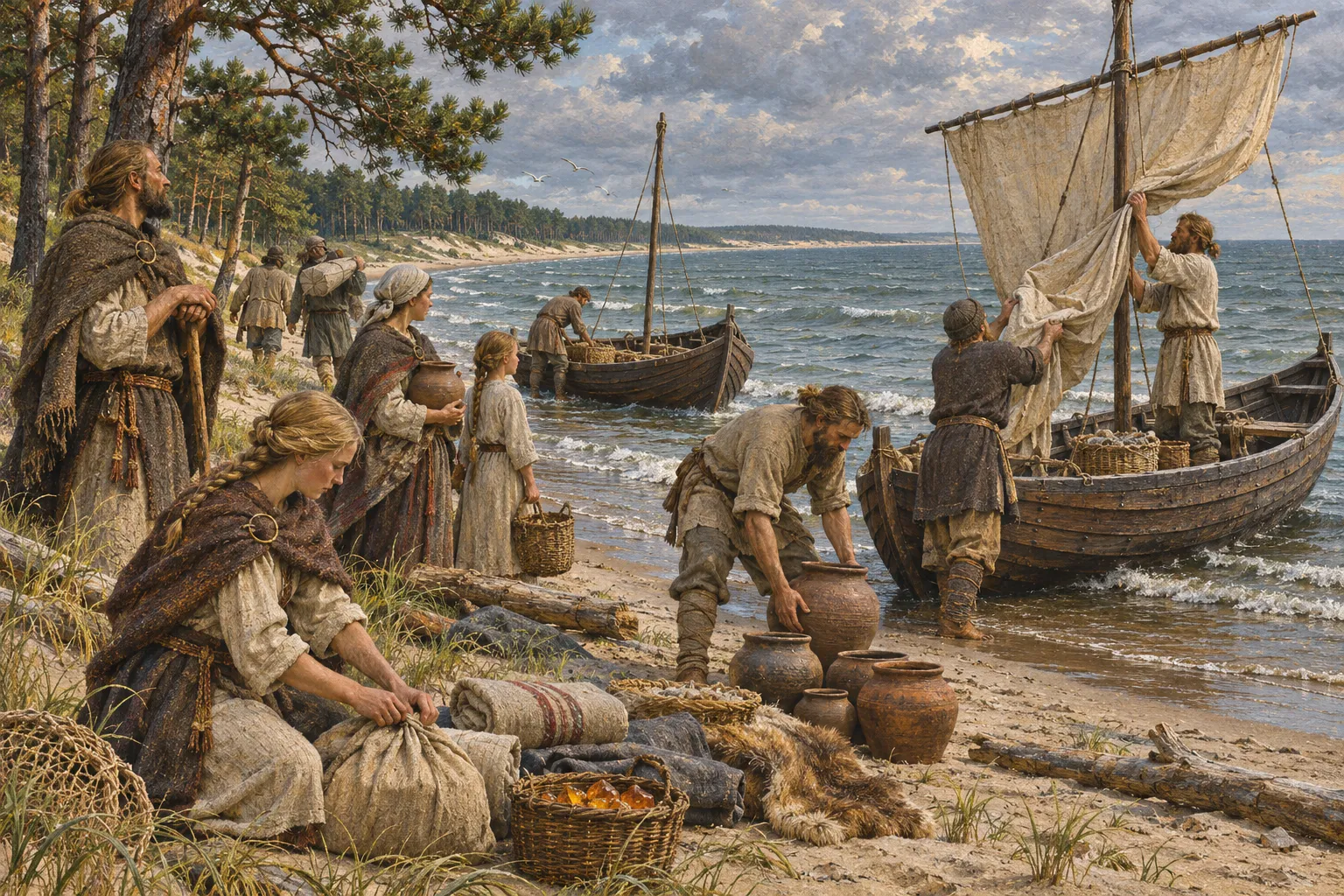
Kačkutė points to surviving ship rivets and written accounts, but no complete excavated Curonian vessel. The illustrated boats draw on that evidence, with their construction left to the imagination. They are not exact copies of unearthed ships. S49
At Grobiņa near Liepāja, burials and objects have been associated with people from Gotland and central Sweden. Gimbutienė discusses them as evidence of Curonian–Scandinavian connections. Those connections could mean migration, trade, neighbours, dependence or conflict. An imported object alone cannot show that the entire region continuously belonged to outsiders. S11
1.4
A stronghold in an overseas account.
Rimbert’s account of Apuolė opens a window onto mid-ninth-century Curonian–Scandinavian conflict.
In Rimbert’s narrative as conveyed by Gimbutienė, Curonians first repel the Danes. The Swedish ruler Olaf then comes to their land: after attacking Seeburg, his force advances to Apulia, identified with Apuolė. Several days of resistance end in an agreement involving silver and hostages. S11
Rimbert’s thousands of warriors raise doubts for Gimbutienė herself: they cannot serve as a verified count of the stronghold’s inhabitants. Yet his account shows a community resisting, negotiating and paying a ransom. Apuolė’s story records those choices as well as the victor. S11
The Skuodas Museum booklet dates the attacks to 853–854. It describes several phases of the hillfort and assigns the well/reservoir to the thirteenth-century phase. That structure cannot therefore establish how people survived the ninth-century siege. The connection suggested in Gimbutienė’s narrative remains a separate interpretation. S46 S11
1.5
Beyond the rampart lay fields.
Curonian society cannot be reduced to a ship or a war band.
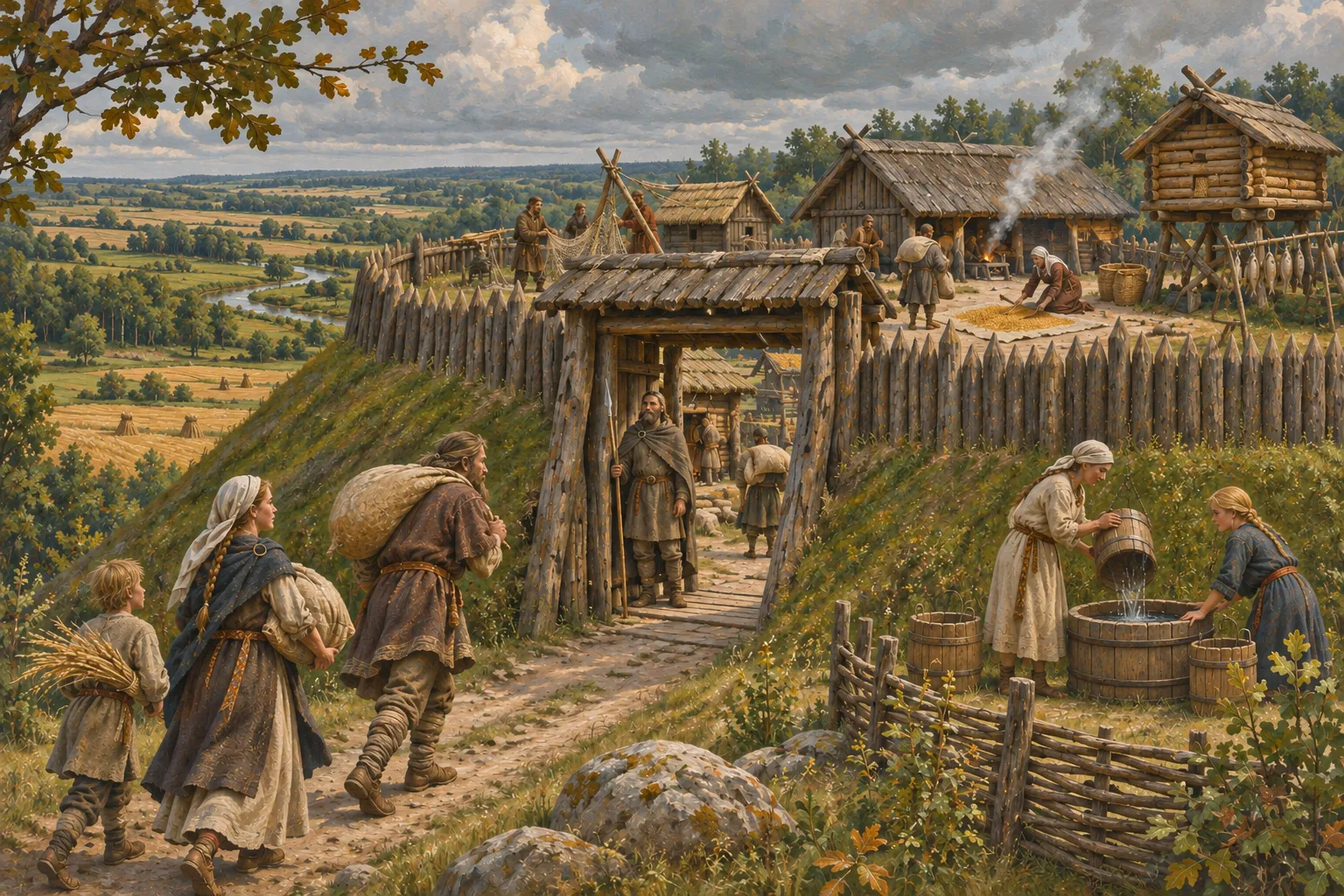
Rimbert names five units in Curonian lands, using the Latin word civitates. Gimbutienė reads them as regional centres and considers how they might have been associated. That does not establish a single capital in the modern sense or an unchanging structure of authority. S11
Alongside Apuolė’s defences, Gimbutienė describes stores of grain and peas. The stronghold needed farmers, craftspeople and people to prepare supplies. A rampart alone could not protect the community without food, water and regular maintenance of its defences. S11
Based on: S11
1.6
A land reputed for divination.
Adam of Bremen’s eleventh-century account concerns both Curonian belief and an outsider’s perspective.
Around 1075 Adam of Bremen wrote of Curonian homes full of diviners and callers of the dead. He claimed that people from very distant lands sought answers there. Beresnevičius examines this outside chronicler’s portrayal, rather than a Curonian account of their own beliefs. S12
Who were Adam’s Spaniards and Greeks? Beresnevičius considers different readings of the text, the author’s religious language and possible exaggeration. The brief notice does not establish an international network of Curonian oracles, but it shows how strongly an eleventh-century writer associated Curonians with divination. S12
What customs might Adam have encountered, and what did his own religion add to the description? Beresnevičius’s analysis raises both questions. Adam’s account remains valuable even when we do not take his words as a literal description of every Curonian home. S12
Based on: S12
1.7
When should an expedition begin?
Historical accounts describe seeking divine favour through signs and lots.
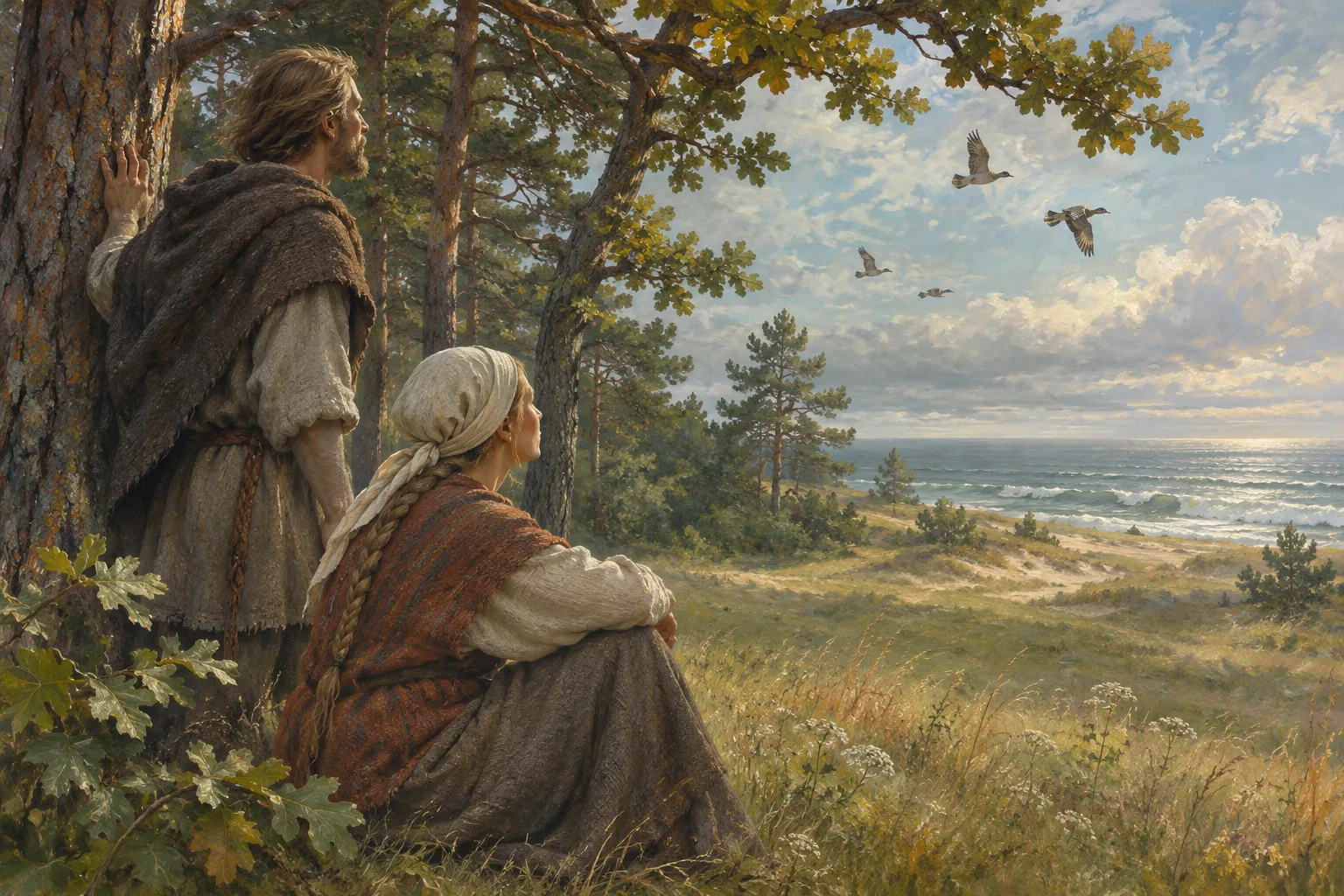
In his account of the 1210 attack on Riga, Henry of Livonia portrays Curonians waiting for a favourable moment and seeking the gods’ help. Beresnevičius discusses the episode when examining bird calls and favourable lots in the Livonian chronicles. Here the decision to attack is also told as a religious act. S12
Beresnevičius cautions that the sources do not always clearly distinguish bird signs from the casting of lots. Detailed later descriptions of divination cannot tell us exactly how earlier Curonian rituals were performed either. The surviving fragments cannot establish priestly dress, a ceremony’s sequence or a pantheon shared by the whole tribe. S12
Based on: S12
1.8
Burial practices changed.
Cemeteries reveal wealth and changing ways of treating the dead.
Cremation spread gradually through Curonian cemeteries. In Gimbutienė’s survey it begins to replace inhumation around the tenth century. At first, burnt grave goods and bones are laid out much as before; later, their arrangement changes. She is interpreting regional finds, without assigning a single date to a change of custom among all Balts. S11
Grave goods show what a community chose to deposit, without explaining its entire belief system. Beresnevičius also discusses later travellers’ notices of cremation among some Curonians. Evidence from different centuries allows questions about change and continuity, but should not be merged into one timeless ceremony. S11 S12
1.9
The coast between castles and agreements.
The conquest of Livonia changed Curonian life in the thirteenth century.
Šapoka’s volume describes the building of Klaipėda castle in 1252 as a strategic move by the Order. It sought to control communication and trade and bring its Livonian and Prussian territories closer together. Routes, access to the sea and the ability to maintain strongholds also shaped relations between Curonians, Samogitians and the Order. S6
In the 1253 partition described by the Universal Lithuanian Encyclopedia (VLE), two thirds of Curonian lands were assigned to the Livonian Order and one third to the Bishop of Courland. A document expresses conquerors’ claims and plans; actual obedience could still be contested locally. S50
1.10
A compelled ally can withdraw.
The Curonian role at Durbe in 1260 reveals complicated local relations with the order.
In VLE’s account of Durbe, Curonians leave the Order’s army and some attack the Germans from behind. They had aims and obligations of their own. The episode shows people able to choose how to act, rather than simply follow the will of a uniform army. S35
Šapoka’s volume connects the Samogitian victory with wider uprisings and difficulties for the order. One battle did not end Curonian resistance. Further fighting, attacks on strongholds and shifting alignments followed, while local circumstances depended on who could sustain power in the region. S6
1.11
Curonians did not disappear in a day.
The fall of a political order is different from the end of a population’s history.
Gimbutienė’s survey marks Curonian defeat in 1267. This identifies a turning point in conquest, rather than a day on which inhabitants, speech and customs vanished together. Migration, new jurisdictions and life under altered conditions continued. S11
The museum catalogue introduction emphasises their eventual incorporation into Lithuanian and Latvian peoples. Their legacy therefore belongs on both sides of today’s border. S45
1.12
A similar name, a different language history.
The ancient Curonian tribe and the later Kursenieki of the spit have different histories.
In his 2023 review of Dalia Kiseliūnaitė’s monograph, Pēteris Vanags connects Kursenieki speech with migrants from Latvian Courland and their descendants. It developed under Lithuanian and German influence on the spit. S48
Vanags discusses the possible use of Kursenieki from the fifteenth or sixteenth century and its later documentation. Recordings of modern fishermen therefore do not directly preserve ninth-century Curonian speech. Tracing the connections between these communities requires attention to time and migration. S48
Based on: S48
1.13
An axe travelling across the lagoon.
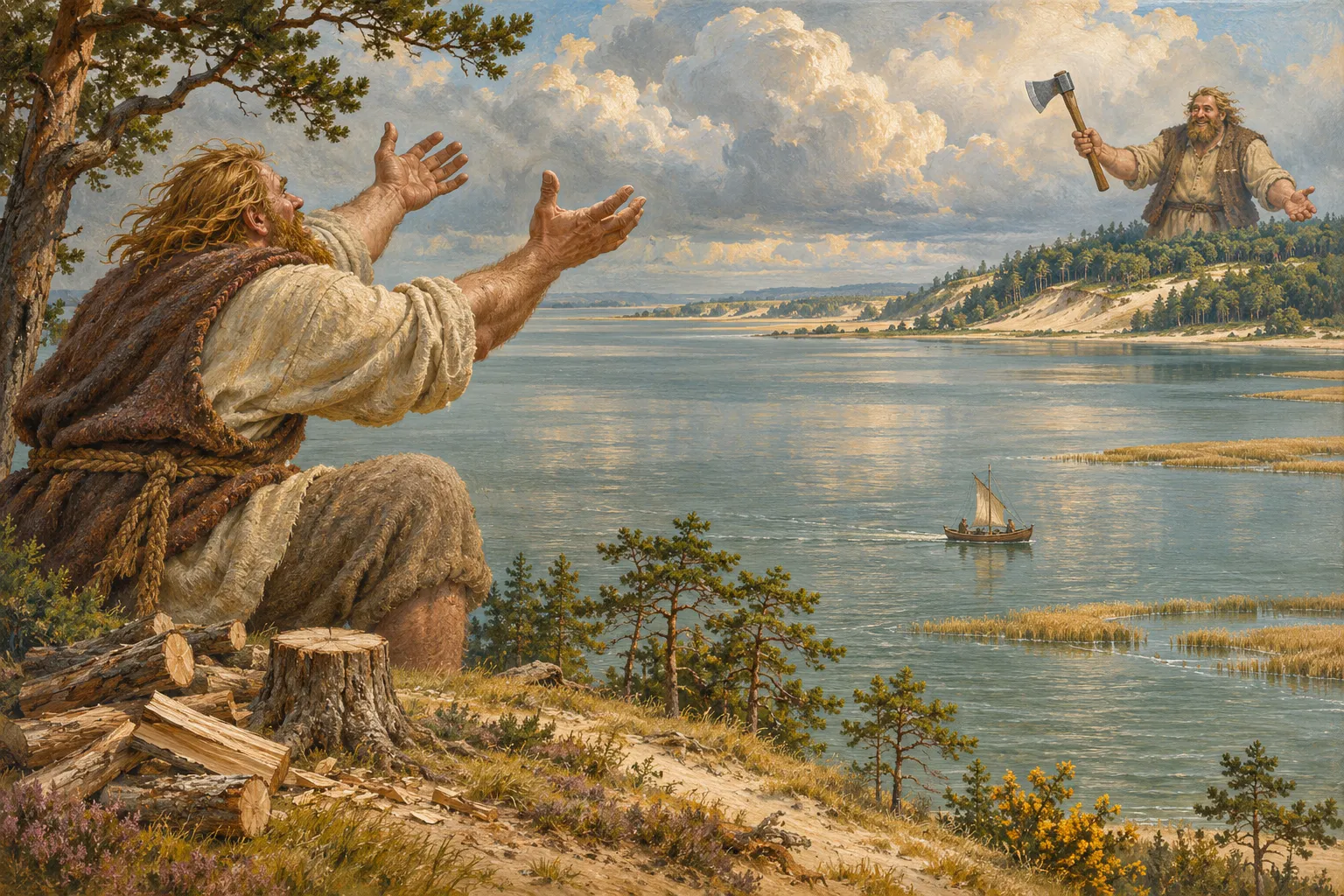
“Kuršių milžinai” in Vėlius’s collection is a later-recorded lagoon legend.
In the tale two giants cut wood, one on Ventė Cape and the other on Liekai Cape. The Ventė giant loses his axe in the water. He calls to his distant neighbour, who throws his own tool across the lagoon. Once the work is finished, the first giant sends it back the same way. S13
The wonder grows from a simple neighbourly act: lending a tool. In the giants’ world a vast human distance becomes a neighbourhood within calling range. Work gives the lagoon its scale, without rulers or battles providing the story’s framework. S13
O. Vilmantienė recorded this version in the Curonian Lagoon area around 1936, according to the collection’s notes. We know when the tale was recorded; that does not date the giants’ lives. Nor does the lagoon’s name establish that the story came from the ancient Curonian tribe’s myths. S13
Based on: S13
1.14
Amber palaces and a later coastal imagination.
Jucevičius’s literary tradition tells the story of Jūratė and Kastytis.
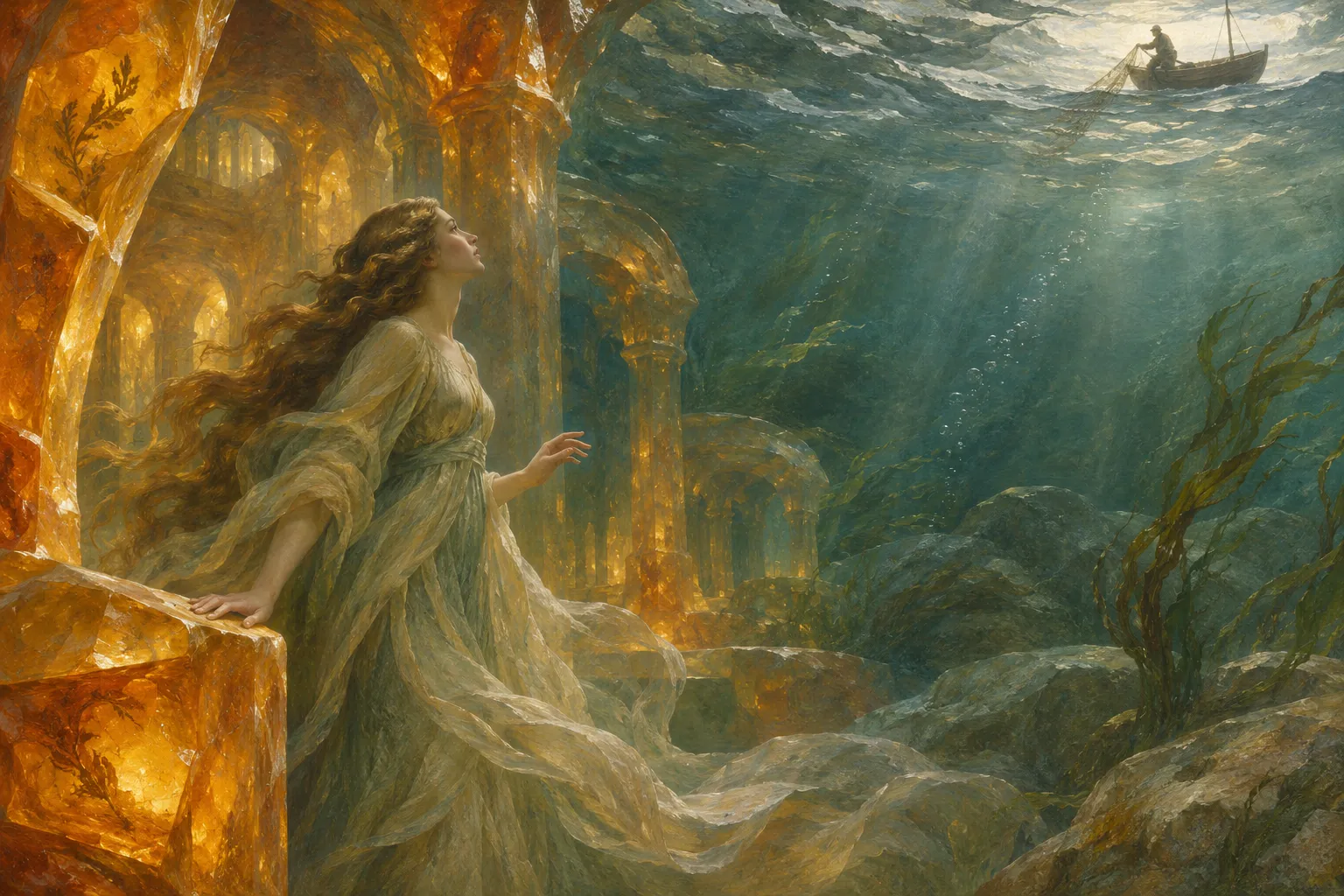
In Jucevičius’s text reprinted in the Lithuanian Mythology anthology, Kastytis lives near the mouth of the Šventoji. The sea queen Jūratė falls in love with him and comes to meet him. The sea has its own beings, love crosses a human–divine boundary, and amber receives a dramatic explanation. S17
In this anthology version, Perkūnas’s strike kills Jūratė and shatters her amber palace. Praamžimas chains Kastytis to a rock on the seabed, with his beloved’s body before him. The amber washed ashore is the palace’s fragments. This is the ending of this telling; other, perhaps more familiar versions differ. S17
Domininkas Burba’s 2022 study examines the plot’s literary origins and dates its first publication to 1839. The anthology introduction gives 1836, but Burba explicitly challenges that earlier dating. The sources disagree about the date. Neither establishes Jūratė as a ninth-century Curonian goddess. S47 S17
1.15
More than the name of a vanished tribe.
The Curonian past survives through objects, places and accounts from different periods.
Cemeteries, weapons and hillforts tell of Curonian life in Gimbutienė’s survey. Beresnevičius asks who described their beliefs and how that writer’s language shaped the account. These studies complement one another: an object and a chronicler’s sentence illuminate different parts of the past. S11 S12
The lagoon giants and Jucevičius’s sea queen tell us about the imagination of later people. Their stories have value and origins of their own. Alongside surviving objects, the Curonian and coastal past leaves room for unanswered questions and for legends whose provenance distinguishes them from accounts of events. S13 S17