2.1
An uncertain beginning.
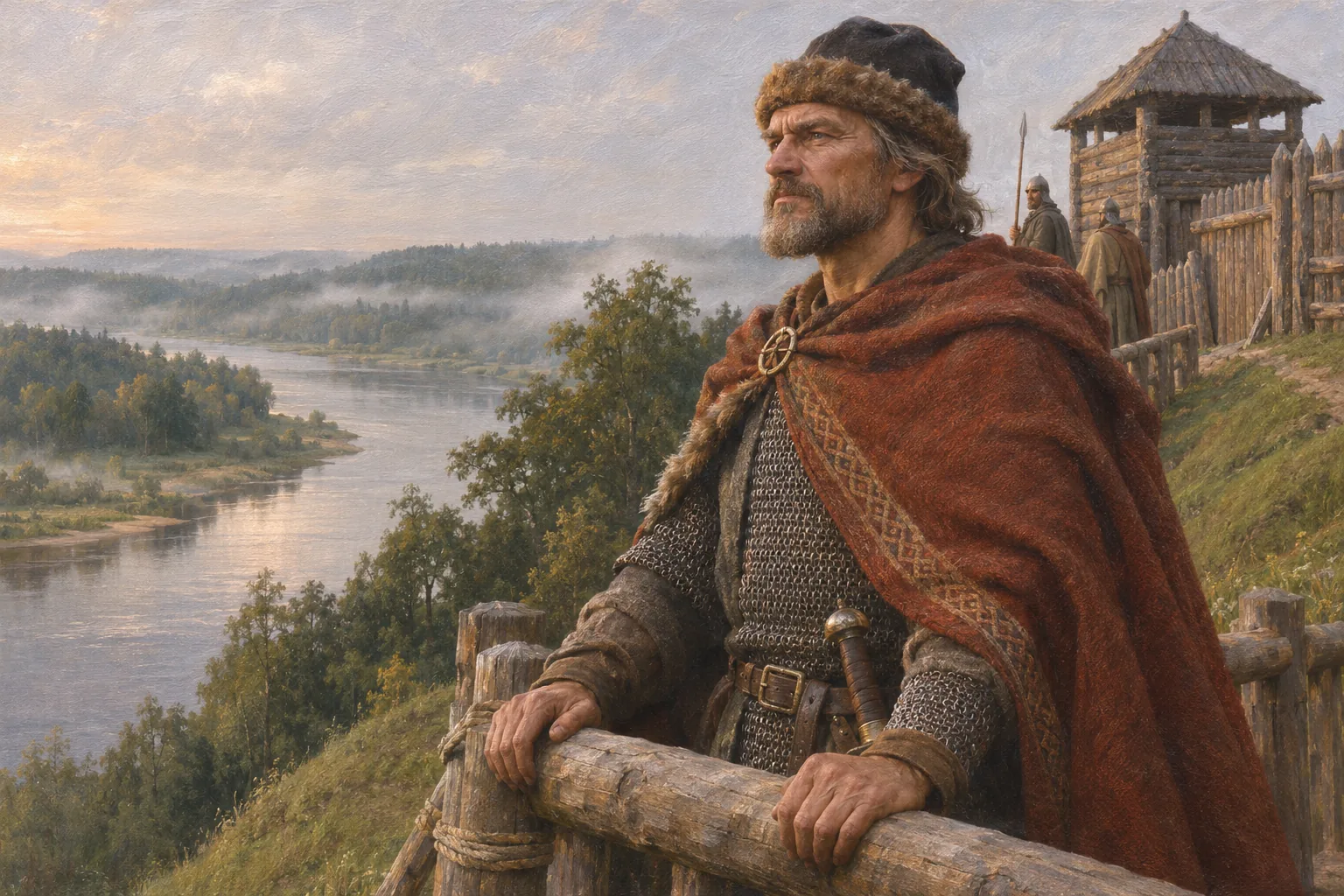
Kęstutis was born around 1300 into a dynasty whose lands extended far beyond the Lithuanian-speaking country.
Kęstutis was a son of Gediminas. His approximate birth date identifies his generation without revealing his childhood. We do not know who taught him, which languages he learned when young or when he first joined a campaign. His biography becomes clearer when sources begin describing the government of Gediminid territories. S19 S76
After Gediminas died around 1341, power remained with his sons. Zenonas Ivinskis, author of the Gediminid chapters in Adolfas Šapoka’s edited history, assigns Kęstutis Trakai, Podlasie, Hrodna and Brest. These possessions linked the Lithuanian heartland with territories of Rus’ and neighbours to the southwest. S6
The Bychowiec Chronicle places the territorial division within Gediminas’s lifetime. It calls both Jaunutis in Vilnius and Kęstutis in Trakai and Samogitia grand dukes. This differs from Ivinskis’s account, in which Vilnius belongs to the senior ruler. The later chronicle’s titles do not themselves establish equal power. S19 S6
Trakai became the seat most closely associated with Kęstutis, but the beginning of his rule there cannot be firmly dated. Rimantas Jasas, editor of the 1971 chronicle edition, warns that Kęstutis’s earliest possessions and accession remain uncertain. S19
2.2
The brother who took Vilnius gave precedence to another.
In 1345 Kęstutis seized Vilnius but yielded the grand-ducal position to Algirdas.
Jaunutis’s rule in Vilnius dissatisfied two of his brothers. Ivinskis explains the coup through the needs of the state: attacks by the Order and the dispute over Volhynia required stronger leadership. In his account, Algirdas and Kęstutis acted because a weak centre could no longer manage threats to their different territories. S6
Kęstutis was nearer Vilnius and acted first. He took the city by surprise and removed Jaunutis. The chronicle tells of Jaunutis fleeing to Taurakalnis, suffering from the cold and being captured. Algirdas arrived late — his brother had already seized Vilnius. S6 S19
The chronicler connects the brothers’ discontent with Duchess Jaunė’s death and Jaunutis’s precedence. Jasas notes that Jaunė is unknown from other historical sources and that the clause does not appear in every copy. The chronicle emphasises family hierarchy; Ivinskis stresses the need to face enemies together. S19 S6
Kęstutis offered Vilnius to Algirdas despite having captured it himself. The displaced Jaunutis eventually received Zaslavl. The coup therefore changed the brothers’ hierarchy without eliminating Jaunutis’s place in the dynasty. Kęstutis’s choice established a partnership that lasted until Algirdas’s death, far longer than Kęstutis’s own later rule in Vilnius. S6 S19
2.3
A partnership with a senior ruler.
Between 1345 and 1377 Algirdas and Kęstutis cooperated without occupying identical positions.
Algirdas became grand duke. Kęstutis retained his territories and a crucial military role. Ivinskis observes that foreigners sometimes treated both men as rulers of Lithuania, while clearly distinguishing their rank. Kęstutis’s support strengthened Algirdas’s authority in Vilnius, which in turn supported Kęstutis. S6
In the Bychowiec Chronicle, the brothers seal their partnership with a promise. Algirdas will rule Vilnius, while the two will share newly acquired towns and lands. They pledge to avoid harming each other and preserve brotherly affection. The chronicler grounds stable rule in a personal family agreement, without formally defining their offices. S19
Writing in the seventeenth century, Albertas Vijūkas-Kojelavičius likewise stresses common enemies and shared gains. In his account Algirdas receives the title and everything else is divided equally. This language of brotherhood explains the two princes’ long cooperation. S7
Kęstutis appears most often in warfare against the Order, Algirdas in campaigns into Rus’. Their activities nevertheless overlapped: both fought in the west, while Kęstutis also defended southern possessions. They had different territorial bases, but war on one frontier could require joint forces and alter the other brother’s plans. S6

2.4
Possessions linked by lakes, rivers and roads.
Kęstutis’s power rested on the Trakai principality and connected territories to the west and southwest.
Kęstutis’s possessions included Trakai, Hrodna, Brest and Podlasie. Each territory had its own local conditions and neighbours to consider. He needed to keep the strongholds connected and be able to assemble forces wherever an attack threatened. S6
Ivinskis also associates Kęstutis with oversight of Samogitia while stressing its continuing autonomy. His relationship with the Samogitians therefore involved more than issuing commands to a uniformly governed province. A shared enemy linked their interests, but support also depended on local decisions, especially apparent in the later struggle for Vilnius. S6
The Bychowiec Chronicle says that Kęstutis moved his capital from Old to New Trakai after admiring the lakeside setting. It places Vytautas’s birth at Old Trakai. The chronicler thus explains two places important to the dynasty: the ruler chose one for its landscape, while the other remained his son’s birthplace. S19
The chronicle’s Trakai foundation story supplies no exact castle plan. Routes and messages between strongholds connected Kęstutis’s territories and helped summon aid. Trakai’s proximity to Vilnius also enabled rapid intervention in the dynasty’s struggles, an advantage he used in both 1345 and 1381. S6 S19
2.5
The river was both obstacle and route.
Warfare along the Nemunas concerned castles, communications and people rather than a fixed straight border.
The Teutonic Order launched campaigns from Prussia into Lithuania, while Lithuanian forces attacked its territories. In Ivinskis’s account, raids often sought livestock, goods and captives. A rapid incursion could end in withdrawal, so a devastated district did not necessarily become a new possession or receive a permanent garrison from the attacker. S6
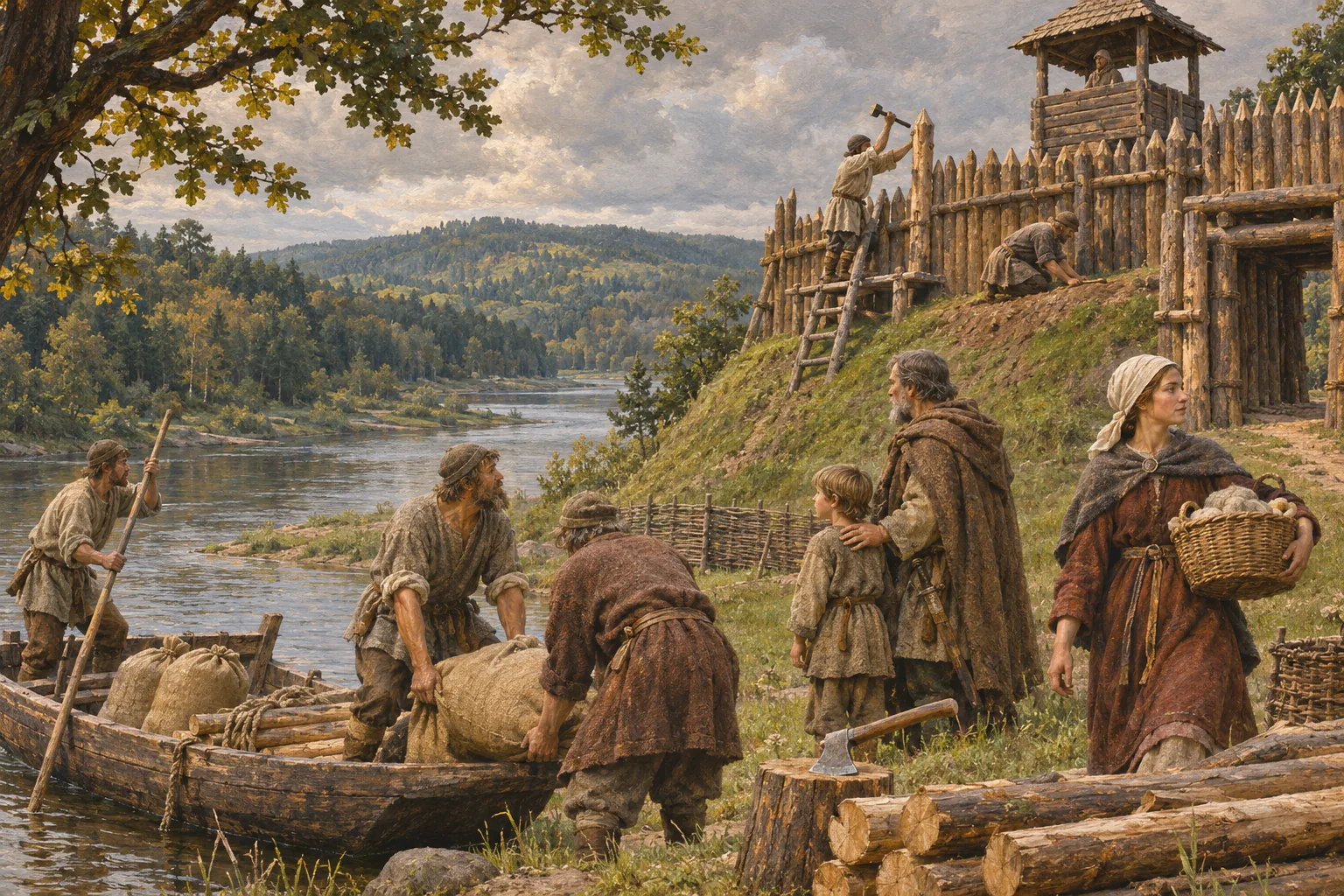
The Nemunas carried people and supplies, while its riverside castles guarded important approaches. Kaunas covered access to Aukštaitija. Forests sheltered ambushes, but river routes could also carry an enemy farther inland. A castle’s position therefore mattered to communications and the defence of its surroundings, as well as to the strength of its walls. S6
Both sides built, destroyed and rebuilt fortifications. A captured castle could briefly carry warfare farther afield, but maintaining it in hostile country was harder than burning a village. Ivinskis notes that even when the Order established positions near the Neris, it did not achieve lasting subjugation of the western lands. S6
Kojelavičius also describes villagers displaced by the loss of castles. Settlements emptied, leaving both the remaining inhabitants and castle walls in need of protection. A restored stronghold could serve the defence of the country only if people could live and work around it again. S7
2.6
The returning enemy could not be stopped.
In 1348 the forces of Algirdas and Kęstutis met an Order force returning from Lithuania near the Strėva.
At the Strėva the brothers tried to intercept the retreating enemy. They challenged the invading force on its return route rather than waiting behind castle walls. The encounter ended in a Lithuanian setback, and the Order’s writers proclaimed a great victory. S6
Ivinskis disputes the army sizes and losses reported in the chronicles, considering them inflated. He acknowledges the Lithuanian defeat but rejects the enemy’s claim to have destroyed almost all of Lithuania’s military strength. S6
Strėva ended neither the brothers’ rule nor the defence of the Nemunas. Warfare continued, castles remained essential and Kęstutis soon had to attend to affairs in the southwest. The state retained its ability to resist and make independent political choices. S6
Based on: S6
2.7
Kęstutis also had to look south.
The dispute over Liubartas’s Volhynian possessions drew Kęstutis into conflict with the rulers of Poland and Hungary.
The Gediminid Liubartas sought to retain Volhynia against the claims of King Casimir of Poland. Kęstutis’s assistance defended both a relative and his own possessions. Podlasie lay beside the disputed region, so the outcome could directly affect the prince of Trakai. Algirdas also participated in these affairs. S6
Kojelavičius presents these wars as a succession of reciprocal invasions. Places are taken and recovered, rulers return with fresh forces and a temporary advantage fails to produce a final settlement. His Kęstutis operates far from the familiar Nemunas castles while remaining an active participant in campaigns and negotiations. S7
King Louis of Hungary’s involvement broadened the opposing coalition. Kęstutis dealt with rulers whose military support and papal connections could help or harm him. A promise of baptism consequently entered the Volhynian conflict: religion was negotiated alongside security, princely standing and the future of his territories. S7 S6
Kęstutis fought beyond the western frontier. His possessions reached the Polish and Rus’ borderlands, so events there also affected his war in Prussia. While he helped Liubartas on one side, the Order remained a threat on the other. Even a short agreement could be valuable under these conditions, without bringing lasting peace. S6 S7
2.8
A blood oath and an unfulfilled baptism.
The agreement with Louis in 1351 linked Kęstutis’s possible baptism with princely standing and military assistance.
In the book coauthored with Stephen C. Rowell, Darius Baronas discusses baptism in return for a papal crown, a separate ecclesiastical province, peace and mutual assistance. These were negotiations over how conversion would change Kęstutis’s relations with his neighbours. He left while travelling towards Buda. S80
Comparing two chronicle accounts, Gintaras Beresnevičius describes the ritual confirming the agreement. Kęstutis sacrificed a bull; he and his warriors sprinkled their faces with its blood and passed between the animal’s parts. Blood and passage gave the pledge religious force. As Beresnevičius stresses, however, the oath was soon broken. S12
Kojelavičius tells a different story of 1351. Captured alive while attacking King Casimir’s camp, Kęstutis receives royal respect and promises possible conversion. After lowering his guards’ vigilance, he escapes at night and resumes warfare with Liubartas. The bull oath does not appear in this episode. S7
Neither account ends in Kęstutis’s conversion. Yet a Christian king negotiates with a pagan prince and recognises his rank. Religion divides them, but shared military and political concerns allow them to seek an agreement on stated terms even while warfare continues. S7 S12
2.9
Religion at the negotiating table.
Conversion was negotiated more than once: the proposals of 1349 and 1358 belonged to different political circumstances.
Ivinskis relates that a promise of baptism passed through Casimir in 1349 and that the pope offered a royal crown. He connects the promise with wartime circumstances. A crown could raise a ruler’s standing, but a promise was not a baptism, and an intermediary’s offer did not end the fighting that prompted negotiations. S6
In 1358 Emperor Charles IV approached both brothers. The Lithuanian conditions directly affected the Order’s future. The negotiations also raised the question of what would happen to a military organisation whose campaigns were justified by war against pagans if Lithuania’s rulers accepted baptism. S6
Ivinskis records demands for extensive Prussian and Livonian territories and the relocation of the Order to fight the Tatars. The conditions mention lands beyond the Nemunas, Courland and districts along the Daugava. The brothers linked conversion to a transformation of the region, including the Order’s removal. S6
The negotiations produced no such settlement. Ivinskis believed that the emperor lacked either the will or the power to enforce the Lithuanian demands. Kęstutis remained pagan and continued fighting, but these contacts show that religious difference did not end discussion. Diplomatic promises do not disclose his personal beliefs or private intentions. S6
2.10
A prince departed in a knight’s clothes.
Captured by the Order in 1361, Kęstutis escaped Marienburg; different authors tell his route differently.
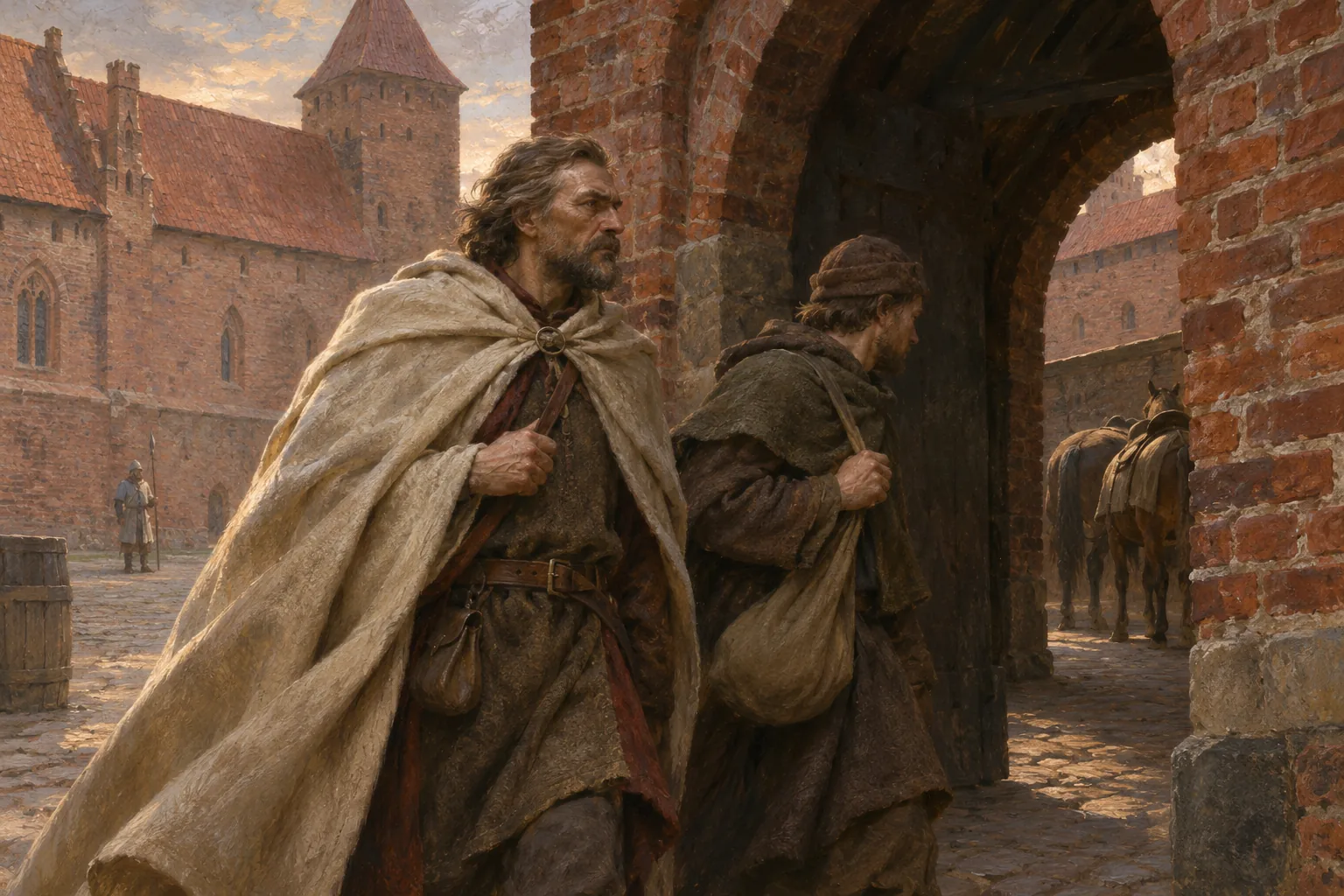
In Ivinskis’s account Kęstutis was captured after being pulled from his horse. At Marienburg he received help from Alpis, a Lithuanian taken in childhood and raised in the Order’s household. A knight’s clothes allowed him to change his appearance and escape. He reached his son-in-law in Mazovia before returning to Lithuania: help came from inside the enemy’s establishment. S6
Kojelavičius develops an adventure story. His Kęstutis receives tools to break through a wall, clothing and a horse, then rides out at noon as though he belongs. He later releases the horse, hides in a marsh and navigates by stars. His daughter’s Mazovian household provides a bath, herbs and an escort. This author’s two-day imprisonment is not a shared chronology. S7
Historian Darius Baronas treats the 1361 escape cautiously. Weak guarding and assistance raise the possibility that escape was facilitated. This remains a preliminary hypothesis — no order from the Order’s leadership to release the captive has been proved. S77
Ivinskis adds a pointed ending: on returning, Kęstutis thanks the grand master for his hospitality and promises a better reception should he capture him. The episode suits the author’s portrait of a fearless prince retaining his dignity. Captivity interrupted Kęstutis without changing his alternating warfare and negotiation with the Order. S6
2.11
Vaidotas’s castle and relief that never arrived.
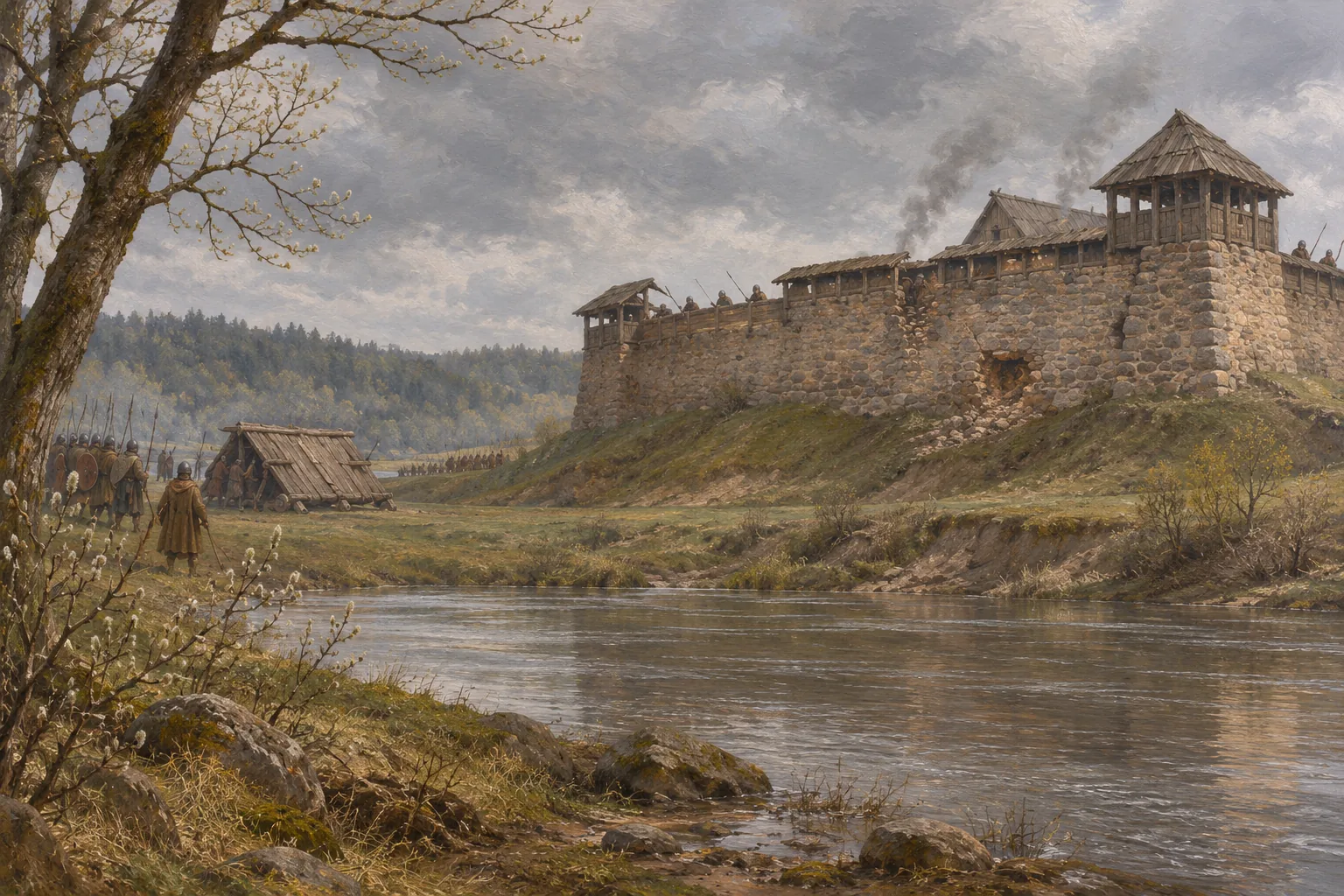
In 1362 the Order besieged Kaunas, defended under Kęstutis’s son Vaidotas.
Kaunas guarded an important route from the Nemunas into Lithuania’s interior, so its loss threatened more than the garrison. Ivinskis also explains the siege as the Order’s revenge for Kęstutis’s escape. His account combines the castle’s military importance with a personal conflict between adversaries. S6
Vaidotas and the garrison resisted for weeks. In Ivinskis’s account, Algirdas and Kęstutis arrived but lacked the strength to break the siege. The defenders eventually attempted a breakout, and Vaidotas was captured. His father was nearby but could not save him — the forces at the castle were insufficient. S6
Kojelavičius offers another version: Algirdas attempted relief but was repulsed. Beresnevičius suggests that caution may reflect weak forces and an Order ditch between the Nemunas and Neris. His explanation reconstructs possible tactical circumstances. None of these accounts supports a simple statement that both brothers were merely absent. S7 S12 S6
The fall of Kaunas did not end the struggle for this river junction. Ivinskis describes efforts to establish another position and the Order’s later Goteswerder, destroyed by Kęstutis in 1369. Losing a castle required new defensive arrangements: garrisons, communications and the ability to obstruct enemy movement remained essential along the river. S6
2.12
Devastated villages lay beyond the castle walls.
Kęstutis’s wars affected cultivators, captives and the surrounding communities whose work sustained castle defence.
Short campaigns could bring a ruler and his warriors booty while costing the attacked population livestock, homes or freedom. Ivinskis lists captives among the usual spoils. Such raiding was reciprocal: Lithuanian counterattacks also devastated enemy territory, making the history of defence a history of attacks on other people’s settlements as well. S6
Kojelavičius connects rebuilding castles with bringing back displaced cultivators. Without them the surroundings would remain empty and warfare could penetrate deeper into Lithuania and Rus’. The ruler needed both to rebuild the walls and to resettle the people in the country that the garrison defended and depended on. S7
A high-ranking captive might be exchanged: Kojelavičius explains one of Kęstutis’s releases this way. He also tells of captives being burned and threatened. A ruler’s or prominent knight’s security did not mean that an ordinary soldier or a villager seized during a raid could expect the same. S7
Kęstutis’s life demonstrates how quickly fortunes changed. At one moment he took prisoners; at another he was unhorsed and captured. Return depended on exchanges, helpers or family connections. For someone without his standing and contacts, the same circumstances of war could lead to a very different outcome. S6 S7
2.13
One campaign, different battle narratives.
The campaign towards Königsberg in 1370 ended in the battle of Rudau and a Lithuanian withdrawal.
The brothers again marched into Prussia. In Ivinskis’s account their forces took separate routes, with Kęstutis approaching through Galindia. They failed to meet. According to the author, instead of joining forces the brothers had to act separately and fight under conditions they had not sought. S6
According to Ivinskis, Kęstutis withdrew first and Algirdas had to fight. The Order’s marshal died in the battle, and the Lithuanian forces eventually retreated. Ivinskis downplays the strategic damage. His explanation centres on failed coordination rather than the complete destruction of the brothers’ armies. S6
Kojelavičius describes a combined army of Lithuanians, Samogitians, men from Rus’ and Tatars. His bloody battle ends with a deliberate order to withdraw in formation while retaining booty. Kęstutis participates in a joint battle, with discipline maintained even during retreat, unlike Ivinskis’s account of forces that failed to unite. S7
2.14
A feast, a rescued captive and a deception.
Christians were Kęstutis’s enemies in war, but contact with them extended beyond the battlefield.
Beresnevičius relates that in 1377 Kęstutis invited the Brandenburg commander Günther Hohenstein to dine and entertained him honourably. Military enemies could recognise each other’s standing at such a meeting. Beresnevičius sees mutual respect among warriors while keeping it alongside the violence inflicted on others in the same war. S12
In 1378, according to the same study, Kęstutis saved the captured Eckersberg commander Jonas Zurbachas from a threatened sacrifice. He changed this prisoner’s fate. Saving one knight, however, did not mean that all captives had equal rights or that religious violence no longer threatened them. S12
Baronas places wartime contacts within a small circle of rulers and knights. Feasts, service across sides and prisoner exchanges created reciprocal expectations, especially among people of rank. Although Kęstutis had close contacts with the Order, such treatment was no universal rule for everyone caught in war. S81
Respect did not exclude deception. Beresnevičius describes a campaign in 1378 preceded by a rumour that Kęstutis was ill. The enemy was encouraged to expect no attack, while the prince invaded Prussia. The episode complicates the later image of an unfailingly open knight who always announced his attacks beforehand. S12
2.15
Palanga, refusal and an imposed marriage.
The best-known story of Kęstutis’s family comes from the much later Bychowiec Chronicle.
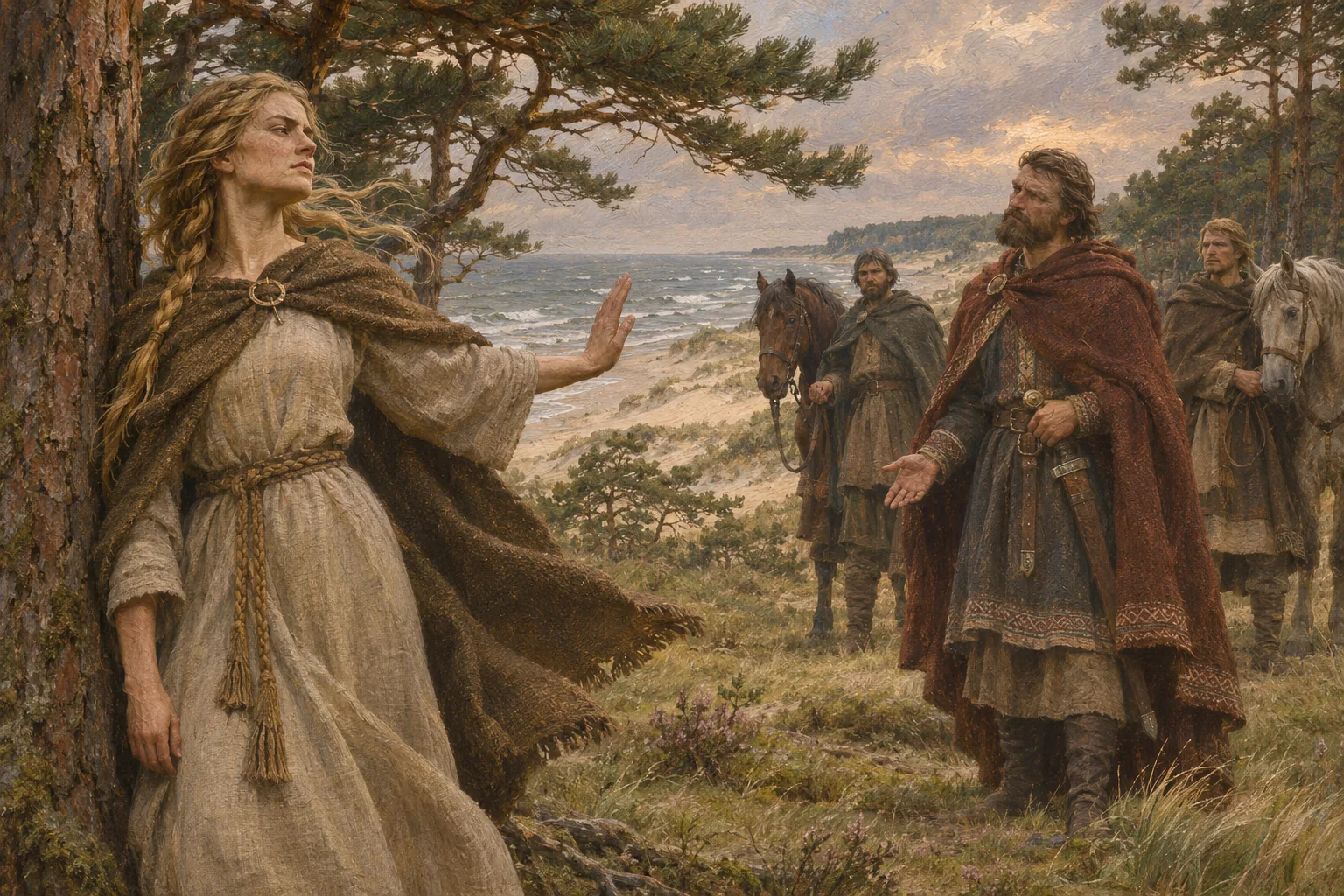
The chronicle takes Kęstutis to Palanga, where he hears about Birutė. She has supposedly promised the gods lifelong chastity and is deeply revered by the people. In this account, the ruler is drawn to a woman whose standing rests on a religious vow and her community’s respect. S19
When Kęstutis proposes marriage, Birutė refuses because of her vow. The chronicle explicitly says he takes her by force. He overrides her decision, although the chronicler goes on to describe an honourable wedding. Their meeting does not begin with a declaration of mutual love. S19
Kęstutis then escorts Birutė honourably to Trakai and celebrates the wedding with his brothers. The chronicler tells of force and ceremonial acceptance in the same text. As he explains the origins of an important dynastic branch, he preserves Birutė’s refusal — her later honour as duchess does not erase it. S19
Jasas warns that Birutė’s name and life story are absent from fourteenth-century sources. Kojelavičius places the marriage after the 1370 campaign despite already having Kęstutis’s children in his narrative. That is a textual position, not a reliable wedding date. Neither this sequence nor the chronicle’s vow proves a specific office guarding an eternal flame. S19 S7
2.16
Kinship offered support, without a guarantee.
Kęstutis’s children and their marriages connected Trakai with other rulers, but the sources preserve no consistent family list.
Vaidotas appears in the defence of Kaunas, Vytautas in his father’s increasingly consequential decisions, and Žygimantas among the family members who later rose to power. These names identify particular people. They do not supply a complete tree with secure mothers, birth order, possessions and dates for every child. S6 S19
The Bychowiec Chronicle lists six sons, but Jasas discusses copies giving seven and warns of confused identities. In his explanation, the chronicle wrongly includes Algirdas’s son Andrius, called Kuprys, among Kęstutis’s children. Later writers struggled to match names to the dynasty’s different branches, leaving inconsistent lists. S19
Danutė’s marriage to Duke Janusz of Mazovia could offer a route to refuge. Kojelavičius portrays their household as a place where the escaped Kęstutis recovered and obtained an escort. Events in 1382 would reveal the limit: marriage did not compel a neighbour always to support his father-in-law or abandon territorial interests. S7 S19
Birutė’s fate receives conflicting accounts. Beresnevičius discusses a legend of her living in Palanga until 1416. Baronas favours evidence of violent death while noting the opposing claim that she reached old age. Neither account establishes an exact death date or a grave location. S12 S79
2.17
A noble knight and the limits of caution.
Authors portray Kęstutis differently: courage can mean either a virtue or a readiness to take risks.
Ivinskis’s Kęstutis is open, honourable and faithful to his word. Even his enemies respect him. In this portrait, defending pagan Lithuania is not associated with hatred of Christians. The interwar author clearly admires the ruler, though this broad assessment cannot establish how he acted on every occasion. S6
Kojelavičius stresses a different combination: Kęstutis is hot-tempered, braver than he is cautious. Adventures, captures and escapes reveal the consequences. The same impetuous energy surprises an enemy and endangers the prince himself. Older authors therefore do more than praise him; they explain his setbacks in different ways. S7
In Beresnevičius’s accounts, the prince saves a captive, honours a commander, breaks a ritually confirmed promise and misleads an enemy with a pretended illness. His choices change with the circumstances. These episodes portray a man making political decisions whose actions do not fit a portrait of flawless chivalry. S12
Ivinskis also contrasts Kęstutis with a politically more flexible Algirdas and links him to defending Lithuanian identity. This is the language of a 1936 history shaped by its own period’s concerns. The fourteenth-century prince defended possessions, dynastic standing and allies; his choices need not be assigned the objectives of a modern nation-state. S6
2.18
The partnership could not simply be inherited.
After Algirdas died in 1377, Jogaila assumed grand-ducal authority and Kęstutis initially recognised him.
Algirdas’s chosen successor Jogaila took over Vilnius, but he needed to reach an understanding with other relatives. Kęstutis still governed Trakai and had decades of military experience and supporters of his own. His recognition strengthened the new ruler. Jogaila, in turn, had to reckon with his influential uncle. S6
Ivinskis explains Kęstutis’s acceptance through respect for his brother and hopes of continued cooperation. In his view, the closeness of Vytautas and Jogaila was to help sustain their fathers’ partnership. The surviving account does not reveal every conversation behind Kęstutis’s decision to support the new ruler of Vilnius and accept the changed family hierarchy. S6
The Bychowiec Chronicle makes continuity a personal practice: Kęstutis visits Jogaila for counsel as he once visited Algirdas. Both fathers supposedly favoured particular sons, and those sons were friends. Family ties initially sustain joint government in this telling, giving the subsequent conflict the meaning of betrayed trust. S19
The younger generation faced the same prolonged war while seeking other solutions. Ivinskis stresses the benefits expected from accommodation with the Order and safer trade. Jogaila’s separate initiatives gradually changed his relationship with his uncle: the dynasty began making different choices over whose territories and whose authority a peace should protect. S6
2.19
Peace had specifically defined limits.
The Trakai truce of 1379 and the Livonian agreement of 1380 protected different territories.
In 1379 Kęstutis and Jogaila jointly concluded a ten-year truce with the Order. Ivinskis identifies its protected territories as Kęstutis’s southern lands beginning at Hrodna and adjoining Order possessions. The long agreement did not cover the whole region previously exposed to warfare. S6
Part of Kęstutis’s territory gained a respite. Samogitia and other frontier districts did not automatically share it. A truce could protect one edge of a ruler’s possessions while campaigns continued elsewhere. Peace depended on whether a particular place was included in the agreement. S6
In February 1380 Jogaila made a separate agreement with the Livonian Order. Samogitia and Kęstutis’s remaining lands were excluded. Jogaila’s diplomatic gain therefore did not necessarily improve his uncle’s position. Territorial interests once coordinated within the brothers’ partnership now diverged more clearly in the new ruler’s agreements. S6
These truces explain the danger of the later secret agreement. Kęstutis had to consider both whether Jogaila negotiated and who remained exposed afterwards. Unequal protection eroded confidence. Relations with the Order could change in ways that increased the security of one dynastic branch at another’s expense. S6
Based on: S6
2.20
A hunt produced an agreement to withhold aid.
At Dovydiškės on 31 May 1380, Jogaila’s agreement with the Order directly affected Kęstutis.
A hunt provided the setting for a secret agreement. Jogaila promised not to assist Kęstutis against an Order attack; the pact would remain valid even if he appeared to help his uncle. In Ivinskis’s account this exceeded an ordinary limited truce: the relationship between uncle and nephew became part of a separate bargain with their adversary. S6
Vytautas attended the hunt but may not have known its secret conditions. Ivinskis considers this likely — Vytautas continued to trust his cousin. Later, when Kęstutis received a warning, father and son disagreed over whether to believe it. The cousins’ closeness carried a political cost. S6
In the chronicle, an Order official warns Kęstutis; the chronicler also calls him the godfather of Kęstutis’s daughter. The prince repeats the warning to Vytautas, who refuses to believe in his cousin’s betrayal. A personal connection across enemy lines delivers news that the family struggles to accept. Yet the informer’s name and office vary between texts. S19
Ivinskis stresses the influence of Julijona, Skirgaila and Vaidila around Jogaila, while the chronicle adds tension over Marija’s marriage to Vaidila. These are differently constructed explanations. The agreement created a concrete military threat to Kęstutis; later authors surrounded it with accounts of family influence, humiliation and betrayed confidence. S6 S19
2.21
Treaty papers helped unseat a ruler.
In 1381 Kęstutis seized Vilnius, removed Jogaila and became grand duke.
Kęstutis acted while Jogaila’s forces and Skirgaila were engaged with Polotsk. Vilnius was exposed to a sudden change of ruler. As in 1345, the prince of Trakai exploited proximity to the capital, but this time did not hand it to a brother. He assumed supreme authority himself after decades of cooperation and trust. S6
Treaty documents were found after Vilnius was seized. In Ivinskis’s account and the chronicle, they confirm Kęstutis’s earlier suspicions. Vytautas can no longer trust his cousin’s word alone: written proof of Jogaila’s secret agreement now changes the balance of power within the dynasty. S6 S19
Jogaila survived and received territories, with Vytautas interceding for him. Vaidila was hanged. The contrast reveals the limits of dynastic accommodation: a relative could lose Vilnius while retaining a place among the ruling family, but that protection did not extend to his associate. Kęstutis’s victory combined mercy with lethal punishment. S6 S19
Kojelavičius turns the coup into an ingenious operation involving hay carts, hidden soldiers and a sudden seizure of the castles. The seventeenth-century author develops this stratagem; the hay carts do not appear in Ivinskis’s concise account. S7
2.22
Taking Vilnius proved easier than keeping it.
Kęstutis’s grand-ducal rule in 1381–1382 faced warfare in the west and resistance within the dynasty.
As grand duke, Kęstutis continued fighting the Order. The new title did not solve the old frontier problem, while responsibility for Vilnius required broader support. Previously he had operated beside a senior ruler. Now he had to maintain the allegiance of relatives whose territories and interests differed from those of Trakai. S6
Kaributas’s resistance drew Kęstutis towards another part of the realm. As he moved against Kaributas, Jogaila could renew his struggle for Vilnius. While one dynastic conflict drew the ruler away from the capital, another claimant sought to recover it. S6 S19
Ivinskis connects Jogaila’s return with German merchants in Vilnius, for whom peace with the Order promised better trade. In his explanation, urban interests clash with Kęstutis’s warfare, though no single motive can be assigned to every townsman. The chronicle gives greater emphasis to Hanul’s political organisation and Jogaila’s return. S6 S19
In 1382 Jogaila recovered Vilnius. Kęstutis’s brief rule failed despite his military experience because he could not retain sufficient support as circumstances changed. The long-serving prince of Trakai could still raise an army. His rival, however, now held the capital with supporters of his own and the ability to coordinate with the Order. S6 S19
2.23
Promises of safety ended in arrest.
The struggle for Trakai in 1382 ended without a decisive battle: negotiations led to the capture of Kęstutis and Vytautas.
Jogaila’s and the Order’s forces took Trakai. Kęstutis could still rally Samogitians and join Vytautas, so recovering Vilnius had not settled the struggle. Their assembled forces approached Trakai again. The question was whether the old ruler could recover his position or the family dispute would end in another settlement. S6 S19
The chronicle says Kęstutis sent his wife to Brest, expecting help from Janusz, his son-in-law. Janusz instead attacked Podlasie and even besieged his mother-in-law. In this late account, marriage ties offered no guarantee of refuge. Mazovian connections had once helped the escaped Kęstutis return home, but did not necessarily protect his family now. S19
The armies did not fight. Ivinskis admits that the reasons are unclear and connects the next step with Skirgaila’s assurances of safety. The chronicle elaborates successive oaths and invitations to negotiate. Kęstutis and Vytautas went to Vilnius, where they lost their freedom. The promises of safety did not protect them from arrest. S6 S19
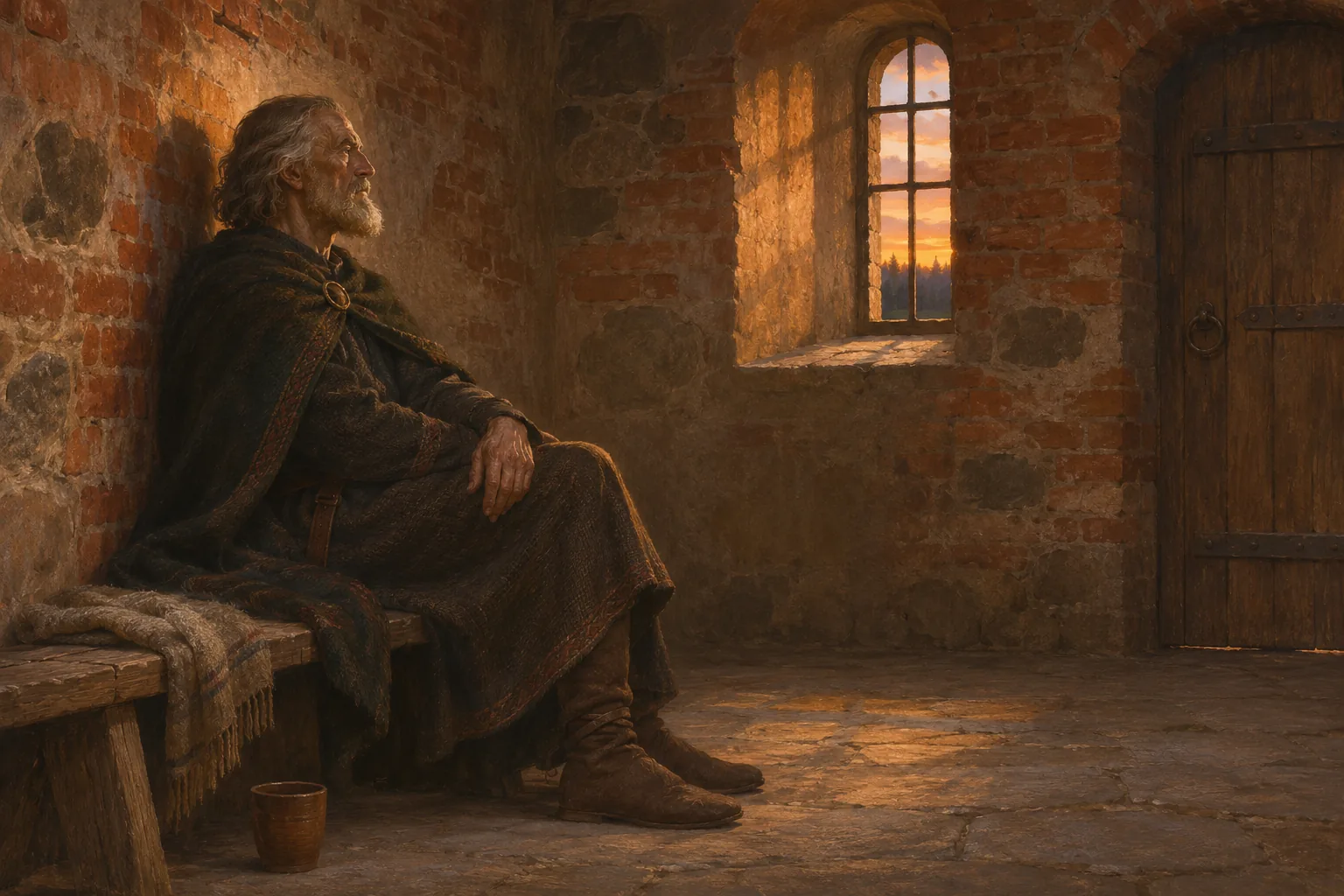
Kęstutis was sent from Vilnius to Krėva. This changed his position more radically than his earlier captivity under the Order: his jailers were rivals within his own dynasty. His fate depended on relatives whose promises of safety he had trusted. S6 S19
2.24
A life ended at Krėva, a body cremated in Vilnius.
Kęstutis died in captivity at Krėva in August 1382; authors differ over responsibility and circumstances.
The Bychowiec Chronicle says Jogaila’s servants strangled Kęstutis on the fifth night. The chronicler connects his death with the earlier broken oaths: the prisoner had lost the promised protection. His death is less disputed than this specific accusation — accounts differ over who ordered the killing and what individual members of Jogaila’s circle knew. S19 S76
Kojelavičius assigns blame more directly: Jogaila sent the killers himself. Ivinskis also treats the death as murder but leaves Jogaila’s personal involvement unresolved and particularly suspects Skirgaila. One author therefore attributes a direct order to Jogaila; the other considers responsibility within his wider circle. S7 S6
Jan Długosz blames Jogaila directly: men from his circle kill Kęstutis at Krėva on the fifth night, acting on his orders. Skirgaila brings the body to Vilnius. There it is burned with weapons, horses, dogs and princely clothing. The narrator praises Kęstutis’s wisdom and courtesy. This earlier text adds both an accusation and a funeral account, while leaving responsibility unresolved. S140
Ivinskis reports an announcement that Kęstutis had taken his own life, treating it as concealment rather than accepting it. The body was taken to Vilnius for ceremonial cremation. Weapons, horses, hunting birds and dogs accompanied it in his account, expressing the dead ruler’s rank and the world in which he had lived. S6
Beresnevičius connects the funeral account with the chronicle tradition of Wigand of Marburg. The ceremonial burning supports discussion of princely burial and pagan rites, without reconstructing every detail of the pyre or identifying a present-day grave. Kęstutis’s death ended his rule; his family’s political struggle continued in a different form. S12 S6
2.25
A long war and a longer afterlife in stories.
Kęstutis left a dynastic legacy and several forms of remembrance, from a chivalric ideal to a local legend.
Kęstutis defended castles, raided neighbours, negotiated conversion, supported his brother and eventually deposed his nephew. His long partnership with Algirdas proved more durable than his own rule in Vilnius. Neither military experience nor dynastic authority secured him support across the realm. S6
Ivinskis commemorates him as one of pagan Lithuania’s brightest figures. Kojelavičius invokes Odysseus and Achilles in his death narrative, joining cunning with bravery. These comparisons also reveal their writers: one values interwar national identity, the other uses classical heroic qualities to express the ruler’s fate. S6 S7
Memory also lived outside histories of rulers. Norbertas Vėlius’s collection includes a legend recorded in 1936 explaining the name of Birutos village through the duchess’s fondness for the place. It records a local story about Birutė, without proving a fourteenth-century visit, and shows how her name became attached to familiar surroundings. S13
Baronas connects the noble-pagan image with retrospective idealisation already visible in late-fifteenth-century writing. That image helped preserve Kęstutis’s memory. Behind it stood a ruler dependent on allies, castles and family agreements; his death revealed how fragile that long-established support could become. S78 S6