2.1
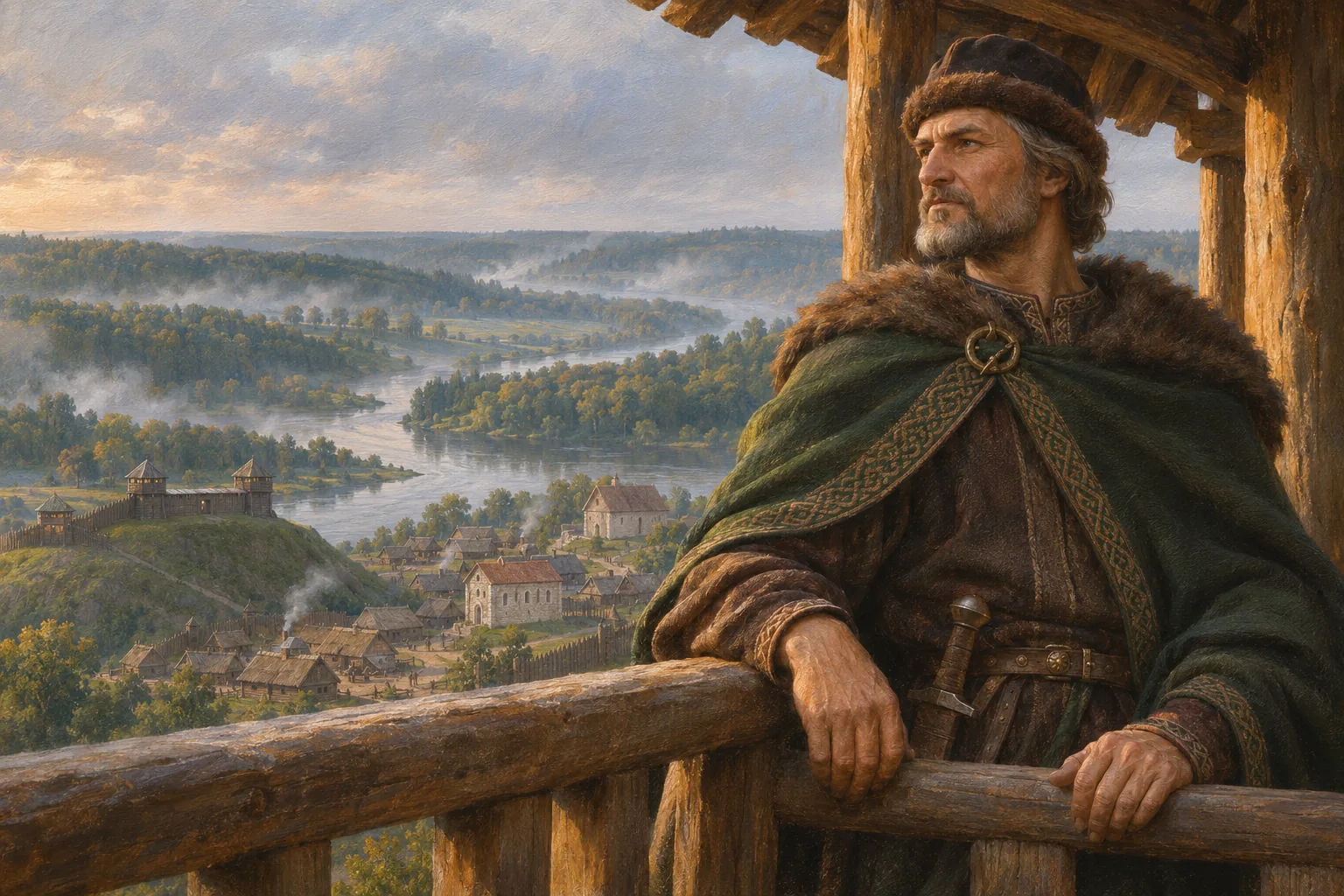
Gediminas’s youth remains obscure.
Gediminas was born around 1275, but the sources do not reveal the story of his youth.
Gediminas’s birthplace, teachers and first campaign are unknown. His dynasty comes into clearer view once it holds power, with castles and ties to neighbouring rulers. Childhood stories written much later cannot fill the gaps in his biography. S6 S83
The 1936 history edited by Šapoka calls Gediminas Vytenis’s brother while acknowledging uncertainty about the dynasty’s earlier origins. It lists several older genealogies that attempt to connect isolated names. They yield no reliable list of parents and grandparents. S6
The sixteenth-century Bychowiec Chronicle tells a different story: Gediminas was supposedly Vytenis’s son. Kojelavičius repeated that relationship in the seventeenth century, defending the dynasty against stories of usurpation. The genealogy gave rulers a legitimate past; its authors sought more than a record of family members. S19 S7
The Lithuanian encyclopedia presents Gediminas and Vytenis’s brotherhood as fact. Tomas Baranauskas challenges this in his 2024 study, proposing a collateral family branch. His hypothesis neither establishes alternative parents with certainty nor settles the early genealogy. S83 S84
2.2
Around 1316 — at the head of an existing realm.
Gediminas’s accession is conventionally placed around 1316, after Vytenis.
Vytenis left a realm already defending itself against the Teutonic Order and active in the lands of Rus’. Gediminas inherited political ties, allies and a war he had not begun. He had no need to unify Lithuania for the first time or expand it from a single castle into uninhabited country. S6
The transfer of power is obscure: the sources supply no coronation day, assembly of nobles or inheritance agreement. In his 1971 chronicle commentary, Rimantas Jasas gave a broader accession interval of 1316–1320. The conventional date marks the start of the reign, without attesting a ceremony. S19 S83
Gediminas also inherited Vytenis’s connections with Riga. The city and its archbishop were in conflict with the Order, giving Lithuania partners in the Christian world before the famous letters. The new ruler could build on cooperation already under way. S6
The eastern inheritance varied: some territories were closely attached, while others merely acknowledged Lithuanian influence. A change of ruler could weaken dependence founded on a personal agreement. Gediminas needed to reinforce old ties as well as acquire new territories, particularly where local princes remained in power. S6
2.3
Power rested on castles, people and agreements.
Gediminas’s supremacy connected the realm, but its territories were not governed alike.
The ruler based in Vilnius relied on princes, relatives and local supporters. The synthesis edited by Šapoka describes a realm composed of larger and smaller principalities. This made it possible to govern extensive lands, provided their princes remained obedient. S6
Aukštaitija and neighbouring territories of Rus’, associated with Minsk, Polotsk and Vitebsk, provided closer support. Local ties still mattered even in a relative’s principality. A son or brother who established himself there strengthened both the dynasty and his own position. S6
In more distant lands, earlier rulers could remain after acknowledging Gediminas’s supremacy. Such an arrangement preserved local continuity and reduced the burden of direct government. It was also fragile: a prince might seek another protector, leaving a Lithuanian ruler who had lost influence to negotiate or mount another expedition. S6
Military necessity strengthened Samogitia’s connection with the grand duke. Local princes needed support against the Order, while Gediminas needed their forces and a resilient western frontier. This mutual dependence did not give him unlimited freedom: a decision threatening local elites’ interests could provoke resistance. S6
Based on: S6
2.4
Vilnius was inhabited before the ruler’s letters.
In 1323, Vilnius appears in the documents as Gediminas’s seat of power.
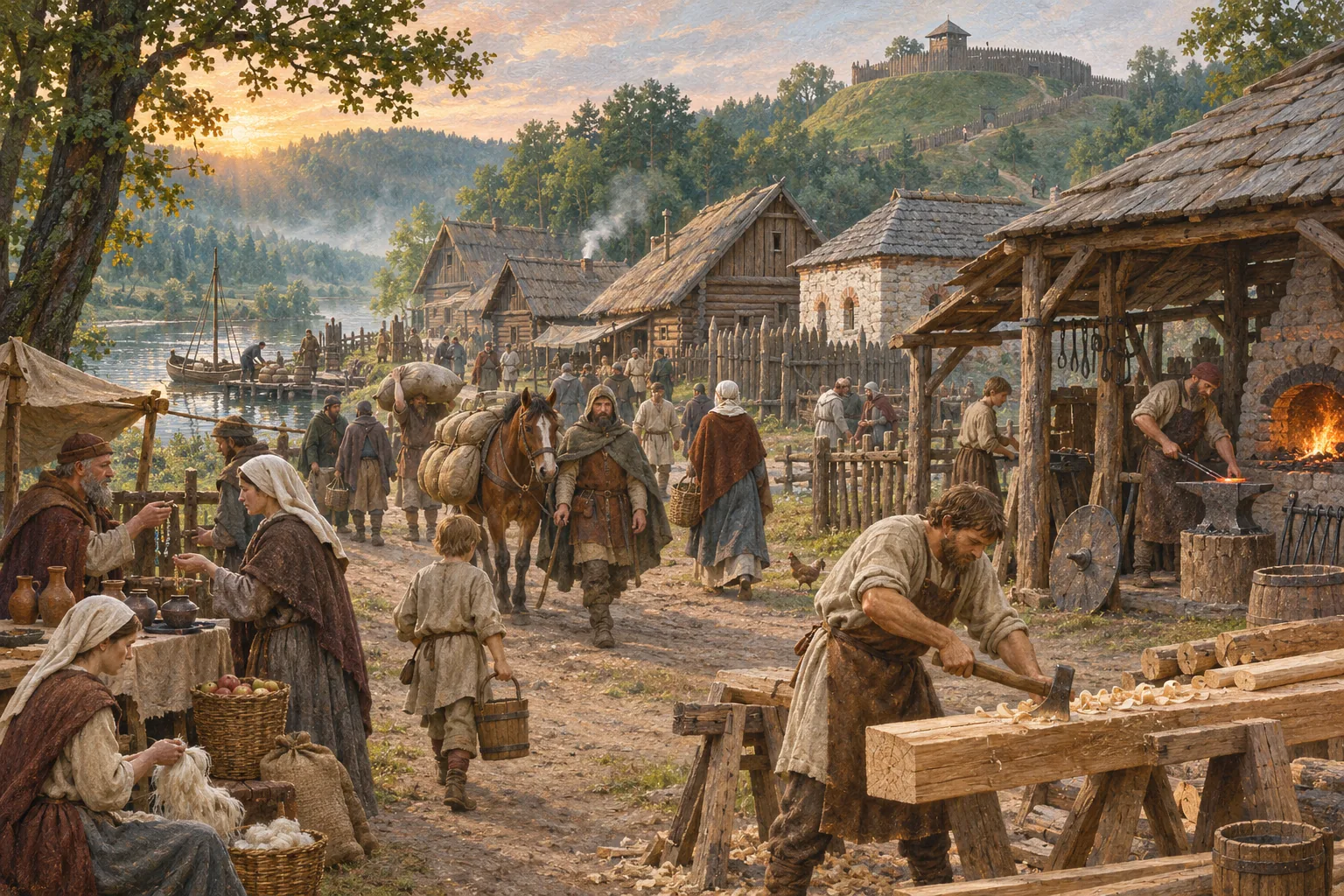
Vilnius enters written history through the ruler’s letters, but people had lived here earlier. The history edited by Šapoka distinguishes earlier settlement from Gediminas’s residence. The ruler’s arrival could strengthen the settlement and its castles. The date of the letters does not tell us when the first inhabitants settled here. S6
The Neris and overland routes connected Vilnius with the surrounding country. Envoys and other visitors came to the ruler, while his castle needed food, labourers and craftspeople. Everyday supplies also bound the residence to its surroundings. S6
Rytis Jonaitis discusses late-thirteenth-century settlement at Vilnius and traces of Christian communities. The 1271 timber date he cites from the hill’s northern foot applies to specific material. It supports earlier activity at this location without establishing a foundation year for the whole city. S86
We do not know exactly when Gediminas moved to Vilnius. The letters and subsequent negotiations attest a functioning residence: foreign envoys were received here, and appeals went out to towns, the pope and Livonian partners. S6
2.5
A dream explaining the capital’s power.
The Vilnius foundation dream is told in detail in the sixteenth-century Bychowiec Chronicle.
In the Bychowiec Chronicle, Gediminas discovers the site of Old Trakai while hunting and moves his capital there from Kernavė. On another hunt near the Vilnia, he kills an aurochs on Taurakalnis. As evening draws on, he sleeps in the Šventaragis valley. His journey connects three seats of power and explains how a new centre arose. S19
In the dream, the Iron Wolf stands on Kreivasis Hill, also called Plikasis in the chronicle, with what sounds like a hundred wolves howling inside. Lizdeika interprets the sign: a capital will stand here, its fame spreading worldwide. The chronicle supplies a religious interpreter, presenting him as a priest found in an eagle’s nest. S19
After hearing the dream’s interpretation, the chronicle’s ruler establishes castles and moves his capital to Vilnius. The wolf’s hill in this account need not match the familiar image of Gediminas Castle today. In his commentary, Jasas notes the earlier settlement and the lack of contemporary testimony for Lizdeika. Detailed though it is, the tale is no eyewitness record. S19
In Kojelavičius’s version, the wolf may be made of iron or covered in armour. It appears on the hill where the aurochs was killed. He also gives alternatives for Lizdeika’s discovery: an eagle’s nest or a cradle suspended in a tree. The seventeenth-century author recounts several variants of the inherited story. S7

2.6
The ruler’s voice needed scribes and messengers.
Gediminas’s letters travelled through a network connecting Vilnius, Riga and western Europe.
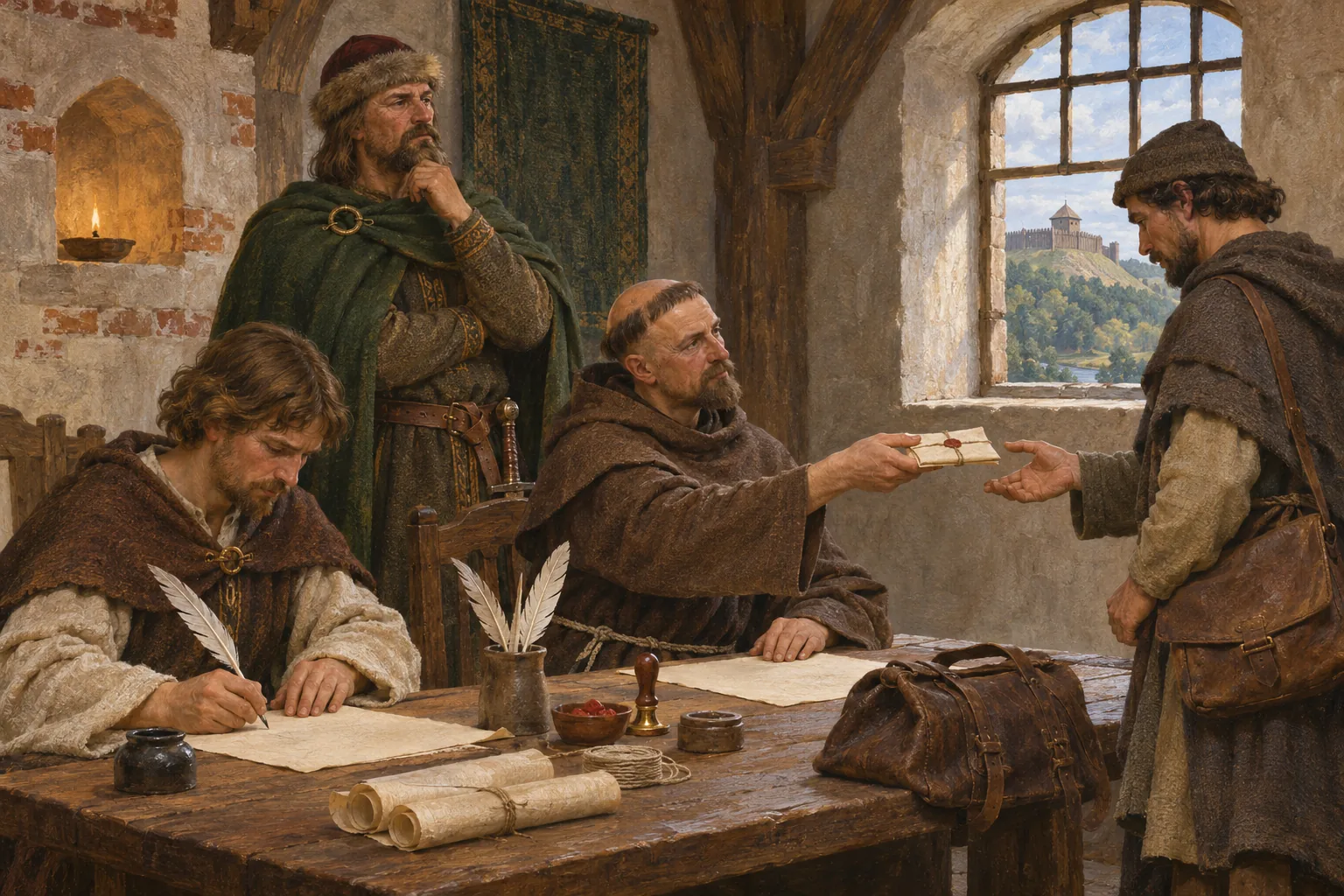
Through letters, Gediminas addressed the pope, town authorities and religious communities — people beyond his army’s reach. Christian clerics around him set out his intentions in Latin. A letter does not itself show that Gediminas wrote it in his own hand or spoke every recipient’s language. S6
Riga was an important intermediary. Support from the city and archbishop helped the letters reach the West while strengthening their own dispute with the Order. Gediminas’s partners had reasons of their own to support his complaint and portray the Order as an obstacle to peace and conversion. S6
The letter of 25 January 1323 ends by requesting copying, display at churches and onward transmission. The surviving item described by the museum is a contemporary parchment copy. The letter’s publicity thus depended on reproduction and on places where people could hear or read its message. S88
The Order challenged these texts’ credibility, alleging that the archbishop of Riga fabricated them. The struggle concerned whose account would be believed as well as the messenger’s route. Further actions had to sustain the letters’ authority: embassies, agreements and answers to the question of whether the ruler would accept baptism. S6
2.7
A place in Lithuania for craftspeople and merchants.
The invitations of 1323 linked peace with settlers’ work and the ruler’s protection.
Gediminas invited merchants, craftspeople, farmers and knights. According to their occupation, he promised help in settling, urban rights or land. The realm needed people who could trade, make goods and farm. The ruler’s promised protection was intended to ease fears about travel and life in a foreign country. S6
The letters also targeted religious communities. Gediminas pointed to Christian churches in Vilnius and Navahrudak and asked for more clerics. This sought to show western recipients that a Christian newcomer would not enter an entirely closed country. Friars could minister to settlers while sustaining the ruler’s communication with the outside world. S6
Neighbours could obstruct the journey. The synthesis edited by Šapoka mentions advice to travel through Mazovia, avoiding passage controlled by the Order. Promises of a secure life were insufficient if settlers could not first reach Lithuania. S6
The 1936 synthesis saw Gediminas’s efforts as an unrealised project to transform the country, frustrated by the Order and western political conflicts. That was the assessment of historians of its time. The invitations record what the ruler offered and sought; they do not tell us how many families arrived or how many promises were kept. S6
Based on: S6
2.8
In his letters, Gediminas called himself king.
The ruler’s title asserted independent authority over Lithuanians and inhabitants of Rus’.
Gediminas called himself king in his letters. He addressed other rulers and Church authorities as master of his own lands. The title told western recipients whose voice they were hearing and what authority it represented. S6
Šapoka’s edited history discusses the formula king of Lithuania and many Ruthenians. It expresses authority extending beyond Lithuanian lands while retaining a limit: many territories of Rus’, rather than all of them. The title articulated a political position as well as the ruler’s ambition. S6
In the January 1323 letter, Gediminas presents himself as king of the Lithuanians and Ruthenians and ruler of Semigallia. The text itself attests the title. It does not reconstruct a Catholic coronation ceremony, which would require separate evidence. S88
Lithuania contested Semigallia with the Livonian Order, and its ability to act there weakened during Gediminas’s reign. Naming the region in his title asserted a claim to disputed authority. Subsequent warfare shows why the title cannot be read as a description of fixed frontiers. S6
2.9
A dispute over who obstructed conversion.
Gediminas wanted the pope to deal with Lithuania beyond the Order’s mediation.
Addressing the pope, Gediminas offered his explanation of the war: Lithuania defended its freedom, while the Order’s attacks drove it away from Christianity. References to Mindaugas and Vytenis placed the argument within a longer history. He sought to reverse his enemies’ account by portraying the Order itself as obstructing the conversion it claimed to promote. S6
The appeal served the archbishop of Riga in his own case against the Order. Papal involvement offered another route to Lithuania’s conversion and could restrict the Order’s military activity. Gediminas could also hope for peace that did not depend solely on agreement with the adversary attacking his territories. S6
The history edited by Šapoka dates the papal letter to 1323. It treats the papal business and invitations to towns as a shared diplomatic effort. The letters were nevertheless separate, each with its own recipient, date and purpose. S6
Baronas and Rowell date the early papal letter to 1322, before the urban invitations. S80
The Order countered that Gediminas used conversion to conceal a wish to cut off western support for the Order. Conflict between pope and emperor further divided the audience. The letters’ success therefore depended on several political struggles at once; a favourable papal response alone could neither stop the war nor persuade every western ruler. S6
2.10
An agreement opening a route for trade.
The agreement of 2 October 1323 connected Lithuania with partners in Livonia.
The agreement with Riga, the archbishop and the Livonian Order offered Gediminas peace and safer trade. Merchants needed to travel, sell their goods and return. The ruler sought access to goods not readily produced in his country. S6 S83
Riga’s townspeople wanted trade, the archbishop sought a stronger position, and Gediminas wanted fewer attacks and continued western connections. Different interests brought them to the same agreement. Recent enemies could also become negotiating partners. S6
The papal legates confirmed the peace in 1324. When Gediminas later refused baptism, they still pressed the Order to preserve the truce. They sought to keep warfare suspended even after conversion negotiations had failed. S6 S83
Peace with the listed Livonian parties did not secure every Lithuanian frontier. Other rulers acted in the west and east, and enforcement depended on the parties’ behaviour. Nevertheless, it was a meaningful achievement: Gediminas could act as a treaty partner and trade where warfare had repeatedly disrupted connections. S6
2.11
In 1324, the promise itself became disputed.
The papal legates’ envoys heard in Vilnius that Gediminas did not intend to be baptised.
The papal legates remained in Riga in 1324 and sent representatives to Vilnius. Their envoys were to establish whether Gediminas stood by his written promises and how he understood his relationship with the pope. S6
Gediminas explained that he had sought peace with Christians. He said he had called the pope father out of respect for an older man, without necessarily promising baptism. A Franciscan scribe was blamed for the letter’s more explicit wording. The ruler’s reply differed from the promise the envoys had read; the letter alone could not settle the dispute. S6
The 1936 synthesis explains the refusal through pagan and Ruthenian opposition and doubts that baptism would restrain the Order. Its authors regard Gediminas’s explanation as evasion. Kojelavičius reads the same decision differently, as fidelity to ancestral religion. S6 S7
Baronas questions the explanation that pressure forced Gediminas to change his position: accounts of the groups involved lack independent corroboration. S80

2.12
Different religions within one ruler’s lands.
Gediminas remained pagan while ruling territories inhabited by different Christian communities.
Catholic friars around Gediminas maintained his western connections, though the realm did not become Catholic. His letters mentioned Christian churches, both describing life in the country and arguing that hostility towards the Order did not mean war against every Christian. S6
Orthodox Christianity and local customs shaped the lands of Rus’. Adaptation helped princes from the Lithuanian dynasty establish themselves there. A ruler’s son might depend on marriage and local support. Dynastic expansion therefore also brought different religious connections into the family itself. S6
Beresnevičius connects Gediminas’s fidelity to the old religion with ancestral authority. In his reading, inherited tradition linked generations and gave power continuity. This explains the weight he places on invoking ancestors. The later author’s account is not, however, a direct record of Gediminas’s own private convictions. S12
Religious coexistence was connected with political needs. Gediminas required the friars’ literacy, the obedience of princes in Rus’ and support in pagan Lithuania. These groups could view his baptism differently. A personal decision would therefore have affected his whole network of government, extending far beyond ceremonies at court. S6
2.13
War over a river and its strongpoints.
The castles of the Nemunas and Jūra sustained the western defences.
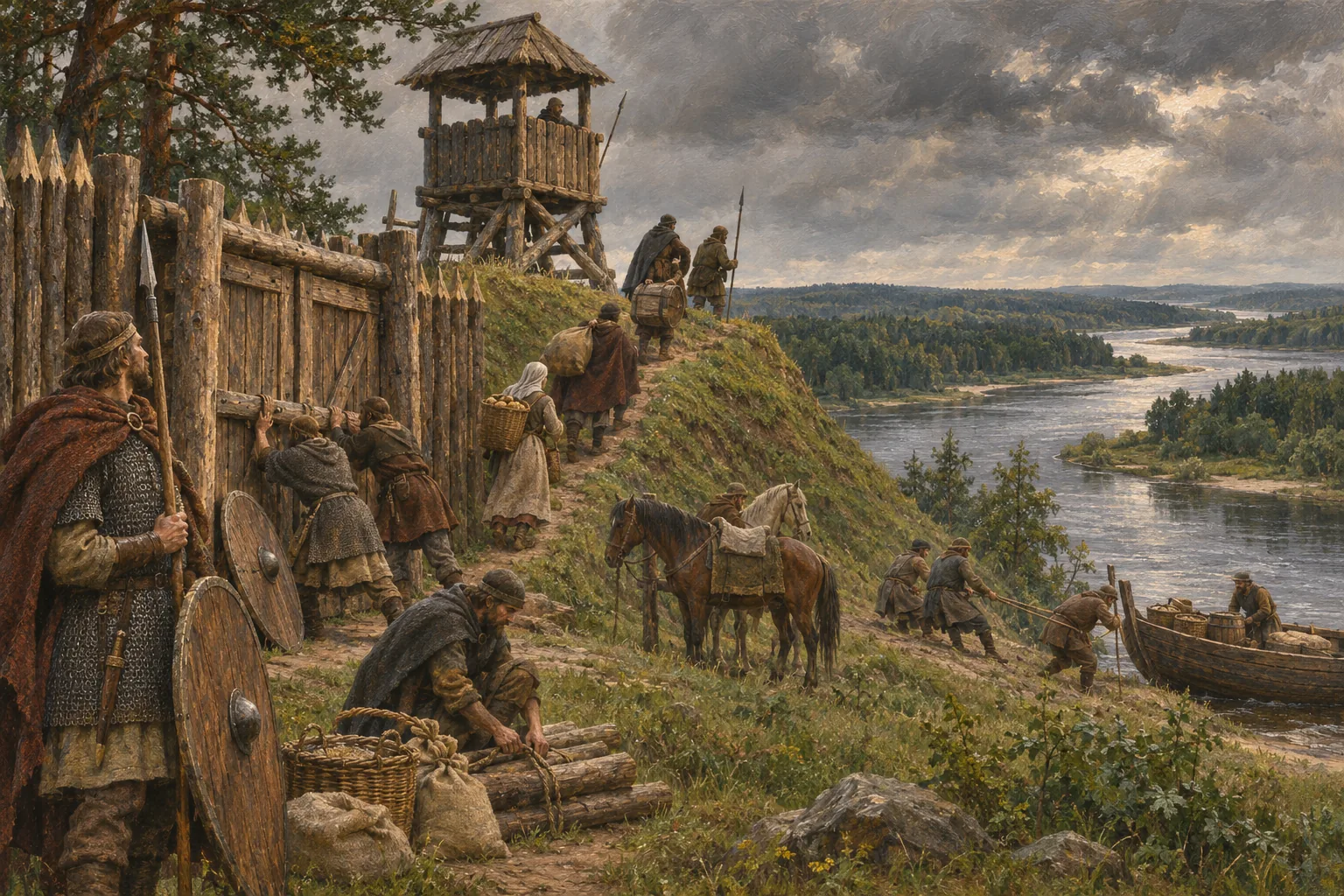
Two castle systems confronted each other along the Nemunas. The Order relied on Ragnit, Jurbarkas and Skirsnemunė; the Lithuanians on Veliuona, Kolainiai and Bisėnai. The history edited by Šapoka also names a Gediminas castle on the Jūra, a defensive site distinct from the castle in Vilnius. S6
Castles supported expeditions and provided places of retreat. Their destruction meant rebuilding both walls and the capacity to defend that stretch of country. The Order’s construction of new castles moved warfare upstream. The Lithuanian side needed to prevent attackers from establishing bases that would remain after a single campaign ended. S6
Castle garrisons needed people, supplies and routes through the surrounding country. Devastated villages weakened defences even when the fortifications held. Both sides plundered and took captives on campaign. Around the castles named in chronicles were communities whose daily lives war disrupted even without a major battle. S6
Gediminas’s diplomacy could temporarily halt attacks or divide opponents, but castle defences remained essential. When truces expired, the Order returned to the river. The ruler used letters to gain time and partners, and castles to protect the country. S6
Based on: S6
2.14
Victory did not end recurring warfare.
The Medininkai victory is conventionally dated to 1320; the burden of war extended beyond one battle.
The battle of Medininkai belongs to the wars against the Order during Gediminas’s reign. The modern encyclopedia dates it to 1320. Kojelavičius recounts an ambush of the invaders under 1319. His chronology differs from current usage. S7 S83
The Samogitians stopped the attack, but victory alone does not establish that Gediminas commanded them in person. He could rely on other commanders and local forces. Later authors gathered different conflicts under his name, although their participants and dates are not always clear. S6 S7
David of Hrodna was the most prominent commander associated with Gediminas’s military policy. The synthesis edited by Šapoka notes that the ruler entrusted armies to him. With commanders fighting on several fronts, Gediminas could also pursue negotiations. S6
Retaliatory expeditions into Livonia and more distant lands likewise devastated settlements and carried people into captivity. Kojelavičius accompanies such actions with large figures for booty and prisoners, which cannot be treated as verified accounts. The cost extended beyond fallen soldiers: lost homes and separated families prolonged the consequences after armies withdrew. S6 S7
2.15
Christian neighbours pursued different interests.
For Gediminas, Riga was both an ally and an important route for trade and communication.
Riga, the archbishop and the Order contested power and rights in Livonia. Cooperation established under Vytenis allowed Gediminas to use these divisions. The Christian city became an important support for his western policy. S6
Riga provided access to wider commerce and goods important in wartime. Šapoka’s edited history particularly stresses this route’s value for arms and western communication. Trade and military cooperation reinforced each other because the city’s autonomy protected a route beyond the Order’s complete control. S6
The archbishop’s dispute with the Order reached the papal court. Gediminas used this opening to pursue his own aims: sending letters and envoys, seeking truces and inviting settlers. A common opponent brought the partners together, though their objectives did not always coincide. S6
Lithuanian military action in Livonia made this connection dangerous for the Order. Conversely, the city’s defeat could seriously affect Gediminas even while his own castles remained untaken. His diplomatic room depended partly on a neighbouring community’s ability to preserve its autonomy. That dependence became especially clear in 1330. S6
Based on: S6
2.16
The Order increased pressure on two fronts.
Renewed war and Riga’s defeat narrowed Gediminas’s options at the end of the decade.
When the truce ended, the Order resumed attacks from the Nemunas. The fighting of 1329 showed that diplomatic respite had not removed its castles or capacity to campaign. Samogitia’s defences required constant maintenance: a military setback could bring the Order’s bases closer and make the next season of defence more difficult. S6 S83
In the north, the Livonian Order could raid Aukštaitija and reach the vicinity of Vilnius. The synthesis edited by Šapoka distinguishes such devastation from lasting occupation: land reached by an army did not necessarily become its possession. Defenders nevertheless had to divide their forces, increasing the burden on the country. S6
In 1330, the Order overcame Riga. Gediminas lost a partner formerly able to resist it independently and assist Lithuanian diplomacy. The city and archbishop had less room to act, so the earlier alliance could no longer operate on the same scale. Successful defence of a Lithuanian castle could not compensate for that political loss. S6
Riga’s defeat did not sever all trade and external ties, but the balance of power changed. With an important intermediary unable to offer its former support, Gediminas had to rely more on other partners and his own defences. His realm survived, though its western policy became harder to pursue. S6
2.17
A shared adversary brought rulers together.
In 1325, Gediminas formed an alliance with the Polish king Władysław Łokietek.
For the Polish ruler, conflict with the Order also concerned Pomerelia. The same enemy threatened Lithuania’s western territories. Shared danger provided a basis for cooperation across the rulers’ religious difference. A dynastic marriage strengthened the alliance: Gediminas’s daughter married Łokietek’s son Kazimierz, the future Polish king. S6
The agreement was intended to coordinate military action, but the partners’ capacities and priorities differed. Lithuanian help for Poland did not guarantee equivalent assistance on another front. Gediminas’s position depended on whether his neighbour assembled forces and chose to act when the Lithuanian ruler needed them. S6
The 1936 synthesis judges the alliance harshly: Lithuania assists Poland, but the promised help does not arrive. Its authors stress the joint attacks that failed to materialise and unequal benefits. This is their assessment; no verdict by Gediminas on the whole relationship survives. S6
Kojelavičius gives more space to joint action and a later separation, when Polish truces leave Gediminas carrying the burden of war. The works differ in emphasis but share a political problem: an ally could negotiate separately with the enemy. Dynastic kinship did not abolish independent political interests. S7
2.18
A daughter’s marriage and an allied expedition.
Aldona’s marriage to Kazimierz connected the ruling families of Lithuania and Poland; a Brandenburg campaign followed in 1326.
The marriage of 1325 brought Gediminas’s daughter into the Polish ruling family. Her husband Kazimierz was not yet king. The Bychowiec Chronicle calls her Ona but dates the marriage to 1323 and confuses Polish royal names. Jasas corrects these details, separating the late narrative from the marriage’s chronology. S6 S19
Writing about the marriage under 1325, Jan Długosz calls Gediminas’s daughter Anna after baptism. He connects the agreement with the release of Polish captives: in his account, their return replaces a dowry of gold or silver. The name Aldona does not appear in this episode. His accompanying hostile claims about Lithuanian life are not a neutral account of its economy. S140
Rimvydas Petrauskas notes that the pagan name Aldona was assigned to Anna by the later writer Stryjkowski. He interprets daughters’ marriages as recognition of the ruling family beyond Lithuania. Such ties crossed confessional boundaries, although sources describe the women’s own actions much less often than those of men. S87
In 1326, Lithuanian forces assisted Poland in a campaign into Brandenburg. Kojelavičius connects the expedition with David of Hrodna and recounts his murder during it. This joint campaign took Lithuanian soldiers far from the Nemunas defensive line. S6 S7
Chronicles give enormous numbers of captives released at the marriage and present the commander as Gediminas’s relative. These details yield no verified dowry account or family list. The marriage and military cooperation are more firmly attested; they led to a distant expedition with risks for its participants. S6 S7

2.19
Some lands were connected by family, others by force.
Gediminas’s influence in Rus’ expanded through marriage, inheritance and war.
Lithuanian connections with the lands of Rus’ predated Gediminas. He inherited possessions and spheres of influence, sometimes needing to consolidate them again. Polotsk, Minsk and Vitebsk were connected more closely with the Lithuanian heartland than distant principalities whose rulers’ obedience might change. S6
For Polotsk, Šapoka’s edited synthesis names Gediminas’s brother Vainys. It explains Algirdas’s connection with Vitebsk through marriage to the local prince’s daughter. Marriage could open a route to inheritance and local support, but a new ruler still needed to establish himself. His wife’s family rights became part of wider dynastic politics. S6
The Bychowiec Chronicle depicts Volhynia as a land conquered by Gediminas and names local rulers killed there. Jasas disputes that sequence, connecting Liubartas’s establishment with inheritance in 1340. An early campaign, a dynastic tie and a later accession are separate events in these accounts. S19 S6
Expansion was assisted by retaining local arrangements and drawing on local princes’ support. New connections could nevertheless bring conflict. Members of the Lithuanian dynasty adapted to Orthodox surroundings, while local elites weighed whose protection they would accept. Political choices depended on the circumstances of each territory. S6
2.20
A dramatic campaign narrative and narrower evidence.
Later chronicles describe Gediminas’s expedition to Kyiv, but their sequence raises substantial questions.
In the Bychowiec Chronicle, Gediminas advances on Kyiv after the Volhynian campaign. He defeats allied opponents on the Irpin, towns submit, and he appoints Algimantas Mindaugaitis as governor. The chronicle thus casts Gediminas as conqueror of an extensive country. S19
Kojelavičius places the expedition under 1320 and entrusts Kyiv to Mintautas of Alšėnai. Whether the differently named governors are the same man is uncertain. Despite their many names and places, these late accounts do not support a reliable conquest map for 1321 or 1322. S7 S19
Jasas’s 1971 commentary stresses the absence of contemporary testimony for the Irpin battle. He distinguishes possible early Lithuanian influence from Kyiv’s later incorporation under Algirdas. Šapoka’s edited synthesis likewise speaks of Gediminas’s influence in Kyiv. Both works distinguish political influence from the chronicle’s full conquest narrative. S19 S6
Baronas and Rowell discuss Fëdor, attested in Kyiv in 1331 alongside the khan’s representatives. They cautiously reconstruct a possible accommodation. Overlapping authority does not support a claim that the Horde’s influence vanished after one early battle. S80
2.21
Eastern policy also depended on connections beyond the realm.
Gediminas participated in rivalries among the princes of Rus’ through kinship and personal influence.
Tver and Moscow were powerful rivals whose interests could conflict with Lithuanian expansion. Gediminas married a daughter to the prince of Tver. The history edited by Šapoka presents this kinship as a way to ease eastern obstacles. Marriage nevertheless gave him no authority over all his ally’s lands or neighbours. S6
Narimantas’s presence in Novgorod and David of Hrodna’s connections with Pskov represented another kind of influence. A prince or commander might be accepted under particular circumstances as a useful partner. These personal connections did not turn Pskov or Novgorod into ordinary Lithuanian possessions. They widened Gediminas’s scope while remaining dependent on local politics. S6 S7
The princes of Rus’ still lived under the Horde’s power. Gediminas had to negotiate with different rulers and balance his family’s interests with his realm’s defence. A marriage could open more possibilities than a single campaign. His eastern policy reached beyond rivalry with Moscow and did not bring every territory into the realm on the same terms. S6
2.22
A large family supported power and contained future rivalries.
Gediminas’s sons held different territories, while his daughters’ marriages connected the dynasty with neighbours.
Seven sons recur in the accounts: Manvydas, Narimantas, Algirdas, Jaunutis, Kęstutis, Karijotas and Liubartas. Their lives are not equally well known. Birth order, early possessions and the dates of acquiring them remain unevenly attested. Their connections with particular lands can be followed more reliably. S6 S19
Marriage connected Algirdas with Vitebsk; dynastic rights and inheritance connected Liubartas with Volhynia. Karijotas is associated with Navahrudak, Narimantas with Pinsk and Kęstutis with Trakai. These bases allowed one family to operate across an extensive country while giving established sons supporters and interests of their own. S6 S19
In the Bychowiec Chronicle, Gediminas appoints Jaunutis to govern Vilnius while still alive. The 1936 synthesis also connects his sons’ possessions with their father’s decisions, but explains Jaunutis’s power in the capital as automatic inheritance after his death. The accounts differ over the transfer of senior authority. Neither supplies a surviving testament. S19 S6
Daughters’ marriages into the ruling families of Poland, Mazovia and Tver complemented the sons’ possessions with another network. These women entered settings with different religions and political customs. Sources more often record a marriage connection than their daily activity, making the extent of family politics clearer than individual daughters’ biographies. S6 S7
Little is known about Gediminas’s wives. Petrauskas traces Jaunė’s name to later chroniclers. Neither the sequence of wives nor the identity of each child’s mother is securely established. S87
2.23
Pressure on the Nemunas continued.
During the 1330s, the realm continued its western defence and strengthened eastern connections.
In the synthesis edited by Šapoka, the defenders of Pilėnai under Margis choose death rather than surrender in 1336. The account conveys the frontier war’s brutality, but does not attest Gediminas’s presence in the castle. Pilėnai belongs to his reign; there is no basis for calling it his own final battle. S6
Beresnevičius asks how religious understanding might have shaped the deaths described in later accounts. He distinguishes self-killing from being killed with consent and criticises the romanticised symbol. His ritual explanation remains a hypothesis rather than a precise reconstruction of what every person inside the castle did. S12
The Order also established itself at Bayerburg on the Nemunas. In 1337, Emperor Louis IV granted it Lithuania. The document asserted a claim without giving the Order actual control over the whole country: its castles and defenders still had to be overcome. S6
Gediminas’s final years combined western defence with his family’s activity in Rus’. Liubartas established himself in Volhynia in 1340. In the west, surviving routes of communication needed protection. These connections and conflicts continued beyond the ruler’s death into the next generation. S6 S19
2.24
The circumstances of death are unknown; his sons inherited power.
Gediminas’s death is conventionally dated to 1341; detailed accounts of his killing came later.
The history edited by Šapoka ends Gediminas’s reign around 1341, acknowledging the lack of reliable information about his death. Jasas gives an interval from autumn 1341 to the winter of 1341–1342. The exact day is unknown; the end of the reign is firmer than accounts of its circumstances. S6 S19
Kojelavičius gives a dramatic account of the ruler killed by a firearm near an Order castle and his remains brought to Vilnius for cremation at Šventaragis. His sequence, however, leads to 1329. Juozas Jurginis explicitly identifies that chronological error in the 1989 introduction. The funeral description belongs to the same later narrative. S7
In the Polish translation of Długosz’s work, Gediminas dies from a fiery arrow while attacking an Order castle. The scene appears among the events of 1307; soon Algirdas is avenging his father. This sequence conflicts with the end of Gediminas’s reign discussed above. The edition’s chronological discrepancy remains unresolved and establishes no new date for his death. S140
Edvardas Gudavičius distinguishes the Trakai ruler killed in 1337 from Gediminas, who was still alive at the 1338 trade treaty. The study does not establish Gediminas’s cause of death. S85
Vilnius passed to Jaunutis after Gediminas. His rule was brief: Algirdas and Kęstutis removed their brother in 1345. Possession of the capital could not outweigh their support and action. Gediminas’s sons kept power within the dynasty but disputed who should lead it. S6 S19
2.25
Letters, dynasty and city remained linked to one name.
Gediminas’s legacy included both the connections he developed and later narratives about him.
Gediminas’s sons’ possessions and daughters’ marriages extended the dynasty’s influence. After his death, the brothers both cooperated and competed. Vilnius remained the seat of senior authority, while another generation could draw on eastern ties. These connections endured, though Gediminas could not determine all his successors’ decisions. S6 S19
In his letters, Gediminas appeals, invites, complains and negotiates — a different view of the ruler from the military chronicles. Vilnius participates in international communication, and conversion is bound up with security and trade. The letters preserve that significance despite the failed baptism negotiations and uncertainty over how far promises were kept. S6
The Bychowiec Chronicle’s wolf promises the capital fame. Kojelavičius recounts its beginnings from the Vilnius of his own day, with its university, courts and trade. Gediminas’s letters attest fourteenth-century activity; later legends explain the city’s importance to the generations telling them. S19 S7