2.1
The king’s peace was not everyone’s peace.
Mindaugas maintained peace with the order, while the Samogitians kept fighting.
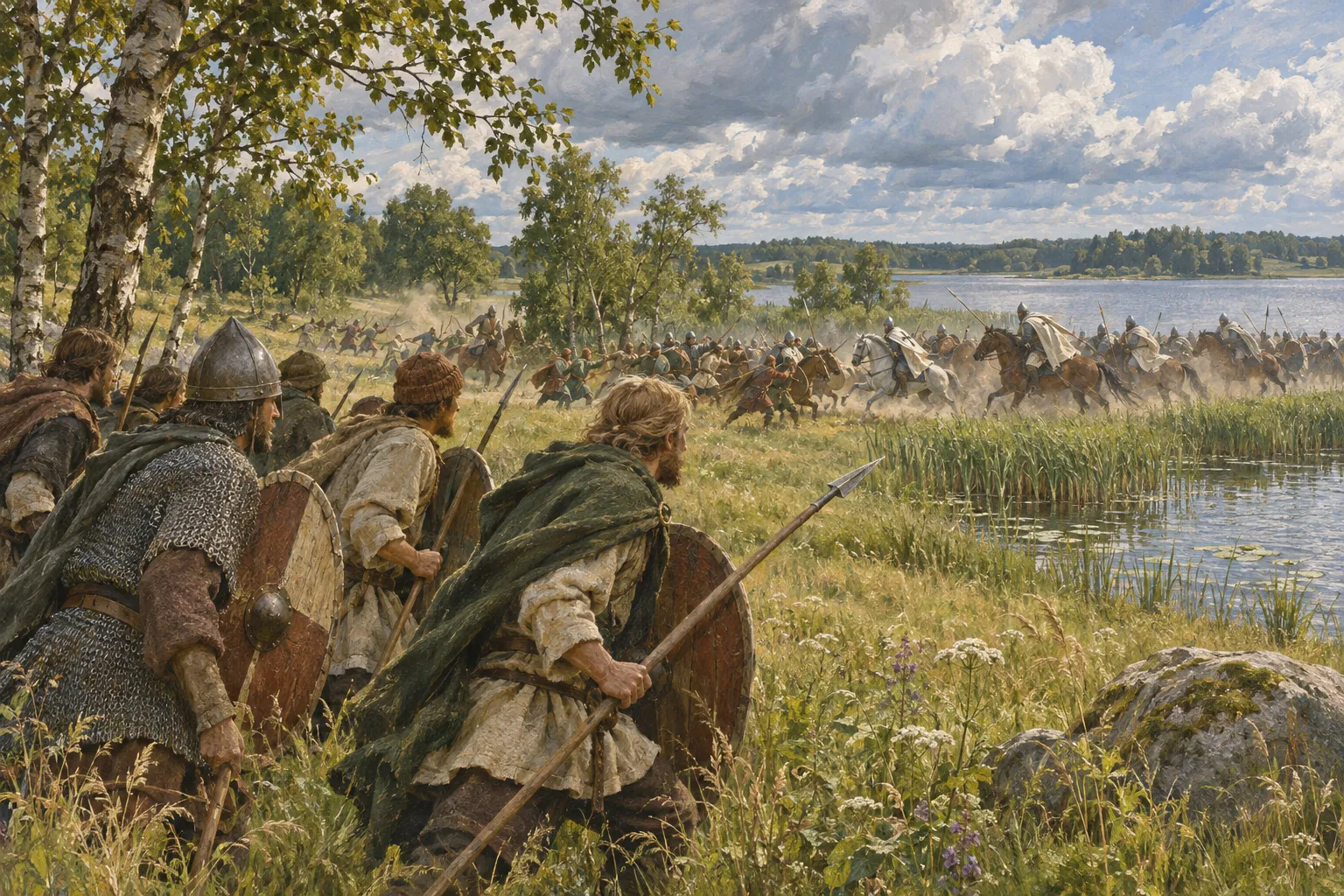
Mindaugas’s baptism in 1251 and coronation in 1253 rested on an agreement with the Livonian Order. It helped him overcome some internal opponents and establish ties with the pope. Fighting continued in Samogitia, however. Local communities resisted the order’s rule despite the king’s agreement. S6
The 1936 synthesis recounts Mindaugas’s land grants and Samogitian resistance to both bishop and order. A claim to land on paper did not yet mean power over it. At Durbe, the Samogitians acted independently as a military and political force with aims of their own. S6
Based on: S6
2.2
The order sought to connect its territories.
Coastal and frontier castles were intended to change the balance of power.
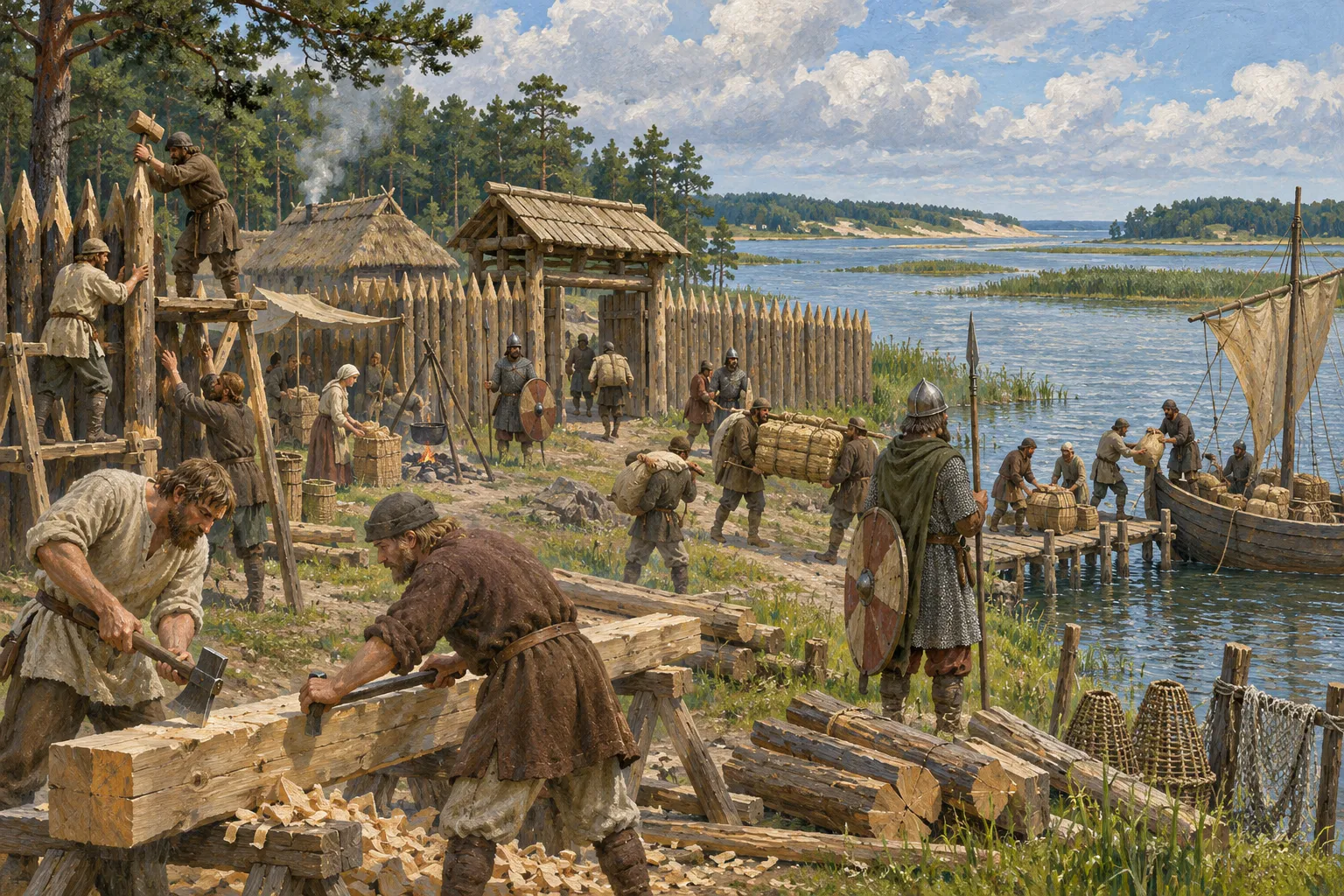
Samogitian lands separated the order’s territories in Livonia and Prussia, making a land route between them strategically important. Construction of Klaipėda Castle began in 1252, giving it a new foothold where the Curonian Lagoon meets the sea. Samogitians attacked the castle but could not prevent the order from establishing itself. S6
The struggle later reached the fortifications along the Nemunas. The synthesis describes the order’s and Samogitian castles around Karšuva and preparations for a major expedition. Winning battles was not enough. Each side needed to supply its garrisons, keep routes open and operate in contested territory. S6
Based on: S6
2.3
The Samogitians changed the campaign’s direction.
Instead of waiting for the attack, they struck elsewhere.
As Livonian and Prussian forces prepared for a joint campaign against the Samogitians, the Samogitians entered Courland under the order’s rule. According to the 1936 history, this forced the enemy to change its plans. The army turned to defend its own lands. S6
The campaign’s course brought the armies to the lake; they had not agreed beforehand to fight there. The Samogitian manoeuvre forced the enemy to respond to an unwelcome move. The campaign was also bound up with pressure on castles. S6
Based on: S6
2.4
A confrontation in Curonian territory.
In 1260 the Samogitians defeated the order’s combined forces by Lake Durbe.
The battle took place on 13 July 1260 by Lake Durbe, in present-day Latvia. Samogitians faced the order’s Livonian and Prussian forces and their supporters. S35
According to the synthesis, the order’s army included local people subjected to its rule. Its ranks held people with different interests, as well as knights united by a common cause. Their loyalties played an important part in the outcome. S6
2.5
One army, divided loyalties.
Curonian withdrawal is a central episode in accounts of Durbe.
The history edited by Šapoka notes that Curonians brought to the battle by the order withdrew. Fighting in the same army did not mean loyalty to the authority that had assembled it. The Curonians’ decision helps explain why the combined forces failed to hold together. S6
The Universal Lithuanian Encyclopedia (VLE) gives a fuller account: some of the withdrawing Curonians attacked the order’s army from the rear. This detail adds to the reconstruction without settling the full course of the fighting. S35
2.6
The order lost important commanders.
Samogitian victory severely weakened the combined army.
The Samogitians won the battle. The Livonian master, the Prussian order’s marshal, many brothers of the order and other soldiers died. The synthesis sees these losses as a blow to the expedition and to the order’s ability to hold territory it had already conquered. S6
The exact sizes of both armies and the course of every phase remain unestablished here. The consequences are clearer: commanders killed, resistance spreading after the victory and changed political decisions. They help explain Durbe’s importance even without a supposedly exact battle plan. S6
Based on: S6
2.7
The effects reached beyond the battlefield.
Resistance spread in Livonia and Prussia after Durbe.
The 1936 synthesis recounts how Baltic communities under the order’s rule rose after the battle. Resistance in Prussia was especially prolonged and persistent. Castles and garrisons came under pressure, and the order had to seek fresh support in the west. S6
The defeat of the order’s army could show that resistance was possible. The rebels had different aims and experiences, however. Samogitian assistance and local resistance did not form a movement directed by a single modern political centre; different forces acted in different regions. S6
Based on: S6
2.8
Durbe also changed the king’s position.
After the victory, pressure grew for Mindaugas to break peace with the order.
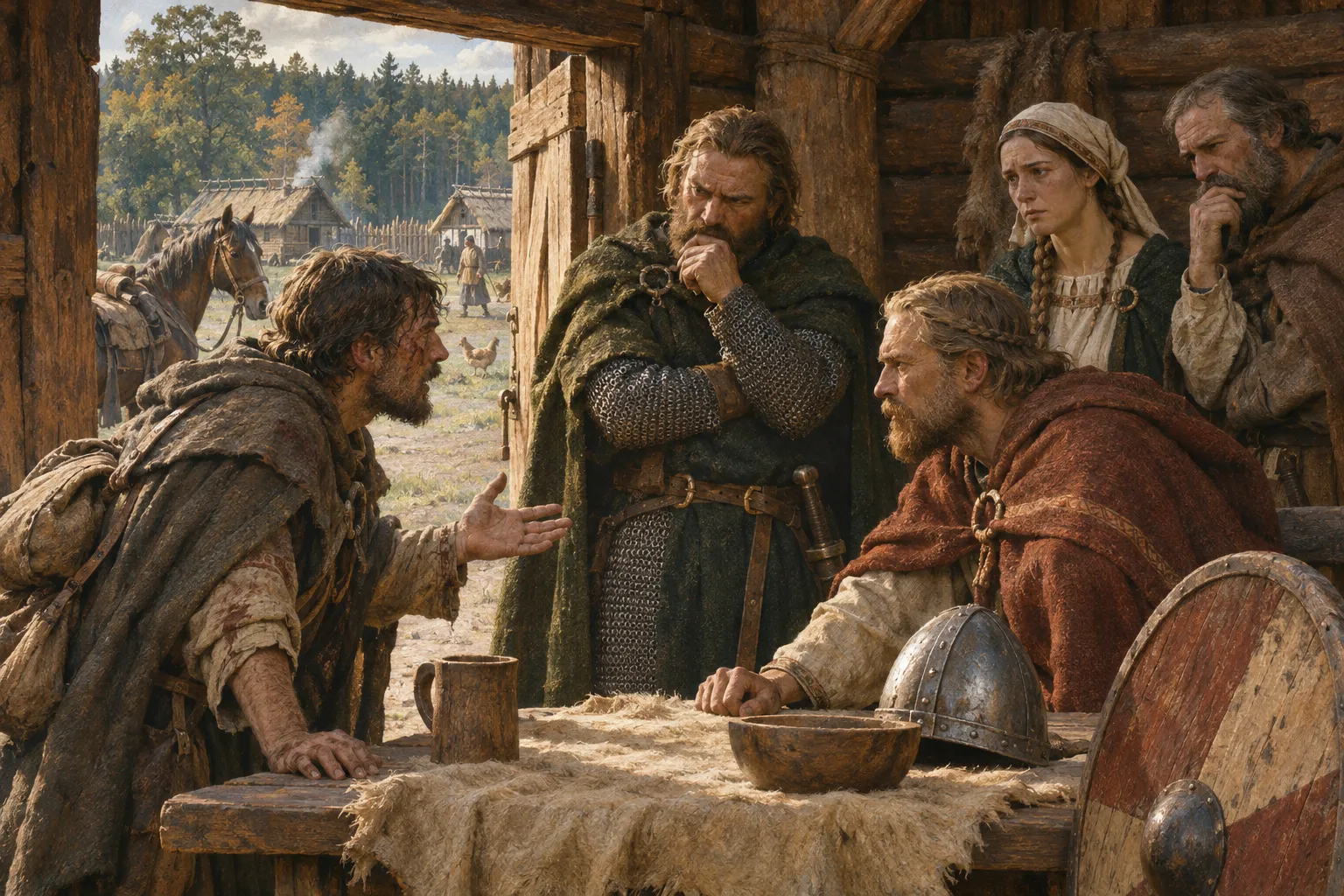
In the synthesis’s account, Treniota urges Mindaugas to join the Samogitians and other resisting communities. The king abandoned his earlier course of peace and re-entered the conflict. The political turn did not guarantee successful joint campaigns or support from every intended ally. S6
Did Mindaugas also abandon Christianity? VLE attributes that interpretation of apostasy after Durbe to some researchers. Ending peace with the order does not by itself reveal the ruler’s whole religious life. S30
2.9
Victory created opportunities without ending the war.
Durbe’s importance lies both in the victory itself and in the fighting that followed.
The order survived Durbe. The 1936 history describes its recovery, help from the west and the long struggle over Prussia. The battle greatly altered the balance of power, but it did not free all the order’s territories in a single day. S6
The battle of Saulė in 1236 helped bring about the Swordbrothers’ incorporation into the Teutonic Order. Durbe in 1260 shook the forces that operated after that change. Samogitian resistance connects the victories, but the armies’ institutional settings and the political consequences differed. S6
Based on: S6