2.1
A woman of Palanga
Birutė’s name survives in a story about a woman whose decision a duke disregarded. Later accounts connect her to a ruling family and the memory of the coast.
In the Bychowiec Chronicle, Kęstutis hears of Birutė living at Palanga. Local people honour her, and she has vowed chastity to her gods. His journey to meet her begins the story that will take her to Trakai. S19
The people in the chronicle lived in the fourteenth century; the story was written much later. Rimantas Jasas, editor of the 1971 edition, discusses the marriage episode as part of a chronicle compiled in the early sixteenth century. S19
Birutė enters the story with a name, a home at Palanga and a vow already made. Later writers call her a vaidilutė, give different marriage dates and disagree over how her life ended. Her name runs through all these accounts. S19 S7 S6
2.2
A promise for life
The chronicle’s Birutė has made her promise to the gods before she meets Kęstutis.
The Bychowiec Chronicle says that people honoured Birutė as if she were a goddess. This comparison conveys their exceptional regard for her, but leaves her religious duties unexplained. It establishes no defined office. S19
Her vow lasts until death. Birutė will remind the duke of it when he asks her to marry him. The promise binds her before Kęstutis makes his wish known. S19
Writing in the seventeenth century, Albertas Vijūkas-Kojelavičius calls her a vaidilutė, a priestess. The title became part of Birutė’s remembered identity, though he gives no account of her daily work. Neither passage describes her tending an eternal flame. S7 S19
2.3
The duke seeks Birutė
On hearing of Birutė, Kęstutis travels to Palanga himself. The chronicler describes their meeting from the duke’s side.
Kęstutis goes to Palanga after hearing of Birutė. When he meets her, the chronicler says, he admires her beauty and intelligence. These qualities explain his attraction in the story; Birutė’s first impression goes unrecorded. S19
He asks her to become his wife. The account gives neither Birutė’s age nor the day of their meeting. It names no companions and describes no elaborate courtship ceremony. S19
The journey from Palanga to Trakai lies ahead. First comes Birutė’s answer to the duke. Her choice differs from his. S19
Based on: S19
2.4
Birutė refuses marriage
Birutė invokes her promise to the gods. In the Bychowiec Chronicle, her refusal is followed by forcible removal and then a grand wedding.
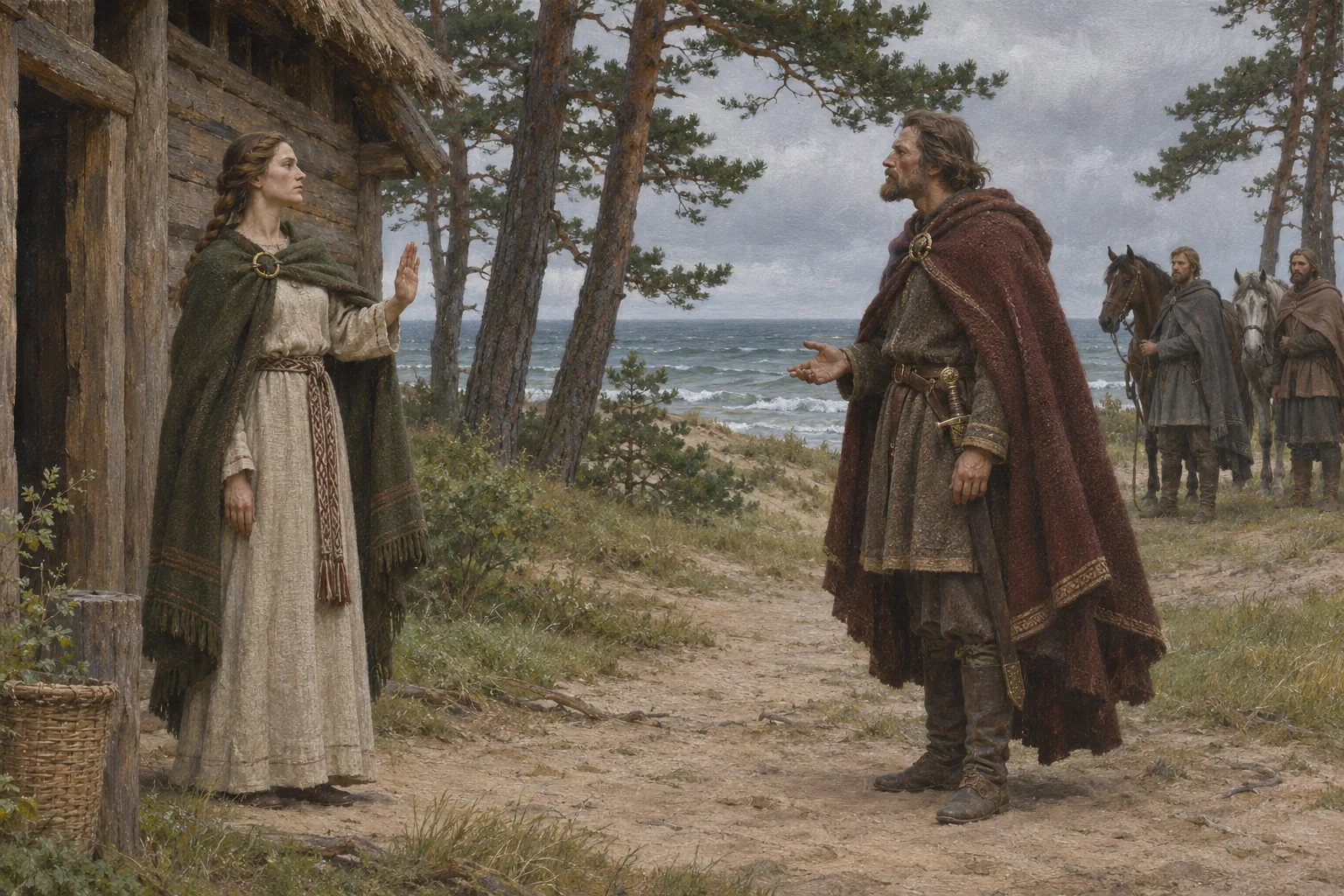
Birutė answers that she cannot marry Kęstutis because she has promised the gods lifelong chastity. The narrator reports the substance of her reply; he does not preserve a verbatim record of their conversation. S19
Kęstutis disregards her answer. The chronicle says that he takes Birutė by force and brings her to Trakai. His admiration and her refusal belong to the same account. S19
At Trakai, Birutė receives an honourable welcome. Kęstutis invites his brothers and holds a great wedding. The chronicle follows forcible removal with celebration, without saying that she withdrew her refusal. S19
Based on: S19
2.5
A wedding with conflicting dates
The Bychowiec narrator does not date the meeting at Palanga. Dates come from later annotations and a different narrative sequence.
In his 1971 commentary, Rimantas Jasas mentions an annotation that Teodor Narbutt reported seeing in the manuscript. Written in a different hand, it dated the marriage to 1343. This is the editor relaying Narbutt’s report, rather than a date given by the marriage narrative. S19
Jasas also discusses the view that Birutė was Kęstutis’s second wife and married him around 1349. That reconstruction belongs to the commentary and differs from the annotation’s date of 1343. S19
Kojelavičius mentions the wedding after his account of the 1370 campaign. This places it later in his narrative than the chronology discussed by Jasas. Its position in the book does not independently establish when the wedding took place. S7 S19
2.6
A family by the lakes of Trakai
After the wedding, the chronicle turns to Trakai and Vytautas’s birth. Other accounts differ over whether Birutė was his mother.
The chapter heading in the Bychowiec Chronicle identifies Vytautas as the son of Kęstutis and Birutė. The narrative places his birth at Old Trakai and credits Kęstutis with choosing a new lakeside site. It describes no role for Birutė in founding Trakai. S19
Jasas notes that the foundation dates of both Trakai sites are unknown, and that other reliable evidence for Vytautas’s birthplace is lacking. The lakes and castles provide a setting for the family story, without establishing when Birutė lived in each place. S19
The 1936 history edited by Šapoka calls Birutė Vytautas’s mother. Kojelavičius calls her his stepmother when describing a later retreat to Hrodna. The two authors give her different relationships to Vytautas. S6 S7
2.7
An incomplete family tree
The accounts disagree about Birutė’s relatives. Even a list of Kęstutis’s children cannot serve as a secure list of hers.
The Bychowiec Chronicle lists six sons of Kęstutis, naming Vytautas first. It does not say here that Birutė bore all six. A list of the father’s children does not identify each child’s mother. S19
Jasas’s commentary reveals more family connections and several errors in the chronicle. Other copies give a different number of sons, and some identities and fates are confused. The editor separates Algirdas’s son Andrius from Kęstutis’s family and corrects claims that some sons died young. S19
Vidimantas appears as Birutė’s father in Kojelavičius: an elderly, wealthy Samogitian noble. In the Bychowiec account he is her father’s brother. The two relationships do not fit a single family tree. S7 S19
Jan Długosz calls Vidimantas the paternal uncle of Kęstutis’s widow, Vytautas’s mother. The woman goes unnamed in this episode. The kinship resembles that given in the Bychowiec Chronicle. Similarity alone leaves open whether the two authors had independent information. S140 S19
2.8
A family caught in the struggle for power
In accounts of the conflict between Kęstutis and Jogaila in 1382, the family loses its security. The authors place Birutė in different towns.
Kojelavičius describes Jogaila retaking Vilnius and advancing towards Trakai. Vytautas retreats to Hrodna with Birutė. Here the author calls her Vytautas’s stepmother. S7
The 1936 history edited by Šapoka places Birutė at Brest, where Kęstutis had left her before going to fight Jogaila. This differs from Kojelavičius’s Hrodna. The history also reports that some later sources say she was killed. S6
Długosz puts both towns in one sequence: Vytautas retreats to Hrodna with his mother; Kęstutis then arrives and leaves his wife at Brest. This is his account of a family separated. He leaves the woman unnamed and does not describe her death in this episode. The sequence still falls short of a verified itinerary for Birutė. S140
After Kęstutis’s death, the edited text of the Bychowiec Chronicle describes retaliation against Birutė’s relatives. It connects the fates of Vidimantas and Butrimas to the earlier killing of Vaidila. This episode does not narrate Birutė’s own death. S19
2.9
A mother’s fate in a political quarrel
Earlier political texts speak of Vytautas’s mother without naming Birutė. Their accusations and replies conflict.
A complaint attributed to Vytautas, or to a writer acting in his name, describes broken guarantees of safety. His father was taken and killed; the speaker adds that his mother was also killed. He then recounts his own imprisonment and escape. S133
The complaint leaves the mother unnamed and gives no place or manner of death. Its editor dates it to around 1390; the text carries no such signed date. It directs the family’s losses against Jogaila and Skirgaila as a political accusation. S133
The Latin version of Wigand of Marburg’s chronicle says that the mother was drowned. It names neither her nor the place. This early report therefore supplies a manner of death, without naming Birutė or placing it in the Baltic Sea. S124
2.10
A different ending
At the Council of Constance, representatives of Jogaila and Vytautas told a different story of the mother’s fate. A later Palanga tradition also placed her death much later.
The rulers’ representatives accused the Order of reviving old quarrels to dishonour Jogaila. They denied his responsibility for the parents’ deaths and said that Vytautas’s mother had lived long after the discord, before dying honourably. S134
Their reply also describes her tomb as still glorious, but gives no location. The mother remains unnamed, with no exact lifespan. These are the words of representatives acting for both Jogaila and Vytautas; her own voice is absent from the dispute. S134
Gintaras Beresnevičius recounts a legend in which Birutė lived at Palanga until 1416, faithful to the old religion. He cites Narbutt’s first volume. This date comes from the legend; the Constance reply gives no death year. S12 S134
2.11
Traces on the hill
The archaeological remains do not identify Birutė.
Vladas Žulkus described raised sand, postholes and traces of small fires lit at different times. He dated a proposed shrine phase to the late fourteenth or early fifteenth century. S135
Libertas Klimka interpreted the post layout as a place for observing celestial movements. That separate interpretation does not establish that Birutė tended an eternal flame there. S135
Based on: S135
2.12
Interpreting the marriage
Modern historians differ over the marriage story and Birutė’s fate.
Darius Baronas questions whether the sixteenth-century marriage story preserves reliable local memory. He favours a violent death and doubts burial at Palanga. These are his interpretations alongside the other accounts. S79
Inga Baranauskienė argues for a historical core and considers a marriage for love possible. She separates the vow to the gods from later imagery of an eternal flame. Her proposed escape routes, drowning circumstances and burial near Ariogala remain reconstructions. S82
2.13
Birutė far from the coast
A local tale takes Birutė’s name far inland, to woods and hills near Šeštokai.
In Norbertas Vėlius’s collection, “Biruta’s Village” says that Birutė liked visiting a wooded, hilly place. The tale explains the village name through those visits, carrying her memory far from the coast. S13
Recorded at Rudamina in 1936, the story survives under the folklore archive reference LTR 1047(2). This dates its collection. The tale gives no date for Birutė’s supposed visit. S13
The village name remembers a visitor in the tale. There is no itinerary, residence or documented connection to the site. The story nevertheless shows how Birutė’s name became familiar well beyond Palanga. S13
Based on: S13
2.14
A coastal woman in verse
Silvestras Valiūnas’s “Biruta” first appeared in 1828. The poem gave the older story a new voice.
Valiūnas’s Biruta carries food to her fishing brothers. An everyday errand brings her to Kęstutis. The poet begins with a coastal woman and her family, leaving any defined priestly office outside this scene. S131
Kęstutis declares that he will be her husband and promises a palace and love. Biruta recalls her vow to Perkūnas, then yields to the ruler’s will. The poem tells their marriage differently from the chronicle’s forcible removal. S131 S19
The poem ends with a home on the hill and Vitold’s birth. The poet brings names, promises and a future family into one life story. This literary ending does not establish the historical Birutė’s words or consent to marriage. S131
2.15
The hill enters a painting
A view of the hill also kept Birutė’s name alive.
In 1899 Kazimieras Alchimavičius painted the chapel on Birutė Hill. TARTLE’s collection record identifies the building as the chapel erected in 1869. It is a later building, rather than a shrine from Birutė’s lifetime. S132
Valiūnas gives his characters voices; Alchimavičius turns to a place carrying Birutė’s name. Both works extend her memory. S131 S132
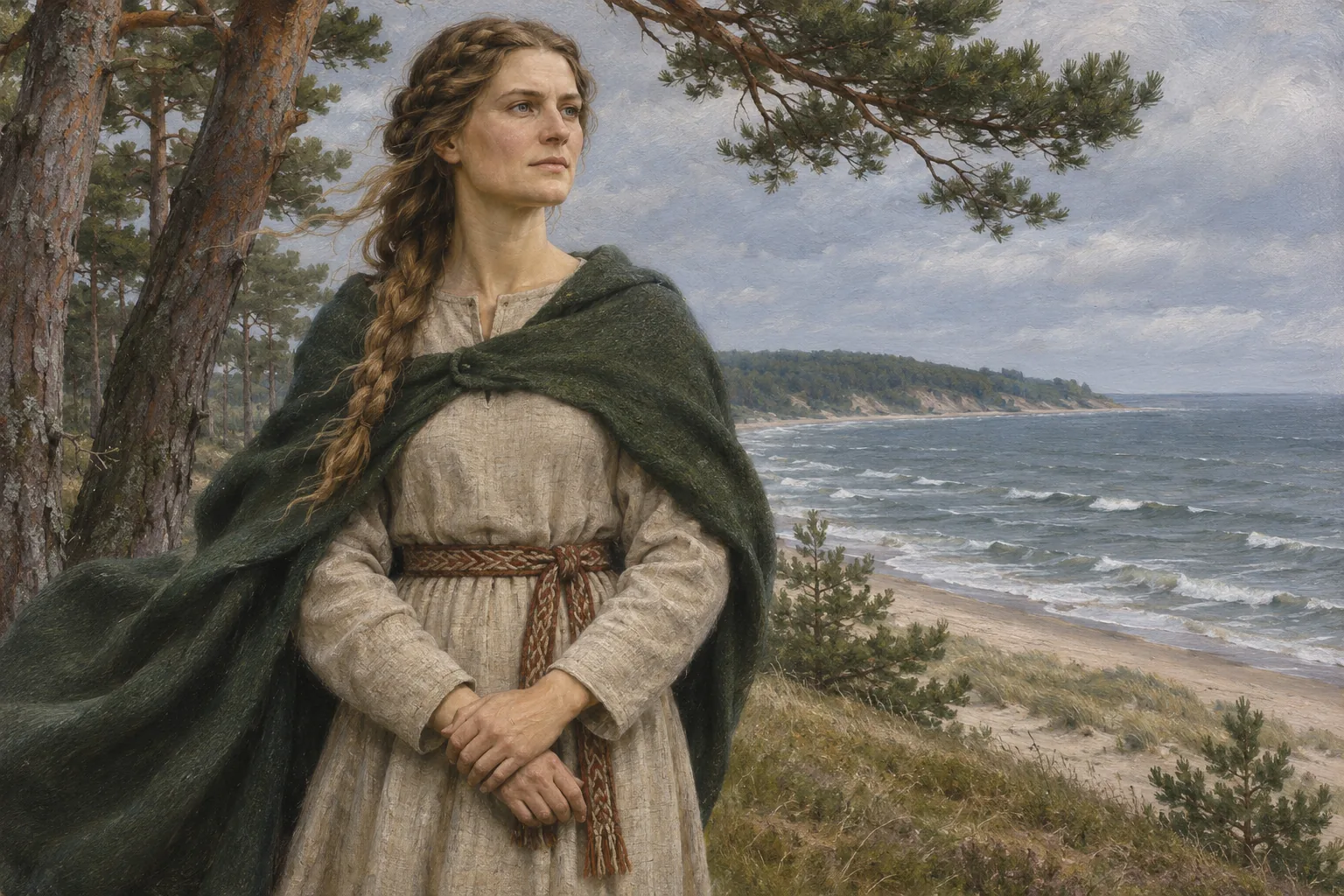
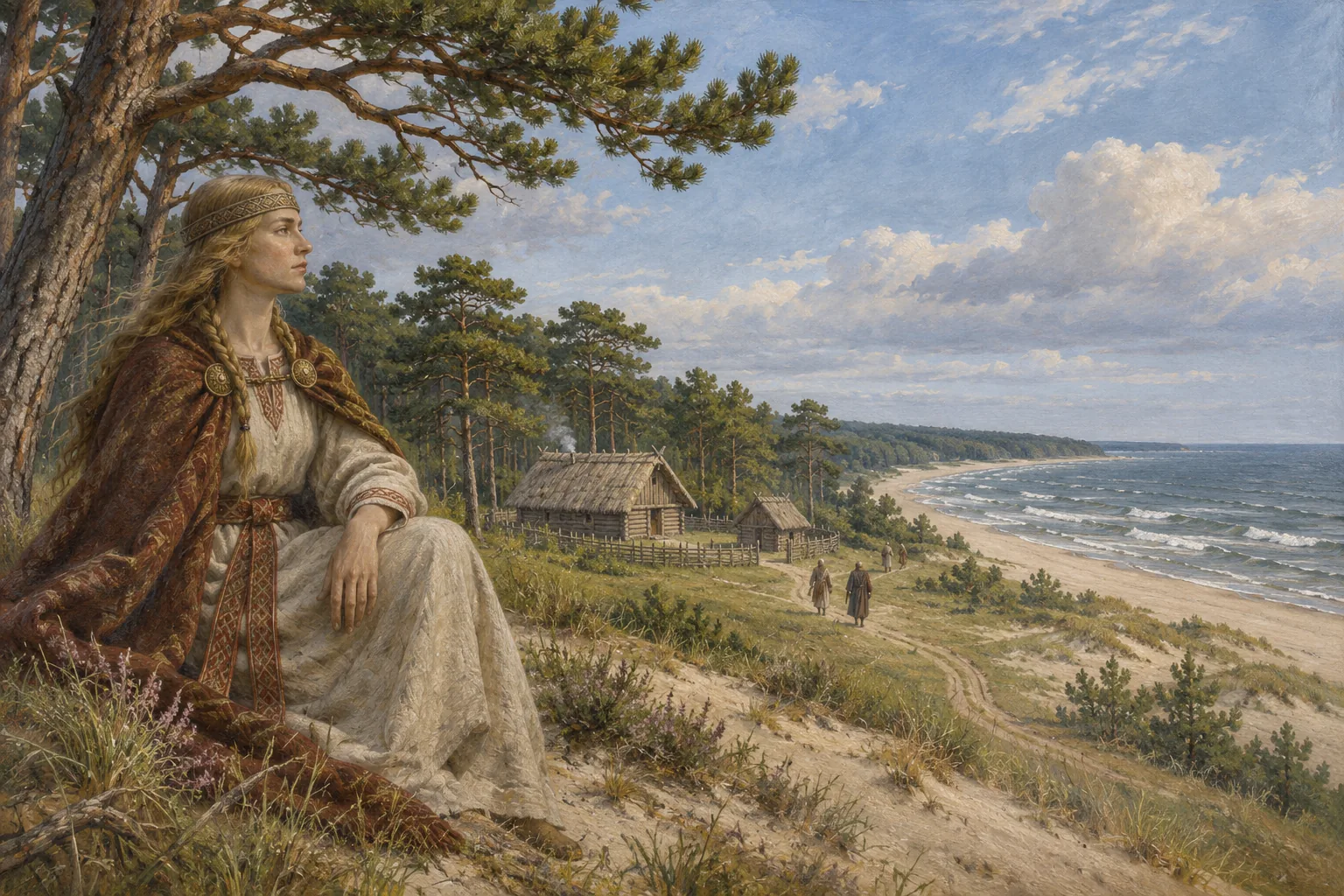
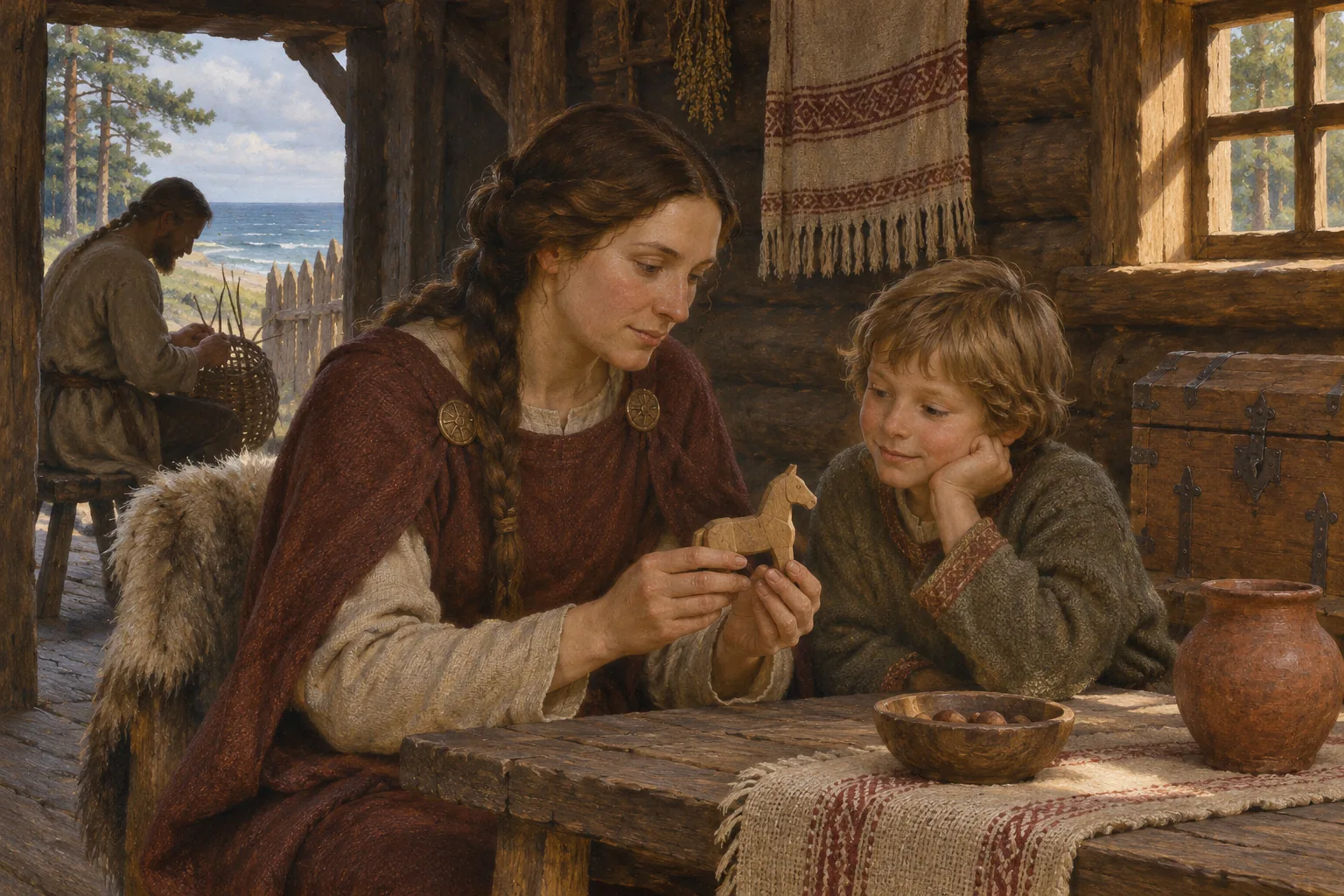
This article’s illustrations are also products of later imagination. Their Birutė is an invented likeness. The coast, homes and encounter accompany the story without supplying evidence of her appearance or daily life. S19
2.16
A familiar name, an incomplete life story
The surviving accounts leave gaps in Birutė’s life. They also preserve a trace of her own choice.
In the Bychowiec Chronicle, Birutė resists the duke’s wish. She recalls the promise that prevents her accepting his proposal. The narrator goes on to describe a grand wedding, but leaves her refusal in the story. S19
Other texts make her Vytautas’s mother or stepmother, and a member of a family scattered by struggles for power. Their accounts leave much of her life untold, and sometimes contradict one another. S6 S7 S19
Palanga, Trakai, a village tale and Valiūnas’s verse preserve different Birutės. She refuses, leaves home or gives a place its name. Behind these stories is a woman whose name we know better than her daily life. S19 S13 S131