1.1
A medieval grave in an ancient mound
A bone date at Kveciai prompted a fresh look at an ancient mound.
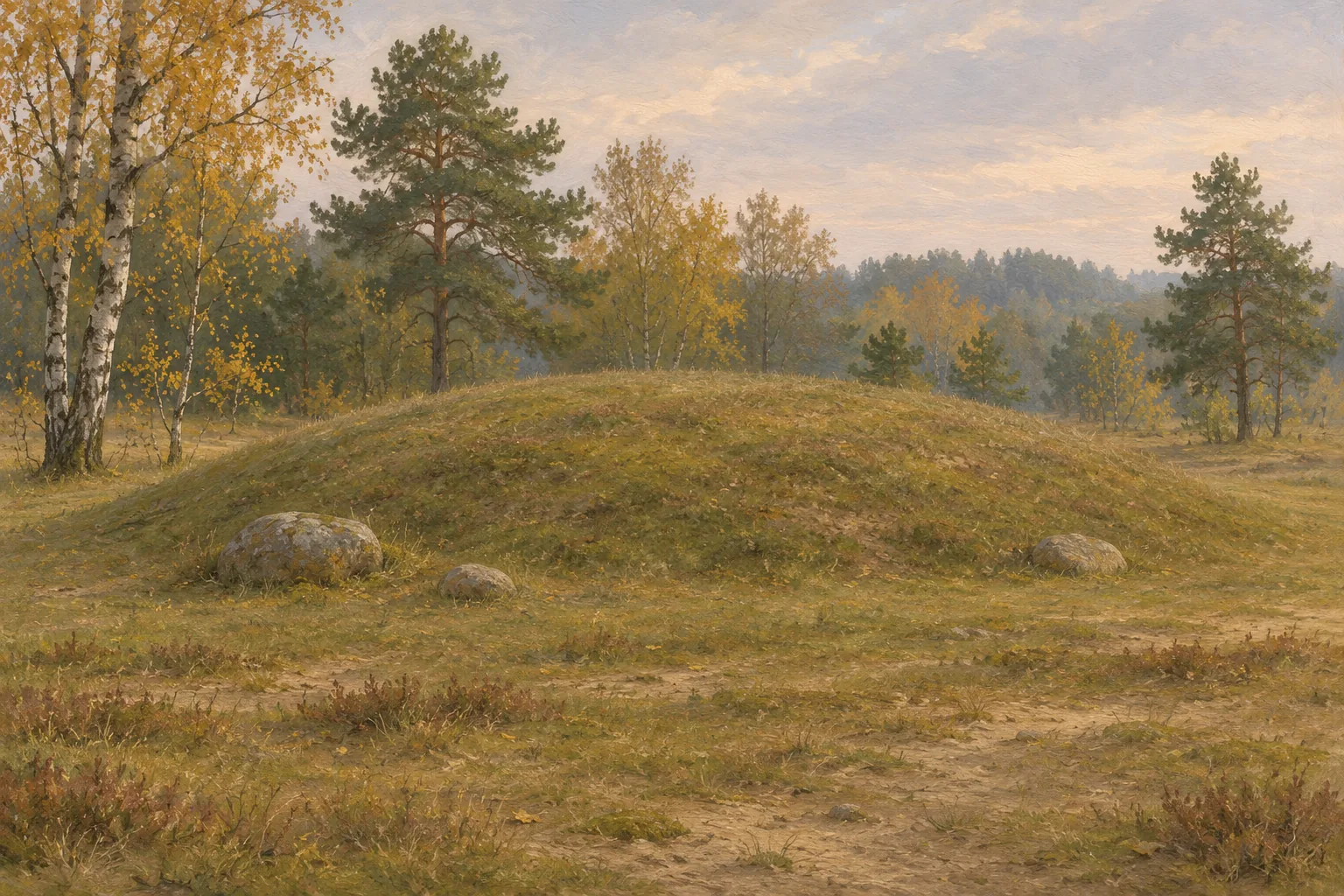
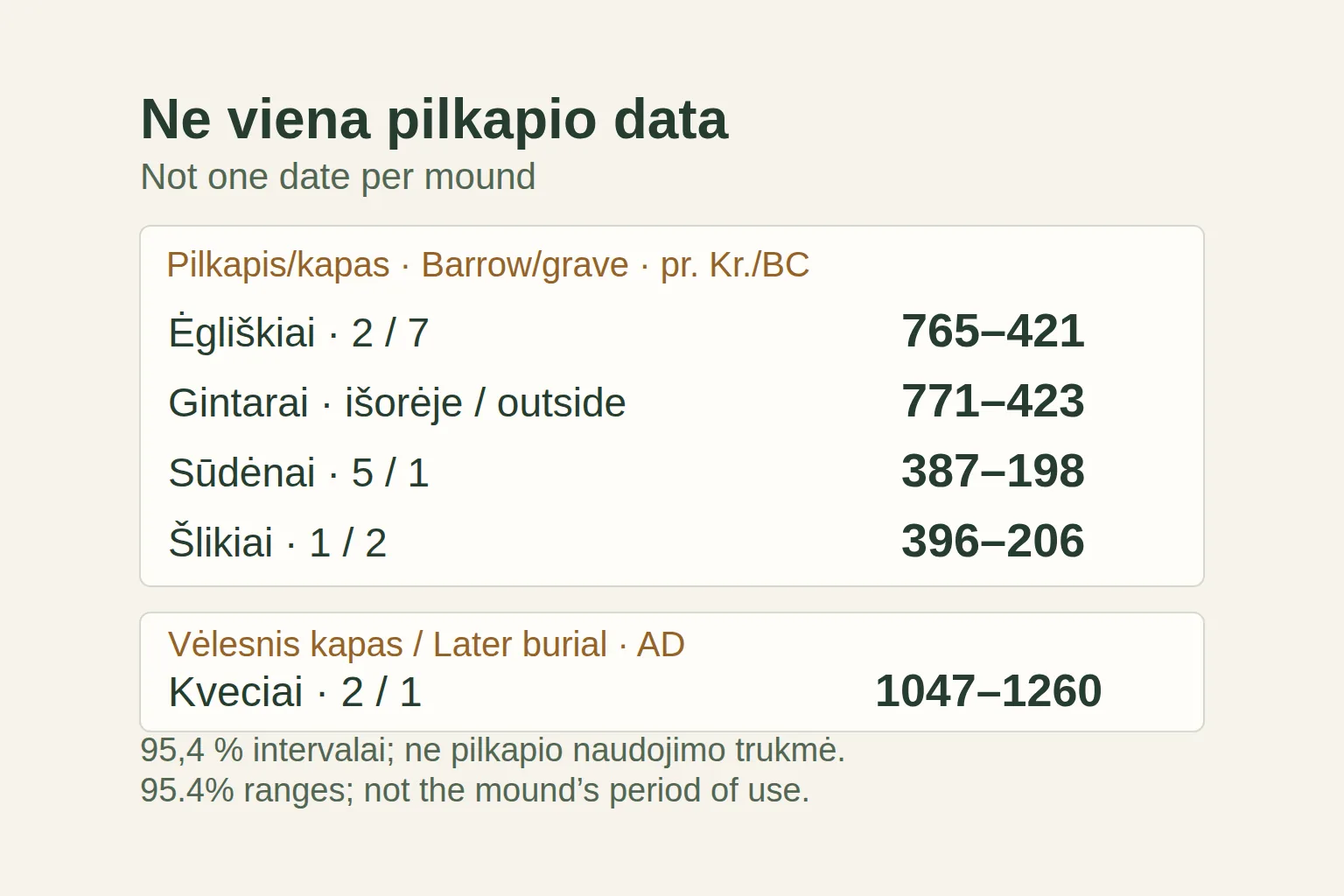
Grave 1 in Barrow 2 at Kveciai had long been assigned to the Pre-Roman Iron Age. Direct dating of the cremated human bones produced a calibrated interval of AD 1047–1260. The person buried there lived in the Middle Ages. The grave’s ancient surroundings had misled researchers about its age. S158
Lijana Muradian’s 2022 study separated this grave from eleven other dated samples belonging to the period before Christ. A medieval burial does not make the whole mound a medieval monument. It shows that people could return to a mound built much earlier and use it for burial. S158
Several periods can meet within one burial place. The shape of a barrow, the bones found inside it and surviving objects nearby may have different histories. The Kveciai finding changes where the account begins: with the date of a particular grave and its relationship to an older mound. S158
Based on: S158
1.2
Different traditions
Burials changed at different times; a mound and cremation describe different things.
Marija Gimbutienė’s 1985 synthesis distinguishes regional patterns: cremation spread differently in Curonian lands, Semigallia and central Samogitia. Her survey does not supply one burial sequence shared by all Baltic peoples. A change of rite alone does not demonstrate a replacement of population. S11
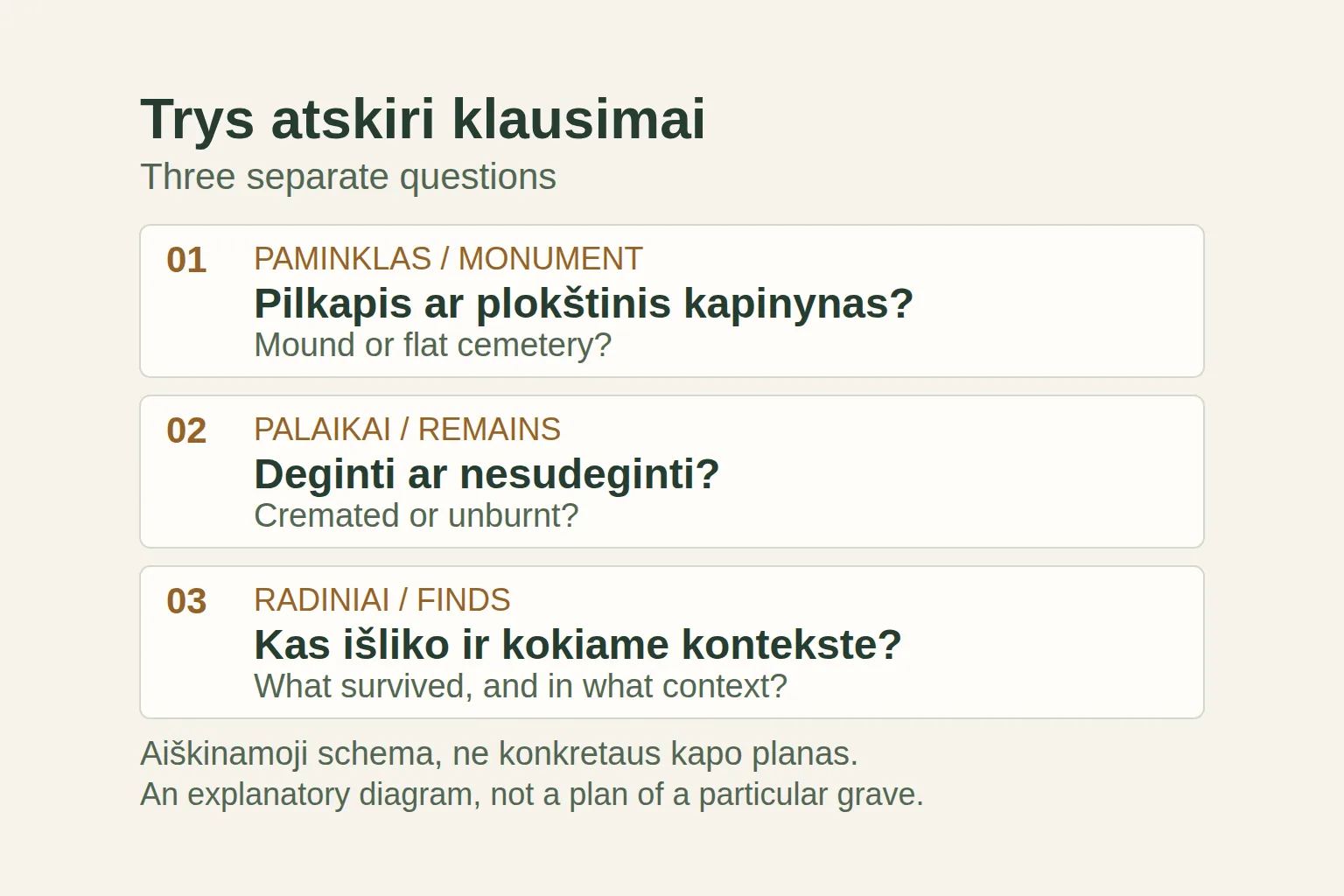
A western Lithuanian barrow can contain both cremated and unburnt remains; a cremation grave can also lie outside its mound. These concern two separate choices: the monument to build and the treatment of the body. One cannot establish the other, still less recover someone’s language or the name of their community. S158
1.3
One mound, several graves
Modest mounds could hold more than one burial.
The barrow cemeteries studied by Muradian at Ėgliškiai, Kurmaičiai, Kveciai, Gintarai, Sūdėnai and Šlikiai belong to western Lithuania. The main group of dated samples falls within the first millennium BC. These monuments precede medieval eastern Lithuanian barrows by a long interval, despite sharing the same general name. S158
The excavation description gives Ėgliškiai Barrow 2 a diameter of 11.5 m and a height of 1.2 m. Eight cremation graves and two inhumations were recorded within it. Barrow 3 held fourteen cremation graves and nine inhumations. These are counts of graves, rather than an independently established number of people. S158
Several graves within one mound allow researchers to examine how a burial place continued in use. They need not have been made at the same time, and recorded dimensions do not establish the mound’s original height. Its development has to be traced through the positions of graves, structures and material that can be dated. S158
Based on: S158
1.4
Stone enclosures
Stones help reveal a barrow’s construction, although resemblance alone cannot establish a date.
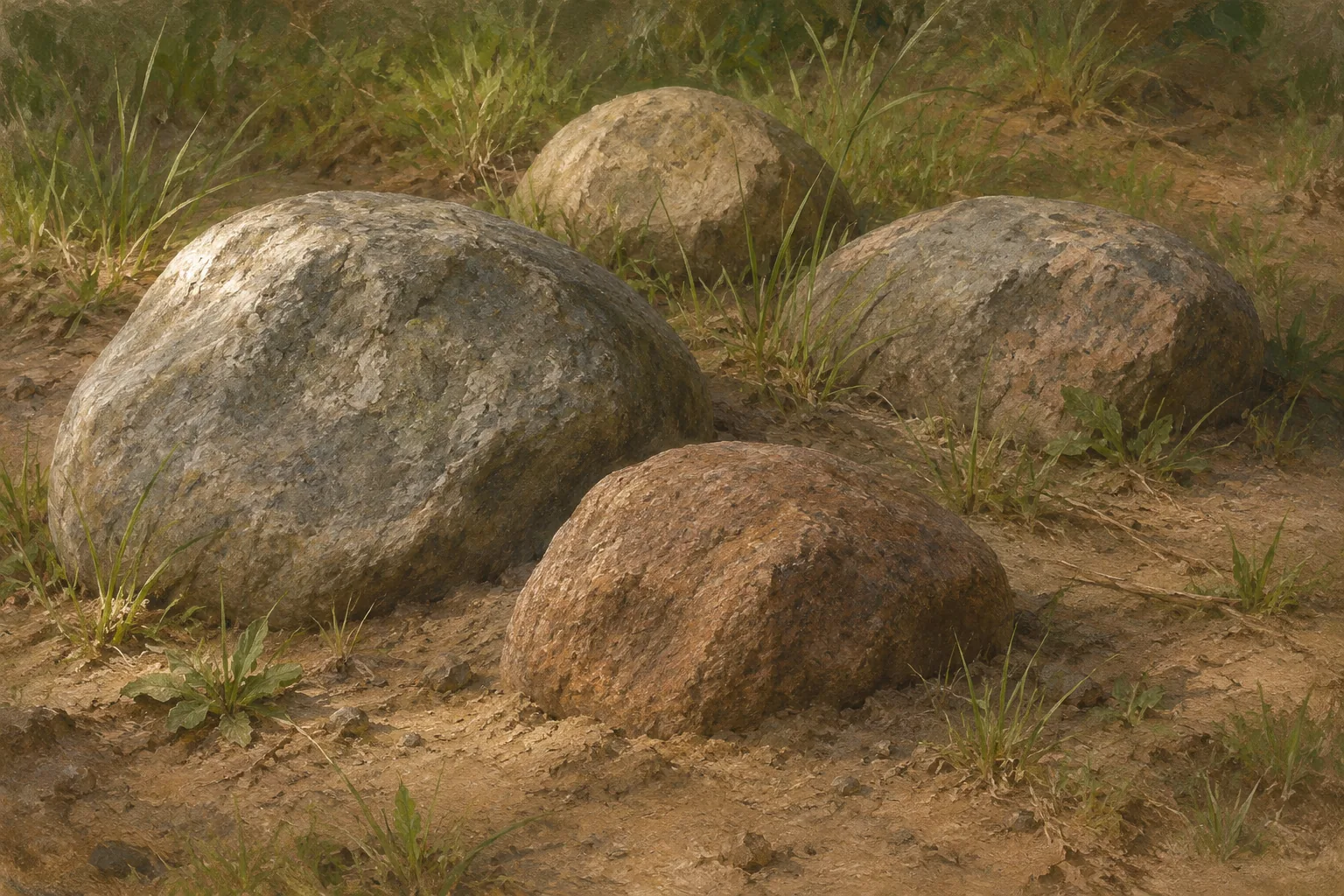
In western Lithuanian barrows, stones formed enclosures and other grave structures. Their arrangement helps distinguish parts of a mound and the positions of graves. An excavated stone circle is a surviving part of a structure, shaped in turn by later burials, damage and the history of investigation. S158
At Kurmaičiai, barrows of different appearance yielded similar dating intervals. At Sūdėnai, similarly built mounds yielded intervals that did not overlap. The comparison challenges the assumption that similar structures must be contemporary, while different ones must be earlier or later. S158
The building stones discussed at Sūdėnai also bear witness to construction work: stones had to be selected and arranged. The stones cannot establish whose labour was gathered or how duties were divided. Differences in construction do not by themselves provide a reliable scale of wealth or social rank. S158
Based on: S158
1.5
Fire and remains
A cremation grave preserves human remains gathered after burning.
Cremation changes the material that archaeologists encounter. Instead of an articulated skeleton, they study fragments of burnt bone and the contexts in which these were found. In Muradian’s study, samples of human bone supplied new dates with which to test earlier assignments based on structures and finds. S158
The contents of a grave and the place of burning are not automatically the same archaeological context. Fragments deposited in a grave reveal the final arrangement of remains, but cannot recover the whole funeral on their own. It matters whether bones were found in a vessel, a separate pit, a mound or beyond it. S158
In western Lithuania, remains prepared by fire were placed in graves of different forms. Cremation could be associated with a mound or a grave beyond it. Connecting bones with a particular place and date makes this variety clearer; traces of fire alone do not reveal a community’s entire religious life. S158
Based on: S158
1.6
Urns and pits
A vessel was one way to arrange remains, rather than a necessary part of every cremation grave.
In the western Lithuanian monuments discussed by Muradian, cremated remains were buried both in urns and without them. The term “cremation grave” therefore does not tell an excavator whether a pot will be found. The first task is to establish where the bones lay and how they related to a pit and its surrounding structure. S158
Pottery supplies different evidence from bone. A vessel’s form can help compare graves and suggest a chronology; direct dating of bone can test that proposal. The circumstances of the grave establish their relationship. Proximity alone does not make finds a group deposited at one moment. S158
A small quantity of surviving bone cannot reveal the full extent of a funeral. What reached the ground was what people gathered and buried; what reached researchers was what also survived and was recovered. These successive selections mean that every missing object cannot be treated as a deliberate decision by the mourners. S158
Based on: S158
1.7
What twelve dates changed
Twelve direct dates allow much broader accounts of barrows to be tested.
The 2022 study used accelerator mass spectrometry, abbreviated AMS, to date twelve samples of cremated human bone from six barrow cemeteries. These are twelve samples, rather than twelve stages covering all western Lithuanian burial customs. Their value lies in the direct connection to the selected remains. S158
The dates are expressed as calibrated intervals. The sample from Grave 5 in Ėgliškiai Barrow 3 has a range of 746–400 BC. It cannot be replaced with a single year. The Hallstatt calibration plateau means that radiocarbon measurements for this period often span several centuries, even when the laboratory measurement is precise. S158
For the selected graves dating before Christ, the model placed the beginning of the tradition within 859–564 BC and its ending within 385–156 BC. These are modelled boundaries, relying on the assumption that the sample represents the earliest and latest events. They do not establish the first year of cremation anywhere in Lithuania. S158
Based on: S158
1.8
Returning to Kveciai
Medieval bones in an ancient mound separate the grave’s date from the monument’s age.
The Kveciai sample prevented all twelve results from being combined into a single chronology for the first millennium BC. Its AD 1047–1260 interval required a separate explanation. Precisely this mismatch helps reveal a later burial where the monument’s appearance alone would encourage an earlier date. S158
A place could remain visible and available for burial after many generations had passed. This grave does not reveal whether medieval mourners knew the names of earlier dead, regarded them as ancestors or understood the mound in another way. Reuse is archaeologically visible; the content of memory remains open. S158
Based on: S158
1.9
Within the mound and beyond it
Someone buried outside a mound need not have lived in a different period from someone within it.
At Gintarai, a sample from a cremation grave outside the outer stone circle yielded a range of 771–423 BC. It overlaps dates from some graves inside other barrows. Burial beyond a mound therefore cannot automatically be treated as a later stage following burial within it. S158
Overlapping intervals allow different practices to have coexisted. They do not prove that two particular people died in the same year or that the same community attended both funerals. A broad dating range can encompass several generations; excavation context helps refine the relationships. S158
A grave outside a stone circle does not by itself identify an outcast or a poor person. Such an explanation would need additional, independent evidence. The evidence instead allows investigation of how communities used burial space when several ways of constructing a grave were available. S158
Based on: S158
1.10
Dates from eastern Lithuania
In eastern Lithuania, evidence from the third to sixth centuries AD also suggests overlapping rites.
Laurynas Kurila’s 2022 model uses dates from 21 inhumations and 20 cremations. It suggests that both rites coexisted in eastern Lithuania for roughly two centuries. Broad date ranges and uneven investigation of the region prevent the assignment of one date when everyone changed their practice. S161
Based on: S161
1.11
What survived of a funeral
Surviving grave contents are traces of burial altered by time and the history of investigation.
Muradian’s 2017 survey recorded 182 graves at 19 northwestern Lithuanian burial sites: 169 cremations and 13 inhumations. Thirty-four cremation graves were in flat cemeteries. These are the study’s collected records, rather than a census of everyone living at the time. S159
The later dating study had to select from material that survived and remained accessible. Damaged monuments, lost bones and excavations conducted at different times left uneven records. A shortage of finds in one grave therefore cannot directly measure the deceased’s poverty, nor can surviving grave counts establish a community’s former size. S158
1.12
Horse graves
Horse remains preserve several different choices in burial.
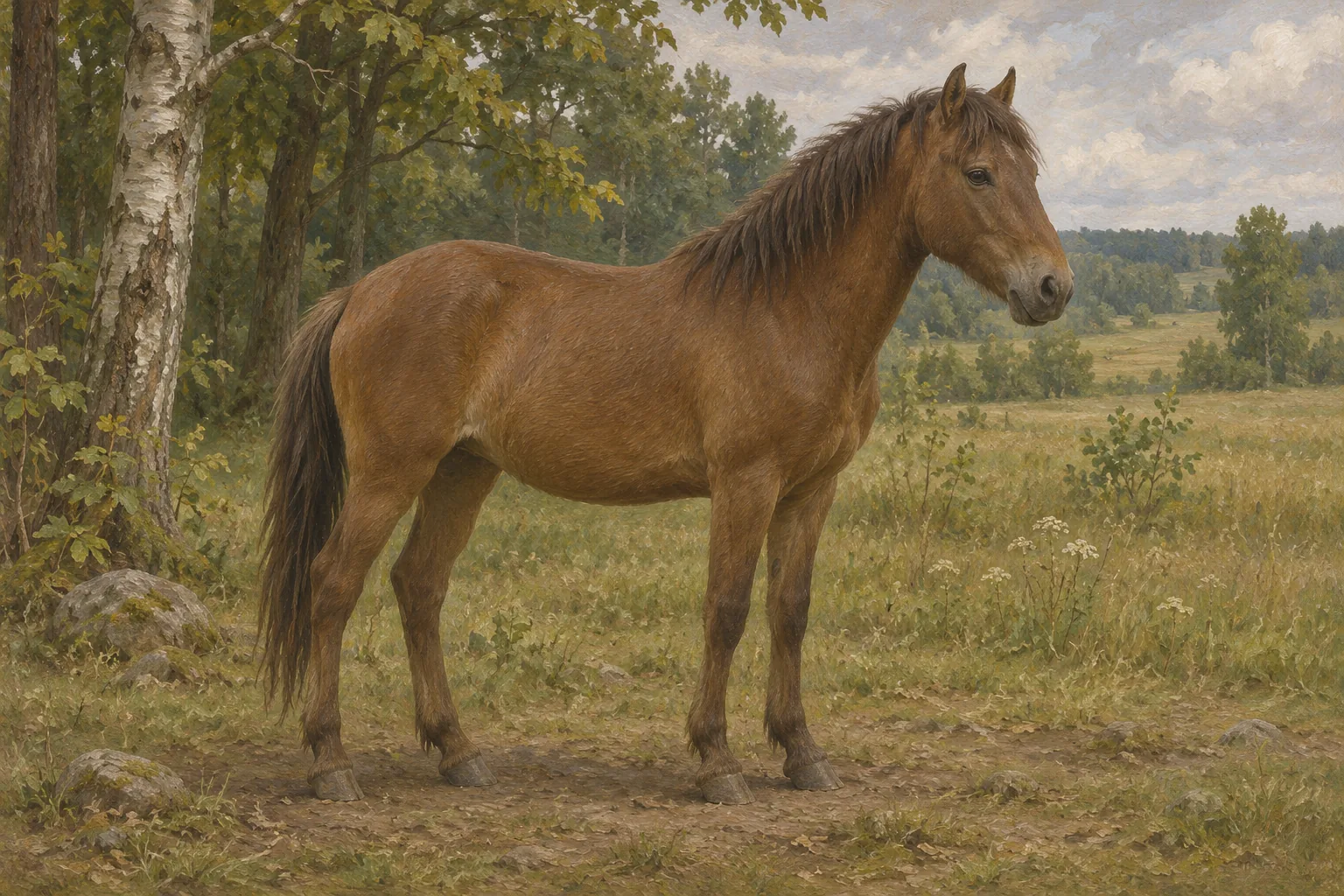
Lithuanian burial sites of the third to fourteenth centuries contain whole horse skeletons, selected body parts and cremated remains. They occur with humans and in separate graves, in barrows and flat cemeteries. Giedrė Piličiauskienė and her co-authors examined this variety in their 2022 study. S160
At Pagrybis in western Lithuania, horse heads and lower limbs were found with human remains. These graves differ from burials containing a whole animal. The term “horse grave” alone cannot justify imagining the same pit or the same funeral action everywhere. S160
Excavations at Marvelė in 1991–2007 revealed 236 horse graves containing approximately 300 animals. Some graves held more than one horse. The distinction matters: the number of graves is not the number of animals, and several horses in one context do not by themselves identify a single owner. S160
Based on: S160
1.13
Horses in research
Bone assemblages allow questions about horses’ age, size and burial dates.
Piličiauskienė and her colleagues examined material from almost 400 horses found at burial sites. Remains of more than 200 animals were suitable for age and size analysis. Preservation determined which bones could be measured, so the analysed animals do not represent every horse equally. S160
The study supplied thirteen new AMS dates. They extended the chronology of some contexts previously assigned to the Migration Period across the third to seventh centuries. Some samples from Pagrybis and Plinkaigalis fell around a calibrated AD 550–650 interval and proved later than expected. S160
The study’s broad chronology does not mean that every horse received a direct date. Different conclusions used different bone assemblages, and the medieval comparison material also includes finds from castles and towns. The study groups therefore cannot all be presented as a census of animals buried in graves. S160
Based on: S160
1.14
What a horse’s body reveals
The animal’s body allows familiar assumptions about horses chosen for burial to be tested.
Older horses occurred more frequently in the study’s later samples. This is a meaningful difference between the assemblages, but custom is not its only possible influence: preservation, collection and the weight of particular cemeteries within the sample also matter. Marvelė’s abundant material does not provide even coverage of all Lithuania. S160
The authors note that both very small and large medieval horses were buried with saddles or other equipment. Height alone is therefore insufficient to establish an animal’s role. A small horse need not have had little ritual value, while a large one does not independently establish an exceptionally wealthy human burial. S160
Bones allow the study of body size and age, but these measurements do not identify an owner’s gender, rank or everyday riding practices. The relationship between animal and human remains a research question. It requires burial context, and sometimes other methods, beyond the animal’s size alone. S160
Based on: S160
1.15
The chronicler’s account
Peter of Dusburg wrote about Prussians from the position of a Christian priest of the Order.
In the chapter on Prussian religion and customs in his 1326 chronicle, Dusburg describes weapons, horses, servants, clothing, hunting dogs and birds of prey being burned with noble dead. He associates people of lower standing with items used in their work. This is the chronicler’s general account, rather than an inventory from one excavated grave. S107
Dusburg explains the burning through a belief that rank and wealth would survive resurrection, with burned objects and animals returning to serve their owners. This explanation belongs to his text and its Christian vocabulary. An archaeological horse burial does not independently confirm the full belief or funeral sequence he describes. S107
Based on: S107
1.16
Sovijus chooses fire
The story explains the choice of fire.
Beresnevičius retells the Sovijus myth preserved in an addition to the Slavonic translation of Malalas’s chronicle: burial in earth, a tree and fire is tested; fire is preferred. This myth, read through a modern study, does not date cremation’s archaeological beginnings. S12
Based on: S12
1.17
Daukantas’s funeral account
In 1845, Daukantas brought funeral actions together into a connected account of the past.
In Simonas Daukantas’s Būdas senovės lietuvių, kalnėnų ir žemaičių, death is followed by a wake, lamentation, a procession, burning and a mound. Objects and funeral participants form a connected sequence of actions. This detailed picture belongs to a nineteenth-century author seeking to reconstruct the life of earlier people. S20
Daukantas draws on earlier writers and on customs he regards as survivals of antiquity in his own time. His funeral account cites authors including Lucas David, Procopius and Kojalavičius. The result brings together information from different periods, although Daukantas did not personally witness ancient funerals. S20
His text preserves a particular understanding of the past, connecting burial with communal duties and the memory of the living. This voice can be placed beside grave evidence while retaining its date of 1845. Where archaeology reveals only the arrangement of bones or stones, details from Daukantas cannot automatically fill every gap. S20
Based on: S20
1.18
Conversion and graves
Christian burial does not begin everywhere on a single date.
Rytis Jonaitis associates Vilnius’s Bokšto Street cemetery with an Orthodox community before Lithuania’s conversion in 1387. His interpretation combines chronology, location and burial practice. An unburnt body alone does not establish Christianity, and graves cannot reliably assign an origin or confession to every individual. S86
Based on: S86
1.19
From find to interpretation
Burial history becomes clearer when different methods address different questions.
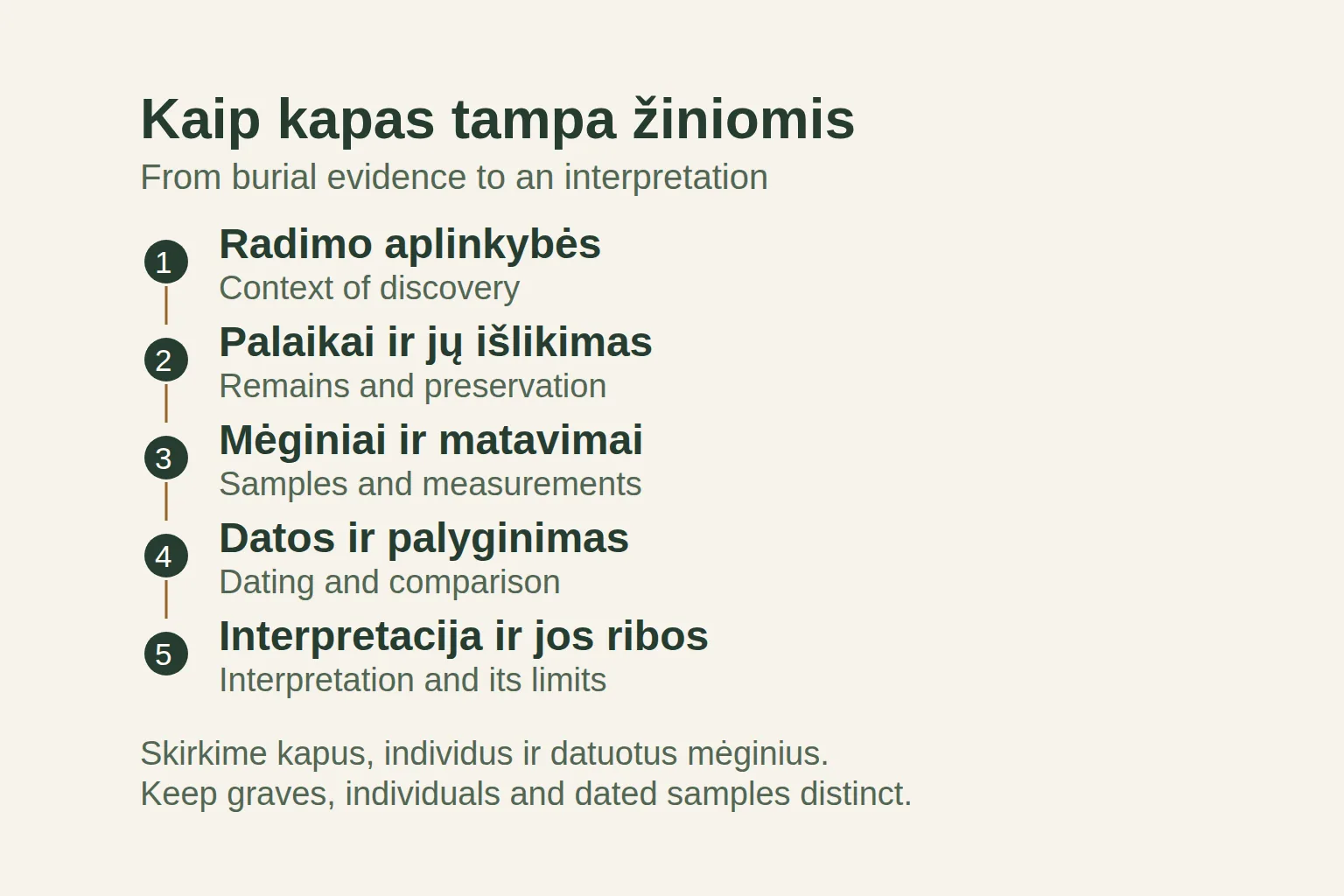
The first question concerns context: where a sample came from and what it relates to. At Kveciai, directly dated cremated bones changed an earlier assignment based on the mound context. A secure connection between sample and grave allows a laboratory result to be assigned to the appropriate event. S158
The second question is what the chosen method measures. Radiocarbon analysis estimates a sample’s probable age, while measurements of horse bones allow assessment of body size and age. One result cannot substitute for another: height cannot establish a burial year, nor a date the human relationship with an animal. S158 S160
The third question is what might have distorted the surviving picture. Muradian discusses the old-wood effect on cremated-bone dates; uneven preservation matters in the horse study. These conditions remain part of the conclusion. A larger sample can refine chronology without removing the need to examine each sample’s circumstances. S158 S160
1.20
Questions still to ask
Stones and bones reveal actions whose full meaning graves have not preserved.
Western Lithuanian mounds retain stone structures, urns and remains deposited at different times. Kveciai shows that an ancient place could receive another grave after a very long interval. These traces connect burial with space and labour chosen by the living, even though they cannot recover their words. S158
Horse remains add particular animals to this picture: of different sizes and ages, buried whole or in parts. At Marvelė, several animals sometimes shared a grave. Such differences allow more precise questions about selection and the use of burial grounds, rather than turning all finds into illustrations of one ceremony. S160
Questions remain about how long a particular mound was used, how much material was lost and why different burial forms were chosen in one place. Answers change when old finds receive new dates or stored bones are re-examined. An old excavation can thus be revisited with a new question, as at Kveciai, where cremated bones revealed a medieval date. S158 S160